
Do Bees Pollinate Weed? What Bees Really Do in Outdoor Cannabis
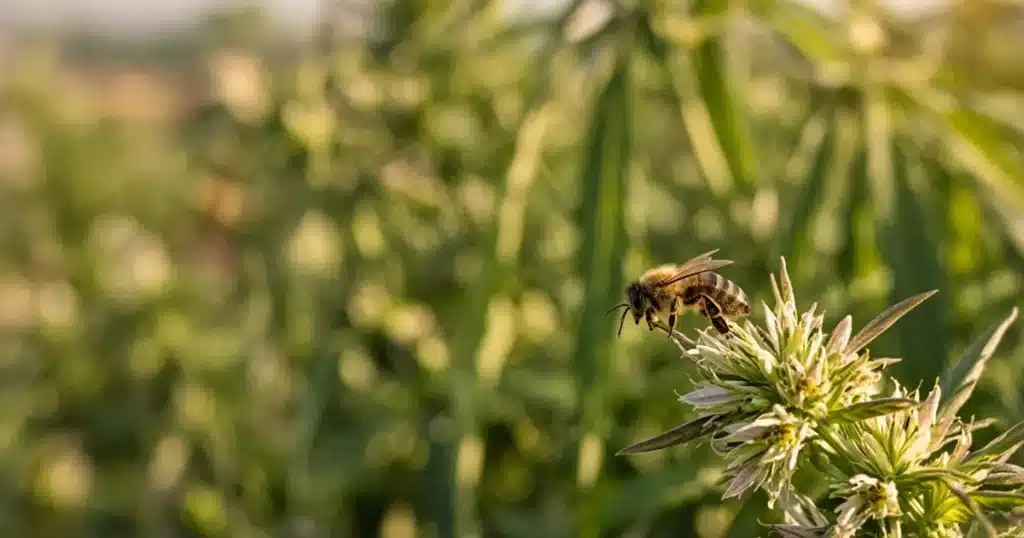
Quick answer: Bees do visit weed plants, but they come for pollen, not nectar. Colorado State University researchers describe cannabis as wind pollinated, with pollen bearing plants that release large amounts of pollen that attracts bees. So bees are visitors that collect pollen as food for their nests, not the plant’s main pollinators. Our guide to how to tell if a female plant has been pollinated covers the plant side of that topic.
Bees and Cannabis: Quick Facts
- Wind pollinated. Researchers describe the plant as relying on wind to spread pollen.
- No nectar. The CSU study abstract says the plant “does not produce any nectar,” and the introduction describes “very little nectar.”
- Bees take pollen. The flowers are pollen rich, and bees collect that pollen.
- Late summer visits. In the northern Colorado study, flowering ran from the end of July to the end of September.
Why Bees Visit Cannabis Plants
Bees need pollen as well as nectar. Pollen is the protein food that bees bring back to their nests. The CSU researchers note that the pollen bearing plants release abundant yellow pollen, while the female flowers are inconspicuous.
Timing matters here too. In the region studied, cannabis flowered at a time with few other bee friendly crops in bloom, which the authors describe as a dearth. That made the pollen rich flowers a useful late summer food source for bees.
People sometimes search for “weed bees” as if there were a special bee for cannabis. There is not. The bees found on cannabis in the CSU study were common bees that also visit many other plants.
Which Bees Visit Weed Plants
Colorado State University researchers collected bees from flowering fields in northern Colorado over one season.
- They collected 1,937 bees from 23 different genera.
- Honeybees made up 38 percent of the bees collected.
- Melissodes bimaculata, the two spotted longhorn bee, made up 25 percent.
- Peponapis pruinosa, the squash bee, made up 16 percent.
- Those three made up nearly 80 percent of all the bees collected.
The researchers note that Melissodes are ground nesters that emerge in late July, which lines up with the flowering window. These numbers come from one region and one season, so the mix of bees in your area may differ.
Are Bees Good for Weed Plants?
The sources here describe what bees get from cannabis, which is pollen, not what cannabis gets from bees. The CSU authors suggest the pollen rich flowers can make the crop an ecologically valuable food source for bees. They do not report any benefit to the plants themselves, so this guide does not claim one.
If you want to see bee visits for yourself, watch on a calm, sunny day in late summer. Bees working pollen rich flowers move quickly from cluster to cluster and often carry visible pollen on their hind legs. They do not linger the way they do on nectar flowers, because there is little or no nectar to drink. Note which bees you see and when, since the mix changes over the season.
What growers can control is how safe the garden is for bees. The biggest risk comes from pesticide sprays, which is why the steps below focus on bee safe pest control.
The Beekeeper View
Beekeepers care most about sprays. Oregon State University Extension updated its guide PNW 591 to list more than 100 conventional and organic pesticides, with their toxicity levels to bees and residual toxicity periods. Commercial beekeeper Harry Vanderpool told OSU the guide is “a tool that helps beekeepers and farmers work together in the right way with the right chemical.”
The Pacific Northwest Pest Management Handbooks also ask growers to contact beekeepers at least 48 hours before applying insecticides or fungicides to blooming crops that attract bees. That gives the beekeeper time to cover or move hives. If you have neighbors with hives, a short message before you spray is a simple and welcome courtesy.
How to Protect Bees Around an Outdoor Grow
- Check your rules first. Before you plant cannabis outdoors, check your state’s home grow law.
- Read the label. The PNW Handbooks note that bee warnings are in the Environmental Hazards section of a pesticide label. Follow the product label, and check that any pesticide is allowed for cannabis in your state.
- Avoid sprays during bloom. Bees face the most exposure when sprays hit flowers they are visiting. Handle pests before bloom when you can.
- Choose products carefully. If you must spray during bloom, the PNW Handbooks advise avoiding products labeled “Toxic” or “Highly Toxic” to bees and products with residues that stay toxic to bees for more than 8 hours.
- Spray in the evening. When a spray is needed in bloom, apply it in the evening, when fewer bees are foraging, if the label allows.
- Mow blooming weeds first. Mow flowering weeds such as mustard, clover or dandelion before you spray.
- Prevent drift. Avoid spraying in wind and keep sprays off nearby flowering plants.
- Tell nearby beekeepers. Give at least 48 hours notice before you spray blooming plants.
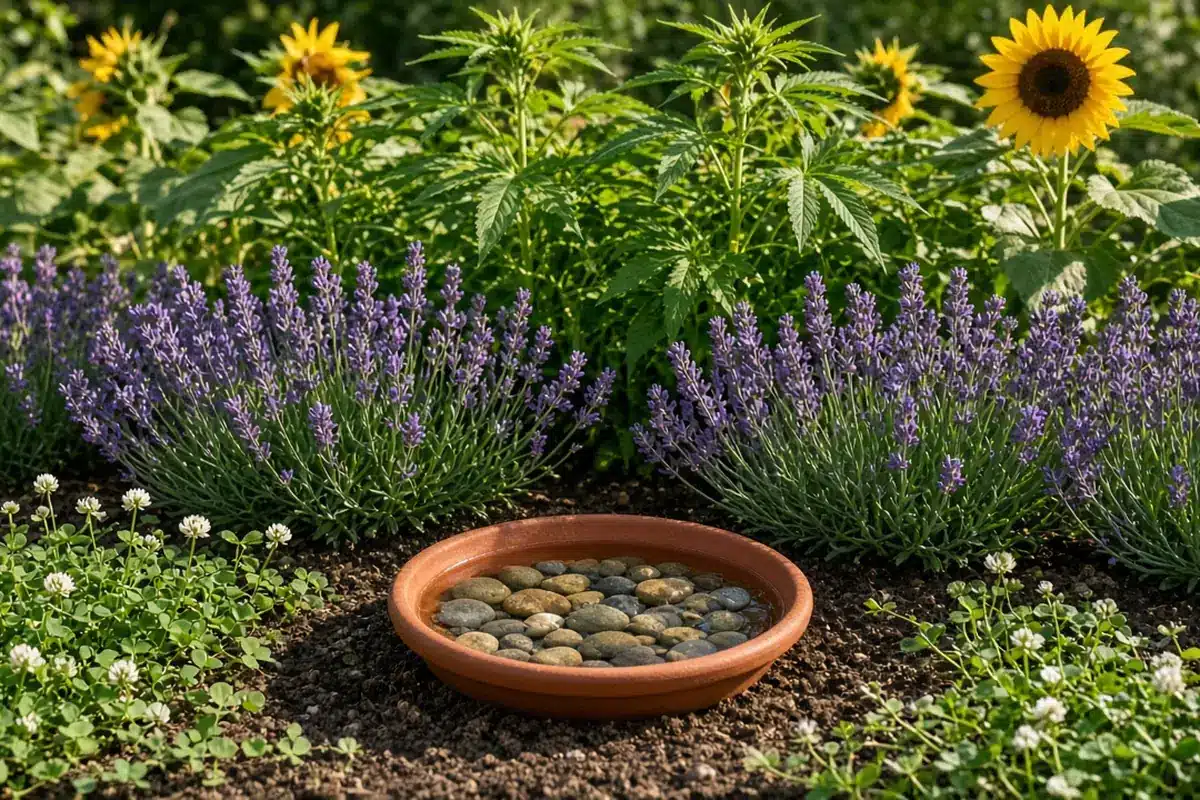
- Add a shallow water dish. Fill a dish with water and pebbles so bees can land and drink.
For more ways to manage pests, see our guide to protecting cannabis plants from pests. For flowers to grow alongside cannabis, see our guide to companion plants.
Troubleshooting
No bees are showing up. Your plants may not be releasing pollen, or there are richer flowers nearby. Bees in the CSU study came for pollen, so plants without pollen draw fewer bees.
Bees are drowning in the water dish. The water is too deep. Add more pebbles or stones so every bee has a dry place to land.
You have a pest problem while bees are active. Check the Environmental Hazards section of the label, avoid products labeled toxic to bees and spray in the evening if the label allows.
Spray may drift toward a neighbor’s hives. Wait for calm weather, keep sprays off flowering plants nearby and give the beekeeper 48 hours notice.
Bees crowd your work area at harvest. Work early in the morning or late in the day, when fewer bees are out, and move slowly around them.
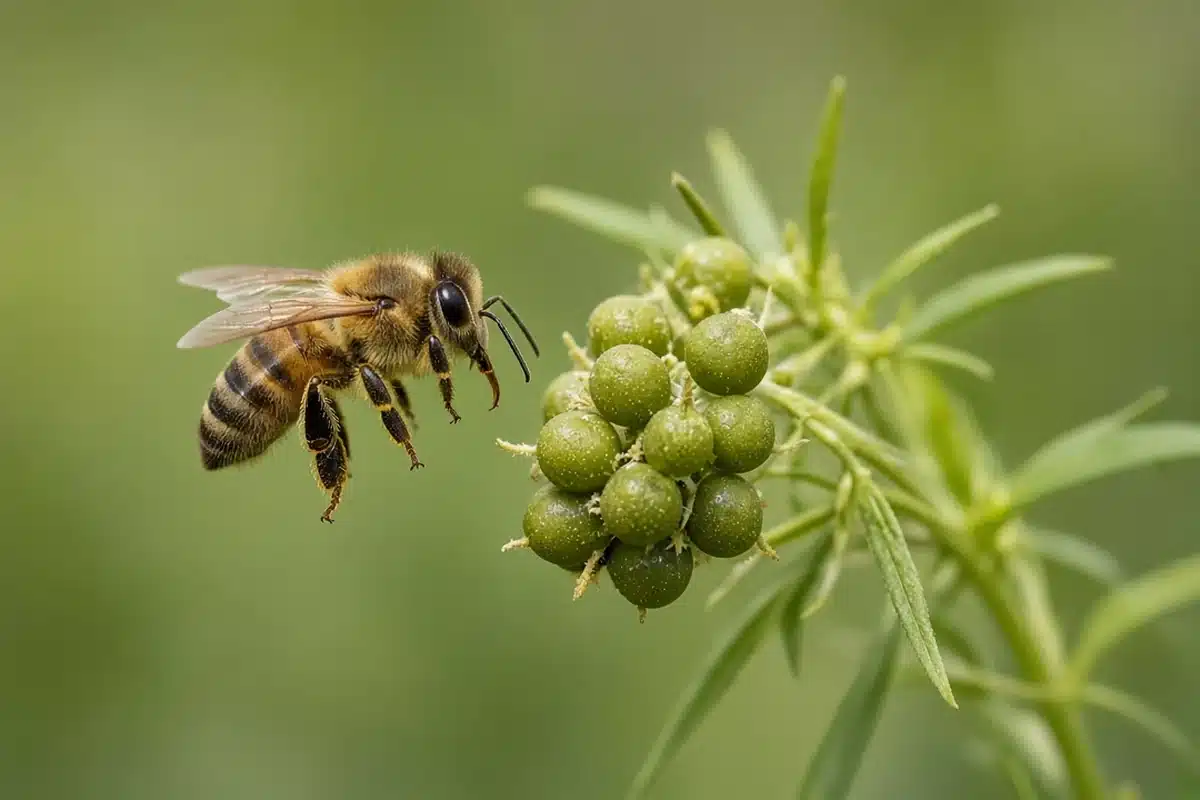
You keep male plants for breeding and bees visit them. That is expected, since those plants carry the pollen. Our guide on what to do with male plants covers keeping them.
Sources
- Colorado State University, O’Brien and Arathi, Bee Diversity and Abundance on Flowers (Biomass and Bioenergy, 2019, PDF): https://hemp.ucdavis.edu/sites/g/files/dgvnsk12601/files/media/documents/Bee%20diversity%20and%20abundance%20on%20flowers%20of%20industrial%20hemp%20%28Cannabis%20sativa%20L.%29%20by%20O%27Brien%20et%20al..pdf
- Oregon State University, OSU updates resources for protecting bees from pesticides: https://news.oregonstate.edu/news/osu-updates-resources-protecting-bees-pesticides
- Pacific Northwest Pest Management Handbooks (Oregon State University, Washington State University and University of Idaho), How to Reduce Bee Poisoning from Pesticides: https://pnwhandbooks.org/insect/bee-protection/reduce-bee-poisoning
FAQ
Do bees pollinate weed?
Bees visit weed plants and collect their pollen, but Colorado State University researchers describe cannabis as wind pollinated. Bees gather the pollen as food for their nests, so they are visitors rather than the plant's main pollinators.
Do bees get nectar from weed plants?
No. The CSU study abstract states that the plant does not produce any nectar, and the introduction describes very little nectar. Bees visit for pollen instead, which is a protein food for their nests.
Which bees visit cannabis the most?
In a Colorado State University study, honeybees made up 38 percent of the bees collected, the two spotted longhorn bee Melissodes bimaculata 25 percent and the squash bee Peponapis pruinosa 16 percent. Together they were nearly 80 percent of 1,937 bees from 23 genera.
Can bees carry cannabis pollen between plants?
Bees carry the pollen they collect back to their nests as food. Colorado State University researchers describe cannabis as wind pollinated, so the wind, not bees, is the main way its pollen spreads.
How can you avoid harming bees around cannabis plants?
Avoid sprays during bloom, read the Environmental Hazards section of any pesticide label and skip products labeled toxic to bees. If a spray is needed, apply it in the evening when the label allows, mow blooming weeds first and tell nearby beekeepers at least 48 hours ahead.


