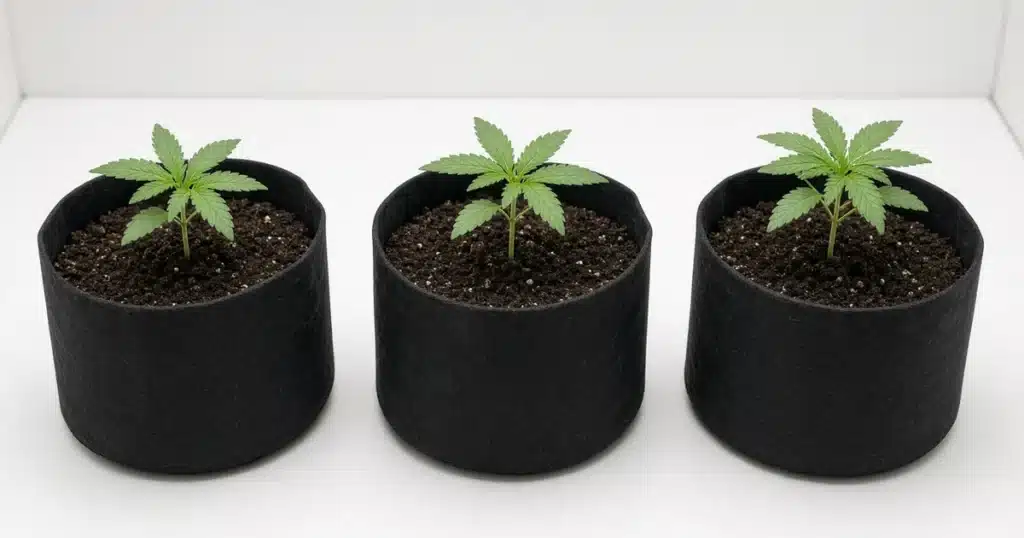
Best Pots for Growing Cannabis: Size, Material and Drainage
Quick answer: The best pots for growing cannabis are big enough for the plant’s final size, drain freely through holes in the bottom and are made of a material that suits how often you can water. University of Maryland Extension says large vegetable plants need a minimum of 8 to 10 gallons of growing media. Many cannabis growers use 3 to 7 gallon pots indoors and larger ones outdoors.
Why the Pot Matters When Growing Pot in Containers
A container sets the size of the root zone. University of Maryland Extension notes that container plants depend on a relatively small volume of growing medium. Their roots cannot grow around obstacles or search the soil far and wide for water and nutrients the way roots in a garden bed can.
That small volume is why size, material and drainage matter so much. UMD warns not to squeeze large plants into small containers, because restricting root growth too much means plants won’t grow well. North Dakota State University Extension puts it simply: the larger the plant, the larger the container.
The pot also controls how fast the mix dries and how warm the roots get. Porous materials dry out more quickly, and dark colors run hotter, as UMD explains.
What Size Pot for Cannabis
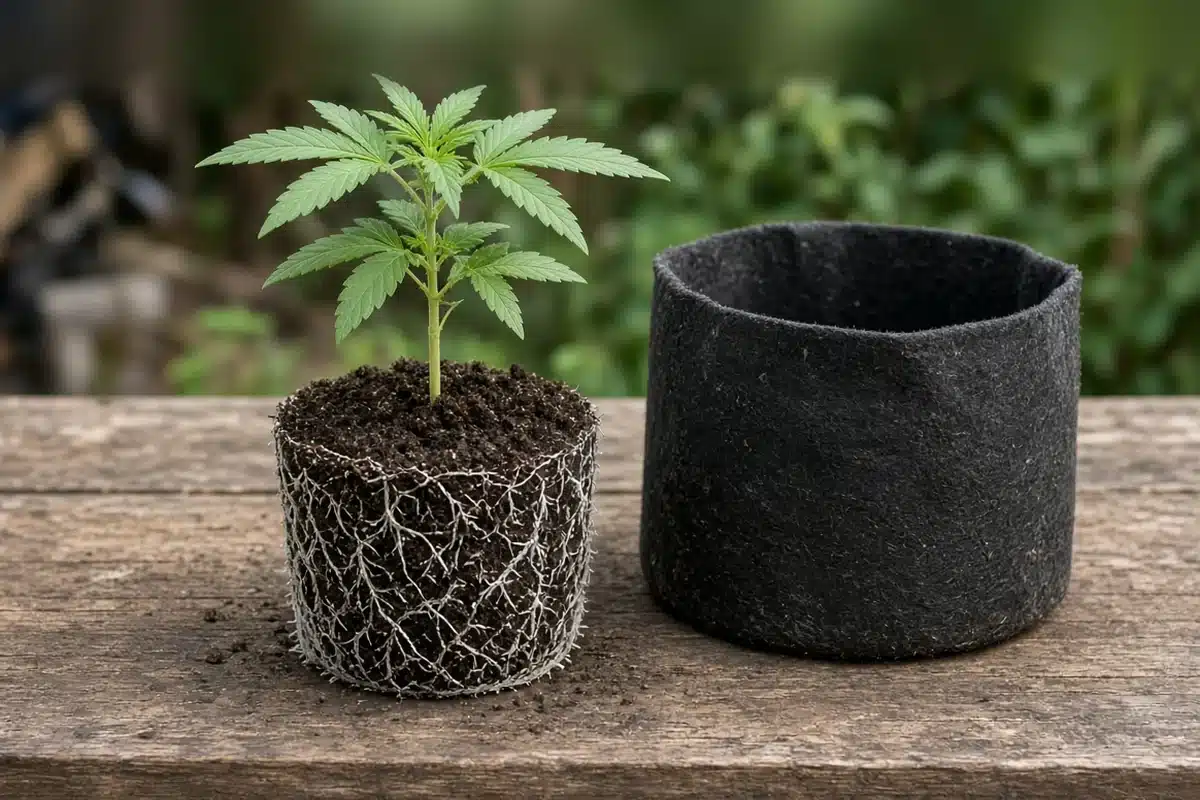
UMD Extension sizes vegetable containers by plant size. Large vegetables such as tomatoes and peppers need a minimum of 8 to 10 gallons with a depth of 12 to 16 inches. Medium vegetables need 4 to 6 gallons at 8 to 12 inches deep, and small plants need 1 to 3 gallons at 4 to 6 inches deep. NDSU says tomatoes need containers at least 5 gallons in size.
Extension sources do not give cannabis pot sizes. The figures below are typical grower ranges, not Extension guidance.
| Plant stage or grow style | Typical grower range |
|---|---|
| Seedling | Small cup or 1 gallon pot |
| Vegetative plant indoors | 3 to 5 gallons |
| Mature photoperiod plant indoors | 5 to 7 gallons |
| Autoflowering plant | 3 to 5 gallons, planted in the final pot |
| Large outdoor plant | 10 gallons or more |
Use the UMD large vegetable guideline of 8 to 10 gallons as a useful floor for a big outdoor cannabis plant. Remember that a bigger pot holds more water too, so match the size to how much the plant can drink.
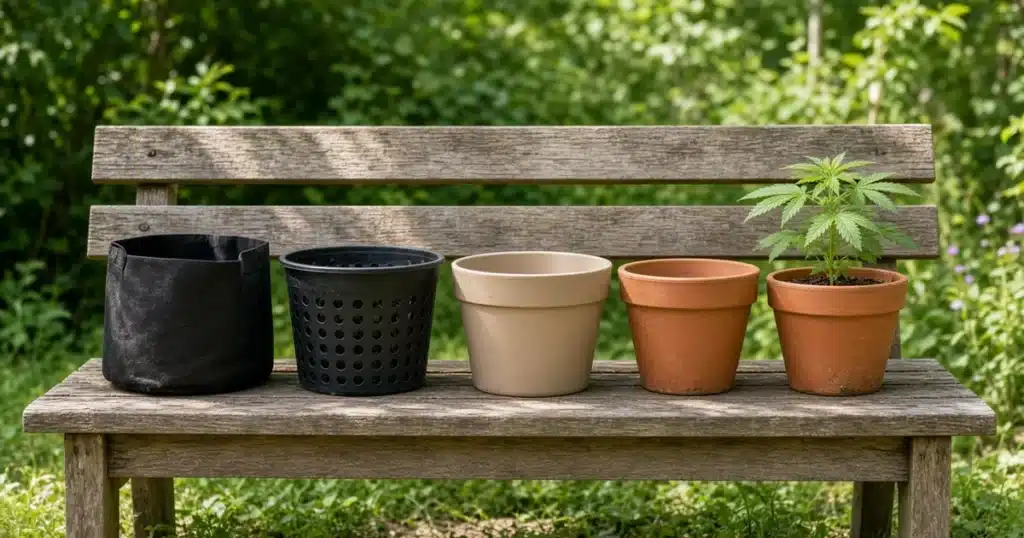
Best Pots for Weed by Material
Each material changes how fast the mix dries, how heavy the pot is and how warm the roots get. Here is a quick one line view of each. Our separate guides go deeper.
| Material | Dries out | Notes |
|---|---|---|
| Fabric | Fast | Breathable sides, light and easy to store |
| Air pot (perforated plastic) | Fast | Holes in the sides let air reach the root zone |
| Plastic | Slow | Cheap, light and holds moisture longer |
| Terracotta or clay | Fast | Porous, heavy and breaks if dropped |
| Wood | Fast | Porous, good for big outdoor boxes |
| Metal | Slow | Can get hot in direct sun |
| Self watering | Slow | Built in reservoir, no bottom drainage holes |
UMD Extension says containers made from porous materials such as clay, ceramic, concrete and wood dry out more quickly than containers made from plastic or metal. If you grow in fabric, see our full guide to fabric pots for cannabis.
UMD also notes that everyday objects such as 5 gallon plastic buckets, wooden crates and half whiskey barrels can be turned into containers. Be aware that plastics not made for outdoor use can become brittle from exposure to the elements. Pots can be used again from one grow to the next, and our guide to cleaning and disinfecting pots for cannabis explains how to get them ready.
Drainage for Cannabis Grow Containers
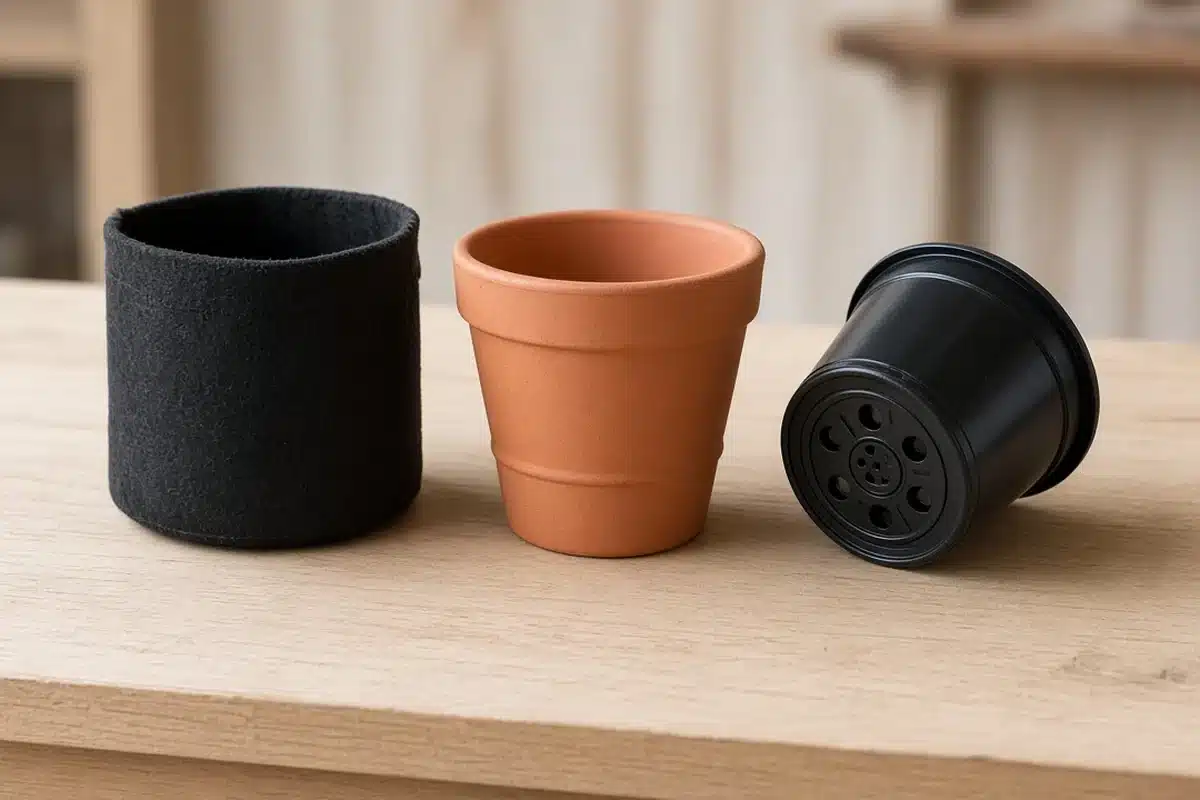
Drainage is the one feature every soil pot needs. UMD Extension says that except for the self watering types, all containers should have holes or slits in the bottom to let water drain out. NDSU says drainage holes should be at least 1/4 inch in diameter, and to make them yourself if the container has none.
UMD explains why. Irrigation water moves through the pore spaces in the mix, pushing out the air. If excess water cannot drain away, fresh air cannot enter and roots will suffocate.
UMD also says adding rocks, gravel or broken pot shards to the bottom of a container will not improve drainage and may raise the water table.
What goes in the pot matters just as much as the pot. NDSU says potting mixes hold water and nutrients and drain excess water easily, while pure garden soil is heavier and will compact in containers.
How to Choose a Cannabis Pot
- Decide on the final size. Think about how big the plant will get indoors or outdoors, and use the size table above as a starting point.
- Pick a material. Choose a fast drying pot if you can water often, or a slower drying pot if you can’t check plants every day.
- Check the drainage. Make sure there are holes in the bottom at least 1/4 inch across, as NDSU advises. Add more if needed.
- Think about color. UMD says dark colors create higher temperatures that could injure young tender roots. Choose a light color for pots in full sun.
- Raise the pot. UMD suggests potting feet or a brick to lift pots off the ground and help drainage.
- Fill with potting mix. Use a container mix, not garden soil, which NDSU says compacts in pots.
- Plan your watering. NDSU says containers have a limited root area and need frequent watering. Check them daily, and expect more water in hot, dry weather.
- Make sure you can move it. NDSU notes containers can be moved as the light changes, so be sure you can lift them.
Troubleshooting
The mix dries out by midday. The pot is too small or too porous for the plant. Move up a size or switch to a slower drying material. NDSU says containers may need watering twice a day in hot, dry weather.
The mix stays wet for days. Check that the drainage holes are open and the pot isn’t sitting in water. Raise it on feet or a brick, as UMD suggests.
Water pours out the sides of the pot. The mix has dried and shrunk from the walls. Water slowly in small amounts so the mix can soak it up.
Roots circling the pot. When roots wrap around the walls and bottom, the plant has outgrown its container. See our guide to root bound cannabis.
Wilting on hot, sunny afternoons. A dark pot in full sun can heat the root zone. Our guide to hot pots and root zone heat explains how to keep containers cooler.
Sources
- University of Maryland Extension, Types of Containers for Growing Vegetables: https://extension.umd.edu/resource/types-containers-growing-vegetables
- University of Maryland Extension, Growing Media (Potting Soil) for Containers: https://extension.umd.edu/resource/growing-media-potting-soil-containers
- NDSU Extension, Dakota Gardener: Container Gardening: https://www.ag.ndsu.edu/news/columns/dakota-gardener/dakota-gardener-container-gardening
FAQ
What size pot is best for growing cannabis?
Many growers use 3 to 5 gallons for smaller indoor plants and 5 to 7 gallons for larger indoor plants, with 10 gallons or more outdoors. These are typical grower ranges. University of Maryland Extension's figure for large vegetable plants is a minimum of 8 to 10 gallons of growing media at 12 to 16 inches deep.
Which pot material is best for growing weed?
It depends on how often you can water. University of Maryland Extension says porous materials such as clay and wood dry out faster than plastic or metal. Fabric and air pots dry fast and breathe well. Plastic is cheap and holds moisture longer. Pick a light color for pots in full sun.
Do cannabis pots need drainage holes?
Yes. University of Maryland Extension says every container except self watering types should have holes or slits in the bottom. NDSU Extension says the holes should be at least 1/4 inch across. Without drainage, water fills the air spaces in the mix and roots can suffocate.
Can you grow cannabis in a 5 gallon bucket?
Yes, if you drill drainage holes in the bottom. University of Maryland Extension lists 5 gallon plastic buckets among everyday objects that work as containers. NDSU says tomatoes need at least 5 gallons, so a bucket is a reasonable size for a small to medium cannabis plant. Use a light colored bucket in sun.
Can you reuse cannabis pots?
Yes. Most pots can be used for many grows. University of Maryland Extension notes that nursery pots and other everyday objects can be reused as containers. Empty out the old mix and roots, check plastic pots for cracks and clean them before you replant. UMD warns that plastics not made for outdoor use can become brittle outdoors.