
How to Disinfect Plant Pots for Cannabis Growing
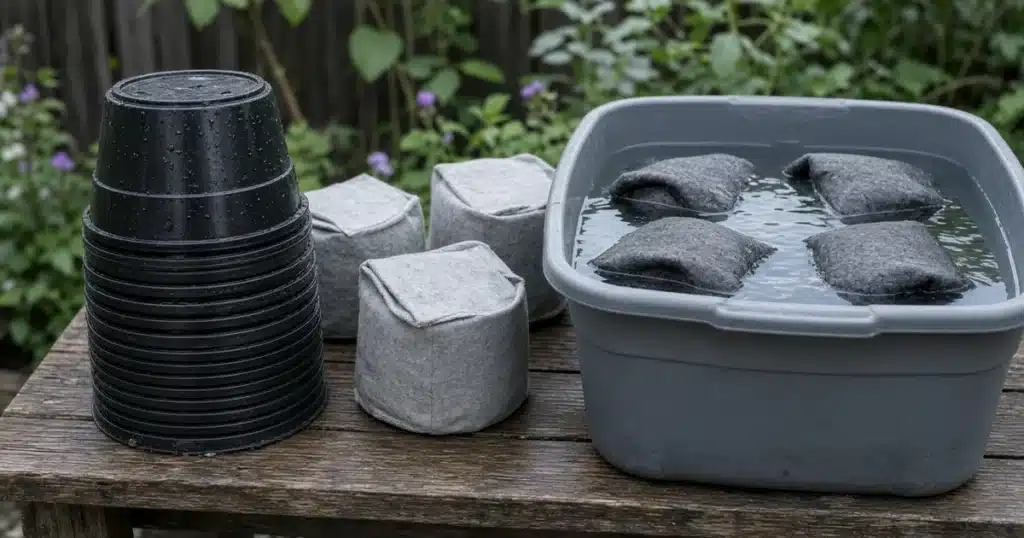
Knowing how to disinfect plant pots saves money and protects the next crop. Disease organisms that cause root rot and damping off can survive in dried root bits and soil stuck to a used pot, then infect the seedlings you plant in it next. Reusing pots is fine, but only after they are properly cleaned and disinfected. The sections below cover why it matters, how to clean and disinfect plastic, fabric and other containers step by step, how the main types of disinfectant compare, and the mistakes that make cleaning fail.
Why disinfect pots before reusing them?
UMass Amherst Extension explains that plant pathogens such as Pythium, Rhizoctonia and Thielaviopsis can survive in root debris and soil particles on surfaces. It cites research showing Thielaviopsis spores surviving on recycled plug trays and infecting new crops. Pythium and Rhizoctonia are common causes of root rot and damping off, which hit seedlings and young plants hardest.
University of Kentucky Extension adds that cleaning and sanitizing containers and tools is an important step in removing the microscopic spores and fragments that cause disease in later crops. It says this matters most where disease was a problem before. Clean pots will not guarantee a healthy crop, but dirty ones can undo a careful start. What that disease looks like on young plants is shown in damping off in cannabis seedlings.
Should you reuse pots after a disease problem?
Be cautious. UMass Extension advises avoiding reuse of containers from a crop that had a disease problem. If you do reuse them, clean and disinfect them with extra care, and consider keeping them for plants that are past the seedling stage. Inexpensive thin plastic pots that are cracked or brittle are often better recycled than rescued.
Even with no sign of disease, UMass Extension recommends washing containers thoroughly to remove soil particles and plant debris before treating them with a disinfectant. Organic matter shields pathogens from the solution.
How do you clean and disinfect pots, step by step?
- Empty the pots completely. Knock out old soil and roots. The used soil does not have to go to waste, as reusing old soil explains.
- Dry-brush the inside and outside. University of Kentucky Extension starts with brushing away dry debris, soil and media particles.
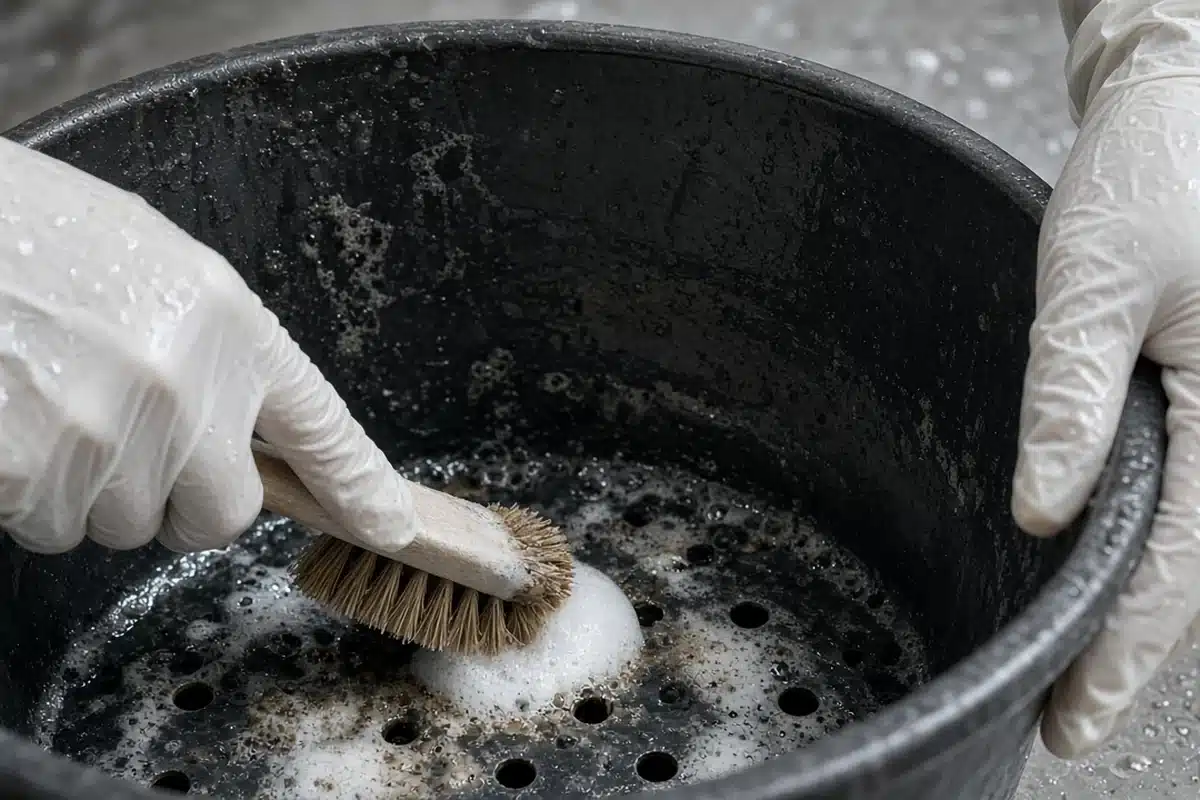
- Wash with soap or detergent and a stiff brush. Pay attention to drainage holes, rims and the seams where roots cling. The same bulletin advises scrubbing containers and tools rather than just rinsing.
- Rinse well. UMass Extension warns that soap residue can inactivate some disinfectants, especially quaternary ammonium products. Repeat washing until no film or grit is left.
- Disinfect. Soak or wet the pots with a disinfectant made up to its label rate. University of Kentucky Extension says contact time is the key to effective disinfection, and that slow drying increases contact time.
- Rinse if the product requires it. Some disinfectants need rinsing and some do not. Follow the label.
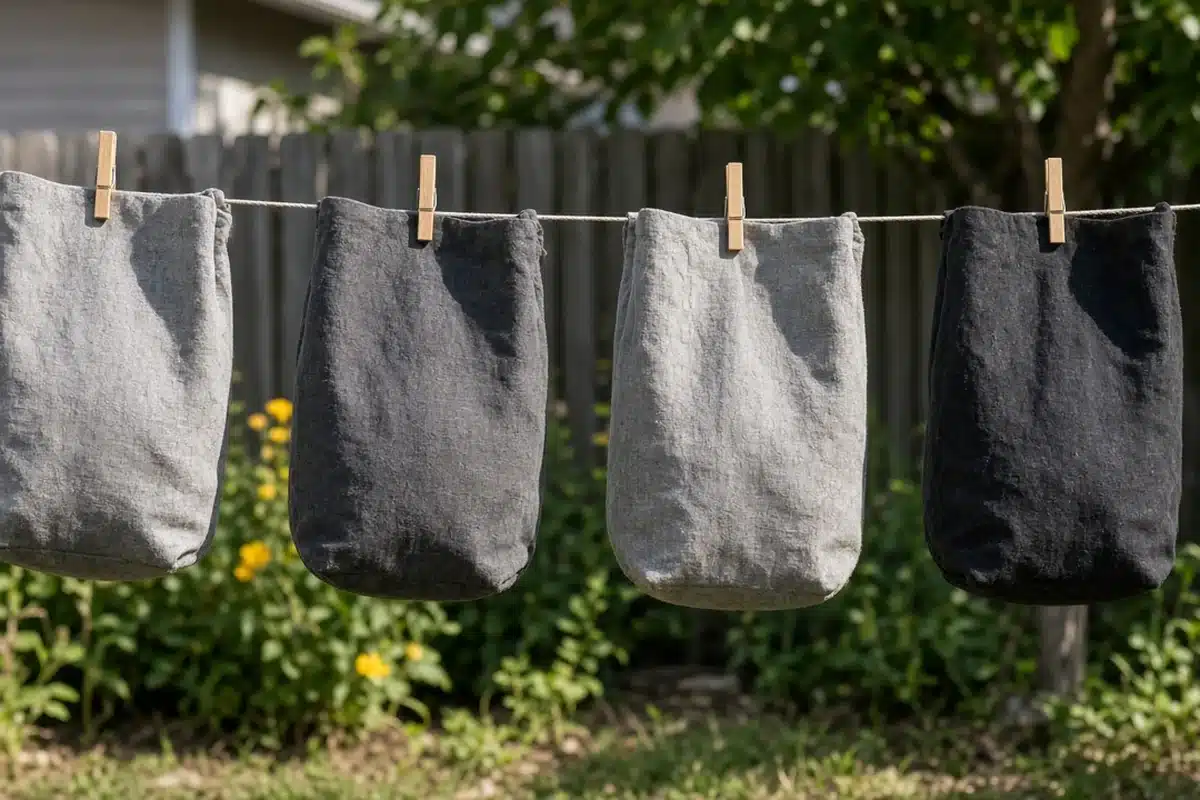
- Dry fully and store covered. Keep clean pots stacked upside down or bagged, off the ground, until you use them.
Wear gloves and eye protection when mixing and using disinfectants, and work in a well-ventilated area.
Which disinfectants work for pots?
Extension guides group pot disinfectants into a few main types. Product names vary, so buy by active ingredient and follow the label.
| Disinfectant type | Contact time (UK Extension) | Notes from extension sources |
|---|---|---|
| Chlorine bleach | Less than 1 to 15 minutes, UMass suggests 30-minute soak | Cheap and effective, corrosive, must be mixed fresh |
| Quaternary ammonium compounds | 10 to 15 minutes | Stable, inactivated by organic matter, no rinse needed |
| Hydrogen dioxide | 1 to 10 minutes | Strong oxidizer, do not mix with other products |
| Hydrogen peroxide and peroxyacetic acid | 10 to 15 minutes | Limited effect on porous surfaces like wood |
| 70% alcohol | 10 to 15 minutes | For tools only, flammable, not practical as a soak |
Source: University of Kentucky Extension PPFS-GH-07 and UMass Amherst Extension, Cleaning and Disinfecting the Greenhouse (greenhouse use, not cannabis-specific).
How do you use bleach safely on pots?
Bleach is the most common choice at home. UMass Extension gives the usual mix as 1 part household bleach (5.25 percent sodium hypochlorite) to 9 parts water, for a final strength of 0.5 percent. Check the strength on your bottle, since many household bleaches are sold at different strengths, and adjust if needed.
Timing matters with bleach. UMass Extension reports that a bleach solution has a half-life of only two hours. After two hours, only half the chlorine is left, and after four hours only a quarter. Mix it fresh just before each use. The same source suggests a 30-minute soak followed by a rinse with clean water.
Bleach also has limits. UMass Extension notes it is corrosive and repeated use can harm plastics and metals. University of Kentucky Extension warns that it damages soft plastic and rubber and must never be mixed with products containing ammonia or acids, since that releases dangerous gases. Use it outdoors or in a well-ventilated space.
How do you use the other disinfectant types?
Quaternary ammonium compounds. UMass Extension describes these as stable products labeled for fungal, bacterial and viral plant pathogens and for algae, and approved for use on pots, flats and tools. They have a weakness that matters at home: any contact with organic matter inactivates them. Pre-clean pots before using them. UMass Extension adds that active solutions foam a little, and when the foaming stops, the solution is no longer working. If you keep a tub in steady use, mix a fresh batch about twice a day. No rinse is needed afterward.
Hydrogen dioxide and peroxide-based products. UMass Extension notes these kill bacteria, fungi, algae and their spores on contact and are labeled for pots, trays and tools. They are strong oxidizers, so never mix them with other pesticides or fertilizers. The concentrate can irritate or damage eyes and skin.
Products to skip. University of Kentucky Extension lists some alternative cleaners as lacking efficacy data. Stick with the main types above and follow each label’s rate and contact time.
How do you clean different kinds of pots?
Rigid plastic pots. These clean most easily. Scrub, soak in a fresh disinfectant solution, rinse and dry. Replace pots that have turned brittle.
Fabric pots. Knock out soil, let them dry, then brush off as much root material as you can. Wash by hand or machine with detergent, rinse well, and soak in disinfectant if disease was a problem. Dry them completely before storing, since damp fabric invites mold.
Terra cotta and clay pots. Clay is porous and holds residues and salts. Scrub hard and allow a longer soak. University of Kentucky Extension notes that bleach is the most effective product for porous surfaces, especially at higher concentrations.
Wooden planters and boxes. Wood is the hardest to disinfect. University of Kentucky Extension says many sanitizers do not penetrate wood well. Scrub well, and consider lining wooden boxes or using them only for larger, established plants.
Seedling trays and cell inserts. These carry the highest risk because they hold the youngest plants. Clean them with the most care or replace them. When it is time for new containers, Kind Seed Co weighs the choices in the best cannabis growing containers.
What about tools and work surfaces?
Pots are only part of the picture. UMass Extension notes that 70 percent alcohol works almost on contact as a dip or wipe for knives and cutting tools, though it is too flammable for soaking. Wipe pruners and trowels between plants and between crops. Clean the potting bench or table where you fill pots, since dust from old media can carry the same pathogens.
What problems point to a cleaning failure?
| Problem in the next crop | Possible cleaning cause | Fix next time |
|---|---|---|
| Seedlings collapse at the soil line | Pathogens left in reused pots or trays | Replace trays, clean pots more thoroughly |
| Brown, slimy roots in young plants | Root debris left in pot crevices | Scrub seams and holes, soak longer |
| Disinfectant seems to do nothing | Soil or soap residue left on surfaces | Wash and rinse before disinfecting |
| Bleach smell gone, poor results | Solution mixed too early | Mix fresh right before soaking |
| Brittle, cracked plastic | Repeated harsh chemical exposure | Rinse after bleach, replace worn pots |
Cleaning checklist drawn from the UMass and University of Kentucky sanitation guidance cited below. Root and seedling problems have many causes, so check watering and environment too.
When should you clean pots during the grow cycle?
After harvest or after any plant is removed. Clean pots as soon as they are empty. Dried roots and soil are harder to remove later.
Before starting seeds. Trays and small pots for seedlings should be new or freshly disinfected. This is the stage most at risk from damping off.
Before potting up. Disinfect larger containers before moving plants up so a clean start is not lost at transplant.
Between indoor runs. Clean pots along with the rest of the grow space, so you are not bringing old pathogens back into a clean area.
What are common mistakes?
- Disinfecting pots that still have soil or roots stuck to them.
- Skipping the rinse after washing, which leaves soap that weakens some disinfectants.
- Mixing bleach ahead of time and using it hours later.
- Mixing bleach with ammonia or acid products.
- Not leaving the disinfectant on long enough.
- Reusing seedling trays from a crop that had root or seedling disease.
- Storing damp fabric pots.
Make pot cleaning part of your end-of-run routine. It is simple, it is cheap, and it is one of the easiest ways to protect your next round of seedlings.
Sources
- UMass Amherst Center for Agriculture, Food and the Environment. Cleaning and Disinfecting the Greenhouse. https://www.umass.edu/agriculture-food-environment/greenhouse-floriculture/fact-sheets/cleaning-disinfecting-greenhouse
- University of Kentucky Cooperative Extension. PPFS-GH-07, Cleaning and Sanitizing Commercial Greenhouse Surfaces. https://plantpathology.mgcafe.uky.edu/files/ppfs-gh-07.pdf
FAQ
What is the bleach ratio for cleaning plant pots?
UMass Amherst Extension uses 1 part household bleach at 5.25 percent strength to 9 parts water, which gives a 0.5 percent solution. Check your bottle's strength and adjust if it differs. Mix it fresh, soak clean pots for about 30 minutes, then rinse with clean water and let them dry.
Do I need to disinfect new plant pots?
New pots from a sealed package usually do not need disinfecting. A quick rinse removes dust from manufacturing and storage. Disinfect any pot that has held soil or plants before, any pot of unknown history, and every reused seedling tray, since those carry the greatest disease risk.
Can I reuse pots after root rot?
UMass Amherst Extension advises avoiding reuse of containers from a crop that had a disease problem. If you choose to reuse them, scrub off every trace of soil and roots, disinfect for the full contact time and use them for sturdier, established plants rather than seedlings. Replace trays and cracked pots.
How do I clean fabric grow pots?
Let them dry, knock out the old soil and brush off roots. Wash with detergent by hand or machine, rinse well, and soak in a disinfectant if there was disease in the last crop. Dry them completely before storing so they do not grow mold.


