
Backcrossing Cannabis: What BX Means on Seeds
Backcrossing cannabis means crossing a hybrid back to one of its parents to bring that parent’s traits forward. The BX number counts the rounds. In a textbook model with fully inbred parents, that parent’s share of the genome is about 75 percent after BX1, 87.5 after BX2 and 93.8 after BX3, before selection. Real cannabis parents may differ.
What Is Backcrossing in Cannabis?
Backcrossing is a breeding method. A breeder crosses two plants, then crosses the offspring back to one of the original parents, called the recurrent parent. Each round pulls the offspring closer to that parent while keeping a trait from the other side. Cannabis breeders use it to restore a favored plant’s character after adding something new. Our guide to F1, F2 and F3 seeds explains the generation labels it builds on.
What Do BX1, BX2 and BX3 Mean?
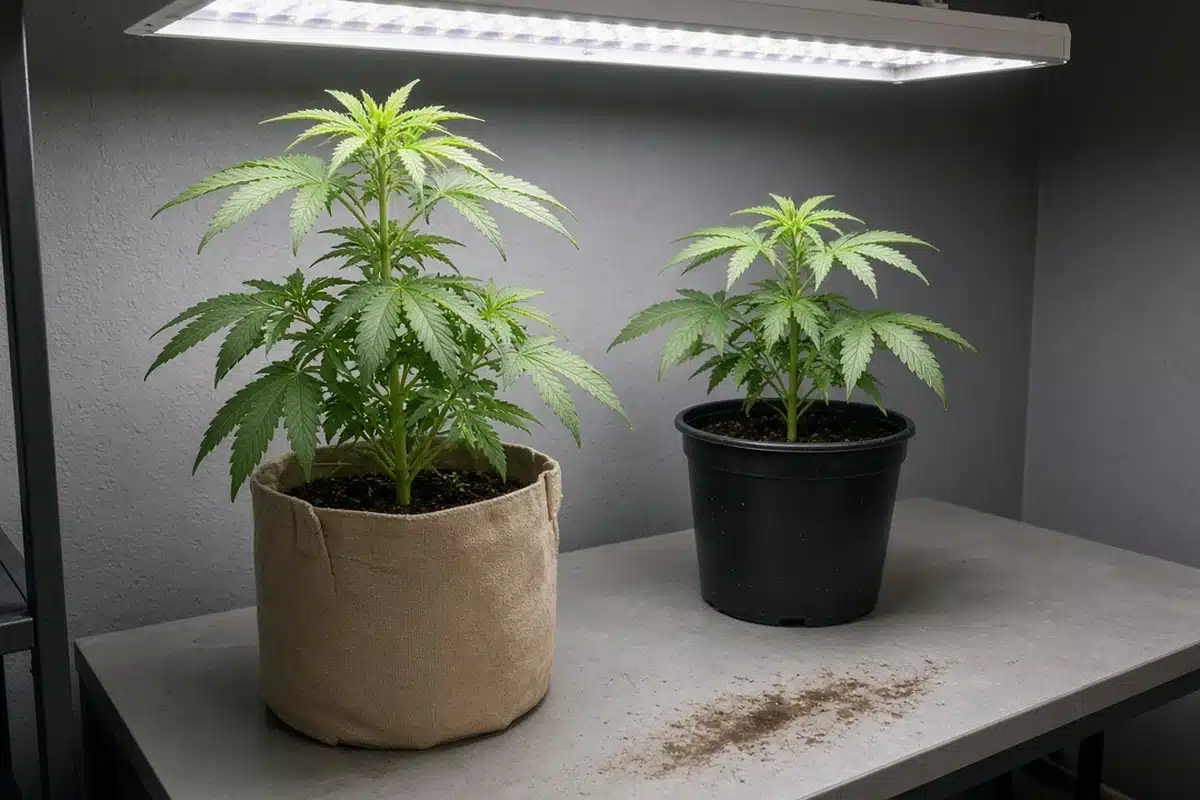
BX is the cannabis seed shorthand for a backcross generation, and the number counts the rounds. BX1 is the first cross back to the recurrent parent, BX2 the second and BX3 the third. Plant breeding texts write the same thing as BC1, BC2 and BC3. A BX3 label is meant to show three crosses back to the same parent, but breeders do not all count the same way, so check with the breeder.
How Much of the Parent Comes Back Each Round?
About half of what is left each time. Iowa State’s Molecular Plant Breeding text gives the expected share of the recurrent parent genome without selection as 75.0 percent at BC1, 87.5 at BC2, 93.8 at BC3, 96.9 at BC4 and 98.4 at BC5 (Iowa State Molecular Plant Breeding). The same chapter notes that five to eight backcross generations are usually needed to move a single gene into a target crop variety. These are expected values, not measured cannabis results.
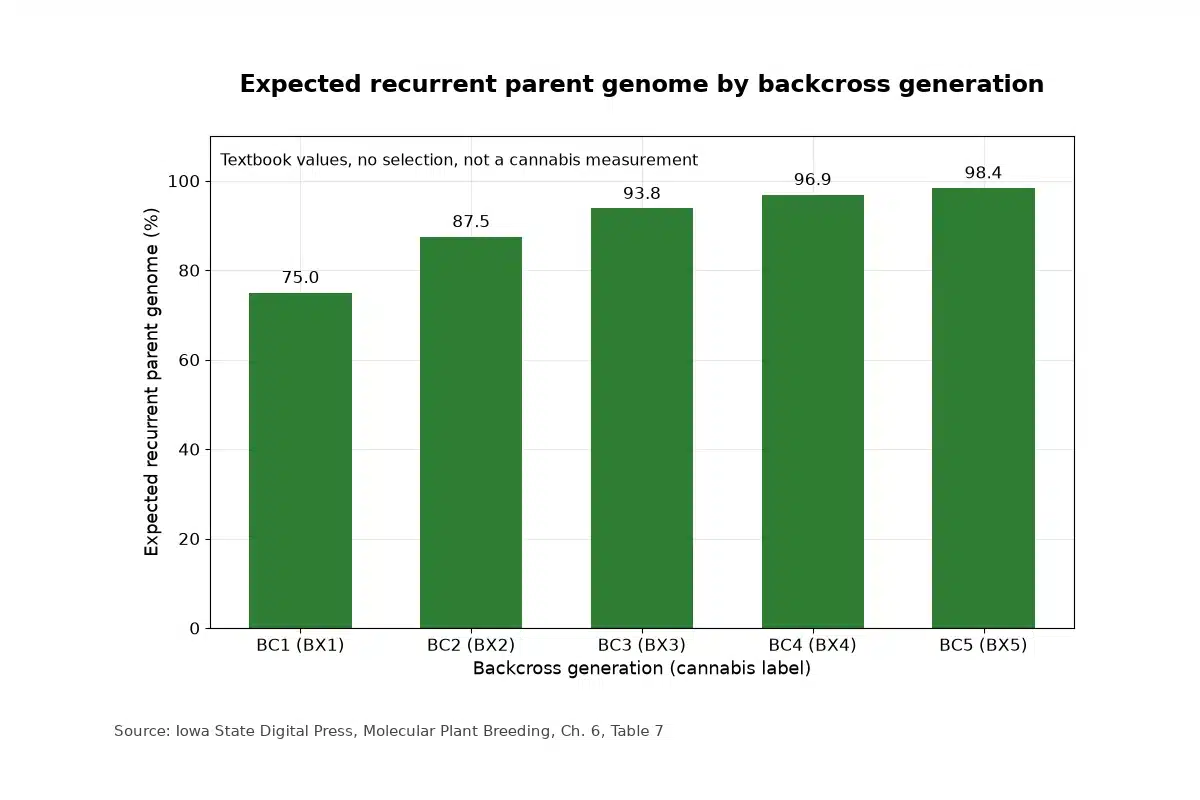
Expected recurrent parent genome by backcross generation, no selection
Source: Iowa State Digital Press, Molecular Plant Breeding, Ch. 6 Marker Assisted Backcrossing, Table 7 (no selection column). Textbook values, not a cannabis measurement. Chart y axis starts at 0 percent.
| Generation | Cannabis label | Expected recurrent parent genome (percent) |
|---|---|---|
| BC1 | BX1 | 75.0 |
| BC2 | BX2 | 87.5 |
| BC3 | BX3 | 93.8 |
| BC4 | BX4 | 96.9 |
| BC5 | BX5 | 98.4 |
Why Do Breeders Backcross?
Breeders backcross to keep a favored plant while adding one trait, or to bring back a parent’s look, smell or structure after an outcross. It can also concentrate a rare trait, a topic our guide to cannabis mutations touches on. There is a catch. The Iowa State chapter describes linkage drag, where unwanted genes linked to the target gene come along with it (Iowa State Molecular Plant Breeding). Careful selection each round, as in our guide to selecting a phenotype, helps.
Curious about breeding projects? See our regular seeds and branded seeds.
Sources
The sources below are general plant breeding texts, not cannabis studies. Their values are textbook expectations, not cannabis measurements.
- Iowa State University Digital Press, Molecular Plant Breeding, Chapter 6: Marker Assisted Backcrossing
- Iowa State University Digital Press, Crop Genetics, Chapter 7: Inbreeding and Heterosis
The percentages here are textbook breeding math, not a trait promise, and this page is Kind Seed Co’s general genetics information.
FAQ
Is a BX strain the same as an IBL?
No. A BX strain comes from crossing back to one parent a set number of times, so it leans toward that parent. An IBL comes from breeding within one line for many generations until it grows true. Both raise uniformity, but they get there by different routes, and a BX line may still vary.
Can backcrossing lock in a trait?
It can help, but there is no guarantee. Each round brings the offspring closer to the recurrent parent, while selection keeps the trait the breeder wants. Iowa State's chapter notes that several rounds are usually needed. Linkage drag can also bring unwanted genes along with the wanted one, so selection still matters at every step.
Does backcrossing reduce vigor?
It can. Iowa State's Crop Genetics text lists backcrossing among mating systems that promote inbreeding, and inbreeding can lower vigor. How much depends on the plants and how hard the breeder selects. The chapter makes this as a general crop breeding point, not a cannabis measurement.
How do I read BX on a seed listing?
Read the number as the count of crosses back to the same parent. BX1 means one round, BX2 two rounds and so on. A higher number means more of that parent's genome in the textbook model, though breeders may count differently. It does not promise any trait, so read the rest of the listing for height, timing and other details.


