Cannabis and Hops: How These Plant Cousins Compare
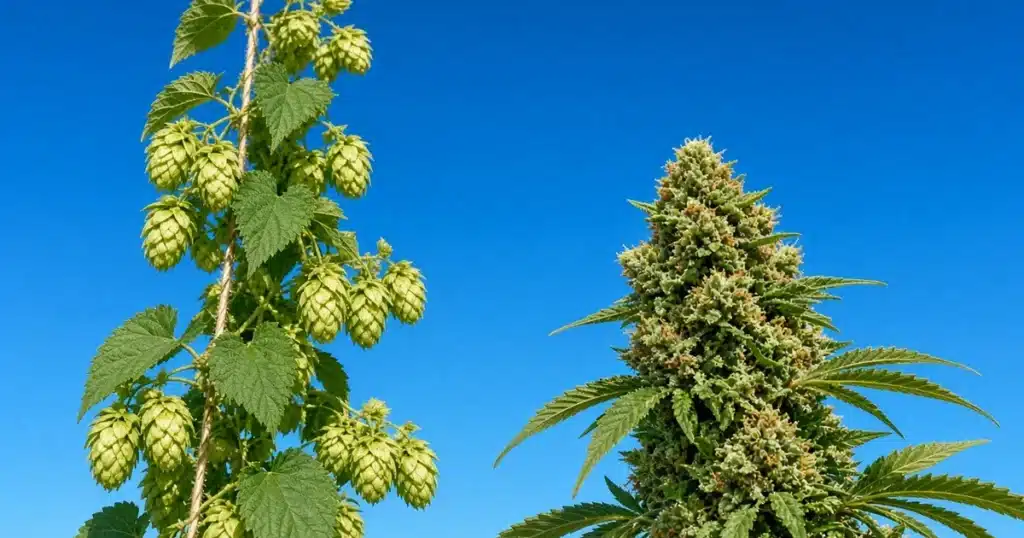
Quick answer: Cannabis and hops are close relatives. University of Nevada, Reno Extension places hops in the Cannabaceae family, the same plant family that includes cannabis. Both plants are dioecious, meaning individual plants are either male or female, and in both crops growers prize the unpollinated female flowers. Nebraska Extension describes hop cones covered in resin glands that are glandular trichomes, much like the resin glands on cannabis flowers. The big differences are lifespan and form: hops are perennial climbing bines, while cannabis is an annual that regrows from seed each year.
Are Cannabis and Hops Related?
Yes. A University of Nevada, Reno Extension publication on hops notes that hops belong to the Cannabaceae family, which includes cannabis in all its forms, hemp among them. The common hop is Humulus lupulus, and the publication also mentions a native Southwestern species.
Being in the same family means the two plants share a common ancestor and many inherited features. Researchers take that link seriously. Oregon State University’s hemp genomics program describes a project comparing the genomes and chemistry of hemp and hops to better understand aroma and flavor across the Cannabaceae family.
What Do Cannabis and Hops Have in Common?
They share a plant family, separate male and female plants, prized seedless female flowers, resin glands and a strong response to day length.
Separate Male and Female Plants
Nebraska Extension’s guide to cultivating hops for cone production states plainly that hops are dioecious. Male flowers form only on male plants, and the cone forming flowers develop only on females. Cannabis follows the same basic pattern. Oregon State Extension’s Hemp Sex Ed publication describes most cannabis as dioecious, with genetically female plants carrying XX chromosomes.
Unpollinated Female Flowers Are the Prize
Hop farmers want seedless cones. Nebraska Extension reports that seedless cones produce more lupulin, and lupulin of higher quality, than cones allowed to set seed. The publication advises removing male plants to prevent seed. Cannabis growers aiming for flowers follow the same logic and remove males to keep female flowers unpollinated.
Resin Glands on the Flowers
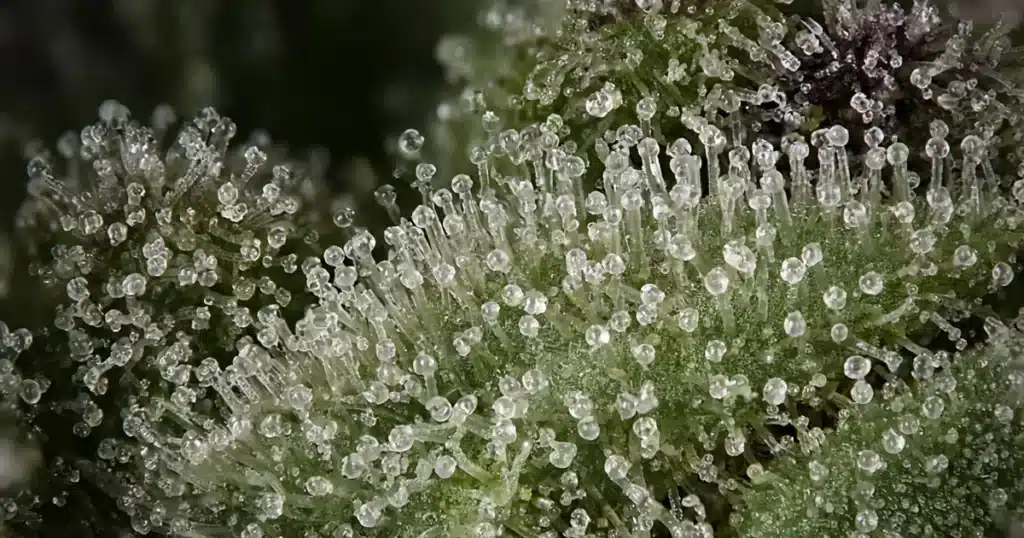
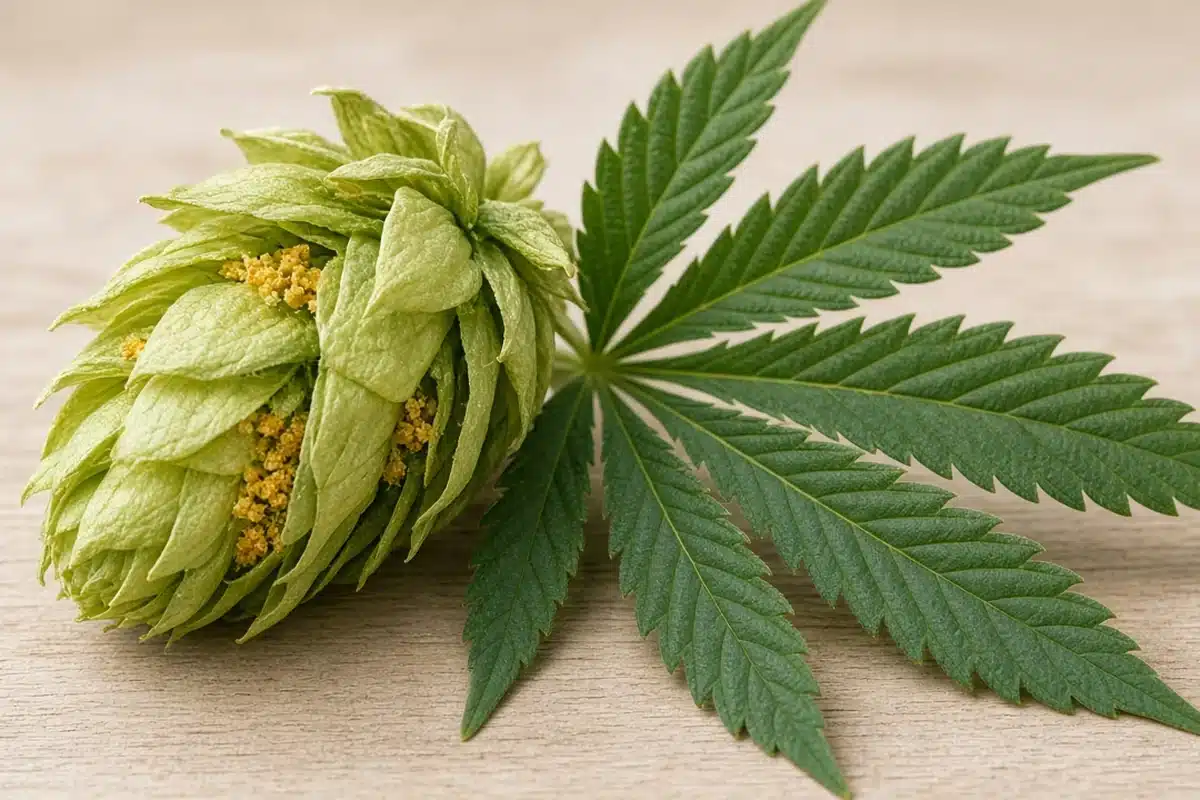
Nebraska Extension describes lupulin as the golden yellow dust on cone bracts. It comes from glands, which the publication identifies as glandular trichomes, that accumulate resins and essential oils. Cannabis flowers also carry glandular trichomes, the frosty resin heads growers watch closely near harvest.
Heat Can Trigger Mixed Flowers
Nebraska suggests that male flowers on a female hop plant can sometimes be a hermaphroditic reaction to very high temperatures in heat sensitive varieties. Oregon State Extension likewise reports that genetically female hemp plants can produce viable male flowers during the season. In both crops, stress can blur the line between the sexes.
Day Length Shapes the Season
Nebraska explains that shortening days and cooling temperatures end the hop growing cycle and send the plant into dormancy. Cannabis also responds strongly to day length. University of Kentucky Extension’s hemp publication describes it as a summer annual that is strongly photoperiod sensitive, flowering according to day length rather than plant age.
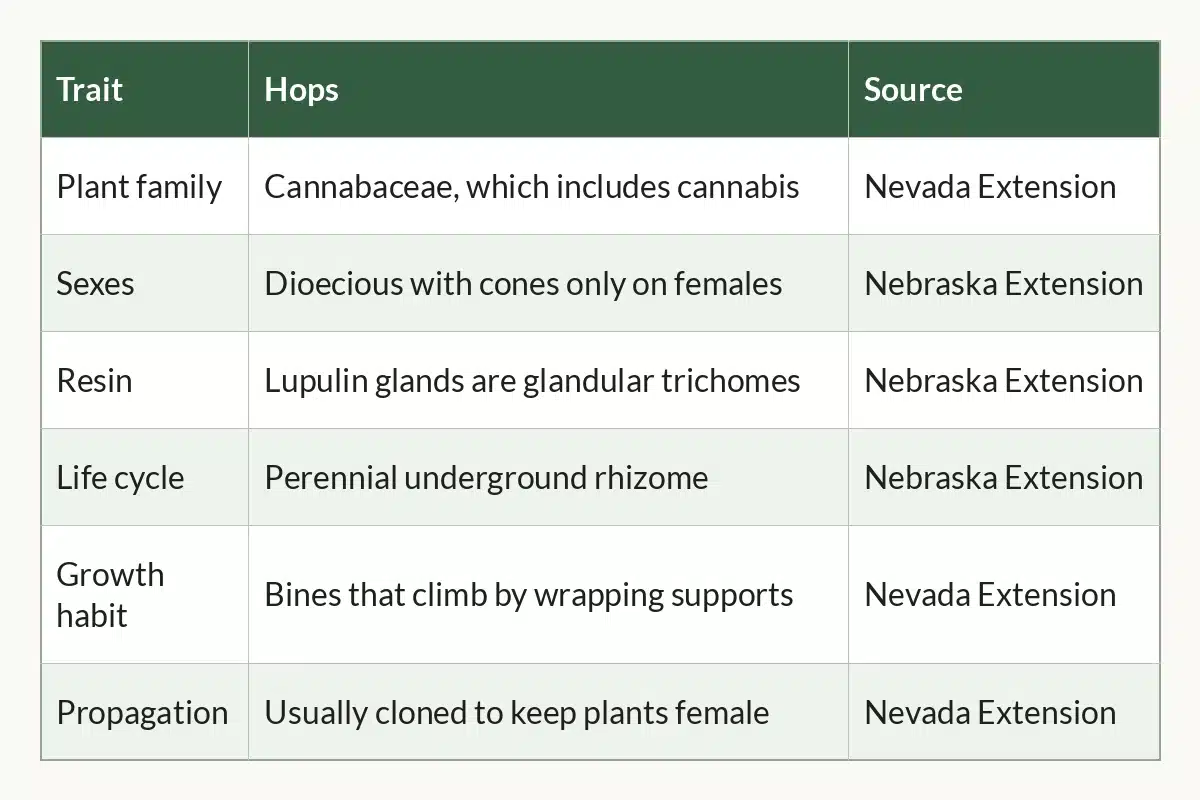
Cannabis vs. Hops at a Glance
| Trait | Hops | Source |
|---|---|---|
| Plant family | Cannabaceae, which includes cannabis | Nevada Extension |
| Sexes | Dioecious with cones only on females | Nebraska Extension |
| Resin | Lupulin glands are glandular trichomes | Nebraska Extension |
| Life cycle | Perennial underground rhizome | Nebraska Extension |
| Growth habit | Bines that climb by wrapping supports | Nevada Extension |
| Propagation | Usually cloned to keep plants female | Nevada Extension |
How Are Cannabis and Hops Different?
The biggest differences are life span, growth habit, roots, climate needs and how each crop is started.
Annual Versus Perennial
This is the biggest split. Missouri Extension’s industrial hemp publication calls hemp an annual that finishes its whole life in a single season, usually 60 to 120 days from planting, with variety and conditions setting the pace. Hops, by contrast, come back year after year. Nebraska Extension explains that hop plants consist of a perennial underground rhizome and root system that sends up a large new shoot system every year that can reach about 20 feet before fall.
Climbing Bines Versus Upright Stems
Nevada Extension explains that hop vines are botanically bines, because they climb without tendrils. The stems wrap around supports with help from hairs on the stem and can grow up to 25 feet. Cannabis grows as an upright, branching herb that stands on its own.
Roots Built for the Long Haul
Nebraska describes two kinds of hop roots: a spreading fibrous system for quick water and nutrient uptake and a swollen vertical root system that can reach 6 to 12 feet deep. A cannabis plant, living only one season, never builds that kind of permanent underground structure.
What Hops Need to Thrive
Nevada Extension lists the classic requirements for traditional hop varieties: roughly 15 hours of daylight, 120 frost free days and a winter chill of six to eight weeks under 40 F. The publication notes that hops generally grow best between about 30 and 52 degrees north latitude. In southern Nevada, test plots near Las Vegas met most of those needs except the long winter chill, and many varieties still produced good yields over four years.
Cannabis has no chilling requirement because it does not overwinter. Instead, it needs a long enough season of warmth and light to grow and flower before frost. That is why hops stay in the ground for years while cannabis is replanted every spring.
Nevada Extension also reports that a hop planting can need as much as 60 percent less water than alfalfa does, one reason the desert trials were worth running. The publication describes harvest timing too. Ripe cones come off the bine easily and smell aromatic, while a green grass smell signals an immature crop. Cannabis growers judge ripeness in a similar spirit, by looking closely at the flowers and their resin rather than counting days alone. In both crops, patience late in the season pays off in aroma and quality.
How the Crops Are Started
Nevada notes that hop plants are usually cloned to make sure every plant is female, and that hops are produced mainly by rhizome division. Cannabis can be grown from seed or cuttings. For a refresher on its structure and life cycle, see our explainer on what is a cannabis plant.
Where Hops Grow in the United States
Hops are a much bigger commercial crop than many people realize. Nebraska Extension reports that the United States grew 59,739 acres of hops in 2019, with 69 percent of that acreage in Washington. The publication describes hops as an opportunity for specialty growers to supply local craft brewers with hops of unique character.
Hemp, the fiber and grain form of cannabis, has its own US production history. Both crops have attracted new interest from small farms in recent years, and the overlap in growing skills is real. Trellising, sex identification, timing harvest by resin development and careful drying matter for both plants.
What Hops Teach Cannabis Growers
- Male plants matter. In both crops, removing males keeps female flowers seedless.
- Heat stress can cause mixed flowers. Hops research and cannabis guidance both link stress to unexpected male flowers.
- Resin forms in glands. The trichomes on hop cones and cannabis buds play a similar role as resin factories.
- Diseases can cross over. Close relatives can share some pathogens. Our post on hop latent viroid in cannabis explains one well known example.
- Aroma runs in the family. Shared chemistry is one reason researchers compare the two. Our article on the humulene terpene covers one aroma compound found in many cannabis plants.
Troubleshooting Confusion Between the Two Plants
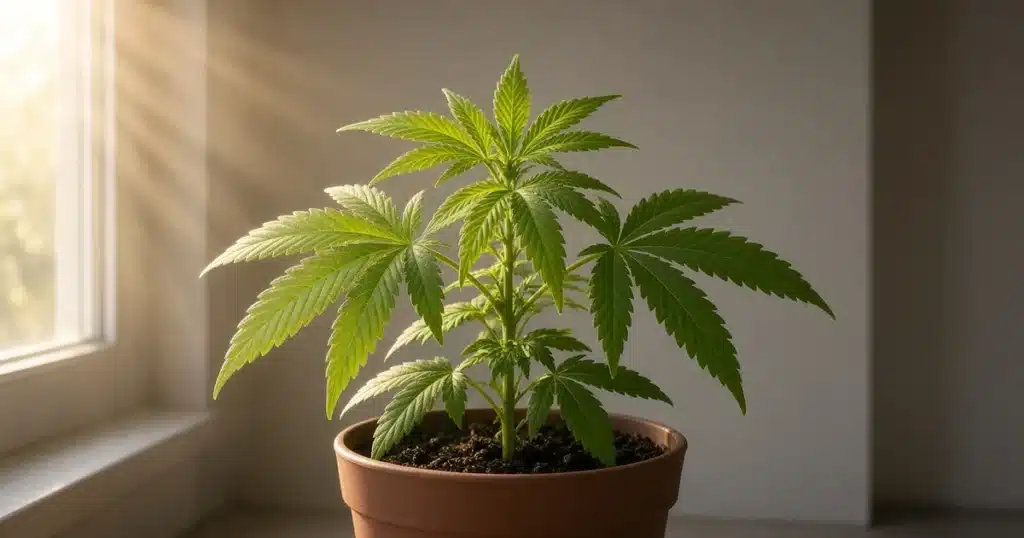
Seedlings look nothing like hops. Young cannabis has distinctive serrated leaflets. Hop leaves are broad and lobed, more like grape leaves.
A climbing plant appears in a hemp field. Hops climb by wrapping around supports. Cannabis does not climb.
Cones versus buds. Hop cones are papery, layered bracts. Cannabis flowers are dense clusters of pistils and small leaves.
Expecting cannabis to regrow. Unlike hops, cannabis will not return from the roots next spring.
Unexpected male flowers. In both plants, check for heat and other stress first.
Sources
- University of Nevada, Reno Extension, Growing Hops in Southern Nevada: https://extension.unr.edu/publication.aspx?PubID=2744
- Nebraska Extension, Cultivating Hops for Cone Production in Nebraska (EC3050): https://extensionpubs.unl.edu/publication/ec3050/2021/pdf/view/ec3050-2021.pdf
- Oregon State University Extension, Hemp Sex Ed (EM 9279): https://extension.oregonstate.edu/catalog/em-9279-hemp-sex-ed
- Oregon State University College of Agricultural Sciences, Hemp Plant Breeding, Genetics and Genomics: https://agsci.oregonstate.edu/hemp/research-consortia/plant-breeding-genetics-genomics
- University of Missouri Extension, Industrial Hemp (MX80): https://extension.missouri.edu/publications/mx80
- University of Kentucky Extension, Hemp (ID-250): https://publications.mgcafe.uky.edu/id-250
FAQ
Are hops and cannabis in the same family?
Yes. Both belong to the Cannabaceae family.
What part of the hop plant is harvested?
The cones, which are clusters of female flowers covered in papery bracts and golden lupulin.
Are hops dioecious like cannabis?
Yes. Hops have separate male and female plants, and only females form cones.
Do hops have trichomes?
Yes. Nebraska Extension describes lupulin glands on hop cones as glandular trichomes.
Is cannabis perennial like hops?
No. Cannabis is an annual, while hops regrow from a perennial rhizome each year.