The Cannabis Genome: What Growers Should Know
Quick answer: The cannabis genome is the full set of DNA instructions inside every cannabis cell. Oregon State University’s hemp genomics team describes it as large, roughly 850 million base pairs, and packed with repetitive stretches that make it hard to assemble. A 2025 study led by the Salk Institute with Oregon State analyzed 193 genomes from 144 plants and reported far more genetic variety than expected, including a first look at the male Y chromosome. For growers, genome research explains why seeds from the same line vary and points to traits breeders have yet to tap.
What Is a Genome?
A genome is an organism’s complete set of genetic information. It is written in DNA, a long molecule made of paired chemical units called base pairs. Genes are the stretches of DNA that carry instructions for building proteins, and those proteins shape everything from leaf width to flowering time to how a plant handles stress.
The Salk Institute’s news release on the cannabis pangenome explains that cannabis is diploid. Like people, each plant carries two sets of chromosomes, one inherited from its mother and one from its father.
Three related ideas often get mixed up. The genome is the complete instruction set. A chromosome is one long, tightly packed strand of that DNA. A gene is a working section of a chromosome. Breeders who talk about selecting for a trait are really selecting plants that carry particular versions of genes, and genome research is what lets them see which versions are present. A single plant can even hide traits that only show up in its offspring.
How Big Is the Cannabis Genome?
Oregon State’s hemp breeding, genetics and genomics program puts the cannabis genome at about 850 million base pairs. The program notes that the genome is packed with repetitive elements, which makes assembly and gene annotation especially challenging.
Salk describes many of those repeats as transposable elements, sometimes called jumping genes. They are stretches of DNA that can move around the genome, which makes them difficult to track. Older sequencing methods read DNA in short pieces only a few hundred base pairs long, and short reads cannot be stitched together reliably across long repeats. Newer long read methods capture thousands of base pairs at once, which is what made recent progress possible.
What Did the Pangenome Study Find?
It found wide genetic variety, with only about 23 percent of genes present in every genome. A single genome shows one plant. A pangenome combines many genomes to show the variation across a whole species. Salk reports that its team collected genomes from 144 cannabis plants from around the world and assembled 193 genomes, 181 of them never catalogued before. The total is higher than the plant count because, for many plants, the researchers resolved both chromosome sets separately.
According to Salk, the study found unexpected diversity:
- About 23 percent of genes appeared in every genome analyzed.
- About 55 percent were nearly universal, found in 95 to 99 percent of genomes.
- About 21 percent appeared in some genomes but not others.
- Less than 1 percent were entirely unique.
Salk adds that genes tied to fatty acid metabolism, growth and defense varied widely between genomes. The researchers described these variable genes as an untapped pool for breeding. Those figures come from one study, and future work may refine them.
Oregon State’s program describes the samples as a mix of flower type plants, European hemp and Asian hemp, which helps explain how wide the variation turned out to be.
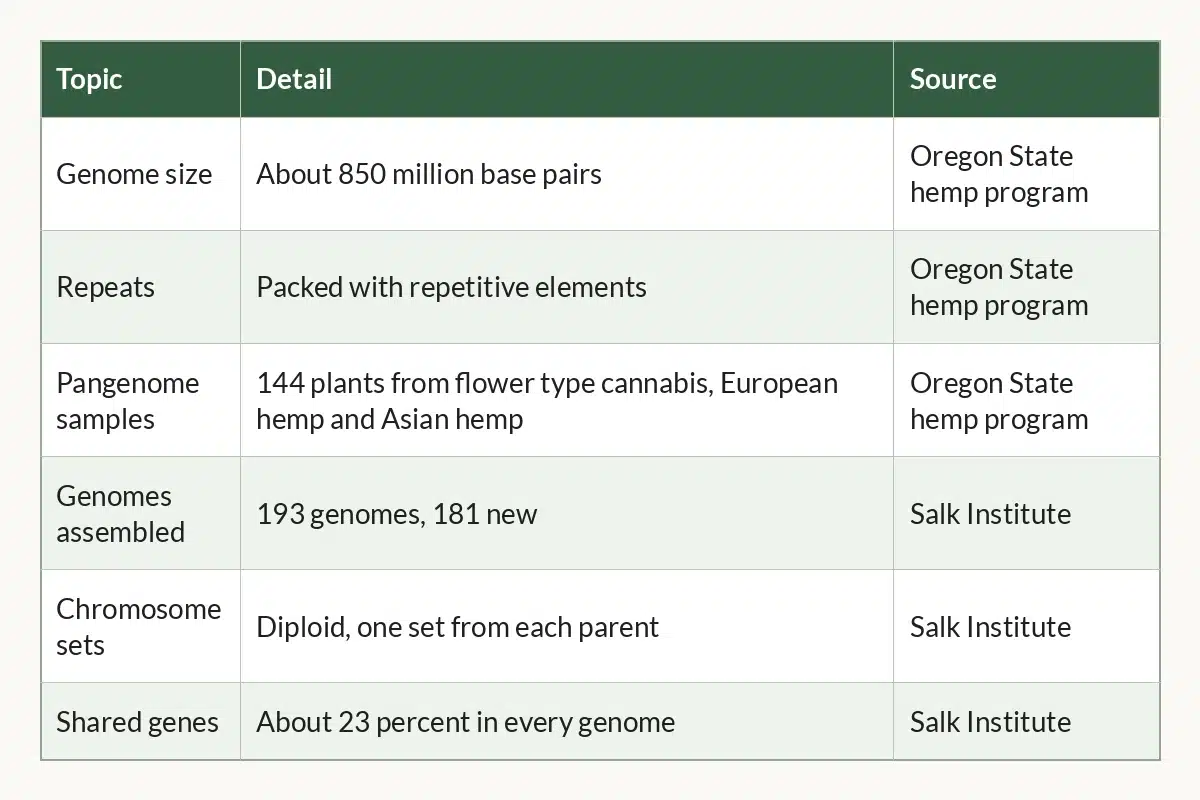
Cannabis Genome Facts at a Glance
| Topic | Detail | Source |
|---|---|---|
| Genome size | About 850 million base pairs | Oregon State hemp program |
| Repeats | Packed with repetitive elements | Oregon State hemp program |
| Pangenome samples | 144 plants from flower type cannabis, European hemp and Asian hemp | Oregon State hemp program |
| Genomes assembled | 193 genomes, 181 new | Salk Institute |
| Chromosome sets | Diploid, one set from each parent | Salk Institute |
| Shared genes | About 23 percent in every genome | Salk Institute |
What About Sex Chromosomes?
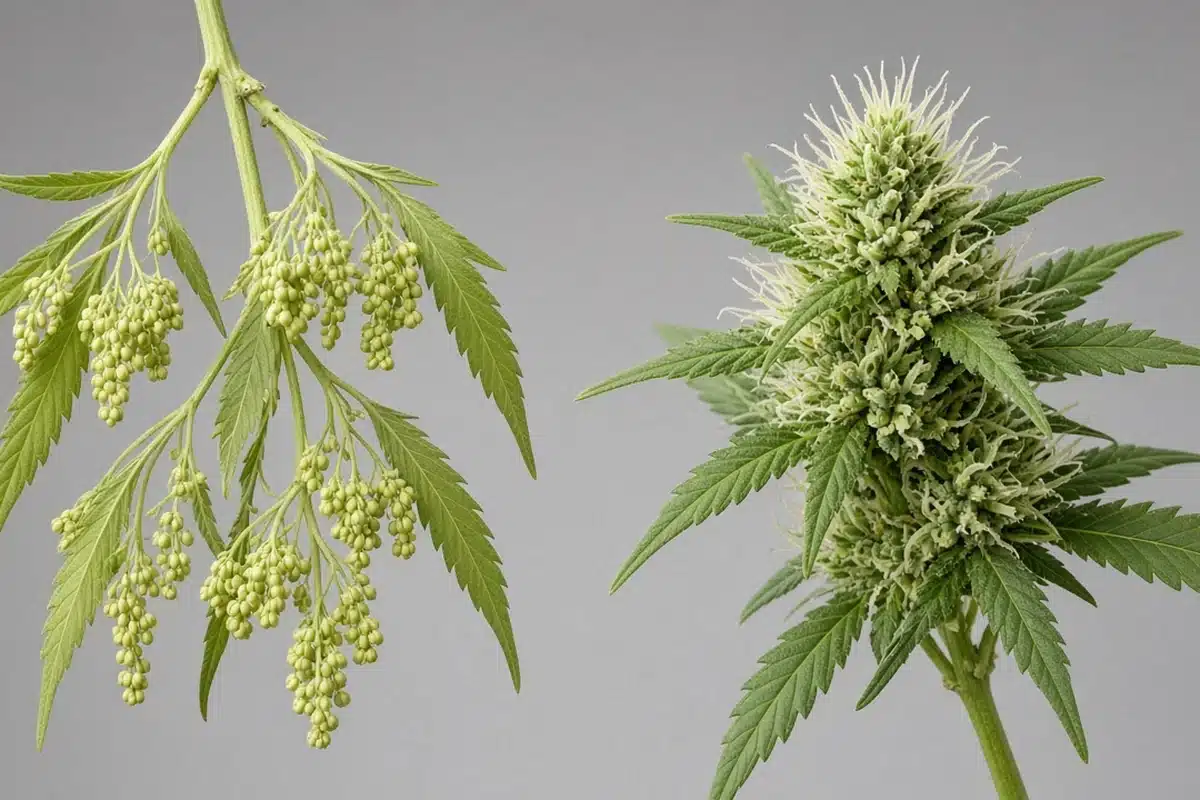
Cannabis is unusual among flowering plants. Salk notes that it belongs to the small group, less than 5 percent of plants, with separate female and male plants. Oregon State Extension’s guide to hemp sex expression describes genetically female plants as XX, and explains that they can still produce viable male flowers at times during the season.
The pangenome work was the first to include sex chromosomes, and Salk reports it gave researchers a first look at the cannabis Y chromosome. The team found genes present only in male plants. Salk points out that feminized seed production uses female plants induced to make male flowers, which bypasses the Y chromosome entirely. The researchers suggest that breeding programs may be missing useful variation carried in true male genomes.
Where Did Cannabis Come From?
Salk describes cannabis as a flowering plant native to Asia and grown by people for more than 10,000 years for fiber, seed oil and food. By comparing European and Asian genomes, the researchers concluded that an ancient wild relative likely still exists somewhere in Asia. Such a relative could carry adaptations useful for breeding sturdier crops.
Oregon State’s program also studies cannabis alongside hops, its close cousin in the Cannabaceae family, comparing the genomes of both plants to understand aroma and flavor.
Why Does Genome Research Matter for Breeding?
It gives breeders a map of the DNA behind the traits they select. For most of the last century, legal limits kept cannabis out of mainstream crop research. Salk calls cannabis one of the least developed of the major crops for exactly that reason, even though people have relied on it for thousands of years. Traditional breeding still worked, but breeders were selecting by eye and by results, without a map of the DNA underneath.
A reference genome and a pangenome change that. Breeders can look for markers linked to traits such as plant height, flowering time or disease response and screen seedlings early instead of waiting a full season. Oregon State’s program lists molecular marker development for breeding among its research goals. Over time, that kind of work may lead to hemp and other cannabis lines that are better suited to particular regions and growing systems.
Salk also highlights that some of the most variable genes relate to growth and defense. In plain terms, the species may hold more natural resilience than current cultivated lines show, waiting in wild and landrace plants that breeders have barely sampled so far.
What the Genome Means for Cannabis Growers
- Expect variation from seed. Each seed draws a different mix from two chromosome sets, so sibling plants differ. Our guide to dominant and recessive cannabis traits explains how that sorting works.
- Value stable lines. Breeders narrow variation over generations. Backcrossing cannabis is one method used to lock in a trait.
- Understand chemical types. Plants fall into broad groups based on their chemistry. The overview of cannabis plant types covers those categories.
- Watch for male flowers. Genetically female plants can still produce pollen under some conditions.
- Keep expectations realistic. Genome research guides long term breeding. It does not change how you water or feed a plant this season.
Troubleshooting Genetic Surprises in the Grow
Plants from one seed pack look different. Each seed inherits its own mix from two chromosome sets, and the pangenome shows how much variety the species holds. Pick keepers by performance rather than expecting perfect uniformity.
A female plant suddenly shows pollen sacs. Oregon State Extension reports that genetically female plants can produce viable male flowers. Remove those flowers early or isolate the plant to protect every other plant in the room.
A trait disappears in the next generation. Recessive traits can hide for a generation and return later. Track parent plants and keep notes on each cross.
A clone grows differently from its mother. The genome stays the same in a cutting, so look first at light, root zone and feeding differences.
Hemp and other cannabis plants cross easily. The pangenome study considered them one species with wide diversity, so pollen moves freely between them. Keep distance between plantings when seed purity matters.
Sources
- Salk Institute, Cannabis pangenome news release (May 2025): https://www.salk.edu/news-release/cannabis-pangenome-reveals-potential-for-medicinal-and-industrial-use/
- Oregon State University College of Agricultural Sciences, Hemp Plant Breeding, Genetics and Genomics: https://agsci.oregonstate.edu/hemp/research-consortia/plant-breeding-genetics-genomics
- Oregon State University Extension, Hemp Sex Ed (EM 9279): https://extension.oregonstate.edu/catalog/em-9279-hemp-sex-ed
FAQ
How big is the cannabis genome?
Oregon State's hemp genomics program estimates it at about 850 million base pairs.
What is a pangenome?
It is a combined set of many genomes from one species, used to capture the full range of genetic variation.
Is cannabis diploid?
Yes. Each plant carries two sets of chromosomes, one from each parent.
Do female cannabis plants have a Y chromosome?
No. Genetically female plants are XX, while the Y chromosome is found in males.
Why is the cannabis genome hard to sequence?
It is large and full of repetitive DNA that short read methods cannot assemble reliably.