Cannabis Drying Too Fast: Signs and How to Slow It
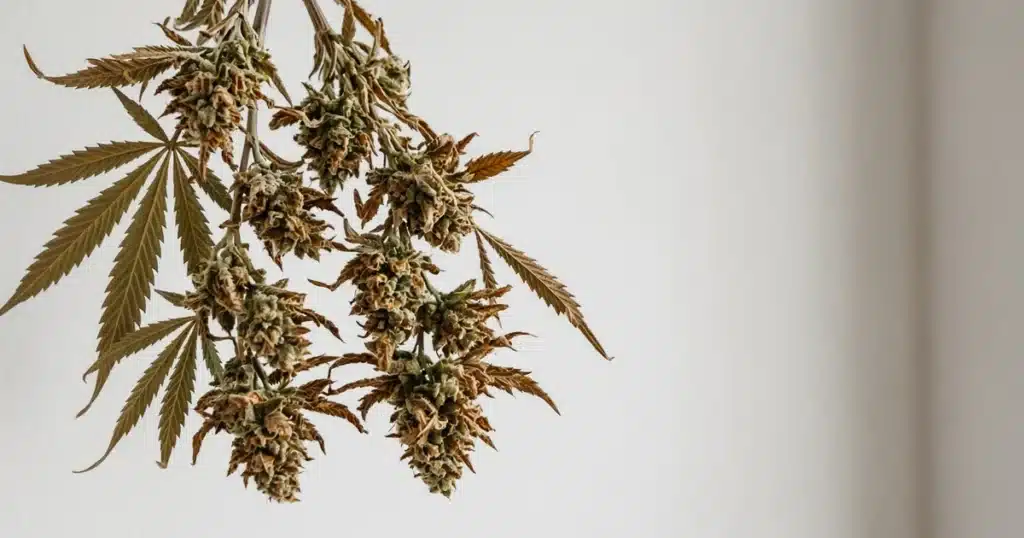
Quick answer: Cannabis is drying too fast when small buds feel crisp in a day or two at room temperature, leaves crumble at a touch and the smell fades early. The usual causes are warm air, low humidity and strong airflow. Slow it by bringing the room back to about 64 to 70°F and 50 to 55 percent humidity, the slow drying range from Oregon State University Extension, and by easing off the fans.
How Do You Know Cannabis Is Drying Too Fast?
Time is the first clue. In the University of Vermont drying trial, bucked buds needed about four to six days with fans running in a room temperature space. Buds in a dryer at 80°F finished in one to two days. If your room dries buds as fast as that heated dryer did, the air is working harder than you planned.
Touch is the second clue. Vermont noted that once flowers are over dried, handling is more likely to knock leaves and trichomes loose. Sugar leaves that crumble off when you brush them, or a dusting of trichomes on your fingers, point the same way.
Smell is the third. Vermont did not measure terpenes, but it pointed out that many terpenes are highly volatile, with the greatest losses starting at drying temperatures of 70°F. A room that runs warm can strip aroma before the buds are even dry.
The Oregon State University Extension review sums up the stakes. It says poor control of temperature and relative humidity can lead to poor quality flowers. Drying too fast is one way that happens. The earlier you spot it, the sooner you can adjust the room.
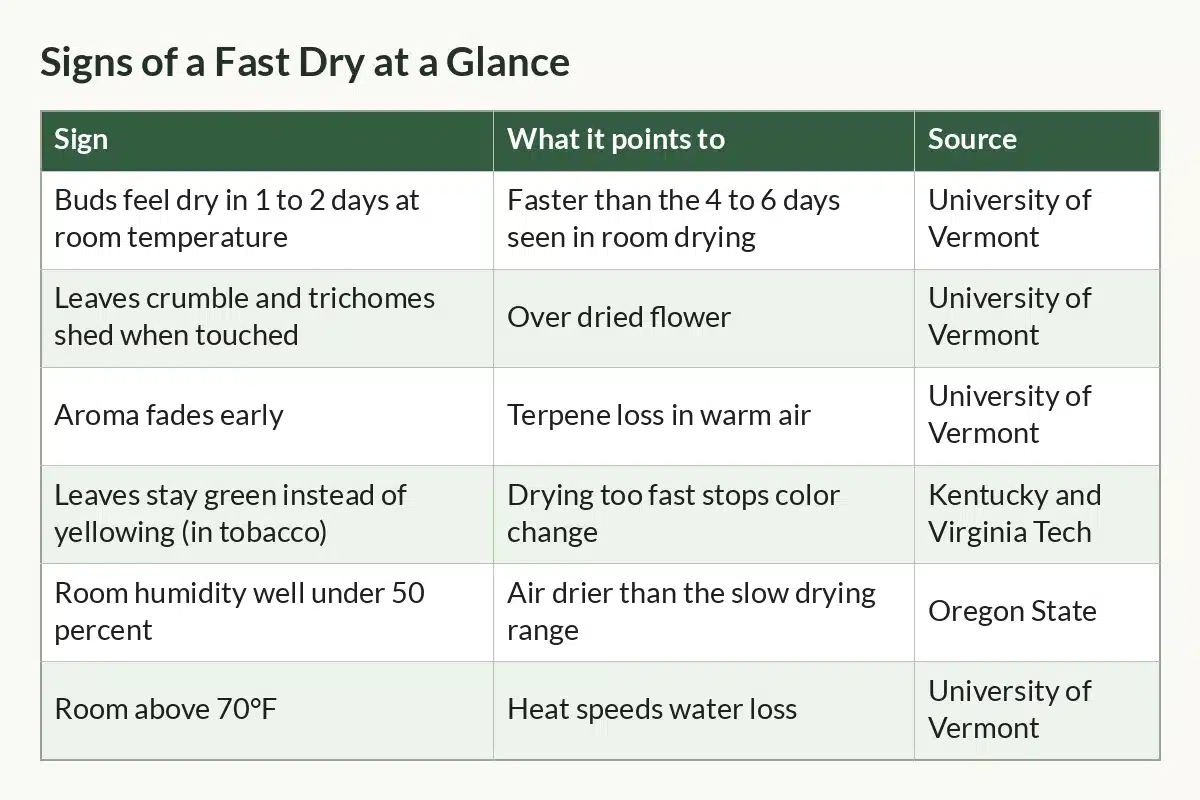
Signs of a Fast Dry at a Glance
| Sign | What it points to | Source |
|---|---|---|
| Buds feel dry in 1 to 2 days at room temperature | Faster than the 4 to 6 days seen in room drying | University of Vermont |
| Leaves crumble and trichomes shed when touched | Over dried flower | University of Vermont |
| Aroma fades early | Terpene loss in warm air | University of Vermont |
| Leaves stay green instead of yellowing (in tobacco) | Drying too fast stops color change | Kentucky and Virginia Tech |
| Room humidity well under 50 percent | Air drier than the slow drying range | Oregon State |
| Room above 70°F | Heat speeds water loss | University of Vermont |
Why Buds Dry Too Fast
Three settings drive the pace: heat, dry air and moving air.
Heat. Vermont found that higher dryer temperatures led to faster drying. Its 105°F dryer finished buds in under a day. A warm attic, a heater set too high or a room next to a furnace can push your dry the same way.
Dry air. Oregon State gives 50 to 55 percent relative humidity for slow drying. Winter indoor air, or a dehumidifier left on a low setting, can drop well below that. Water leaves the buds faster when the air around them is thirsty.
Strong airflow. Every Vermont setup used a fan, so airflow itself is normal. A fan aimed straight at buds, or a powerful exhaust in a small space, speeds things up beyond that.
Tobacco research shows why speed matters. The University of Kentucky guide to tobacco curing says high drying rates leave more green pigment in the leaf and make it hard to remove later. The Virginia Tech tobacco curing guide says leaves killed too early by fast drying or high heat stay green. Those guides are about tobacco, not cannabis, and no source here tests the same effect in buds. They do show a plant leaf that needs time to change while it dries.
How to Slow Down a Fast Dry
- Lower the temperature. Bring the room back toward the 64 to 70°F (18 to 21°C) range Oregon State gives. Vermont’s note on terpene loss above 70°F gives you a reason to stay at the low end.
- Raise the humidity into range. Aim for 50 to 55 percent. Turn the dehumidifier off or set it higher if the room sits well below 50. For tobacco, Kentucky names relative humidity as the condition with the narrowest good range, which makes it the hardest to control.
- Turn the fan down or away. Keep air moving, but lighter. Kentucky sets a minimum airflow of 15 feet per minute for tobacco, which is a slow drift of about 0.17 miles per hour. Virginia Tech’s tobacco guide warns that opening vents wider than needed speeds drying, so open only enough to hold humidity down.
- Close vents during the dry part of the day. For tobacco drying too fast, Kentucky advises shutting the ventilators and barn doors by day so moisture leaves more slowly. It opens them at night to let humid night air in. You can try the same idea in a garage or shed, though no source here tested it on cannabis. Kentucky describes a good tobacco dry as leaves that feel moist and pliable in the morning and dry in the afternoon.
- Keep buds on larger pieces. North Carolina A&T says drying time depends on bud size and density. Whole branches dry slower than loose buds on a rack. NC A&T says buds can need anywhere from 1 to 12 days, and it ties that spread to how wet they are at the start as well as their size and density.
- Check twice a day. Keep a log of temperature and humidity. The Vermont team noted that humidity gauges could help growers control drying time.
Our post on what affects relative humidity control for cannabis explains how temperature and moisture work together in a closed room.
What to Do With Buds That Already Dried Fast
First, stop the drying. Once small stems snap, move the buds into airtight jars so they don’t keep losing moisture. The National Center for Home Food Preservation uses the snap test for herbs, where the leaves crumble and the stems break when bent.
Second, handle them as little as you can. The University of Arizona Extension hemp guide says trichomes become brittle during drying and that movement causes them to shed. Each trip from jar to scale to grinder costs a little more. Vermont made the same point about over dried flower. It found that the risk of leaf and trichome shattering grows when the material is handled again and again, and it named that as a quality concern.
Third, look at moisture. Some growers try to bring back a little moisture to overly crisp buds. Our guide on why you may need to rehydrate cannabis covers the options and the risks, so we won’t repeat them here.
Then plan the next harvest. Write down what the room read during this dry, and fix the setting that ran too far. For longer term storage after drying, see our guide to curing and storing cannabis flowers.
Troubleshooting a Fast Dry
Buds are crisp outside but soft in the center. The outside dried ahead of the inside. Slow the room, then give the centers time. NC A&T notes that bud size and density drive drying time.
The room drops to low humidity overnight. Kentucky notes for tobacco that cool conditions can come with low humidity that makes drying too fast. Watch night readings as closely as day readings.
A heater is running to keep the room warm. Oregon State lists heaters as a normal tool, but NC State Extension would not go above 100°F. Turn the heater down if buds are drying in a day or two. NC State also notes that some growers dry well without any added heat at all.
Trichomes coat the bottom of the jar. Over dried flowers shed when handled, as Vermont and Arizona both note. Arizona cites grower talk of a possible 10 percent drop in CBD after each move of dried flower, a figure it calls speculative. Handle less.
Small buds finish days ahead of big ones. That is normal. Pull small branches as they snap rather than waiting for the whole batch. Virginia Tech makes a similar point for tobacco barns: uniform loading with no tight spots gives more even drying.
Sources
- University of Vermont, 2021 Hemp Cannabidiol Drying Trial: https://www.uvm.edu/d10-files/documents/2024-08/2021_Hemp_Cannabidiol_Drying_Trial.pdf
- Oregon State University Extension, Post harvest processing of hemp flowers: https://extension.oregonstate.edu/catalog/post-harvest-processing-hemp-flowers
- University of Kentucky, AGR 177 Proper Curing Management to Minimize Green Tobacco: https://darktobacco.mgcafe.uky.edu/sites/darktobacco.ca.uky.edu/files/agr177.pdf
- Virginia Tech, Curing Tobacco (2025 Tobacco Agronomy): https://www.arec.vaes.vt.edu/content/dam/arec_vaes_vt_edu/southern-piedmont/2025-tobacco-agronomy/07%20Curing%202025.pdf
- University of Arizona Extension, AZ1944 CBD Hemp Production in Arizona: https://extension.arizona.edu/sites/default/files/2024-08/az1944-2021-final.pdf
- NC State Extension, Hemp Harvest Timing and Drying: https://hemp.ces.ncsu.edu/hemp-harvest-timing-and-drying/
- North Carolina A&T, Hemp harvest and post harvest considerations: https://ncat.edu/caes/agricultural-research/industrial-hemp-program/hemp-conference/files/ivey.pdf
- National Center for Home Food Preservation (University of Georgia), Drying Herbs: https://nchfp.uga.edu/how/dry/herbs
FAQ
How fast is too fast for drying cannabis?
If buds are crisp in one to two days at room temperature, that matches Vermont's heated dryer, not its room drying, which took four to six days.
Does a fast dry hurt the smell?
It can. Vermont notes that many terpenes are highly volatile, with the greatest losses starting at drying temperatures of 70°F.
What humidity slows drying?
Oregon State gives 50 to 55 percent for slow drying.
Can I fix buds that dried too fast?
You can stop further loss by jarring them. Rehydrating has tradeoffs, which our rehydrate guide covers.
Does tobacco research apply to cannabis?
Only as a comparison. Kentucky and Virginia Tech describe tobacco leaves that stay green after a fast dry. No source here has tested the same effect in cannabis buds.
Should I turn off the fan?
No. Turn it down. Every Vermont setup used a fan for the whole dry.