Drying Racks for Cannabis vs Hanging Buds
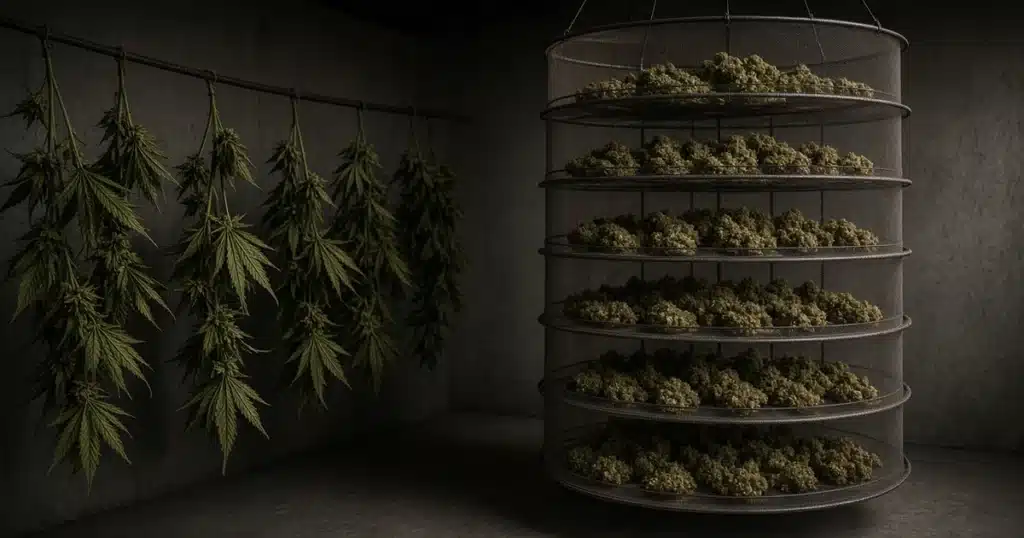
Quick answer: Neither one is better in the sources, and both methods are well established. Hanging keeps whole plants or branches intact and is how hemp farms dry in barns, sheds and shipping containers. A drying rack or screen holds buds in one thin layer on mesh, with air reaching them from below as well as above. Neither source base says one method dries better than the other. Choose by your space and by whether your buds are still on the stem.
Drying Racks or Hanging: Which Is Better?
Neither one, based on the sources. They solve different problems.
Hanging is the classic farm method. The University of Missouri Extension harvest guide says CBD hemp is hang dried in barns or sheds, or dried with forced air. The North Carolina A&T hemp program dries plants hung upside down inside a shipping container.
Screens and trays are the flat method. The UVM Extension Ag Engineering guide to drying herbs, hops and hemp lists window screens and hanging in barns side by side as common ambient air methods. For small batches, it says, a window screen set on saw horses in the shade can work very well as a drying system.
Most of the screen and tray advice comes from Extension herb drying guides. UVM’s guide is written for herbs, hops and hemp together. The Iowa State University Extension and Wisconsin Extension guides are written for kitchen herbs. None of them tested racks against hanging for cannabis buds, so there is no evidence here that one gives a faster, more even or better dry.
Cost is not much of a factor either way. UVM Extension says ambient air drying, which covers both screens and hanging, is very simple and costs essentially nothing. A line and some twine, or a window screen and two supports, will do.
The practical choice comes down to two questions. Are your buds still on the branch? And do you have height or flat space? Branches suit a line. Loose buds suit a screen. Our post on wet vs dry trimming your cannabis plants can help you decide which you will have.
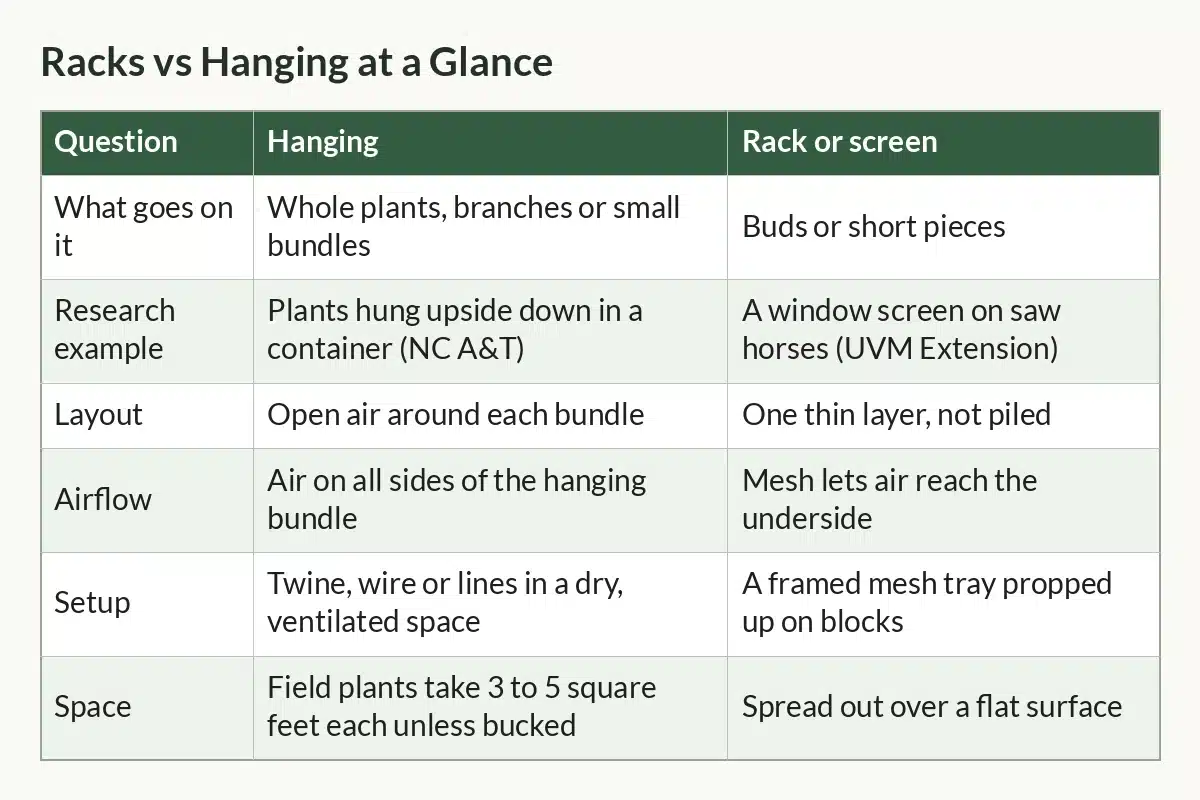
Racks vs Hanging at a Glance
| Question | Hanging | Rack or screen |
|---|---|---|
| What goes on it | Whole plants, branches or small bundles | Buds or short pieces |
| Research example | Plants hung upside down in a container (NC A&T) | A window screen on saw horses (UVM Extension) |
| Layout | Open air around each bundle | One thin layer, not piled |
| Airflow | Air on all sides of the hanging bundle | Mesh lets air reach the underside |
| Setup | Twine, wire or lines in a dry, ventilated space | A framed mesh tray propped up on blocks |
| Space | Field plants take 3 to 5 square feet each unless bucked | Spread out over a flat surface |
How Hanging Branches Dries Buds
A hanging bundle sits in open air. UVM Extension says you can bunch plants with twine and hang them somewhere dry. It also wants drying plants kept as open to the air as they can be, with lots of open space around the drying area.
Herb guides favor small bundles. Iowa State’s advice is small bundles of 5 to 8 stems, hung in a dark, warm spot at 70 to 80°F. Wisconsin suggests 5 or 6 stems to a bundle, hung upside down somewhere warm, dry and well ventilated, away from direct sunlight. For cannabis, that points to single branches or small groups with space between them. Wisconsin also stresses good air circulation so hanging herbs don’t get moldy, and it names attics and linen closets as spots that often work well.
Hanging takes room. North Carolina A&T puts the space need at 3 to 5 square feet for most field plants, unless they have been bucked first. In a small closet or tent, that can limit how much you hang at once.
Herb bundles take time. Iowa State and Wisconsin both say hung herb bundles generally dry in 2 to 4 weeks. Those are kitchen herb times, not cannabis times, and they depend on temperature and humidity.
How Mesh Drying Racks Work
A rack or screen gives plant material a flat, ventilated surface. UVM Extension explains that a screen lets you spread plant matter in a thin layer, which maximizes the surface exposed to the surrounding air. It adds that the material should touch solid surfaces like tables or framing as little as possible and should ideally sit in a single layer.
Wisconsin describes a simple homemade version. Stretch fine mesh screen or cheesecloth over a wooden frame and you have a drying tray, though a small window screen also works. Propping the tray up on blocks allows good air circulation around the plant material. Wisconsin says to keep only a single layer on the tray.
Iowa State gives the same basic setup. It says to lay the herbs out one layer deep on screens or drying trays, keep them somewhere warm and dark with good air circulation, and leave them until fully dry.
Hanging mesh racks with several tiers follow the same idea in a smaller footprint. Each tier is a screen, so the single layer rule applies to every level. The reason is airflow. UVM Extension explains that drying works by passing relatively dry air over the crop. That air picks up moisture as it moves through the plant material, and then it has to leave the space so fresh, dry air can take its place. A thick pile blocks that flow, while a thin layer lets each bud give up its water to the air around it. UVM adds that opening windows and doors can help ventilate the space when needed.
How to Dry Buds on a Rack
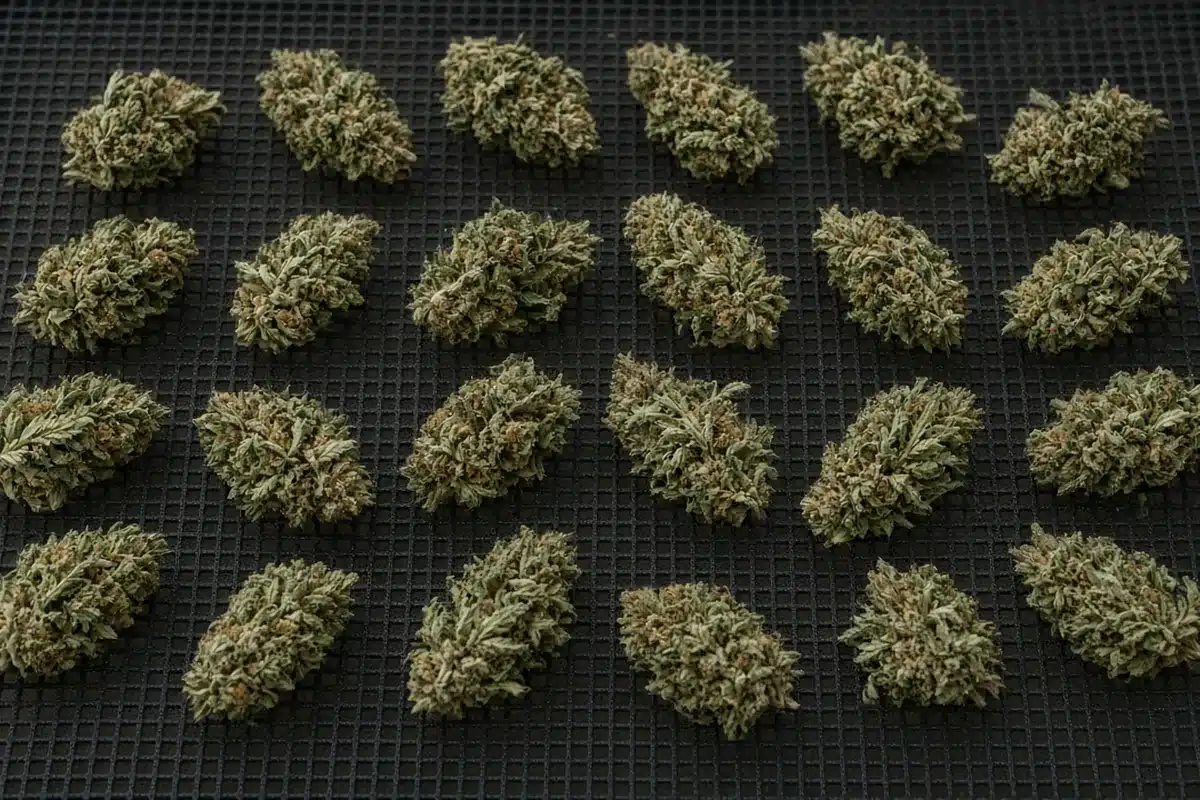
- Buck the buds first. Take buds off the stems so they sit flat. Our guide on how to trim cannabis flowers covers the cuts.
- Spread them in one thin layer. Iowa State, Wisconsin and UVM Extension all call for a single layer. Wisconsin notes that a simple tray can be fine mesh screen or cheesecloth on a wooden frame, or just a small window screen.
- Keep the screen off solid surfaces. Wisconsin props trays on blocks for air circulation. UVM Extension sets its screen on saw horses.
- Put the rack in a warm, dark, ventilated spot. Iowa State asks for warmth, darkness and good air circulation. Wisconsin gives 70 to 80°F for air drying herbs and suggests an attic or linen closet, since garages have car fumes.
- Keep air moving. UVM Extension says a well ventilated space helps and that a simple box fan can circulate the air.
- Check buds every day. Wisconsin advises checking drying herbs for mold and discarding any that go bad.
- Move buds to jars when they are fully dry. Wisconsin says to keep herbs on the tray until they are thoroughly dry. After jars are filled, it says to check them for a couple of days. If moisture shows up, take the buds out and dry them longer.
For shears, trays and the rest of the kit, see our list of cannabis harvesting tools every home grower needs.
Troubleshooting Rack and Hang Drying
Buds are piled on the rack. Spread them out. All three herb and hemp guides that cover screens call for a single layer.
The rack sits flat on a shelf. Lift it. Wisconsin props trays on blocks so air can circulate, and UVM Extension uses saw horses.
Hanging bundles mold in the middle. The bundles are too big or the air is too still. Iowa State and Wisconsin both call for small bundles, and UVM Extension stresses open air around drying plants. Wisconsin also warns that wet herbs can mold and ruin the whole bunch, so shake off any water before hanging.
There is no room to hang everything. NC A&T figures 3 to 5 square feet for every field plant that hasn’t been bucked. Buck some branches and use a rack for the loose buds.
The room feels damp. Wisconsin says basements are usually too damp for drying herbs. Move the rack or line to a drier, ventilated room.
Sources
- University of Missouri Extension, MX79 Harvesting Industrial Hemp: https://extension.missouri.edu/publications/mx79
- North Carolina A&T, Hemp harvest and post harvest considerations: https://ncat.edu/caes/agricultural-research/industrial-hemp-program/hemp-conference/files/ivey.pdf
- UVM Extension Ag Engineering, Drying and Curing Herbs and Flowers (Hops, Hemp, and Everything Else!): https://blog.uvm.edu/cwcallah/2021/02/23/drying-and-curing-herbs-and-flowers-hops-hemp-and-everything-else/
- Iowa State University Extension, Growing, Harvesting and Drying Herbs: https://yardandgarden.extension.iastate.edu/how-to/growing-harvesting-and-drying-herbs
- Wisconsin Extension Master Gardener, Drying Herbs: https://mastergardener.extension.wisc.edu/files/2015/12/drying-herbs.pdf
FAQ
Is hanging better than a drying rack?
The sources don't rank them. Hanging suits branches, and racks suit loose buds in a single layer.
How full can a drying rack be?
One thin layer per tier. Iowa State, Wisconsin and UVM Extension all say single layer.
Can I make my own drying screen?
Yes. Wisconsin describes fine mesh or cheesecloth on a wooden frame, propped up on blocks.
Can I use both methods at once?
Yes. Hang the branches and put loose or broken buds on the rack.
Does a drying rack need a fan?
Moving air helps. UVM Extension says even a simple box fan will keep the air moving in a drying space.
Where should a rack or line go?
In a warm, dry, ventilated spot out of direct sunlight, as the herb guides describe.