Cannabis Gravitropism: How Roots Find Down and Shoots Find Up
Quick answer: Gravitropism is the way a plant steers its growth in response to gravity. Roots grow down, a response called positive gravitropism, and shoots grow up, called negative gravitropism. The growth hormone auxin drives both responses by making cells on one side of a root or stem grow at a different rate than cells on the other. NC State’s botany handbook notes that gravitropism is why a seed sends its roots into the soil and its shoots toward the surface. For cannabis growers, gravitropism explains why bent stems turn their tips upward and why seed orientation rarely matters.
What Is Gravitropism?
A tropism is directed growth in response to something in the environment. NC State’s handbook chapter on botany explains that auxins drive these responses by supporting cell division and elongation unevenly. The response to gravity is called geotropism or gravitropism, and the response to light is phototropism.
Minnesota’s open horticulture textbook chapter on hormones defines gravitropism as a change in growth that follows a change in gravitational force, and it names gravitropism and phototropism as the two main types of growth response controlled by auxin. Oregon State Extension, in its guide to plant hormones, lists downward root growth in response to gravity among the chief effects of auxin.
Gravitropism keeps roots heading into soil, where they find water and nutrients, and keeps shoots heading up toward light. Both directions matter from the moment a seed sprouts.
You can watch this happen in any cannabis seedling. Soon after a seed cracks open, the young root points down into the mix and the hypocotyl arches up toward the surface. The arch pulls the seed leaves up behind it rather than pushing them tip first through the soil, then straightens once it breaks into the light. Roots growing down are said to show positive gravitropism, while shoots growing up show negative gravitropism.
Where Does a Root Sense Which Way Is Down?
The response starts at the growing tip. The Master Gardener botany text from Virginia Cooperative Extension describes the root cap as the outermost tip of the root, a layer of cells that wears away as the root pushes through soil while it covers and protects the growing point behind it. Right behind the cap sits the zone of cell division, then the zone of elongation where cells lengthen.
This layout is the key to gravitropism. A root bends by growing unevenly in the elongation zone, just behind the tip. Cells on one side lengthen more than cells on the other, and the tip swings to point downward. Because this happens near the very front of the root, a root can correct course quickly as it moves through the soil, steering around stones and dense pockets and then turning down again.
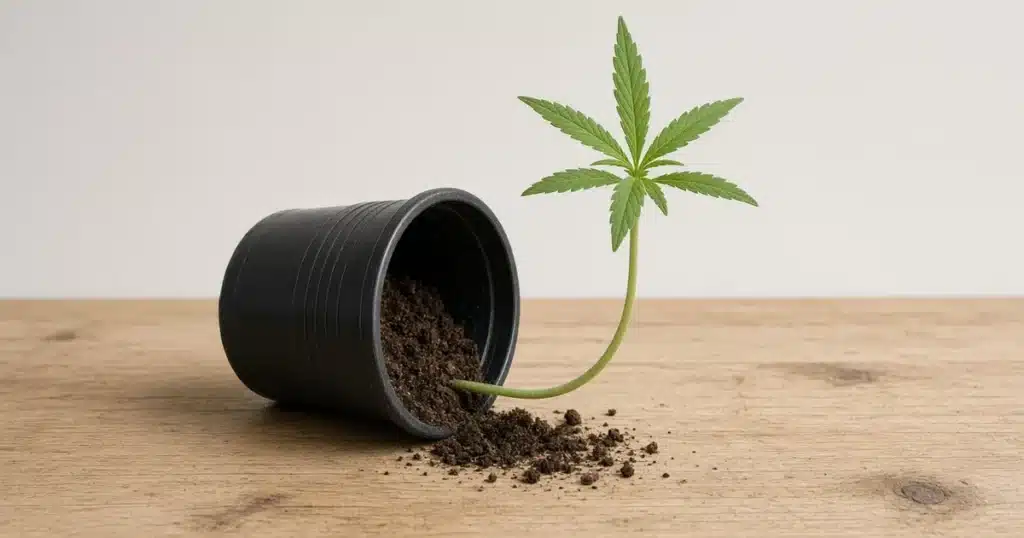
Shoots respond the same general way, only in reverse. A stem that ends up lying flat grows faster on its lower side, so its tip curves up. Anyone who bends branches during training has seen it happen.
Lateral roots follow their own rules. They tend to grow out at an angle rather than straight down, which lets the root system spread through the container or bed. Only the main roots dive steeply. That mix of steep and angled growth is what lets a root system explore a wide volume of soil.
How Does Auxin Bend Roots and Shoots?
Auxin bends roots and shoots by making cells on one side grow longer than cells on the other. Minnesota’s chapter credits auxins with promoting growth by making cells longer, a step at the heart of how plants react to their surroundings. The NC State chapter also says auxins support cell division and elongation unevenly, producing growth in a particular direction.
In shoots, the result is easy to picture. When a stem tips over, its lower side becomes the fast growing side. Cells there lengthen more than cells on the upper side, and the tip rises until the stem points up again.
Roots respond to auxin differently than stems do, so the two organs bend in opposite directions under the same pull of gravity. The details of that difference are still an active research area, but the outcome is reliable: roots go down and shoots go up.
Gravity and light usually work together in a cannabis plant. A stem tipped sideways under an overhead lamp gets both signals at once, so the tip turns upward quickly. With the lights off, gravity alone still does the job.
Training methods work with this response rather than against it. Low stress training ties branches outward so their tips rise and form many tops at a similar height. Supercropping and bending rely on the same upward turn. Bent tips will always try to point up, so plan your ties with that in mind and the canopy ends up level instead of crowded in the center.
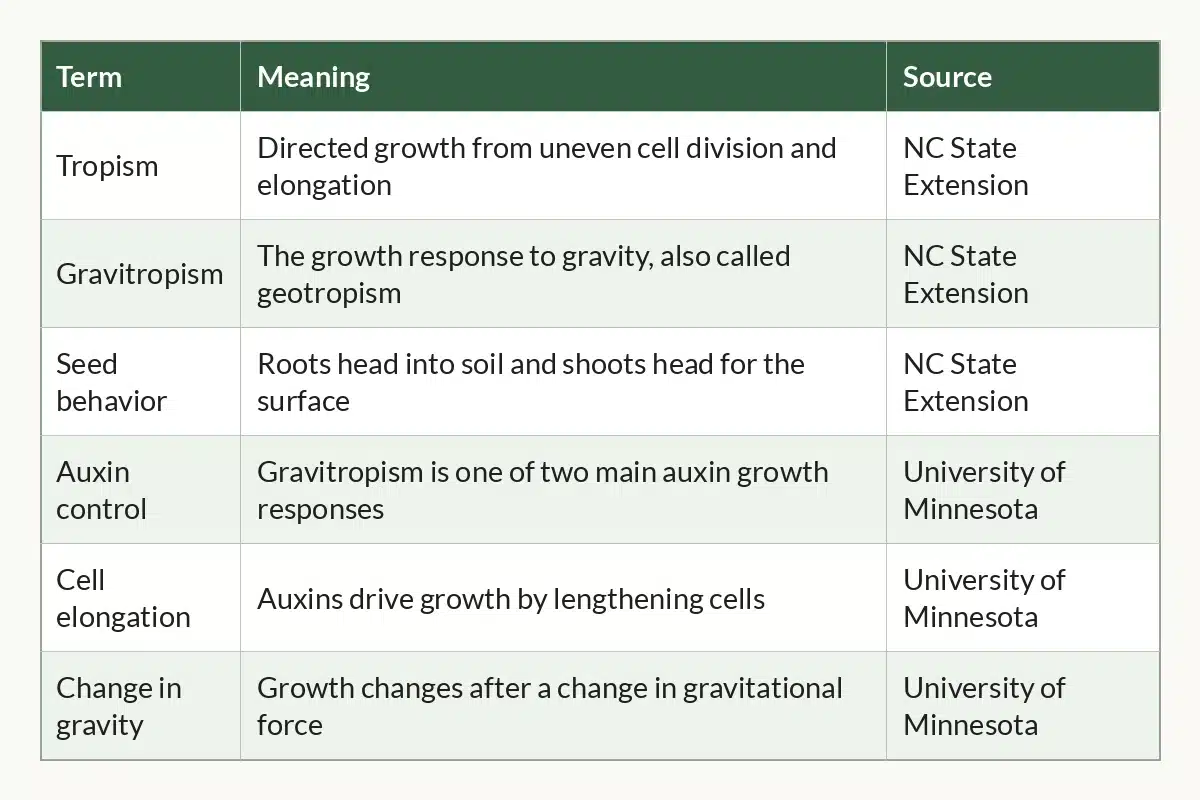
Cannabis Gravitropism at a Glance
| Term | Meaning | Source |
|---|---|---|
| Tropism | Directed growth from uneven cell division and elongation | NC State Extension |
| Gravitropism | The growth response to gravity, also called geotropism | NC State Extension |
| Seed behavior | Roots head into soil and shoots head for the surface | NC State Extension |
| Auxin control | Gravitropism is one of two main auxin growth responses | University of Minnesota |
| Cell elongation | Auxins drive growth by lengthening cells | University of Minnesota |
| Change in gravity | Growth changes after a change in gravitational force | University of Minnesota |
Does Seed Orientation Matter for Cannabis?
Not much. Because the root senses gravity at its tip, a sprouting cannabis seed corrects itself no matter which way it was planted. The emerging root curves down and the shoot curves up within the first days. A seed planted sideways or upside down may produce a seedling with a slight bend at the base, but it still finds its way.
Some growers like to place seeds with the pointed end down, hoping to save the root a turn. It does no harm, but the root will find its way regardless, so there is no need to fuss over it. Very deep planting is a bigger concern than orientation. A seedling that has to push through too much soil uses up stored energy before reaching light. The shoot also has to lift its seed leaves through the mix, and sometimes the shell stays stuck on top. Our guide to cannabis seedling helmet head explains what to do when a seed coat will not let go.
Occasionally a single seed produces two shoots. That has nothing to do with gravity, but if you see it, our post on two seedlings from one cannabis seed explains why it happens.
How Gravitropism Shows Up in the Grow Room
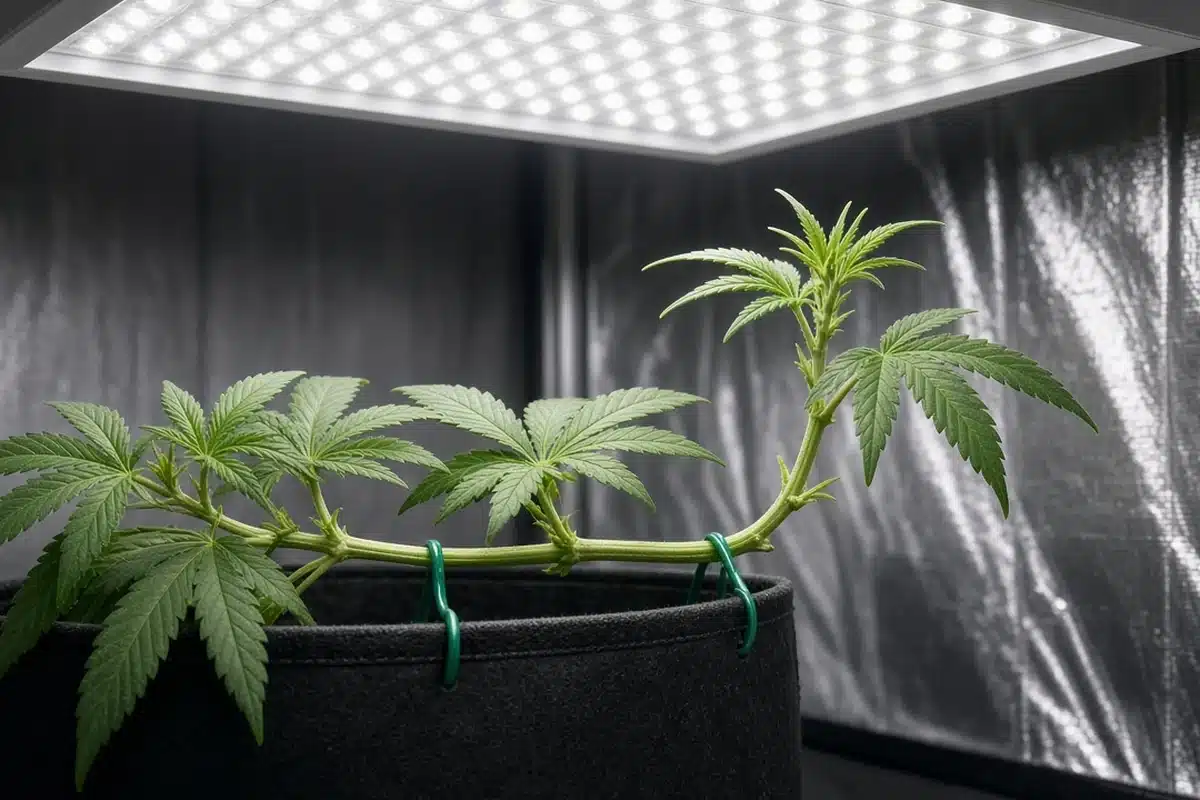
- Bent branches turn their tips up. When you tie a branch down for training, the tip soon curves back upward. This is negative gravitropism at work, along with the pull of light.
- Fallen plants recover. A pot knocked over and left on its side will start lifting its tips upward.
- Roots head downward first. Young roots dive toward the base of the container before spreading sideways.
- Seedlings straighten after planting. Sideways seeds sort themselves out.
- Transplants reorient. Roots disturbed during a move resume growing down as they recover.
- Plant seeds shallow. About a knuckle deep in moist mix is a common guideline.
- Retie as tips rise. Upturned tips during training may need repositioning to keep the canopy even.
Our article on why cannabis roots matter covers how roots support everything above ground once they have found their way down.
Troubleshooting Gravity Related Growth
Seedling has a crook at the base. The seed was likely planted sideways. It will grow normally from here.
Branch tips point straight up after training. That is normal gravitropism. Retie or redirect tips to keep growth even.
Roots circle along the pot floor. Roots grew down and reached the base. Move the plant up before it becomes root bound.
Plant fell over overnight. Set it upright and support the stem. Bends from the event may remain.
Seedling never surfaces. It may have been planted too deep. Sow shallower next time.
Sources
- NC State Extension, Extension Gardener Handbook, Chapter 3 Botany: https://content.ces.ncsu.edu/extension-gardener-handbook/3-botany
- University of Minnesota, The Science of Plants, 4.2 Plant Hormones: https://open.lib.umn.edu/horticulture/chapter/4-2-plant-hormones/
- Virginia Cooperative Extension, Master Gardener Handbook, Chapter 1 Botany: https://pressbooks.lib.vt.edu/emgtraining/chapter/1/
- Oregon State University Extension, How Hormones and Growth Regulators Affect Your Plants (EM 9902): https://extension.oregonstate.edu/catalog/em-9902-how-hormones-growth-regulators-affect-your-plants
FAQ
What is gravitropism in cannabis?
It is the growth response to gravity that sends roots down and shoots up.
Does it matter which way I plant a cannabis seed?
Not much. The root senses gravity and curves downward on its own.
Why do branch tips turn up after training?
Shoots grow against gravity, so bent tips soon curve back upward.
Do shoots respond to gravity in the dark?
Yes. Gravity works without light, so a tipped plant still turns its tips upward.
Which hormone controls gravitropism?
Auxin, which shifts to the lower side and changes how fast cells grow there.