The Cannabis Leaf Cuticle: A Waxy Shield on Every Leaf

Quick answer: The cuticle is a thin, waxy layer that coats the outer surface of every cannabis leaf. NC State Extension describes it as waxes blended with cutin, a material that slows drying and keeps out some disease organisms. Virginia Cooperative Extension notes that cutin builds up in response to light, increasing as light gets stronger. That is why plants raised in shade or indoors should be moved into full sun gradually over a few weeks. The cuticle also sheds water, which affects anything you spray on leaves.
What Is the Leaf Cuticle?
Every leaf has an outer skin called the epidermis. On top of that skin sits the cuticle. NC State’s botany handbook chapter defines it as a thin layer covering the epidermis, made of waxes and cutin.
The Virginia Master Gardener training chapter on botany shows the cuticle on both the upper and lower surfaces of the leaf in its leaf cross section. Below the epidermis lie the mesophyll layers where photosynthesis happens, plus the veins that carry water and sugar. The cuticle is the first barrier between all of that tissue and the outside air.
You can see the cuticle at work after misting a leaf. Water beads up and rolls off rather than soaking in. That shine on a well lit fan leaf is partly the waxy surface catching the light.
The cuticle is only one part of a cannabis leaf. The leaflets, veins, stomata and fine surface hairs each have their own role, and our cannabis leaf anatomy guide walks through those visible parts. Here the focus stays on the thin waxy coat that covers all of them.
What Does the Cuticle Do for Cannabis?
Its main job is to keep water in. According to NC State, cutin guards the leaf against drying out. Without it, water would escape through the whole leaf surface, and a plant would wilt far faster on a warm, dry day.
The cuticle also acts as a physical barrier. Both Extension chapters note that it prevents penetration of some disease causing organisms. It is not a perfect shield, but it does make the job harder for many of them.
Age changes the cuticle too. Young leaves near the plant’s crown are still building their outer layers, while older fan leaves have had weeks to develop. So fresh growth often shows stress first when conditions change suddenly, whether from strong new light, dry air or a careless spray. After any change, watch the newest leaves for the earliest warning.
Because the cuticle blocks most water loss through the leaf surface, a plant controls its water use mainly through its stomata, the small pores on the leaf. Per NC State, guard cells around each stoma open and close in response to conditions, closing in high temperature and low humidity. The post on cannabis stomata explains how those pores work, and the one on cannabis transpiration covers how water moves out of the plant.
This matters during dry spells and heat. When guard cells close the stomata to save water, the cuticle is what keeps the remaining leaf surface from leaking. A plant with a well developed cuticle can ride out a hot afternoon with less stress than one whose leaves grew soft and thin in low light.
How Does Light Change the Cuticle?
Stronger light makes the cuticle thicker. NC State reports that the amount of cuticle material leaf cells produce correlates with the intensity of sunlight the leaves receive. Virginia puts it more directly: cutin builds in step with sunlight, so stronger light means a thicker layer.
For cannabis, the consequence is practical. Leaves grown under modest indoor light or in shade build a thinner cuticle than leaves grown in full sun. Move those plants straight outdoors into strong sunlight and their leaves can lose water faster than the plant can replace it.
Virginia’s guidance is to shift shade grown plants into full sun step by step across a few weeks so the waxy layer can thicken. NC State gives the same advice, adding that a slow transition spares leaves from sudden water loss and sun scorch. Growers call this process hardening off.
Indoor growers face a smaller version of the same issue. Upgrading to a much stronger light, or lowering a fixture sharply, raises intensity overnight. Leaves grown under the old setting may need several days to adjust. Stepping up gradually gives new growth time to form a cuticle matched to the brighter conditions.
Clones are a special case. Cuttings rooted under domes in high humidity and soft light often have tender leaves. When the dome comes off, water loss jumps. Venting the dome a little more each day helps young leaves adapt before they face open air.
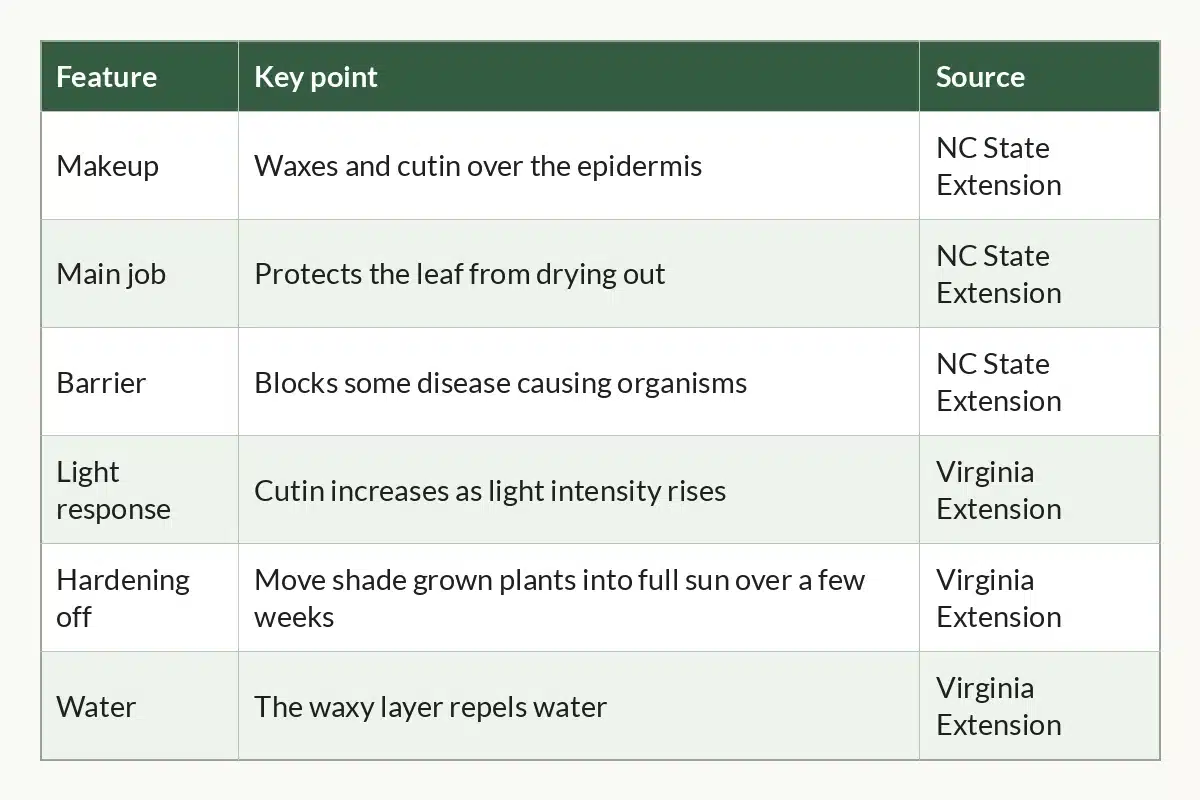
Cannabis Leaf Cuticle at a Glance
| Feature | Key point | Source |
|---|---|---|
| Makeup | Waxes and cutin over the epidermis | NC State Extension |
| Main job | Protects the leaf from drying out | NC State Extension |
| Barrier | Blocks some disease causing organisms | NC State Extension |
| Light response | Cutin increases as light intensity rises | Virginia Extension |
| Hardening off | Move shade grown plants into full sun over a few weeks | Virginia Extension |
| Water | The waxy layer repels water | Virginia Extension |
Does the Cuticle Affect Foliar Feeding?
Yes. Anything sprayed on a leaf has to get past the cuticle before it can do anything. Virginia’s chapter notes that a nutrient applied to leaves must get around or through the waxy cuticle before it can enter a cell.
University of Missouri’s Integrated Pest Management program explored this in a Missouri Produce Growers article on foliar feeding. It explains that research points to nutrients entering mostly through extremely small pores in the cuticle rather than through stomata. Those pores carry negative charges, so positively charged nutrients such as calcium, magnesium and potassium pass through more easily than negatively charged ones such as phosphate.
The same article notes that plant species vary widely in how well they take in nutrients through leaves, with cuticle thickness among the factors. It describes foliar feeding as a supplement to a sound soil fertility program, not a substitute, and warns that raising spray concentration to make up for poor uptake can damage leaves.
Missouri’s article adds that nutrients differ in how far they travel once inside a leaf. Smaller, less charged molecules such as potassium and urea move through the vascular system to other parts of the plant, while larger, more highly charged ions tend to stay near where they entered. A foliar spray may correct a spot on the leaves it touches without doing much for other parts of the plant.
For cannabis growers, foliar sprays are a limited tool. Feeding the root zone properly does most of the work. A well fed plant also builds sturdy new leaves, each with a cuticle matched to the light it grows under.
How to Protect the Cannabis Cuticle

- Harden off before moving outdoors. Increase sun exposure over a few weeks.
- Start in morning sun. Give new outdoor plants gentle morning light before full afternoon sun.
- Watch for wilting. Pull plants back into shade if leaves droop during the transition.
- Avoid harsh sprays. Strong solutions can damage the leaf surface.
- Spray lightly if you spray at all. Think of foliar feeding as a supplement only.
- Keep humidity in range. Very dry air pushes water loss beyond what roots can replace.
- Raise indoor light gradually. Even indoors, step up intensity over several days.
Troubleshooting Cuticle Related Problems
Leaves turn pale or crisp after moving outdoors. The cuticle had not built up yet. Shade the plants and reintroduce sun slowly.
Plants wilt in afternoon sun despite moist soil. Water loss is outpacing uptake. Provide partial shade during the transition.
Spray beads up and rolls off. The cuticle repels water. Spray as a fine mist on the leaf surfaces, or skip foliar feeding.
Spots appear after spraying. The solution may be too strong. Dilute or stop.
New indoor light causes droopy leaves. Intensity rose too fast. Raise the light or lower power until leaves adjust.
Sources
- NC State Extension, Extension Gardener Handbook, Chapter 3 Botany: https://content.ces.ncsu.edu/extension-gardener-handbook/3-botany
- Virginia Cooperative Extension, Master Gardener Handbook, Chapter 1 Botany: https://pressbooks.lib.vt.edu/emgtraining/chapter/1/
- University of Missouri Integrated Pest Management, Foliar Feeding: https://ipm.missouri.edu/MPG/2019/4/foliarFeeding/
FAQ
What is the cuticle on a cannabis leaf?
A thin layer of waxes and cutin on top of the leaf's outer skin that keeps water in.
Why do indoor plants struggle when moved outside?
Their cuticle is thinner because it builds in response to light. A gradual move lets it thicken.
How long should hardening off take?
Extension guidance suggests moving shade grown plants into full sun over a few weeks.
Can nutrients pass through the cuticle?
Some can, mainly positively charged ones, but uptake through leaves is limited compared with roots.
Does the cuticle protect against disease?
It blocks some disease causing organisms, though it is not a complete barrier.