
Root Exudates: How Cannabis Roots Feed Soil Life
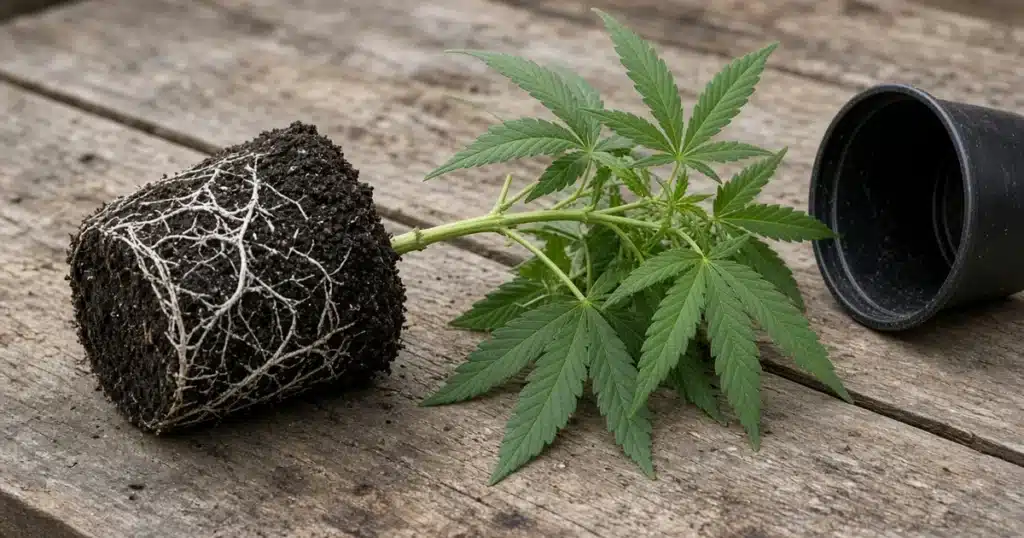
Quick answer: Root exudates are compounds that living roots release into the soil around them. UF/IFAS Extension describes them as a blend of sugars, amino acids, organic acids and similar small compounds that feed microbes in the rhizosphere, the thin zone of soil right around the roots. Oregon State Extension adds that sticky root secretions help glue soil particles into crumbs that store and drain water. In exchange for that carbon, many root zone microbes help plants reach nutrients. For cannabis growers, exudates explain why living soil changes so much around active roots.
What Are Root Exudates?
Plants make sugar in their leaves and send a share of it down to the roots. Roots use most of it to grow and respire, but they also leak and actively release a range of compounds into the soil. Those compounds are the root exudates.
A UF/IFAS Extension publication on root zone microbes explains that roots give off exudates and volatile compounds, a complex blend of small molecules. Sugars, amino acids and organic acids are among the main ingredients, and these can serve as food for microbes living close to the root.
Oregon State Extension’s guide to soil biology for farms and gardens describes a related set of root secretions as sticky mucilages that most plants produce. Some exudates come from living cells, while others are byproducts of root cells breaking down as roots grow and slough off their outer layers.
Exudation is not constant. Root tips, where cells divide and push forward, are especially active, and the mix of compounds shifts as a plant ages and as conditions change. A seedling, a plant in heavy vegetative growth and a plant late in flower all feed the soil differently. That helps explain why the soil community around an older root system can look very different from the one around a young transplant.
How Much Carbon Do Roots Give Away?
Published estimates run from about 5 to 35 percent of a plant’s carbon. UF/IFAS cites an estimate that nearly 10 to 35 percent of a plant’s carbon is released to the rhizosphere as exudates and used by microbes. Nebraska Extension’s guide to managing soil organic matter gives a more conservative figure. It puts exudates at roughly 5 to 10 percent of the carbon a plant fixes, with the share shifting by species, plant age and the cropping system.
These are general estimates from crop and soil research, not measurements on cannabis. The wide range shows how much exudation depends on the plant and its conditions. Either way, a meaningful slice of the sugar a cannabis plant makes in its leaves ends up feeding soil life rather than building plant tissue.
What Is the Rhizosphere?
UF/IFAS defines the rhizosphere as the soil wrapped around the root system, a zone shaped directly by signals passing between plants and microbes. It reports that this zone holds fewer kinds of microbes than the bulk soil farther away but far more of them in total, probably because plants draw in a select group of soil organisms.
Roots, then, do not simply tolerate whatever lives in the soil. Through exudates, they help select and feed the community that gathers around them. Two plants in the same bag of soil can end up with noticeably different neighbors at the root surface.
What Do Exudates Do in the Soil?
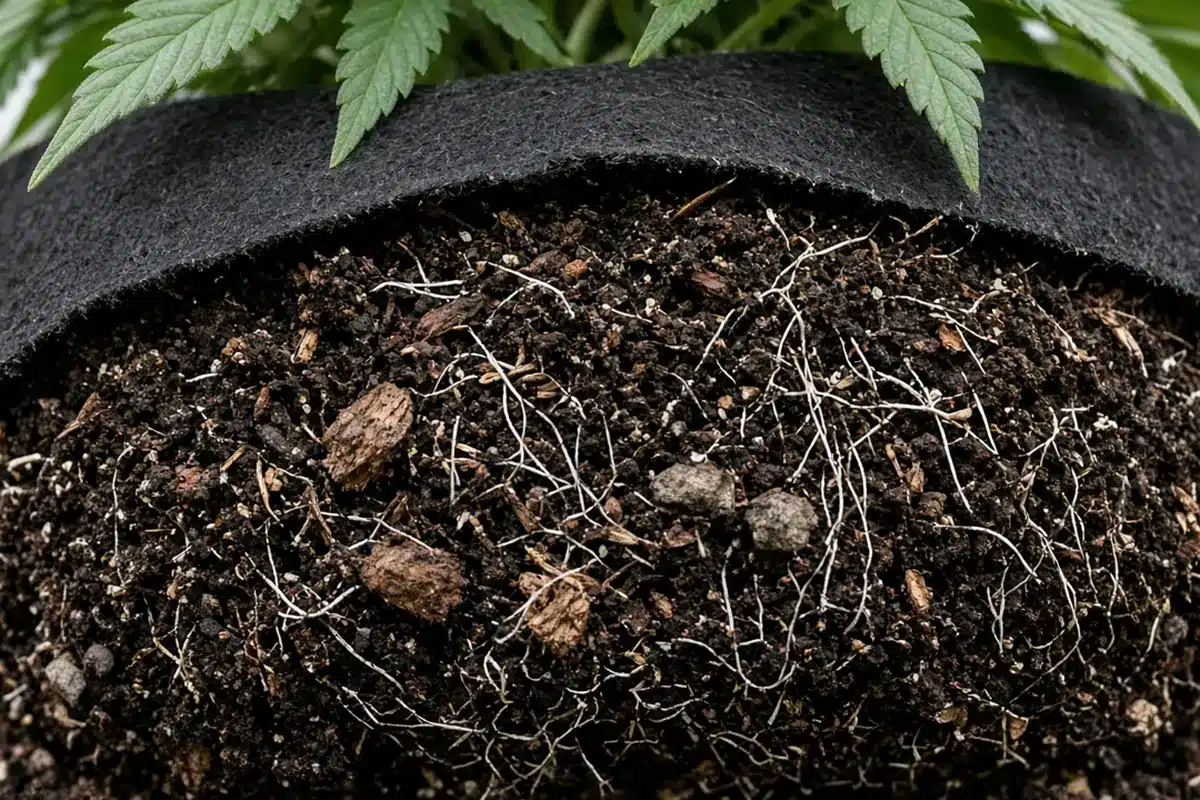
- Feed microbes. Sugars and amino acids are easy food for bacteria and fungi near the root. Oregon State says decomposer bacteria eat simple exudates as well as fresh plant residue.
- Build soil crumbs. Oregon State explains that sticky root secretions cement soil particles together, and the aggregates they form influence how soil stores and drains water.
- Support partner fungi. Oregon State writes that mycorrhizal fungi feed on exudates in return for the help they give the plant. Our post on what mycorrhizae are explains that partnership.
- Add to organic matter. Nebraska Extension lists root exudates among the inputs that feed soil microbial activity and build soil organic matter over time.
How Do Microbes Pay the Plant Back?
UF/IFAS describes many rhizosphere microbes as symbionts that supply nutrients such as nitrogen and phosphorus, along with water, in exchange for carbon fixed by the plant. It notes that arbuscular mycorrhizal fungi partner with over 80 percent of land plants and trade phosphorus and nitrogen for plant carbon.
Oregon State lists several services microbes in the rhizosphere perform. They convert nutrients to forms plants can use, and some bind metals in chelates that improve the availability of metallic nutrients. Oregon State also notes that some of these microbes produce plant growth hormones.
UF/IFAS adds that beneficial microbes can form a protective layer on root surfaces that may reduce access for disease organisms. That is a general finding across crops. Take it as one more reason to keep soil life thriving, not a sure thing for any single plant.
How Does Soil Life Help Soil Structure?
Structure is easy to overlook, yet roots feel it at every turn. UF/IFAS lists aggregation among the soil processes that rhizosphere microbes help govern, while Oregon State credits glues and mucilage made by microbes and plants with helping aggregates hold together. Stable crumbs leave pore spaces for air and water and give microbes places to live.
For a cannabis grower, good structure means a pot that drains evenly, a bed that does not crust and roots that can push through the soil easily. Exudates are one small, invisible part of that picture, working alongside organic matter, fungi and the physical mix you start with.
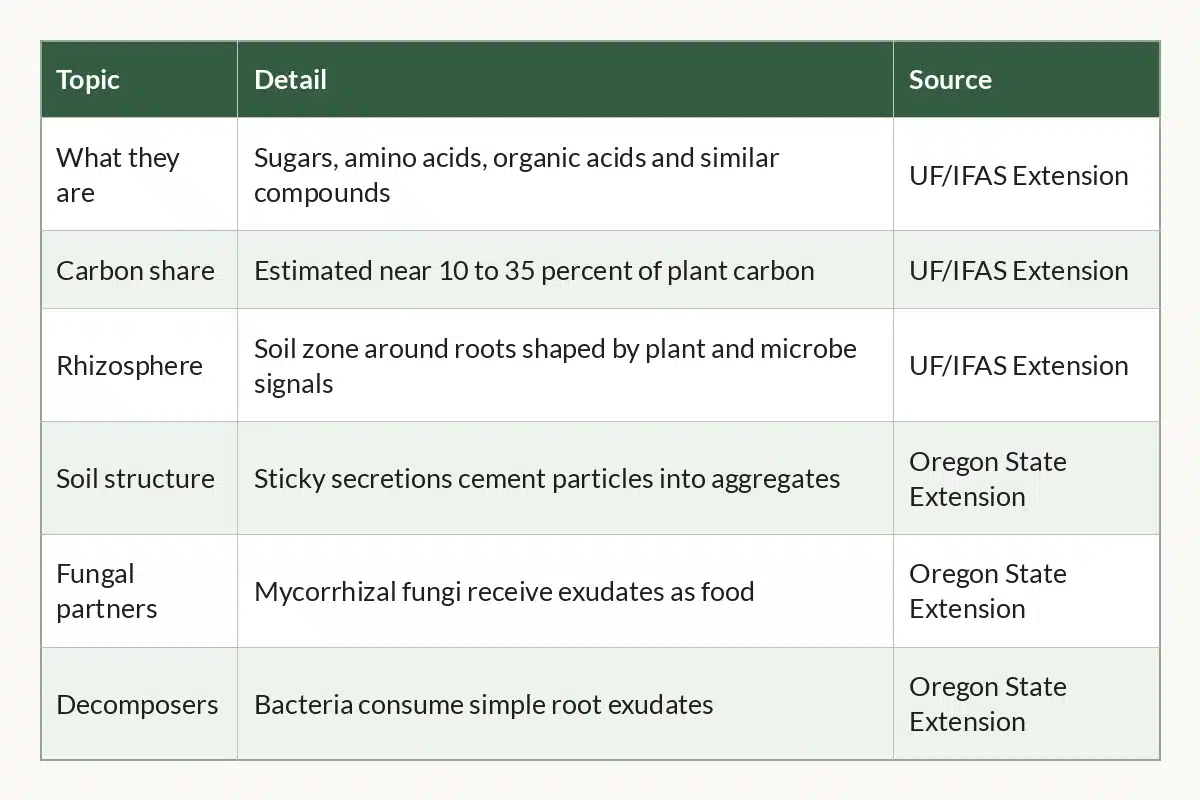
Root Exudates at a Glance
| Topic | Detail | Source |
|---|---|---|
| What they are | Sugars, amino acids, organic acids and similar compounds | UF/IFAS Extension |
| Carbon share | Estimated near 10 to 35 percent of plant carbon | UF/IFAS Extension |
| Rhizosphere | Soil zone around roots shaped by plant and microbe signals | UF/IFAS Extension |
| Soil structure | Sticky secretions cement particles into aggregates | Oregon State Extension |
| Fungal partners | Mycorrhizal fungi receive exudates as food | Oregon State Extension |
| Decomposers | Bacteria consume simple root exudates | Oregon State Extension |
Do Exudates Help Plants Find Iron?
Some plants use exudates to pull scarce nutrients from the soil. UF/IFAS Extension’s publication on chelates in plant nutrition explains that roots can release exudates containing natural chelates. Its example is a compound produced by grassy plants under low iron stress, which binds iron and carries it back to the root.
Cannabis is not a grass, so that exact mechanism does not apply directly. The broader point does: roots are chemically active, and the compounds they release can change nutrient availability right at the root surface.
What Root Exudates Mean for Cannabis Growers
- Keep roots active. Exudation depends on a living, growing root system fed by vigorous leaves and good light.
- Feed the soil, not just the plant. Organic matter and an active microbial community give exudates something to work with. Our guide to living soil and cannabis covers building that system.
- Protect soil structure. Avoid compacting containers or beds, since the crumbs built by exudates and microbes hold air and water.
- Keep roots breathing. Waterlogged soil starves roots of oxygen and slows the root activity that drives exudation.
- Be thoughtful with sterile media. Rockwool and inert mixes have little microbial life, so exudates there mostly feed whatever microbes arrive with water and inputs.
- Learn the whole root zone. Our six tips for understanding the cannabis root zone put exudates in context.
Troubleshooting Root Zone Problems
Soil turns hard and crusted. Low organic matter and little root activity weaken soil crumbs. Add compost and keep roots growing.
Water sits on top of the pot. Poor structure slows drainage. Loosen the mix and avoid compaction.
Plants stall in fresh sterile media. There may be few microbes to trade with. Focus on steady feeding and strong root growth.
The top of a living soil bed stays bare and dry. Exposed topsoil gives exudates and microbes little to work with. Mulch the surface and keep it evenly moist.
Living soil seems sluggish early on. Microbial populations need time to build around new roots. Give the system a few weeks.
Sources
- UF/IFAS Extension, SS723 publication on rhizosphere microbes in crop production: https://ask.ifas.ufl.edu/publication/SS723
- Oregon State Extension, EM 9409 guide to soil biota for farms and gardens: https://extension.oregonstate.edu/catalog/em-9409-understanding-soil-health-biota-farms-gardens
- Nebraska Extension, Soil Management for Increased Soil Organic Matter (G2283): https://extensionpubs.unl.edu/publication/g2283/2017/html/view
- UF/IFAS Extension, Understanding and Applying Chelated Fertilizers Effectively Based on Soil pH (HS1208): https://ask.ifas.ufl.edu/publication/HS1208
FAQ
What are root exudates made of?
UF/IFAS names sugars, amino acids and organic acids, along with other small compounds.
Why do plants give away sugar through their roots?
Exudates feed microbes that help plants reach nutrients such as nitrogen and phosphorus and help build soil structure.
What is the rhizosphere?
It is the zone of soil immediately around the roots, shaped by exudates and the microbes they attract.
Do root exudates matter in hydroponics?
Roots still release exudates, but there is far less microbial life to use them than in living soil.
How much carbon do roots release?
Extension estimates range from about 5 percent to as much as 35 percent of plant carbon, depending on the plant and conditions.


