Cation Exchange Capacity: What CEC Means for Cannabis Growers
Quick answer: Cation exchange capacity, or CEC, measures how many positively charged nutrients a soil or growing mix can hold and release to roots. UGA Extension explains that clay and organic matter carry negative charges that attract nutrients like calcium, magnesium and potassium, keeping them in the root zone instead of washing away. Purdue Extension notes that peat moss, coconut coir, vermiculite and compost have high CEC, while sand, perlite and rockwool have low CEC. For cannabis growers, CEC explains why some soils hold nutrients for weeks and why low CEC media need more frequent feeding.
What Is Cation Exchange Capacity?
CEC is the amount of positively charged nutrients a soil or mix can hold on its surfaces. Many plant nutrients dissolve in water as charged particles called ions. Positively charged ones are called cations. In its publication on cation exchange capacity and base saturation, UGA Extension explains that clay particles and organic matter usually carry a negative charge, so they attract and hold these cations on their surfaces.
Held cations are not locked away. They swap places with other cations in the soil solution, which is where the term exchange comes from. When roots pull nutrients out of the soil water, held cations move off the particles to replace them. When you add fertilizer, the opposite happens and nutrients move back onto the particles.
CEC is simply a measure of how many of these negative charges a soil has. A higher number means a bigger nutrient bank.
Think of each soil particle as a magnet covered in small sticky spots, and each nutrient cation as a metal bead. Clay and organic matter have many spots, so they hold many beads. Sand has few. When roots take beads from the water around the particles, the particles release more beads to keep the supply steady. The more spots a soil has, the longer it can keep that supply going between feedings.
Which Nutrients Does CEC Hold?
Of all the cations, UGA singles out potassium, calcium and magnesium as the ones plants take up in the greatest quantity. Other cations held on exchange sites include ammonium, sodium, hydrogen, aluminum and the micronutrients iron, manganese, copper and zinc.
Negatively charged nutrients behave differently. Nitrate, sulfate and phosphate forms are anions, and most soils hold few of them on exchange sites. That is why nitrate moves easily with water and can leach out of the root zone even in a soil with a high CEC.
This split matters when you feed cannabis. A high CEC soil can buffer swings in potassium, calcium and magnesium, but it will not stop nitrogen in nitrate form from washing out with heavy watering.
CEC also shapes how forgiving a soil is. A high CEC soil absorbs a heavy feeding and releases it slowly, which smooths out mistakes. A low CEC mix passes changes straight through to the roots, good or bad. Beginners often find rich, compost amended soil easier for that reason, while experienced growers use low CEC media precisely because they respond quickly to every adjustment. Neither approach is wrong, and both can grow excellent plants. What matters is matching your feeding style to the medium you choose.
How Does CEC Differ Between Soils and Mixes?
Texture and organic matter drive CEC. UGA’s publication gives typical values in milliequivalents per 100 grams of soil: sand at 1 to 5, loam at 5 to 15, clay loam at 15 to 30, clay above 30, and organic matter at 200 to 400. Clay type matters too, with some clay minerals holding far more than others.
UGA also explains how labs arrive at the number. Many routine soil tests calculate CEC by adding up the measured amounts of potassium, magnesium, calcium, sodium and hydrogen. The circular notes that the extraction method used in Georgia suits acid, low CEC soils common in that state, and that soils high in clay or organic matter, or alkaline soils, need other methods. If a lab report lists CEC, it pays to know which method produced it, especially outside the Southeast.
Soilless mixes follow the same logic. Purdue Extension’s guide to evaluating container substrates explains that clay, silt, organic matter and vermiculite carry fixed negative charges that hold nutrient cations, which also keeps nutrients from leaching. It recommends that greenhouse substrates reach a CEC of at least 6 to 15 milliequivalents per 100 cubic centimeters, noting that substrates with lower levels need more frequent fertilizing.
Purdue sorts common components into two groups:
- High CEC: clay, peat moss, coconut coir, vermiculite and composted organic matter.
- Low CEC: sand, perlite, polystyrene beads, rockwool and uncomposted materials such as rice and peanut hulls.
So many cannabis growers use coco that it deserves a closer look. Purdue describes coir as a byproduct milled from coconut husks and marketed as an alternative to peat and bark. Purdue lists coir among the high CEC components, so it holds on to more nutrients than a low CEC mix. Growers often buffer or pre charge coir before planting.
Peat behaves similarly in terms of CEC, but Purdue points out that it is acidic by nature, with a pH of about 3.0 to 4.0, so mixes built on peat need lime to bring pH up to a range cannabis tolerates.
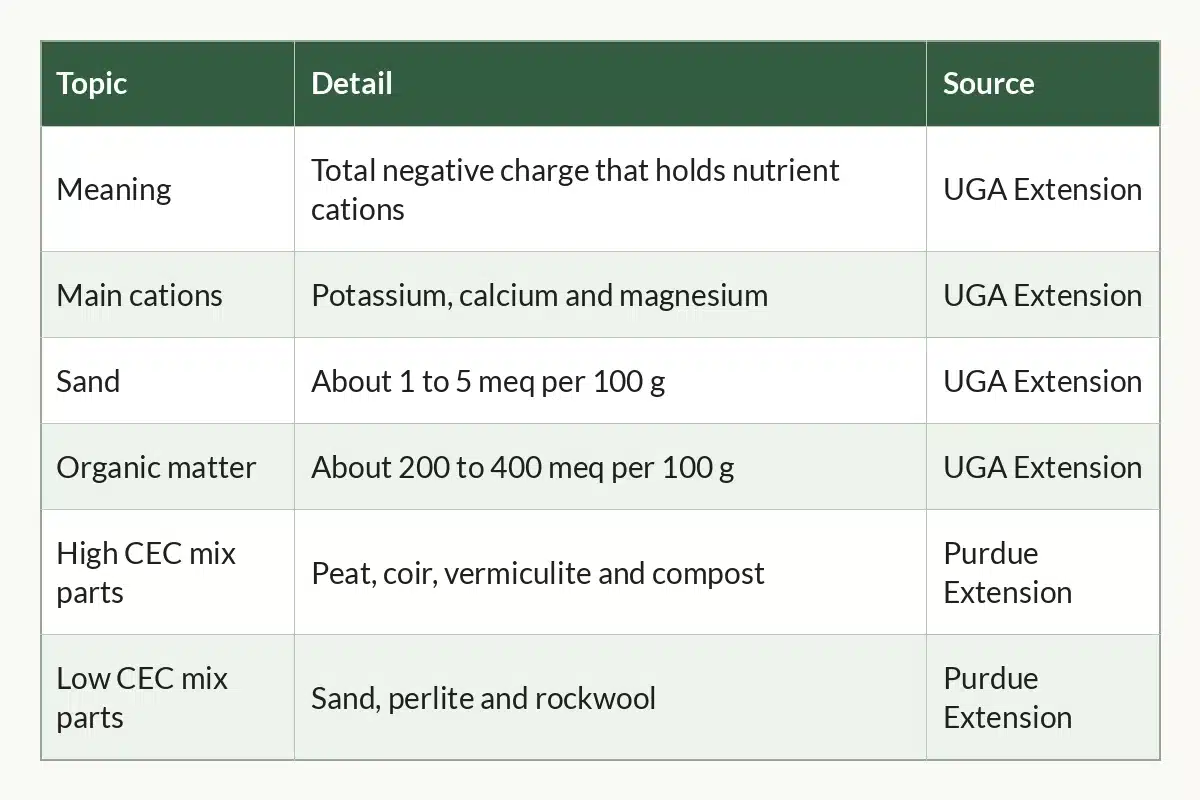
Cation Exchange Capacity at a Glance
| Topic | Detail | Source |
|---|---|---|
| Meaning | Total negative charge that holds nutrient cations | UGA Extension |
| Main cations | Potassium, calcium and magnesium | UGA Extension |
| Sand | About 1 to 5 meq per 100 g | UGA Extension |
| Organic matter | About 200 to 400 meq per 100 g | UGA Extension |
| High CEC mix parts | Peat, coir, vermiculite and compost | Purdue Extension |
| Low CEC mix parts | Sand, perlite and rockwool | Purdue Extension |
How Does pH Affect CEC?
Soil pH changes part of the CEC. UGA explains that the CEC of organic matter and some clay minerals changes with pH. It is lowest in very acid soil, around pH 3.5 to 4.0, and rises as pH increases, for example after liming. Because of that, soil labs commonly measure CEC at pH 7.0 to compare soils fairly.
UGA’s greenhouse guide on pH management in greenhouse crops adds that at low pH, the abundant hydrogen ions can push micronutrient cations off substrate particles and into solution, where they can be taken up in excess. That is one more reason to keep pH in range. Our guide to pH and cannabis covers target ranges.
The same UGA circular discusses base saturation, the share of CEC occupied by calcium, magnesium and potassium. It notes that soils with high base saturation tend to have higher pH and are more fertile, with fewer acid cations.
What CEC Means for Cannabis Growing
- Check your soil test. Many lab reports list CEC. The soil testing guide for cannabis walks through reading the results.
- Expect sandy soil to need frequent feeding. Low CEC soils hold little in reserve.
- Add organic matter to raise CEC. Compost and other organic materials have very high CEC.
- Work with clay rather than against it. Clay holds nutrients well but needs structure. Our guide to clay soil for cannabis covers how to loosen it.
- Know that coir holds cations. Coco coir has high CEC, so it interacts with calcium, magnesium and potassium in your feed.
- Remember perlite adds air, not nutrients. Low CEC aggregates improve drainage but hold little.
- Feed rockwool and hydro steadily. Low CEC media rely almost entirely on the nutrient solution.
Troubleshooting CEC Related Problems
Plants in sandy soil fade quickly between feedings. Low CEC means a small reserve. Feed lighter but more often, and add compost.
Nutrient changes take a long time to show. High CEC soils buffer changes. Give adjustments time.
Coco grown plants show calcium or magnesium shortages. Coir holds these cations on its exchange sites. Use a feed suited to coco.
Micronutrient problems at very low pH. Excess hydrogen ions displace micronutrients. Raise pH into range.
Heavy watering leaves plants pale. Nitrate leaches regardless of CEC. Adjust watering and nitrogen feeding.
Sources
- UGA Extension, Cation Exchange Capacity and Base Saturation (C1040): https://fieldreport.caes.uga.edu/publications/C1040/cation-exchange-capacity-and-base-saturation/
- Purdue Extension, Evaluating Container Substrates and Their Components (HO-255-W): https://www.extension.purdue.edu/extmedia/HO/HO-255-W.pdf
- UGA Extension, Essential pH Management in Greenhouse Crops (B1256): https://fieldreport.caes.uga.edu/publications/B1256/essential-ph-management-in-greenhouse-crops-ph-and-plant-nutrition/
FAQ
What is a good CEC for cannabis soil?
Higher is generally better for holding nutrients. Purdue suggests at least 6 to 15 meq per 100 cc for container substrates.
Does coco coir have high CEC?
Yes. Purdue lists coir among high CEC substrate components.
Does perlite hold nutrients?
Very little. Perlite is a low CEC material used mainly for drainage and air.
How can I raise my soil's CEC?
Adding compost or other organic matter is the most practical way, since organic matter has very high CEC.
Does CEC hold nitrogen?
It holds ammonium, but nitrate is negatively charged and moves freely with water.