
Cannabis Transpiration: How Plants Move Water
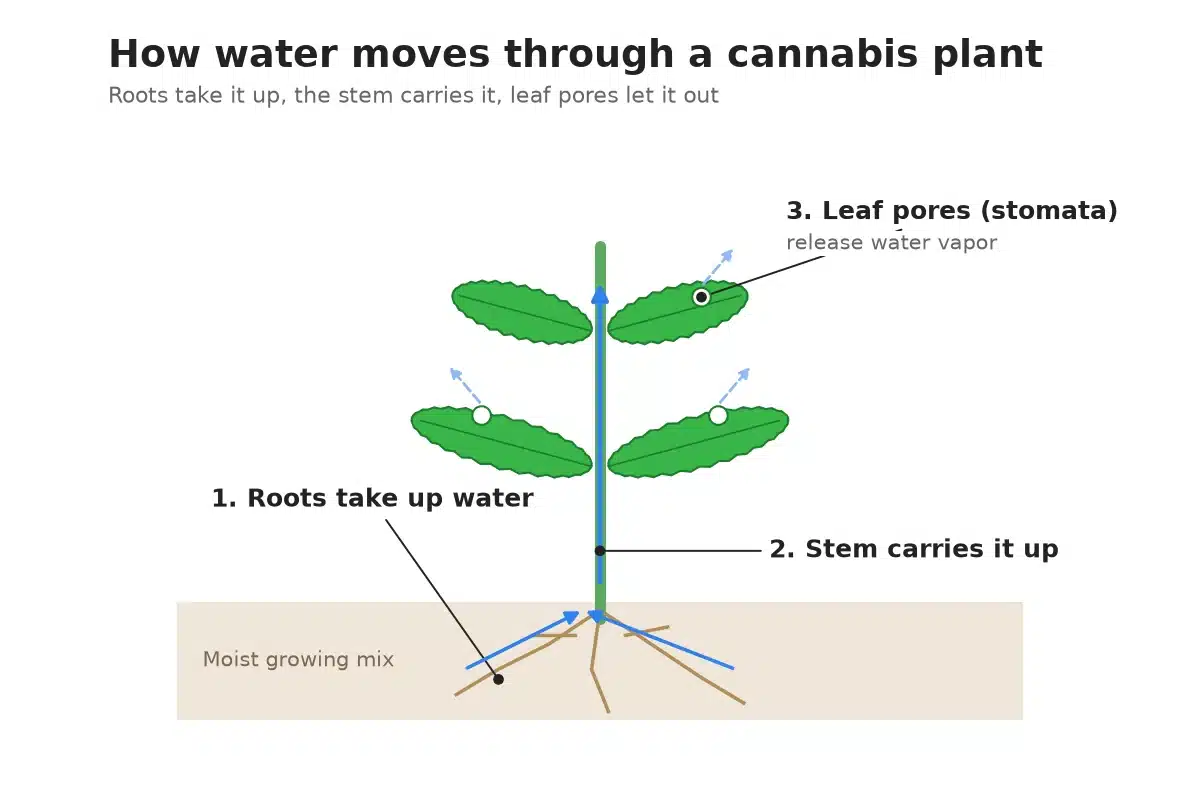
Cannabis transpiration is the movement of water from the roots, up the stem and out through tiny leaf pores called stomata, where it evaporates. That flow pulls dissolved nutrients up from the root zone and carries heat away from the leaf surface. In controlled research on cannabis leaves, transpiration kept rising with more light and heat up to the highest levels tested, and fell when CO2 was raised. Those links explain many day-to-day changes in how fast your plants drink, and why the same pot can last several days one week and barely a day the next after a change to lights, heat or humidity.
How does water move through a cannabis plant?
Think of the plant as a wick. Water evaporates from inside the leaf and escapes through the open stomata. That loss creates a pull that draws water up through the stem from the roots, and the roots in turn take up water from the soil or solution around them. Nutrients dissolved in that water ride along.
The stomata are the control point. Each pore can open wider or close down. Open pores let carbon dioxide in for photosynthesis and let water vapor out. Closed pores save water but also cut off the CO2 supply. The plant is always trading one against the other, opening when conditions favor growth and closing when water runs short. Kind Seed Co takes a closer look at the pores themselves in what stomata are.
What did research on cannabis find?
A team at the University of Mississippi measured gas and water exchange on cannabis leaves across five light levels (0 to 2,000 µmol/m²/s), five temperatures (20 to 40 °C) and six CO2 levels (250 to 750 ppm).
| Condition tested | Transpiration | Pore opening (stomatal conductance) |
|---|---|---|
| More light, up to 2,000 µmol/m²/s | Rose | Rose at every temperature |
| Warmer, up to 40 °C | Rose | Rose up to 30 °C, then fell |
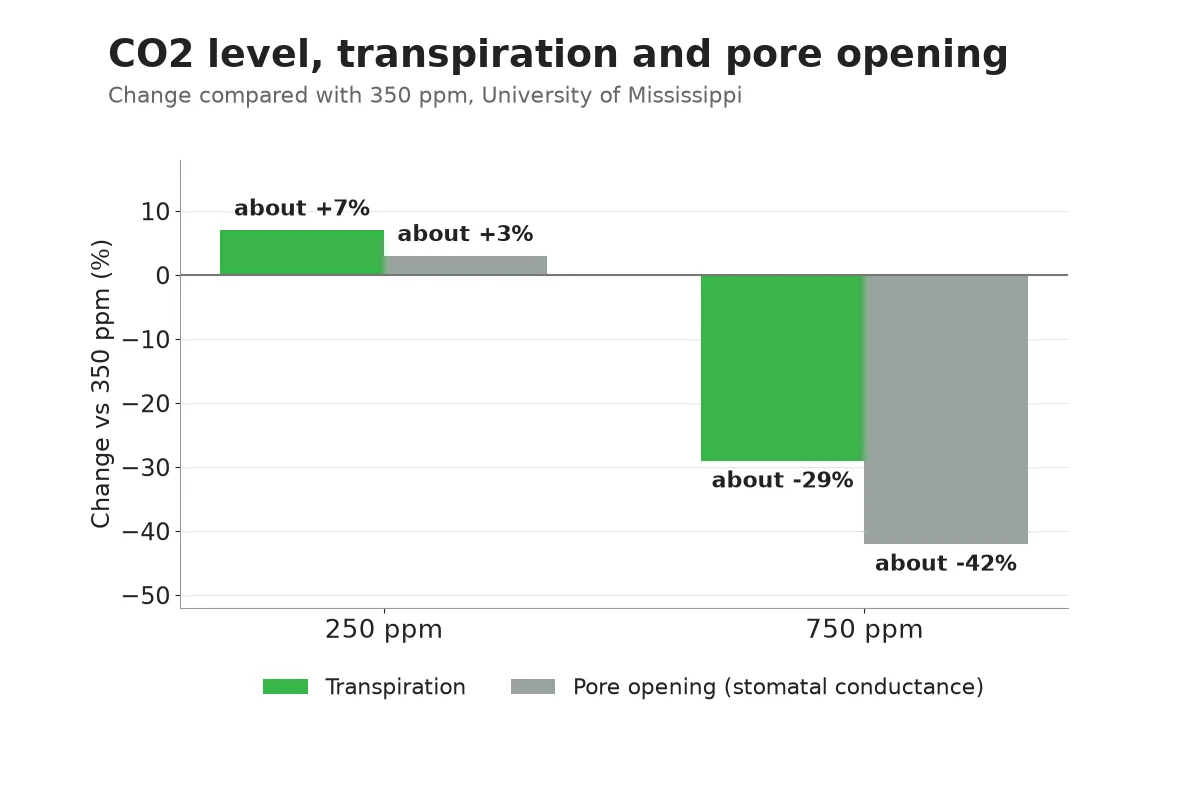
| CO2 at 250 vs 350 ppm | About 7% higher | About 3% higher |
| CO2 at 750 vs 350 ppm | About 29% lower | About 42% lower |
Source: Chandra et al., Physiology and Molecular Biology of Plants, 2008.
Two findings stand out. First, water loss kept climbing with heat even after the pores began to close above 30 °C. Second, the study placed the best conditions for photosynthesis at 25 to 30 °C and about 1,500 µmol/m²/s, with photosynthesis and water use efficiency both falling under the highest heat and light combinations. In other words, past a point, plants were losing more water without getting more growth from it.
How much growth do plants get for the water they lose?
Water use efficiency (WUE) compares carbon gained by photosynthesis with water lost through transpiration. It is a useful way to think about a grow room, because high transpiration is only good when growth keeps pace.
The same University of Mississippi study tracked WUE alongside water loss:
- At 20 to 25 °C, both photosynthesis and WUE rose as light increased.
- At 30 °C, they rose only up to about 1,500 µmol/m²/s, then fell at higher light.
- Overall, the highest heat and light combinations lowered both photosynthesis and WUE.
- Dropping CO2 from 350 to 250 ppm cut WUE by about 53%.
- Raising CO2 to 750 ppm lifted WUE by about 111% and photosynthesis by about 50%.
The practical reading is simple. Pushing light and heat past the range a plant can use keeps water flowing out of the leaves without more growth to show for it. Keeping temperature in a moderate range lets extra light turn into growth rather than just more water through the pot.
Why do light and heat work together?
Light opens the pores, and heat speeds evaporation through them. In the study, light raised pore opening at every temperature tested. Heat raised it only up to 30 °C, after which pores began to close while water loss kept rising. That pattern helps explain why a warm room under strong lights can dry pots surprisingly fast, even when leaves are starting to protect themselves.
A second study from the same group widened the picture. It tested seven cannabis varieties, three marijuana types and four hemp types, between 20 and 40 °C. In every variety, pore opening rose with temperature to a peak and then fell at higher temperatures. Water use efficiency also dropped in the heat, and the authors traced that drop to two changes at once: more water lost through transpiration and less photosynthesis. The varieties did not all peak at the same temperature, so plants of different genetics may not respond to a hot room in the same way. Watch pot weights plant by plant rather than assuming the whole room drinks alike.
Why does transpiration matter to growers?
It sets water use. More light and more heat mean more water leaving the leaves, so the root zone dries faster. Plants under strong lights in a warm room drink far more than the same plants in a cool, dim space.
It moves nutrients. Water flow and nutrient flow are linked. When transpiration slows, plants tend to move dissolved nutrients upward more slowly too.
It cools leaves. Evaporation carries heat away. When pores close in hot, dry conditions, that cooling drops.
It links to humidity. Dry air pulls water from leaves faster, and very humid air slows it. Vapor pressure deficit (VPD) puts a single number on that pull by combining temperature and humidity. See the VPD chart for stage targets.
What controls transpiration?
- Light. Stomata open as light rises, and transpiration rises with them.
- Temperature. Warmer leaves lose water faster.
- Air dryness. Drier air increases the pull on leaf water.
- Airflow. Moving air clears the humid layer at the leaf surface. Gentle airflow keeps it moving without stripping leaves.
- CO2. Higher CO2 partly closes the pores, which cut transpiration by about 29% at 750 ppm in the study above.
- Roots and root-zone moisture. Roots that are damaged, cold or sitting in soggy mix cannot supply water fast enough, so the plant limits loss.
How does transpiration change by stage?
Seedlings. Small leaf area means low total water use. The root zone stays wet longer than it looks, which is why seedlings in large pots are easy to overwater. Keep humidity on the higher side so tiny roots are not outpaced by water loss.
Vegetative growth. Leaf area expands quickly, and so does water use. This is when daily water needs climb fastest. Expect to water more often as the canopy fills.
Early flowering. Plants are often at their largest leaf area now. Strong lights and a full canopy push transpiration high, so watch pot weight closely.
Late flowering. Lower humidity is common in late flower. Drier air raises the pull on leaves, so water use can stay high even as growth slows.
How do you use transpiration in a grow, step by step?
- Learn your pot weights. Lift each pot right after watering and again when it is ready for water. University of Maryland Extension suggests this lift test for lightweight containers.
- Check daily until you know the pattern, especially in warm weather, rather than watering on a fixed schedule.
- Expect water use to rise when you raise light intensity or room temperature, and plan for it.
- Keep humidity in range for the stage, using a hygrometer at canopy height.
- Keep air moving gently through and over the canopy.
- If you add CO2, expect plants to drink a little less and adjust watering by weight.
- Recheck after any change to lights, heat or humidity, since each one shifts the flow.
For watering technique, see watering marijuana plants.
What signs point to a transpiration problem?
| Symptom | Likely cause | Fix |
|---|---|---|
| Midday droop that recovers at night | Water loss faster than roots can supply | Check pot weight, water if light, lower heat or light intensity |
| Droop with wet mix | Roots short of oxygen in soggy mix | Let the pot dry back, improve drainage |
| Mix stays wet for days | Low transpiration from cool, humid or dim conditions | Raise airflow, check humidity and temperature |
| Leaf edges crisp in dry, hot air | Air pulling water out faster than it is replaced | Raise humidity, lower temperature |
| Pots dry far faster after a light upgrade | Higher light raised transpiration | Water more often, raise the light if needed |
Based on common grower practice and University of Maryland Extension container guidance.
Droop alone is a weak clue. University of Maryland Extension notes plants can wilt both when too dry and when kept too wet, so check the root zone before adding water.
What are common mistakes?
- Watering by the calendar instead of by pot weight.
- Raising light or heat without expecting the higher water use that follows.
- Running very humid air late in flower, which slows the flow and keeps the canopy damp.
- Treating every droop as thirst.
- Pointing a strong fan straight at the plants instead of moving air gently through the canopy.
- Forgetting that CO2-enriched rooms change water use.
Lift your pots at the same time each day to track how fast plants drink.
Sources
- Chandra S, Lata H, Khan IA, ElSohly MA. Photosynthetic response of Cannabis sativa L. to variations in photosynthetic photon flux densities, temperature and CO2 conditions. Physiology and Molecular Biology of Plants. 2008;14(4):299-306. https://pmc.ncbi.nlm.nih.gov/articles/PMC3550641/
- University of Maryland Extension. Growing Vegetables in Containers and Salad Tables (J. Traunfeld, 2026). https://extension.umd.edu/resource/growing-vegetables-containers-and-salad-tables
- Chandra S, Lata H, Khan IA, ElSohly MA. Temperature response of photosynthesis in different drug and fiber varieties of Cannabis sativa L. Physiology and Molecular Biology of Plants. 2011;17(3):297-303. https://pmc.ncbi.nlm.nih.gov/articles/PMC3550580/
FAQ
Why do cannabis plants drink more in heat?
Heat and strong light raise transpiration, so water leaves the leaves faster and roots pull more from the soil. In research, transpiration rose all the way to 40 °C, the highest temperature tested. Plants in warm spaces under strong lights often need water more often.
Does humidity affect transpiration?
It does. Dry air pulls water from leaves faster, while very humid air slows it. That balance is what VPD measures. Keeping humidity in the right range for each stage helps plants move water and nutrients steadily without drying out or staying too wet.
Does extra CO2 lower water use?
In one study, transpiration was about 29 percent lower at 750 ppm CO2 than at 350 ppm, because leaf pores partly closed. With pores partly shut, less water vapor escapes. Plants in CO2-enriched rooms may drink a little less, so check soil moisture and adjust watering.
Is guttation the same as transpiration?
The two differ. Transpiration is water vapor leaving through leaf pores. Guttation is liquid droplets pushed out at leaf edges, usually when roots take up water and the air is humid. Both involve water moving through the plant, but they happen in different ways.


