
Cannabis Transplant Shock: Signs, Causes and Recovery
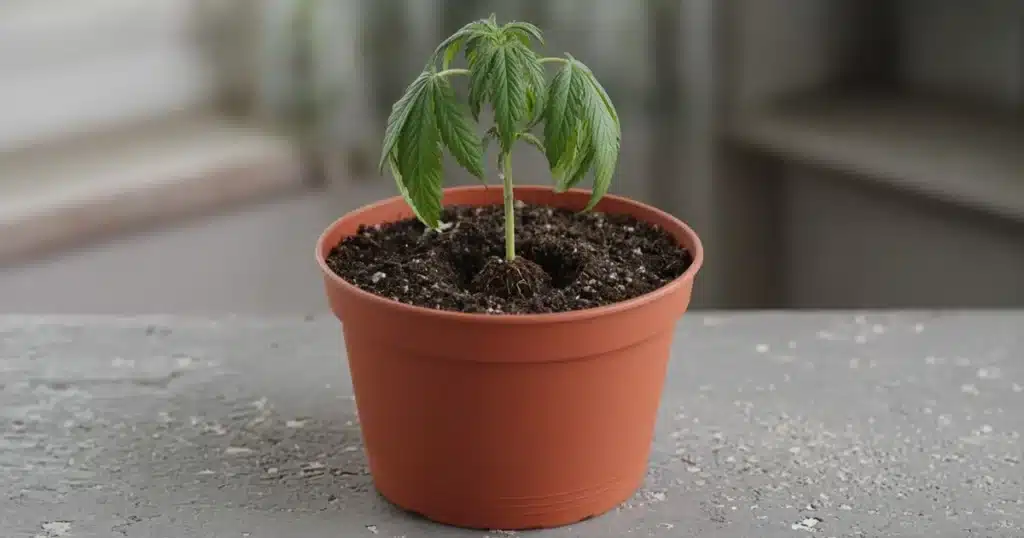
Cannabis transplant shock is the stress a plant shows after it moves to a new pot or into the ground. Leaves droop, growth stalls and some leaves may yellow or burn. It happens because roots are disturbed and the plant faces new conditions at the same time. Most plants recover once roots grow into the new soil, and good prep before the move prevents most cases.
What does transplant shock look like?
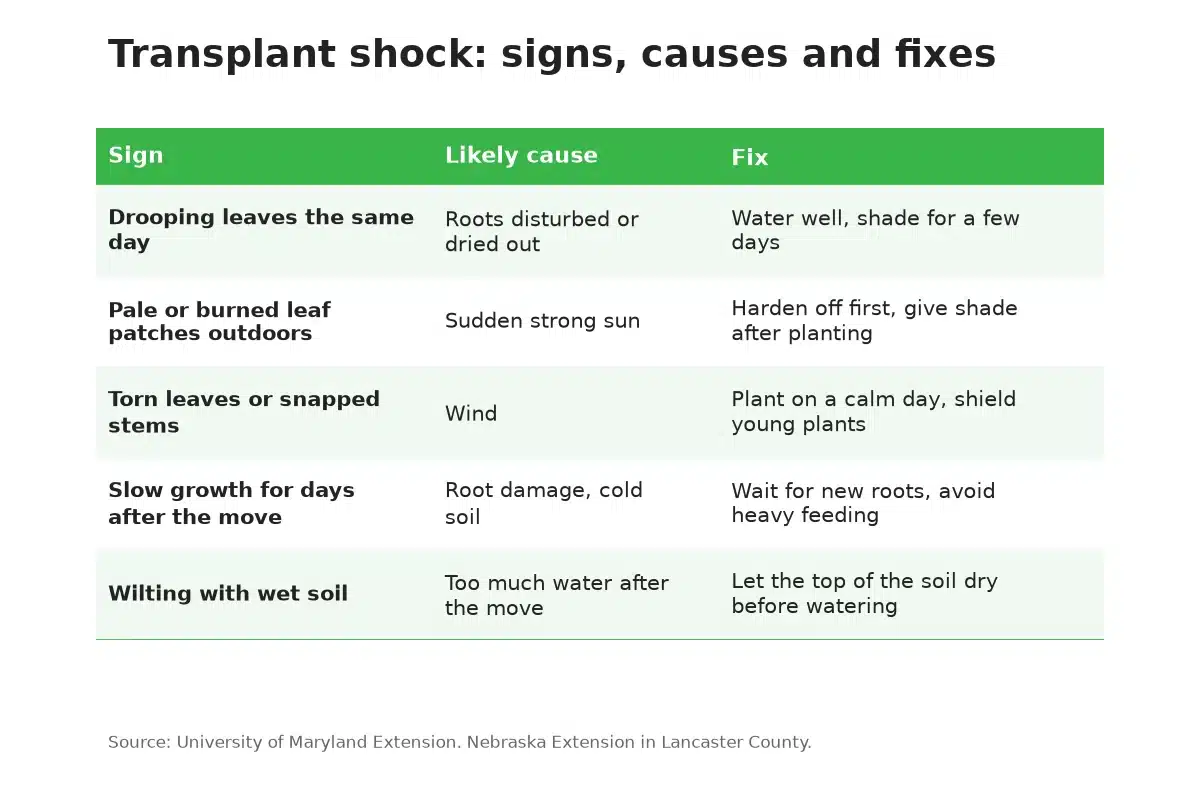
| Sign | Likely cause | Fix |
|---|---|---|
| Drooping leaves the same day | Roots disturbed or dried out | Water well, shade for a few days |
| Pale or burned leaf patches outdoors | Sudden strong sun | Harden off first, give shade after planting |
| Torn leaves or snapped stems | Wind | Plant on a calm day, shield young plants |
| Slow growth for days after the move | Root damage, cold soil | Wait for new roots, avoid heavy feeding |
| Wilting with wet soil | Too much water after the move | Let the top of the soil dry before watering |
Source: University of Maryland Extension. Nebraska Extension in Lancaster County.
The most common signs:
- Leaves that droop or wilt soon after the move.
- Growth that slows or stops for a while.
- Pale or scorched patches on leaves after a move outdoors, which Nebraska Extension links to sunburn on plants that were not hardened off.
- Torn leaves or damaged stems from wind.
- Lower leaves that yellow or drop.
What causes transplant shock?
K-State Research and Extension in Johnson County describes shock as a sum of stressors. When a plant is moved, roots are likely to be disturbed or broken, stems may bend and leaves may drop. Add a harsh new setting and the total can be too much for a young plant.
Nebraska Extension lists the main outdoor stressors as cold temperatures, wind, less water and strong sunlight. Plants grown indoors have had steady warmth, still air and water whenever they needed it. Outdoors, heat, sun and wind make them lose water faster. Even light wind can throw soil particles at leaves and stems, scratching cells in a way Nebraska Extension compares to sandblasting, which leads to more water loss and dead tissue.
Common causes:
- Root damage. Torn or broken roots cannot take up water well for a while.
- Drying out during the move. University of Maryland Extension stresses not letting plants dry out at any time.
- Sudden sun, wind or cold. Indoor plants are soft and not ready for outdoor conditions.
- Moving too late. Plants left too long in small pots become root bound. The signs are laid out in root bound cannabis.
- Heavy fertilizer right after the move. Young roots are easily damaged by too much fertilizer, especially under moisture stress, according to Maryland Extension.
How long does transplant shock last?
There is no fixed timeline. Recovery depends on how many roots were lost and how harsh the new setting is. A plant that lost many roots or got sunburned has more to repair than one moved with its root ball whole. The best sign of recovery is fresh new growth at the top of the plant, because it shows roots are taking up water again.
How to help a plant recover, step by step
- Water the new soil well. Maryland Extension advises watering around the base so the soil settles into empty spaces around the roots.
- Give shade and shelter. Maryland Extension suggests protecting tender plants from wind and direct sun for a few days after planting, using baskets, pots or floating row cover.
- Keep the soil evenly moist but not soaked. Maryland Extension notes the soil should be uniformly moist but not saturated.
- Use only a weak fertilizer. Nebraska Extension recommends a weak fertilizer solution after planting to get plants growing again and reduce shock. Follow the label for dilution.
- Do not repot or prune again. Each change adds stress.
- Watch new growth. Damaged leaves may not fully recover, so judge progress by the new leaves.
Avoid giving extra water just because leaves droop. If the soil is still wet and the plant wilts, roots may lack air. Telling the two apart is easier with overwatering cannabis open beside you.
How to prevent transplant shock
Before the move
- Move plants at the right time. Maryland Extension says the best time to move small seedlings is when they are small and there is little danger of setback from root shock, usually around when the first true leaves appear.
- Water a few hours before. Maryland Extension recommends watering plants several hours before you transplant them.
- Pick a cloudy, calm day. Maryland Extension suggests a cloudy, windless day to reduce stress.
- Harden off plants headed outdoors. More on this below.
- Hold off on fertilizer. Nebraska Extension advises against fertilizing before or during hardening off.
During the move
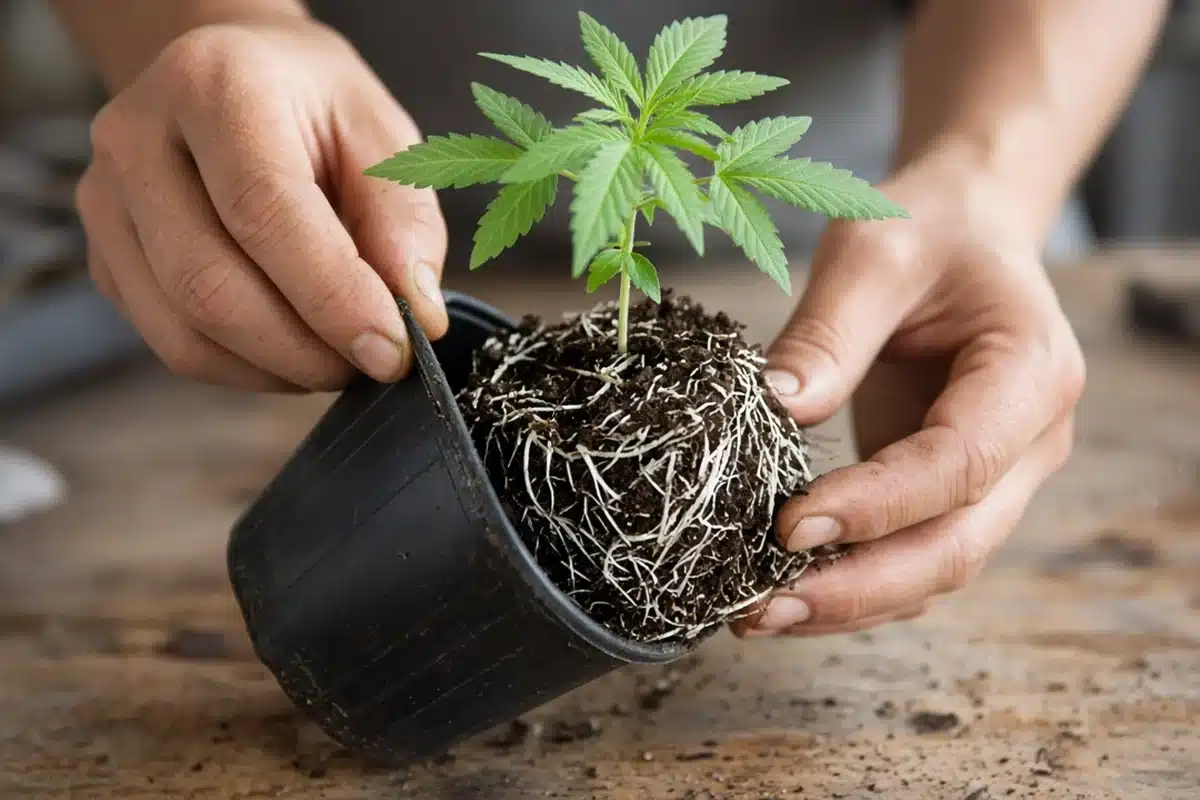
- Handle gently. Turn the pot sideways or upside down to release the plant, as Maryland Extension describes.
- Hold small seedlings by their leaves, not their stems. Maryland Extension notes stems are delicate.
- Dig a hole big enough so the root mass is not cramped.
- Press soil firmly around the roots and water in.
- Plant biodegradable pots fully below the soil line. Maryland Extension warns that a rim sticking above the soil acts as a wick and dries the root zone.
For the whole move from start to finish, follow transplanting marijuana plants.
Hardening off plants that go outdoors
Hardening off slowly gets indoor plants used to outdoor conditions. Nebraska Extension explains that it slows growth, thickens leaf waxes, adds lignin to cell walls, raises stored carbohydrates and speeds root growth. These changes make plants tougher.
A simple plan based on extension guidance:
- Start 7 to 14 days before planting out. Maryland Extension gives a range of 5 to 14 days, Nebraska Extension suggests 7 to 10 days, and K-State suggests starting two weeks before the planting date.
- On day one, set plants outside in a shaded, sheltered spot for a short time. K-State suggests one hour, while Nebraska Extension suggests 2 to 3 hours.
- Add a few hours of outdoor time and sun each day.
- Water a little less often, but do not let plants wilt.
- Bring warm season plants inside on nights below 50°F, per Maryland Extension. Do not put tender seedlings out on windy days or below 45°F.
- After several days of 10 to 12 hours outside, leave them out day and night for a couple of days, as Nebraska Extension describes. Then plant.
A cannabis-specific schedule is set out on the Kind Seed Co page for hardening off cannabis seedlings.
Check roots before you move
Healthy roots handle a move far better. Maryland Extension describes good roots as white and fibrous. A few long roots circling the bottom of the container are normal. A thick mat of circling roots on a tough, woody looking plant is a sign it stayed in its pot too long.
Maryland Extension also calls leaving seedlings in a seed tray too long one of the most common mistakes gardeners make. Moving them into larger pots while they are small keeps root loss low.
K-State Extension notes that hardened plants respond to mild dry spells by sending roots outward and making them longer as they reach for water. That is one more reason gradual exposure before planting out pays off later.
Why stress adds up
K-State Extension compares transplanting to pruning trees, where no more than 30% of live growth is removed at once because every cut is one more stressor. Root loss, a bent stem, dropped leaves and a harsh new setting each add to the total. Keep the number of changes low on moving day.
Stage by stage
Seedlings. They are the easiest to move with little root loss if they go into a larger pot early. Handle them by the leaves.
Vegetative plants. Bigger root balls mean more roots at risk. Water ahead, keep the root ball whole and give shade for a few days.
Flowering plants. A move during flowering adds stress at a sensitive time. Plan pot sizes so plants do not need a move after flowering starts.
Common mistakes
- Moving plants straight from indoors to full sun.
- Transplanting on a hot, windy afternoon.
- Letting the root ball dry out during the move.
- Breaking up healthy roots that are holding the soil together.
- Feeding at full strength right after the move.
- Watering again and again because the plant droops, while the soil is still wet.
- Leaving plants in small pots until roots circle the bottom.
Sources
- University of Maryland Extension. Planting Vegetable Transplants. https://www.extension.umd.edu/resource/planting-vegetable-transplants
- University of Maryland Extension. Care of Vegetable Seedlings. https://www.extension.umd.edu/resource/care-vegetable-seedlings
- Nebraska Extension in Lancaster County. Hardening Off Transplants. https://lancaster.unl.edu/hardening-transplants/
- Reardon, A. 2024. Mitigating Transplant Shock. K-State Research and Extension, Johnson County. https://www.johnson.k-state.edu/programs/lawn-garden/agent-articles-fact-sheets-and-more/agent-articles/environment/Mitigating%20Transplant%20Shock.html
FAQ
Why is my cannabis plant drooping after transplant?
Drooping is the most common sign of transplant shock. Roots were disturbed and cannot take up water well for a while, and new sun or wind adds stress. Water the new soil well, give some shade and shelter for a few days, and avoid adding more water while the soil is still wet.
How long does cannabis transplant shock last?
There is no fixed timeline. It depends on how many roots were damaged and how harsh the new conditions are. A plant moved with its root ball whole has less to repair than one with torn roots or sunburn. Fresh new growth at the top of the plant is the clearest sign of recovery.
How do I prevent transplant shock?
Water a few hours before the move, pick a cloudy, calm day, and handle the root ball gently. Move plants before they get root bound. For plants headed outdoors, harden them off over one to two weeks. Hold off on strong fertilizer until the plant is settled in its new home.
Should I fertilize after transplanting?
Only lightly. Nebraska Extension recommends a weak fertilizer solution after planting out to help plants start growing again and reduce shock. Avoid feeding before or during hardening off. Maryland Extension warns that young roots are easily damaged by too much fertilizer, especially when plants are short on water.


