
Lygus Bugs on Cannabis: How to Spot and Manage Them

Lygus bugs are small plant bugs, including the tarnished plant bug, that are common on outdoor cannabis across much of the US. They feed on young shoots, flowers and developing seeds by piercing plant cells. Most outdoor plants can carry low numbers without serious harm, but heavy feeding can distort new growth and cause flowers to drop. Weed control around the garden is the main way to keep them in check.
What are lygus bugs?
Lygus bugs are true bugs in the plant bug family. Three species matter most on cannabis in the US, according to Utah State University Extension and Colorado State University:
- Tarnished plant bug, Lygus lineolaris.
- Western tarnished plant bug, Lygus hesperus.
- Pale legume bug, Lygus elisus.
A 2019 review of hemp insects in the Journal of Integrated Pest Management found that lygus bugs are often among the most common insects on hemp. The tarnished plant bug is found throughout the growing season wherever hemp is grown, and it was the plant feeding insect seen most often in Tennessee and Virginia hemp. In Colorado the pale legume bug is often the main species.
How to identify lygus bugs
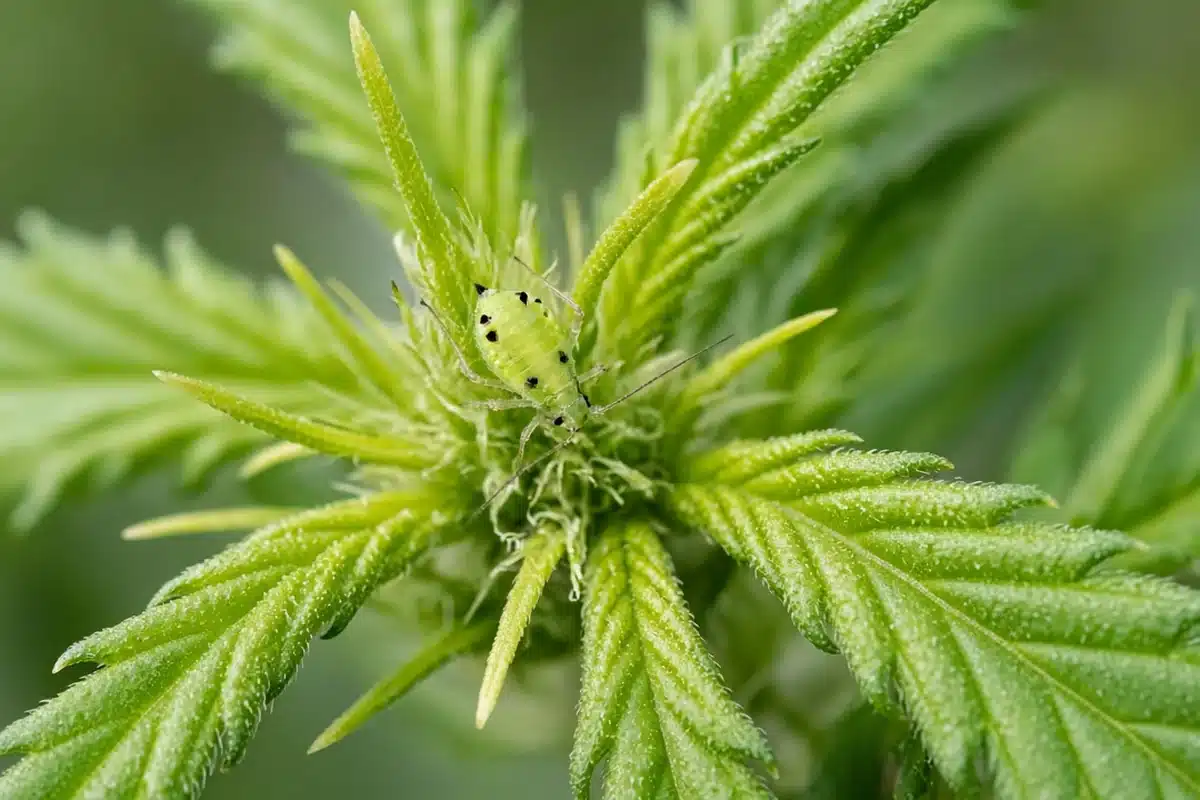
University of California IPM describes adults as about a quarter inch (6 mm) long, oval and fairly flat. They are greenish or brownish with reddish brown marks on the wings. The best clue is a small yellow or pale green triangle in the center of the back. Utah State Extension adds that adults can show yellow, black and red markings depending on the species.
Nymphs look different. They are pale green, have no wings and are rounder than adults. UC IPM notes they can look like aphids but move much faster. Older nymphs have five black dots on the back, two right behind the head, two on the next segment and one in the middle of the abdomen.
| Insect | How to tell it apart | Friend or pest |
|---|---|---|
| Lygus bug adult | Pale triangle on the back, no black dots | Pest |
| Lygus bug nymph | Green, wingless, fast, five black dots when older | Pest |
| Calocoris | Two black dots behind the head, dark wing tips, longer body | Not a pest |
| False chinch bug | Smaller, grayish brown, slender | Minor pest |
| Bigeyed bug | Large eyes, looks similar to lygus | Beneficial predator |
Source: UC IPM. Utah State University Extension.
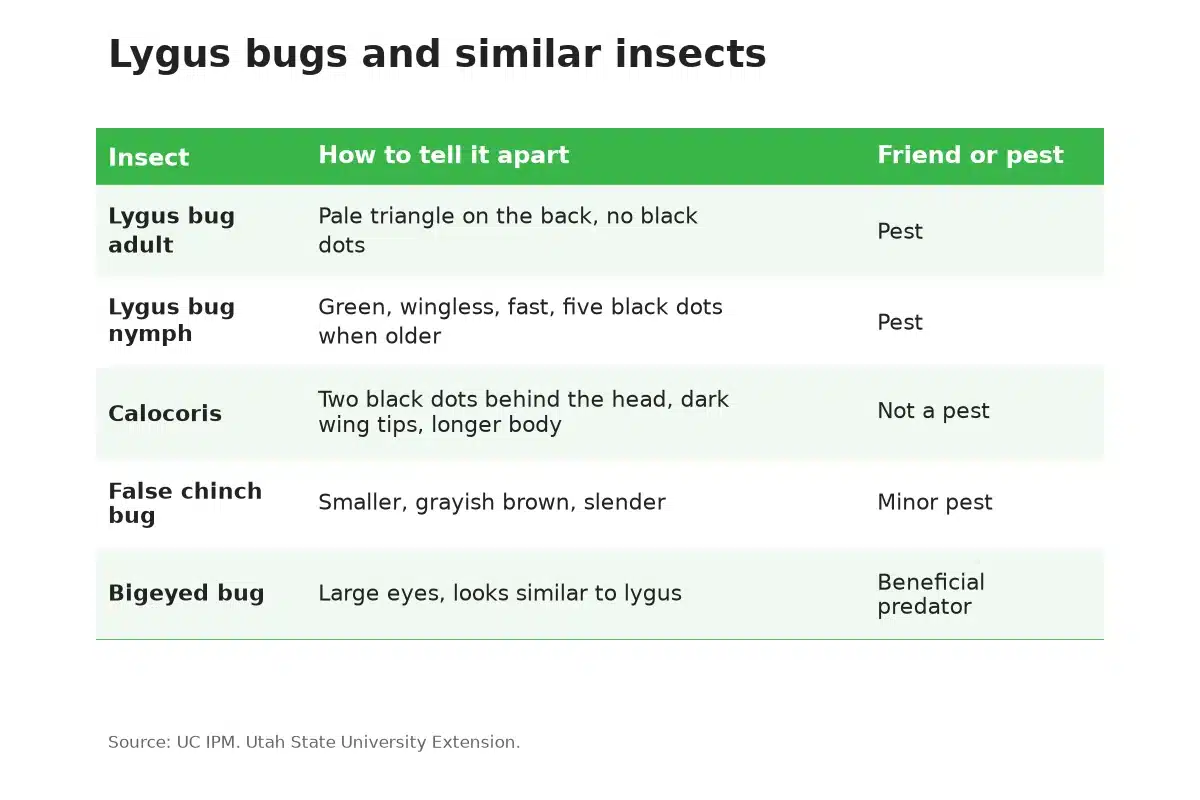
False chinch bugs are the trickiest match. UC IPM notes they are only 0.1 to 0.2 inch long, with silvery gray wings that lack the small triangle near the wing tip that lygus bugs have. Their nymphs are brownish gray with orange or reddish marks.
Lygus bugs are also different from leafhoppers, which Colorado State notes feed by tapping plant fluids rather than destroying cells. That second pest gets its own post, leafhoppers on cannabis.
Life cycle and when they show up
Lygus bugs overwinter as adults in plant debris, according to Utah State Extension. There are about three to four generations a year. Colorado State notes that lygus bugs develop on hundreds of plant species. Legumes such as alfalfa, peas and vetch, and mustards such as flixweed and canola, are among the most important hosts.
Home gardens give them plenty of food. Utah State lists beans, leafy greens, tomatoes and seed crops as hosts, along with weeds such as butterweed, dock, dog fennel, fleabane, goldenrod and vetch. A cannabis patch next to a vegetable bed or a weedy fence line can draw bugs from both sides.
Movement into cannabis often happens when those nearby host plants dry down or are cut. UC IPM reports the same pattern in other crops. Once adults are on weeds, they migrate when the weeds dry or are removed.
The 2019 hemp review found that lygus bugs breed on plants in vegetative growth, and numbers tend to climb after flowering starts. In Virginia, tarnished plant bugs were on hemp from the time seedlings came up until harvest. Utah State lists summer through harvest as the main period of concern.
What damage do lygus bugs cause?
Lygus bugs feed with piercing and sucking mouthparts. Colorado State explains that they destroy cells at the feeding site, a type of injury called "lacerate and flush." This is more destructive than the feeding of aphids or leafhoppers, which tap into plant fluids. Lygus feeding focuses on young tissue such as emerging leaves, flowers and developing seeds.
Signs to look for:
- Distorted new growth at shoot tips.
- Ragged or deformed expanding leaves, reported by Cornell University on hemp.
- Flowers that drop or abort, which Utah State says can follow heavy feeding.
- Shriveled or deformed seeds on plants grown for seed.
Not every source sees leaf damage. The 2019 hemp review noted no visible leaf injuries from lygus on hemp at the time. Utah State also lists no documented foliage symptoms. Treat leaf damage as a possible sign, and confirm it by finding the bugs.
How serious is it? Colorado State says damage to hemp is likely minimal. Utah State rates the threat as low to medium and reports no economic damage documented in Utah. Cornell rates the pest concern as moderate. The bigger risk is for plants grown for seed, since lygus bugs reduce seed quality in many crops.
How to scout for lygus bugs, step by step
- Start in summer. Utah State lists summer through harvest as the period of concern.
- Look at shoot tips and flowers first. That is where lygus bugs feed, and Utah State recommends checking flowers regularly for adults and nymphs.
- Check nearby weeds and legumes. Utah State recommends a sweep net in weeds around the garden to see if a population is building.
- Look for both life stages. Green nymphs on shoots mean bugs are breeding nearby.
- Note what you find. Separate pests from helpful insects that resemble them, such as the bigeyed bug, before you act.
- Watch after mowing or harvest of nearby fields, when Colorado State says bugs may move in.
Yellow sticky traps can help you see which flying insects are active, but visual checks of flowers give a better picture of lygus numbers.
How to manage lygus bugs
Utah State notes that treatment thresholds have not been developed for hemp. For most home growers, prevention and habitat control are the main tools.
- Control weeds in and around the garden. Utah State lists weeds such as fleabane, dock and vetch as hosts.
- Remove flowering weeds, legumes and alfalfa from edges. Cornell suggests reducing daisy fleabane and planting away from alfalfa.
- Time weed removal. UC IPM recommends weed control while lygus bugs are still nymphs, before they become winged adults that move into crops.
- Mow cover crops before they flower. UC IPM advises mowing legume cover crops before bloom, while bugs are still nymphs.
- Clear plant debris after harvest. Adults overwinter in debris.
- Protect natural enemies.
Natural enemies that help
UC IPM lists several predators that feed on lygus nymphs:
- Bigeyed bugs.
- Damsel bugs.
- Minute pirate bugs.
- Spiders.
UC IPM also names a naturally occurring parasitic wasp, Anaphes iole, found in fields and nearby lygus habitat. Avoid broad sprays that kill these helpers. Keeping beneficial insects around is the focus of the best bugs for a cannabis grow.
If you choose a spray, read the label and check that the product is allowed on your crop where you live. UC IPM notes that sprays work best against young nymphs, since products are much less effective on adults. Soap is a common first choice, so look through the Kind Seed Co notes on insecticidal soap for cannabis before mixing anything.
Lygus pressure from veg to flower
Seedlings and young plants. Lygus bugs can arrive early, but damage is rare. Use this time to clear weeds and debris around the garden.
Vegetative stage. Bugs can breed on vegetative plants. Check shoot tips for distorted growth.
Flowering. Numbers often rise. Check flowers closely and watch for flowers that drop.
Seed crops. Plants grown for seed need the closest checks, since seed damage is the main concern.
Common mistakes
- Spraying without confirming the pest. Bigeyed bugs look similar and are helpful.
- Mowing nearby weeds or alfalfa during flowering, which can push adults onto your plants.
- Blaming every distorted leaf on lygus. Confirm the bugs are there.
- Waiting until adults are common. Habitat control works best while bugs are still nymphs.
- Leaving plant debris in the garden over winter.
Sources
- Utah State University Extension. Lygus Bug (Tarnished Plant Bug), hemp IPM notes. https://extension.usu.edu/planthealth/ipm/notes_ag/hemp-lygus-bug
- Colorado State University. Lygus Bugs, Insects and Mites that Feed on Hemp. https://webdoc.agsci.colostate.edu/hempinsects/PDFs/Lygus%20Bugs%20with%20photos.pdf
- Cranshaw, W., Schreiner, M., Britt, K., Kuhar, T.P., McPartland, J., and Grant, J. 2019. Developing Insect Pest Management Systems for Hemp in the United States: A Work in Progress. Journal of Integrated Pest Management 10(1):26. doi:10.1093/jipm/pmz023. Full text hosted by Colorado State University: https://webdoc.agsci.colostate.edu/hempinsects/PDFs/JIPM_2019.pdf
- Cornell University. Hemp Insect Management, 2022 Cornell Hemp Field Day handouts. https://hemp.cals.cornell.edu/resources/reports-factsheets/2022-cornell-hemp-field-day-handouts/hemp-insect-management/
- UC Statewide IPM Program. Lygus Bug (Western Tarnished Plant Bug), Strawberry Pest Management Guidelines. https://ipm.ucanr.edu/agriculture/strawberry/lygus-bug/
FAQ
What do lygus bugs look like on cannabis?
Adults are about a quarter inch long, oval and flat, greenish or brownish with a small pale triangle in the middle of the back. Nymphs are green and wingless and look like aphids but move faster. Older nymphs carry five black dots on the back, which helps separate them from other bugs.
Are lygus bugs harmful to cannabis?
They can be. They feed on young shoots, flowers and seeds, which can distort growth and cause flowers to drop. Extension sources rate the risk to outdoor plants as low to moderate, with no economic damage documented in Utah. Plants grown for seed face the biggest risk, since seed damage is common.
Is a tarnished plant bug the same as a lygus bug?
Yes. The tarnished plant bug, Lygus lineolaris, is one of several lygus bugs. Others found on cannabis in the US include the western tarnished plant bug and the pale legume bug. They look alike, feed the same way and are managed the same way, so most growers treat them as one group.
How do I keep lygus bugs off my plants?
Focus on habitat. Control weeds such as fleabane, dock and vetch, keep alfalfa and other legumes away from the garden edge, and clear plant debris after harvest. Remove weeds while bugs are still nymphs. Protect predators such as bigeyed bugs, damsel bugs, minute pirate bugs and spiders.


