Cannabis Xylem and Phloem: How Water and Sugar Move
Quick answer: Xylem and phloem are the two transport tissues inside every cannabis stem, leaf and root. Xylem carries water and dissolved minerals up from the roots, and phloem carries sugars made in the leaves to wherever the plant is growing or storing food. Virginia Cooperative Extension describes them as the main parts of a plant’s vascular system, which also gives the stem support. Because cannabis is a dicot, those tissues sit in a ring just inside the outer skin of the stem, which is why bent or crushed stems can slow growth above the damage.
What Are Xylem and Phloem?
Think of them as two sets of pipes running side by side. The Virginia Cooperative Extension Master Gardener botany chapter explains that xylem tubes conduct water and minerals toward the leaves, while phloem tubes move sugars and other products of metabolism away from the leaves. Together they form strands called vascular bundles that run the full length of the stem.
They do not work the same way at all. Xylem moves water mostly by pulling, while phloem moves sugar by pushing, using energy from the plant. Both tissues can also carry hormones, according to NC State Extension, so they work as a signal network as well as a plumbing system.
Our overview of what a cannabis plant is gives a short tour of the vascular system along with the plant’s other parts. Each tissue works in its own way, and each one shows up in the grow room.
Xylem and phloem also explain why some problems show up in particular places. Minerals carried in the xylem tend to collect where water is lost fastest, which is in the leaves. Sugars in the phloem flow toward the strongest sinks. When a grower spots a pattern on the leaves, such as older leaves fading while new growth stays green, the transport system is often part of the explanation. To read those patterns, you first need to know which tissue does which job.
How Does Xylem Move Water Through Cannabis?
Water enters through the roots, mostly through root hairs near the growing tips, and then travels up the xylem to the leaves. The botany chapter of NC State’s Extension Gardener Handbook describes the water inside the xylem as a continuous column from root tips to shoot tips. That column helps keep the plant firm, a condition called turgor.
The pull comes from the leaves. As water evaporates through the stomata, a process called transpiration, it draws more water up the xylem behind it. NC State reports that roughly nine tenths of the water a plant takes up is lost this way, with the remaining tenth used in chemical reactions and plant tissue.
Xylem also carries minerals. Nutrients dissolved in the root zone ride the same water stream up to the leaves. If transpiration slows, so does the delivery of those nutrients. The post on cannabis transpiration explains how temperature, humidity and air movement change that flow.
Watch for one warning sign tied to this. On a hot afternoon, leaves can droop even in moist soil because water leaves faster than the xylem can resupply it. Virginia’s chapter describes this kind of temporary wilting and notes that a plant often recovers quickly once water loss slows in the evening. If leaves stay limp after the heat passes, look at the roots and watering instead.
How Does Phloem Move Sugar in Cannabis?
Leaves make sugar through photosynthesis. Phloem moves it to the places that need it, such as new shoots, roots and developing flowers. Virginia’s chapter calls this movement translocation and notes that it often requires respiration energy as substances move upward and downward to growing areas or storage.
The direction of flow depends on demand. A large fan leaf in full light is a source, making more sugar than it uses. A young shoot or a flower cluster is a sink, using more than it makes. Phloem connects the two.
Phloem flow changes as a cannabis plant moves through its life. In vegetative growth, most sugar heads to new leaves, stems and roots. Once flowering begins, developing bud sites become strong sinks and draw a growing share. That shift is one reason growers protect large, green fan leaves during flower. They are the sugar factories that keep the phloem supplied. NC State adds that phloem usually carries food down toward roots, yet it can also move food upward to the end of a stem.
What the plant does with those sugars is covered in the companion piece on how cannabis plants use sugars.
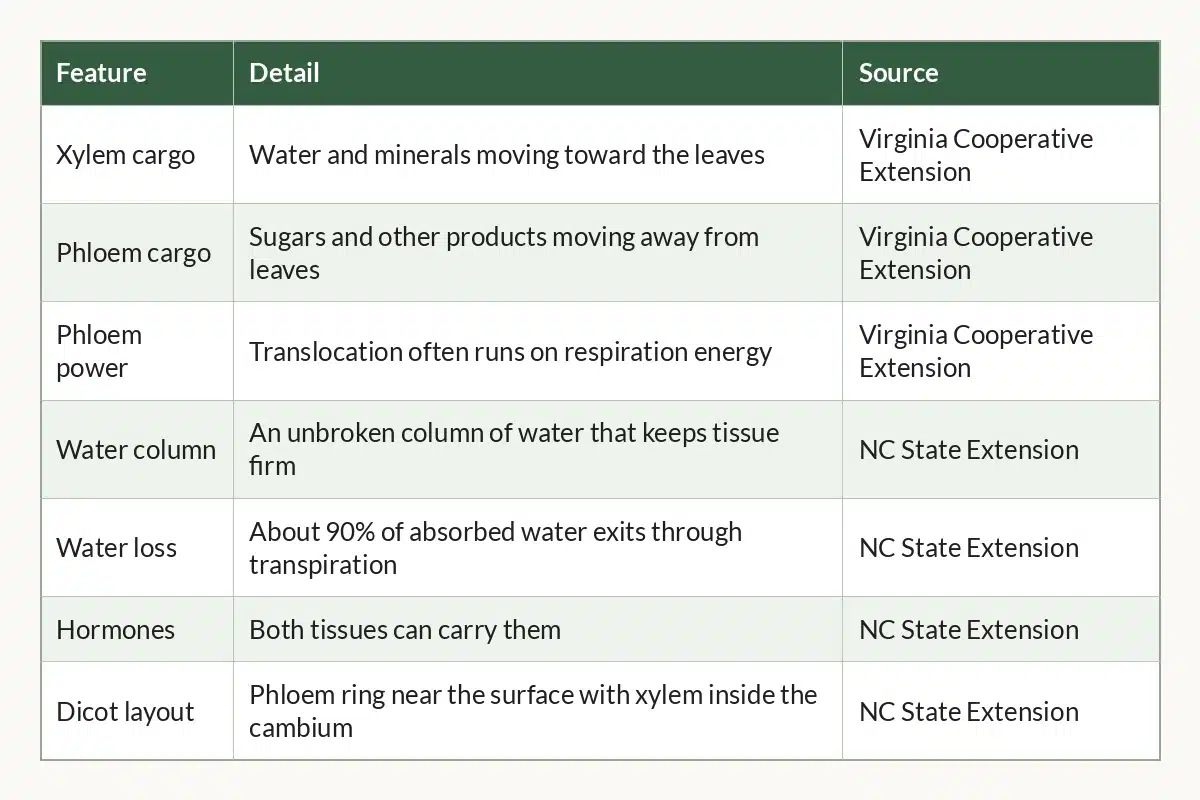
Cannabis Xylem and Phloem at a Glance
| Feature | Detail | Source |
|---|---|---|
| Xylem cargo | Water and minerals moving toward the leaves | Virginia Cooperative Extension |
| Phloem cargo | Sugars and other products moving away from leaves | Virginia Cooperative Extension |
| Phloem power | Translocation often runs on respiration energy | Virginia Cooperative Extension |
| Water column | An unbroken column of water that keeps tissue firm | NC State Extension |
| Water loss | About 90% of absorbed water exits through transpiration | NC State Extension |
| Hormones | Both tissues can carry them | NC State Extension |
| Dicot layout | Phloem ring near the surface with xylem inside the cambium | NC State Extension |
Where Are Xylem and Phloem in a Cannabis Stem?
Missouri Extension describes hemp as an annual, dicot, herbaceous plant. That matters because dicots and monocots arrange their vascular tissue differently. NC State explains that dicots lay out their transport tissue as a circle, with phloem close to the outer covering and xylem just inside a thin growth layer called the vascular cambium. The cambium produces new xylem and phloem and makes the stem thicker over time.
Missouri’s industrial hemp guide adds a hemp specific view of stem anatomy. The outer layer has a bark covering that holds bast fibers, and the core contains hurd, the woody inner portion. NC State notes that soft, nonwoody stems hold far less xylem than trees and shrubs do, which fits a stem that lives for a single season.
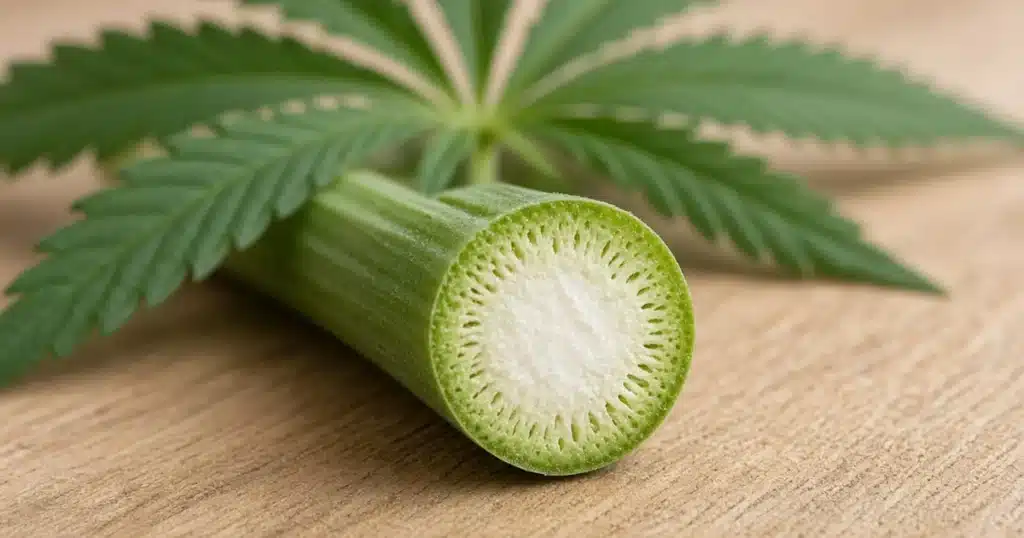
You can see the vascular ring yourself. Cut across a pruned cannabis branch and look at the fresh end. A pale ring sits just under the green skin, wrapped around a softer center. In older, thicker stems the center may be partly hollow, and the woody layer grows thicker as the season goes on.
Because the transport ring sits so close to the surface, damage to the outer stem matters. A stem that is crushed, cracked or tied too tightly can lose part of that ring. Growth above the damaged spot may slow until the plant repairs or reroutes the flow.
What Xylem and Phloem Mean for Growers
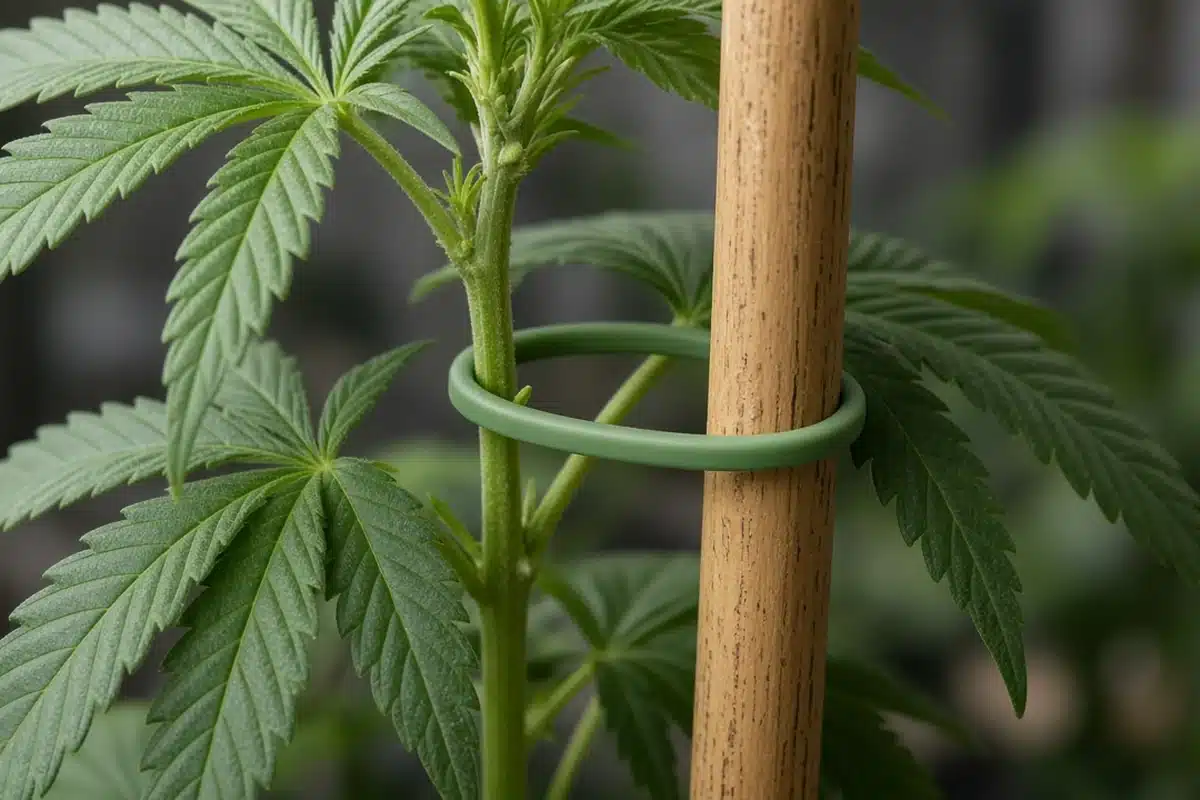
- Keep ties loose. Check plant ties often and loosen them as stems thicken.
- Bend, do not crush. When training, bend stems slowly so the outer tissue stays intact.
- Support heavy branches. Stakes or trellis netting reduce stress on stems in late flower.
- Keep roots working. Xylem can only carry what roots absorb, so keep the root zone moist and airy.
- Manage the climate. Steady temperature and humidity keep transpiration, and nutrient flow, moving.
- Give leaves light. Phloem moves sugar from leaves that are actively making it.
- Inspect after damage. Watch growth above any cracked or bent stem and support it if needed.
A gentle oscillating fan helps here too. It keeps air flowing around the leaves, which supports steady transpiration, and lets stems flex a little the way they would outdoors in a light breeze.
For the cell level processes behind all of this, see our article on cannabis growing at a cellular level.
Troubleshooting Transport Problems
Top wilts after a stem cracks. Part of the xylem ring may be broken. Splint the stem and support it while it recovers.
Growth slows above a plant tie. The tie may be pinching the stem. Loosen it.
Leaves wilt in hot, dry air even with moist soil. Water loss is outpacing uptake. Lower temperature or raise humidity.
New leaves show nutrient issues while the root zone is fed. Slow transpiration can limit delivery. Check airflow and humidity.
Lower leaves fade while buds grow. The plant may be moving resources toward flowers. Review feeding for the stage.
Sources
- Virginia Cooperative Extension, Master Gardener Handbook, Chapter 1 Botany: https://pressbooks.lib.vt.edu/emgtraining/chapter/1/
- NC State Extension, Extension Gardener Handbook, Chapter 3 Botany: https://content.ces.ncsu.edu/extension-gardener-handbook/3-botany
- University of Missouri Extension, Industrial Hemp (MX80): https://extension.missouri.edu/publications/mx80
FAQ
What is the difference between xylem and phloem?
Xylem moves water and minerals up from the roots. Phloem moves sugars from the leaves to growing and storage areas.
Does cannabis have vascular bundles in a ring?
Yes. As a dicot, cannabis arranges its vascular tissue in a ring close to the stem surface.
Can xylem and phloem carry hormones?
Yes. Both tissues can move hormones through the plant.
Why does a crushed stem slow growth?
The transport tissues sit near the surface, so crushing can block water and sugar flow.
How much water does a plant lose through transpiration?
Roughly nine tenths of what it takes up, with the rest used in chemical reactions and tissue.