
White Grubs in Cannabis Soil: Find and Fix Them
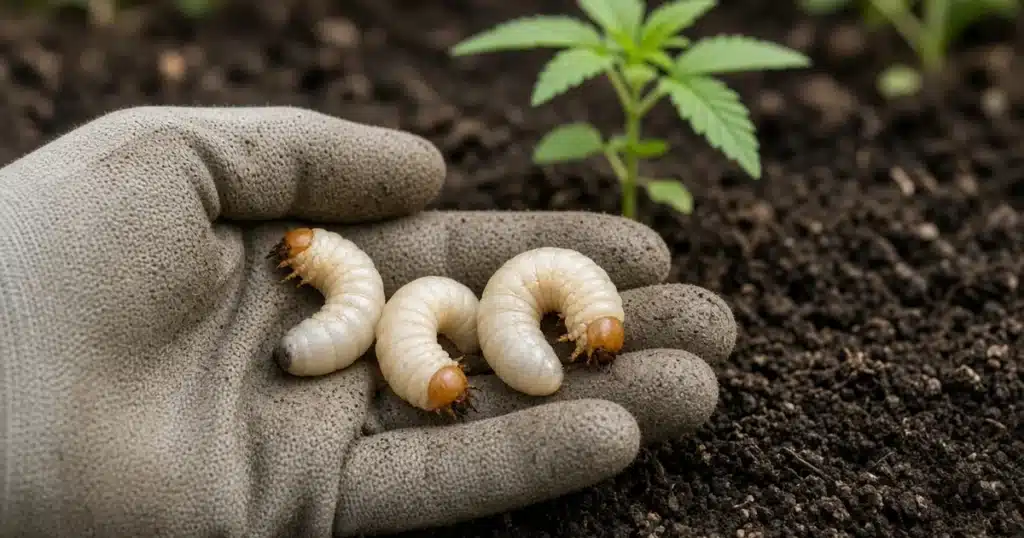
White grubs in cannabis soil are easy to recognize once you have seen one. They are plump, cream-colored larvae that curl into a tight C shape when you lift them out of a clod. University of Maine Cooperative Extension describes them as a group of beetle larvae in the scarab family with brown heads, and they live in the soil eating roots. A few in a large bed rarely matter. A dense patch under a young plant can be a different story, so it pays to know what you are looking at and when to act.
What exactly is a white grub?
"White grub" is not one species. It is a name for the larvae of several scarab beetles. University of Maine Extension lists the immature stages of European chafer, Japanese beetle and the May beetles or June bugs as the common ones in home gardens. The adults look nothing alike, but the larvae share the same shape and habits.
UW-Madison Extension gives a clear description of the May and June beetle larva. It has a distinctly C-shaped, cream-colored body, a reddish-brown head and three pairs of legs near the head end. Grubs can reach about 1 1/4 inches long and use strong mouthparts to chew on roots.
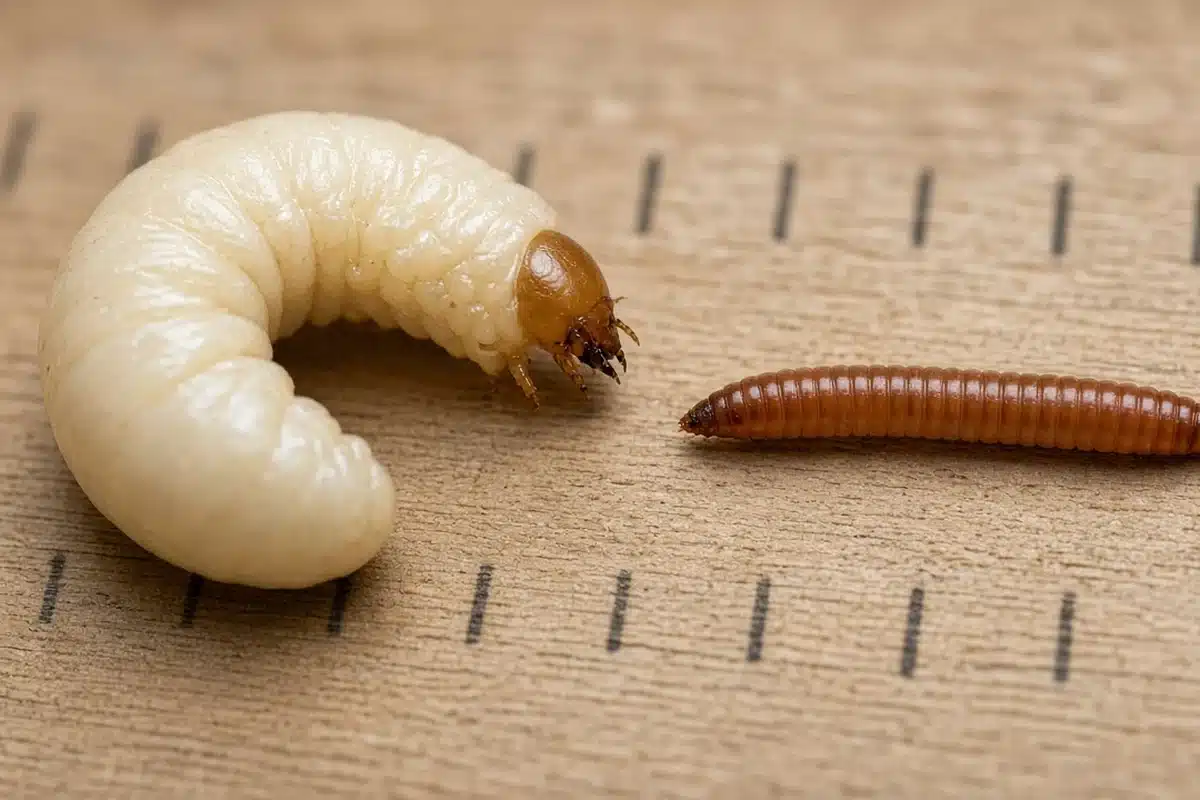
That shape is the quickest way to separate grubs from other soil larvae you might dig up in an outdoor bed:
- White grubs are soft, fat and curled, with a darker head and legs bunched up front.
- Wireworms are slim, straight and hard-bodied. University of Maine Extension describes them as cylindrical, brownish to yellow and about 1 1/2 inches long. Wireworms in cannabis soil, a separate Kind Seed Co article, goes into that pest in detail.
- Cutworms are caterpillars that feed at night and cut small plants off at or near the soil line.
If you are unsure what you have found, UW-Madison Extension recommends taking the larva to your local Extension office for identification, because grubs of different beetles can turn up in the same garden.
Why new beds are hit hardest
The single best predictor of a grub problem is what the ground was before it became a garden. University of Maine Extension notes that white grubs are most likely to damage plants in or near ground that was recently covered in sod. Lawn grass is the natural food source for many scarab larvae, so when a strip of lawn is turned into a cannabis bed, the grubs living under the turf are suddenly left with your transplants as the main roots on offer.
Adult beetles also play a part. UW-Madison Extension explains that May and June beetle adults are active after dusk in late May and early June, are drawn to lights at night and often bump into window screens. Females burrow into the soil to lay eggs, and the grubs that hatch feed on plant roots. Lawns and grassy edges near a bed can keep supplying new grubs year after year.
How the life cycle shapes your timing
The May and June beetle species that UW-Madison Extension describes mostly take three years to go from egg to adult, and one widespread species takes two. Over the first two years the larvae pass through three growth stages, getting larger and more destructive at each stage. Late in the summer and fall of their final year they pupate in the soil, and the adults emerge the following spring.
Because generations overlap, adults can show up every year. UW-Madison Extension adds that in some places one generation is much larger than the others, which can mean a heavy beetle flight every third year. For a grower, the practical point is that a bad grub year in a bed can be followed by a quiet one, and the reverse.
Signs that grubs are feeding on roots
Grub feeding is hidden, so the first clues show up above ground. UW-Madison Extension notes that white grubs damage plants by feeding on roots and disrupting the uptake of water and nutrients, and that early signs look much like drought stress. Watch for:
- Leaves that yellow or wilt even though the soil is moist.
- Young plants that stall and stay small while neighbors keep growing.
- A plant that wobbles or lifts easily because it has lost much of its root system.
- Animals digging in the bed. UW-Madison Extension lists skunks, raccoons and turkeys among the animals that dig and forage for grubs, often causing more damage than the grubs themselves.
UW-Madison Extension also points out that grubs can kill small plants but tend to have less effect on larger plants with bigger, sturdier root systems. That is why the risk to cannabis is highest in the weeks right after transplanting.
How to check a bed for grubs, step by step
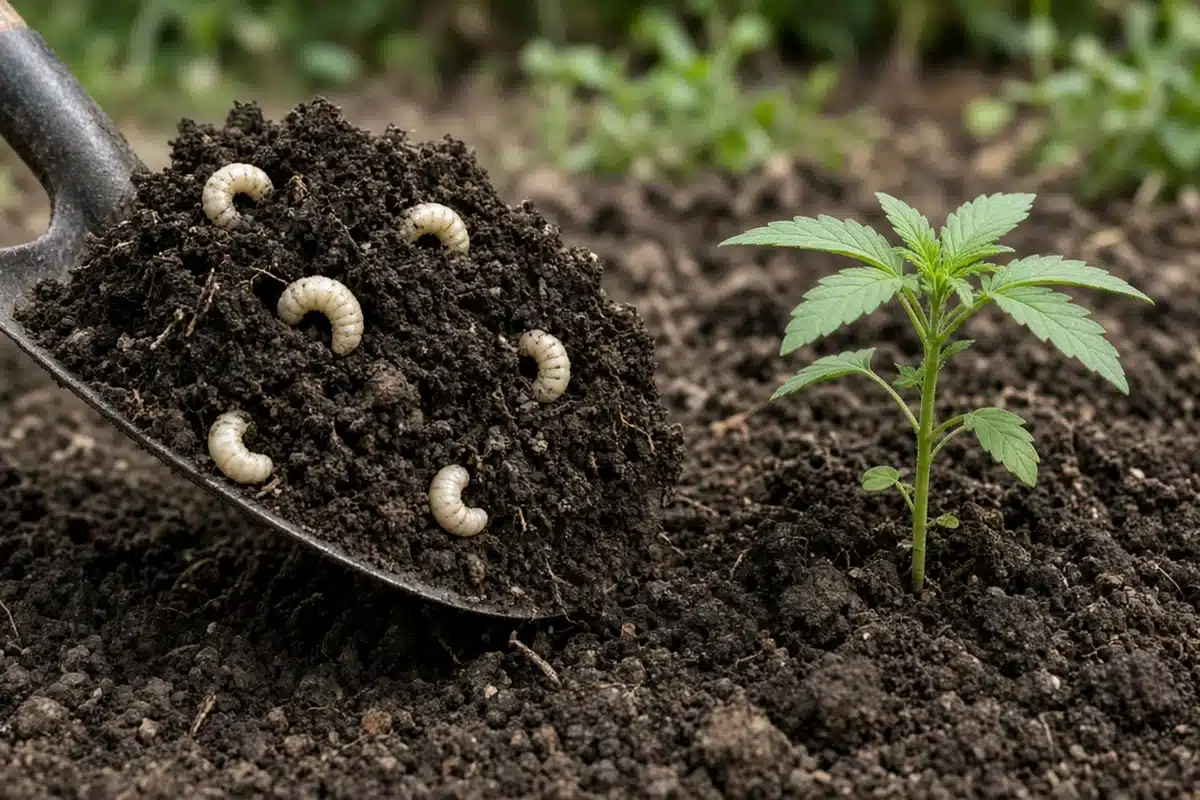
A simple dig test tells you more than any guess. Do it before planting a converted lawn area and again if a young plant starts to stall.
- Pick a few spots spread across the bed, including any area that was recently sod.
- Cut a square of soil roughly a spade blade wide on each side and lift it out to about the depth of the spade.
- Break the soil apart over a tarp or tray and count any C-shaped grubs you find.
- Check the root zone of any struggling plant the same way, working gently from the side so you do not cut the main roots.
- Note the counts for each spot so you can compare them with later checks.
- Bag a few grubs and take them to your local Extension office if you need a firm identification.
No universal threshold exists for cannabis beds. As a general rule, a grub or two in several squares is common in garden soil, while many grubs packed around one plant’s roots is worth acting on.
Protecting young cannabis plants
UW-Madison Extension advises that control is rarely needed unless an area has a history of damage, and that monitoring and knowing local history go a long way toward predicting trouble. Most home growers can manage grubs with cultural steps.
- Prepare converted beds early. Turning and breaking up sod well ahead of planting exposes grubs, and many are picked off by birds. Hand-pick any you see as you work.
- Keep plants vigorous. UW-Madison Extension notes that good irrigation and general plant care help reduce the impact of grub damage, which matters most while the root system is small.
- Start with sturdier transplants. A plant with a well-developed root ball tolerates some root loss better than a tiny seedling.
- Hand-check planting holes. Before setting each transplant, loosen the hole and remove any grubs you find.
- Consider beneficial nematodes. University of Maine Extension lists beneficial nematodes as an option for controlling the soil-dwelling larval stages of these pests. Follow the product label closely on timing and soil moisture.
- Use containers or raised beds with fresh mix where a converted lawn area keeps producing grubs.
If chemical control ever seems necessary, UW-Madison Extension recommends confirming the identification first and following all label directions. Product choice is not covered here, so ask your local Extension office for options that fit your situation.
Troubleshooting common grub questions
Plants wilt but the soil is wet. Dig carefully beside the plant and look at the roots. Grubs, root rot and waterlogging can all cause wilting in moist soil. Chewed, missing fine roots with larvae nearby point toward grubs. A clean dig with dark, mushy roots points elsewhere. If the roots look healthy and no larvae turn up, a lab report can rule out a nutrient or pH cause, and soil testing for cannabis shows how to collect a good sample.
Animals keep digging up the bed. Skunks and raccoons dig for grubs. Check the disturbed spots for larvae. Reducing the grub population and protecting young plants with a temporary wire cage usually solves both problems.
You find grubs but plants look fine. Leave them be and keep monitoring. Larger plants with strong root systems often outgrow light feeding, as UW-Madison Extension notes.
Grubs appear in a container. Potting mix rarely carries them, so look for a beetle that laid eggs in a pot left outdoors near a lawn. Repotting into fresh mix and keeping pots off the grass helps.
Sources
- University of Maine Cooperative Extension. Soil Insect Pests of Vegetables, Pest Management Fact Sheet 5045. https://extension.umaine.edu/ipm/5045e/
- UW-Madison Extension. May/June Beetles (XHT1240). https://hort.extension.wisc.edu/files/2015/04/MayJune-Beetles.pdf
FAQ
Are white grubs bad for cannabis plants?
They can be. White grubs feed on roots, and UW-Madison Extension notes that early damage looks like drought stress, with yellowing, wilting and stunting. Young transplants are most at risk because grubs can kill small plants, while larger plants with strong root systems usually tolerate light feeding much better than seedlings do.
Where do grubs in a new garden bed come from?
Most come from the lawn that used to be there. University of Maine Extension notes that white grubs are most likely to damage plants in or near ground that was recently sod-covered. Scarab beetles lay eggs in grassy areas, so beds cut from lawn often start out with a resident grub population.
How can I tell a grub from a wireworm?
Look at the shape and feel. White grubs are soft, cream-colored and curled into a C with a brown head and legs near the front. Wireworms are slim, straight, hard-bodied and brownish yellow. Both live in soil and feed below ground, but they belong to different beetle families and behave differently.
Do I need to treat every grub I find?
No. UW-Madison Extension says control is rarely needed unless an area has a history of damage. A few grubs scattered through a bed are normal. Focus on dig tests, hand-picking, healthy transplants and keeping young roots protected, and save stronger steps for beds with heavy, repeated grub counts.


