
Drip Irrigation for Cannabis: A Simple Setup Guide
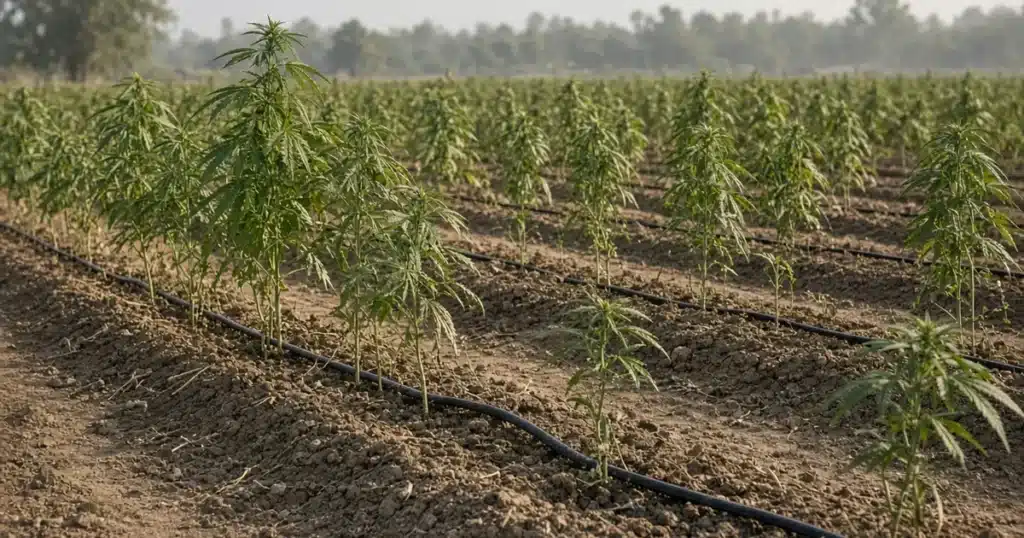
Drip irrigation for cannabis puts water at the root zone through tape or emitters, so plants get water where they use it. Colorado State Extension puts drip application efficiency at about 90%. In field hemp, Oregon State found plants more drought-tolerant than they look, with growth rising up to about 25 to 30 inches of seasonal irrigation.
Why Use Drip Irrigation for Cannabis?
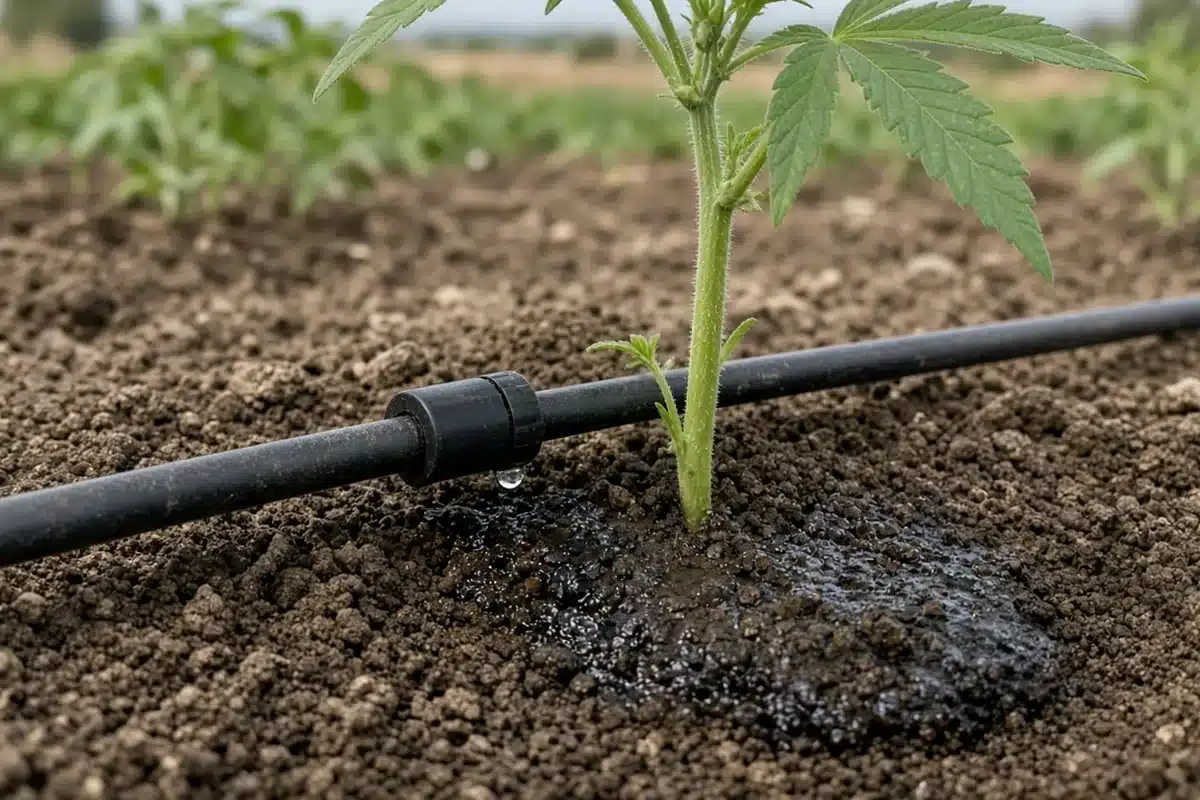
Colorado State Extension says drip applies low volumes of water efficiently, with application efficiency of about 90% (CSU Extension). Oregon State notes that hemp growers have often irrigated with drip tape under plastic mulch (Oregon State EM 9571). Kentucky State adds that drip helps water transplants while they establish in the field (Kentucky State). Our post on mulch covers what goes over the soil.
How Much Water Does Outdoor Hemp Need?
In Southern Oregon trials on CBD-type field hemp, growth of stems, leaves and side colas rose steadily from nearly zero up to about 25 to 30 inches of total seasonal irrigation (Oregon State EM 9571). Full-season varieties took 120 to 140 days and grew 5 to 7 feet tall, while autoflower types took 70 to 90 days at 2 to 3 feet. UF/IFAS gives ½ to 1 inch per week through drip for hemp grown for flower in Florida (UF/IFAS EDIS).
Source: Oregon State Extension EM 9571 (CBD-type field hemp).
Data for this chart:
| Type | Season length | Height | Source |
|---|---|---|---|
| Full-season | 120 to 140 days | 5 to 7 feet | OSU EM 9571 |
| Autoflower | 70 to 90 days | 2 to 3 feet | OSU EM 9571 |
How Do You Set Drip Run Times?
Colorado State bases run times on six inputs: soil water-holding capacity, allowed depletion for the crop, current and maximum rooting depth, water already depleted, tape flow rate and efficiency (CSU Extension). It notes crops pull about 70% of available water from the upper half of the root zone, and warns that watering until a wide wet band shows on the surface can push water below the roots. Our watering guide covers hand watering.
Drip Irrigation With Plastic Mulch: How Does It Work?
Oregon State describes widely spaced hemp on drip tape under plastic mulch as a common setup (Oregon State EM 9571). UF/IFAS says liquid fertigation can be applied weekly for flower production under plasticulture (UF/IFAS EDIS). Good soil prep matters too, so see the best soil for growing outdoors.
Setting up a field or backyard plot? Our outdoor seeds are listed here.
For a shorter season, there are also autoflower seeds.
Sources
Some sources below studied hemp or other crops rather than drug-type cannabis, and their findings are reported as results for those crops.
- Colorado State University Extension: Determining Irrigation Run Times With Drip Tape
- Oregon State Extension EM 9571: Optimum Irrigation for CBD-Type Hemp in the Field
- Kentucky State University: Organic Hemp for Cannabinoid Extraction
- UF/IFAS EDIS SL521: Nutrient Management Recommendation Series, Hemp
This drip guide is general growing information from Kind Seed Co, with the sources above as its basis.
FAQ
Where do most roots take up water under drip?
Colorado State Extension says crops extract about 70% of their plant-available water from the upper half of the root system. That is why it suggests checking soil moisture partway down the root zone rather than at the surface, and why heavy watering that soaks far below the roots wastes water and nutrients.
Should drip run on a fixed schedule?
Colorado State recommends basing drip run times on soil water-holding capacity, allowed depletion for the crop, rooting depth, water already used and tape flow rate. It warns that over-watering can leach nitrate below the roots and leave less air in the soil, while too little water also hurts plant health.
How much water does field hemp use?
In Southern Oregon trials on CBD-type hemp, growth of stems, leaves and secondary colas rose steadily with irrigation up to about 25 to 30 inches of total seasonal water. Oregon State also found hemp more drought-tolerant than its lush look suggests. Those results come from field trials of both full-season and autoflower types.
Do autoflowers need less water?
In Oregon State's field trials, autoflower hemp completed its cycle in 70 to 90 days and could be harvested by late July, avoiding the high water demand of August and early September. Full-season varieties took 120 to 140 days. Autoflowers also grew only 2 to 3 feet tall, compared with 5 to 7 feet.


