Mulch For Cannabis: Best Types, Depth And Timing

Quick answer: Mulch for cannabis is a layer of straw, shredded leaves, dried grass clippings, compost or bark spread over the soil around outdoor plants. It holds moisture, evens out soil temperature and blocks garden weeds. Iowa State University says 2 to 4 inches is generally effective. Put it down after the soil warms, and keep it 2 to 3 inches away from the stem.
What Mulch Does for Cannabis Plants
University of New Hampshire Extension defines a garden mulch as any material spread on the soil surface to change the environment where the plant is growing. Iowa State University lists the main benefits:
- Controls annual garden weeds.
- Conserves soil moisture.
- Moderates soil temperature.
- Reduces soil erosion.
University of Wisconsin Madison Extension adds that mulch reduces erosion and crusting because rain strikes the mulch rather than splashing on bare soil, and that it helps protect plants from disease spores splashed up from the soil. Mulch also retains moisture by cutting evaporation from the soil surface, which pairs well with the basics in our guide to watering cannabis plants.
Think of mulch as a blanket, not a feed. Some types add organic matter as they break down, but woody types can even pull nitrogen from the soil while they decompose, as UNH notes for hardwood and pine bark.
How Organic Mulch Changes Soil Temperature
Wisconsin Extension says that in summer, organic mulches tend to buffer soil temperature by keeping the ground cooler in the daytime and warmer at night. They also add organic matter to the soil and do not have to be removed at the end of the season.
Best Mulch for Outdoor Cannabis
Organic mulches come from plant material, and Extension guides agree on a few that suit vegetable style beds.
| Mulch | Depth | Notes |
|---|---|---|
| Straw | 4 to 6 inches (Wisconsin) | Packs down, so apply deeper than other organic mulches |
| Shredded leaves | 3 to 4 inches (UNH) | Shred or compost first to prevent matting |
| Dried grass clippings | 2 to 3 inches (UNH) | Dry 2 to 3 days first, since fresh clippings may mat |
| Compost | 2 to 3 inches (UNH) | Adds nutrients but may carry weed seeds |
| Shredded hardwood or pine bark | 2 to 3 inches (UNH) | Extra nitrogen needed |
| Pine needles | 3 to 4 inches (UNH) | Easy to apply and slow to break down |
Straw
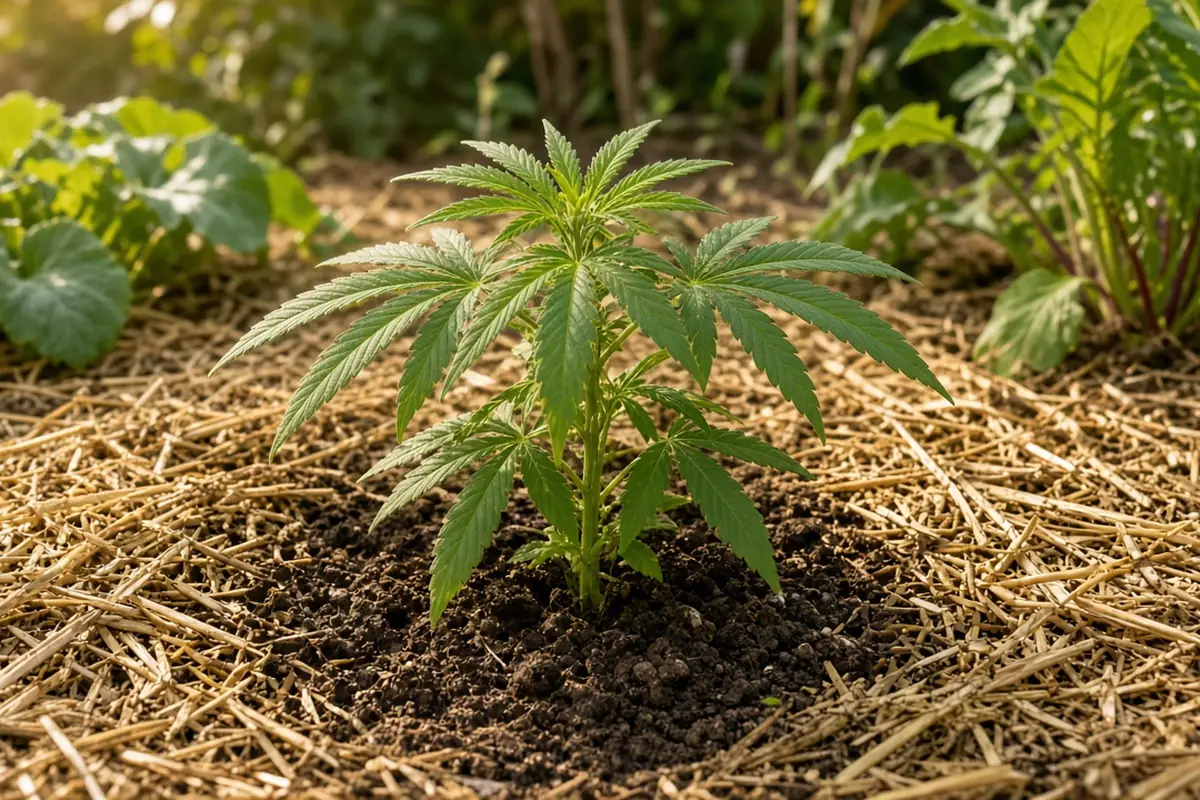
Iowa State University calls straw an excellent mulch for the vegetable garden. It is less likely to mat and smother plant crowns, but Iowa State warns it may give mice and other rodents a winter home near trees and shrubs. Choose straw that is free of seeds.
Leaves, Clippings and Compost
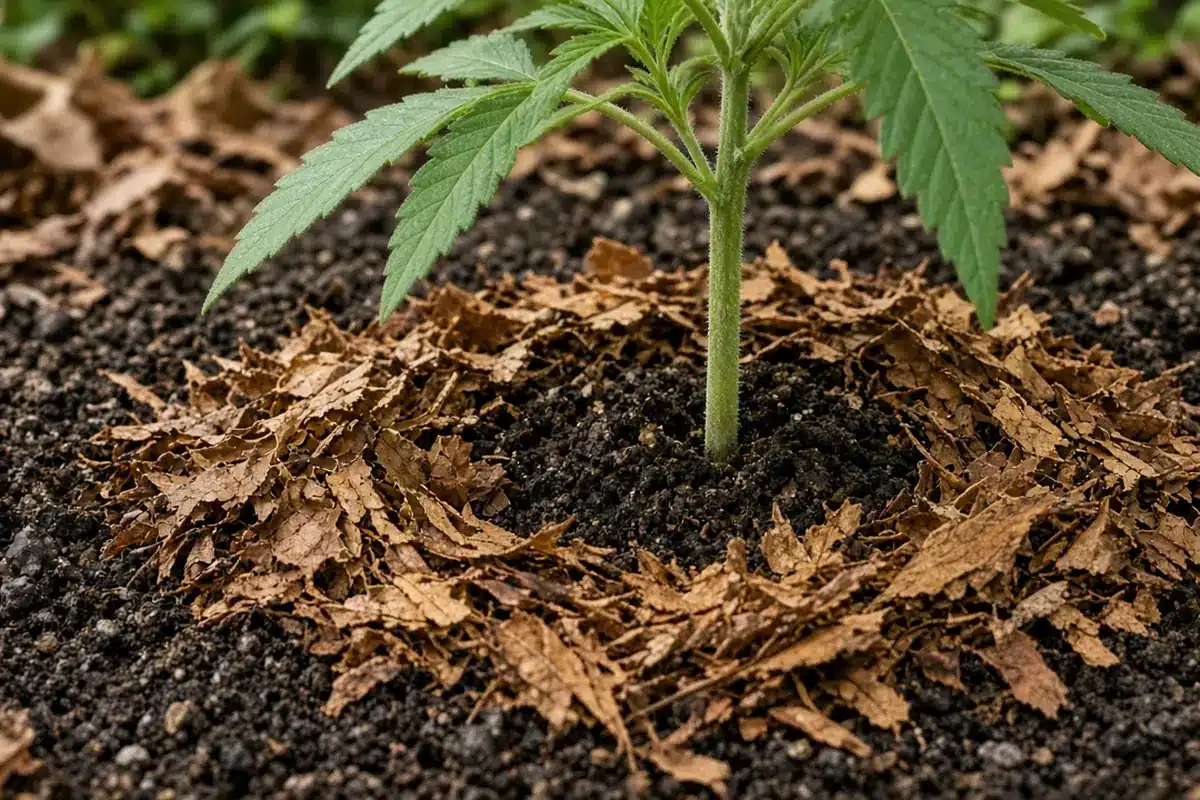
Shred or compost leaves before using them to prevent matting. UNH says to let grass clippings dry for 2 to 3 days first, since fresh clippings may mat. UNH also notes compost is an excellent source of nutrients but could carry weed seeds if it is not fully finished.
Wood Chips and Bark
UNH says shredded hardwood and pine bark mulches need extra nitrogen. Bark and wood chips break down slowly and suit paths and perennial areas better than an annual cannabis bed. Iowa State suggests coarser mulches like wood chips at the deeper end of the 2 to 4 inch range.
How Deep to Mulch Cannabis
Iowa State University says 2 to 4 inches is generally effective, with coarser mulches at the higher end and finer mulches such as grass clippings at the lower end. A thin layer is less effective at weed suppression and moisture conservation and needs frequent topping up. An overly deep layer can lead to waterlogging, reduced soil oxygen and shallow rooting.
Young transplants get less mulch at first. Wisconsin Extension says vegetables grown from transplants should be mulched sparingly, about 1 inch, while young, then gradually raised to 3 inches as plants grow taller.
When to Mulch Outdoor Cannabis
UNH Extension says all natural mulches should go down after the crop has begun to grow and after the soil has warmed. Iowa State says that in early spring you should wait until the ground warms, since mulching too early can insulate the ground and slow growth. Wisconsin adds that sandy soils warm up faster than heavy clay soils, so mulch can often go down sooner on sandy ground.
How to Mulch Around Cannabis Plants
- Clear garden weeds first. UNH says to weed the area well before applying mulch.
- Water the bed. UNH says the soil should be weed free and moist when natural mulches go down.
- Wait for warm soil. Mulch after the soil has warmed and your plants are growing, as UNH and Iowa State advise. Before you plant cannabis outdoors, check your state’s home grow law.
- Choose the material. Use the table above to pick a mulch and its depth.
- Spread it over the whole bed. UNH says to spread mulch over the entire planting area.
- Start thin around young plants. Wisconsin says about 1 inch for young transplants, rising to 3 inches as they grow.
- Keep a gap at the stem. UNH says to keep mulch 2 to 3 inches away from the base of plants to avoid conditions that encourage disease or attract rodents.
- Top up as it breaks down. Iowa State says a thin layer needs frequent replenishment to keep working.
UNH also warns not to form a mulch volcano, a mound piled up at the base of the plant.
Plastic Mulch and Landscape Fabric
Wisconsin Extension says synthetic mulches keep the soil warmer than bare soil in summer. Clear plastic warms the soil the most, averaging 9°F above uncovered soil, while black plastic warms it about 5°F. UNH calls black plastic excellent for conserving moisture and warming the soil, but it does not break down and has to be removed after each crop.
UNH says landscape cloth woven from fabric, plastic or paper lets water and air move through. In a hot summer bed, organic mulch is usually the cooler choice for cannabis roots.
Mulch Indoors
Colorado State University researchers note that indoor living soil beds kept in continuous use often carry a surface mulch, and that surface mulches favor the establishment of rice root aphid. If you mulch indoor beds, check the root zone often.
Troubleshooting
Slugs and snails show up. Wisconsin Extension says one drawback of organic mulches is more slug problems, especially in damp weather. Iowa State adds that mulch can also attract snails, sowbugs and earwigs. For prevention, see our guide to protecting marijuana plants from pests and bugs.
The mulch smells like vinegar. Iowa State says mulch stored in very large or soaked piles can turn sour from fermentation and produce compounds toxic to plants. Sour mulch has a strong vinegar or silage odor. Do not use it around plants.
You worry about termites near the house. Keep mulch beds a little away from your foundation.
Yellow, slime or black specks appear on the mulch. Mulch can support fungi and slime molds, Iowa State says. See our guide to slime mold and artillery fungus in mulch.
The soil stays soggy under the mulch. The layer may be too deep. Iowa State says an excessively deep layer can lead to waterlogging and reduced soil oxygen. Thin it to 2 to 4 inches.
Plants look pale after a bark mulch. UNH says woody mulches need extra nitrogen as they decompose. Switch to straw or compost in the root zone.
You want a living cover instead. Growing a crop to protect bare soil is a different method. See our guide to cover crops for cannabis.
Frequently Asked Questions
Is mulch good for cannabis plants?
For outdoor beds, usually yes. Iowa State University says mulches help control annual weeds, conserve soil moisture, moderate soil temperatures and reduce soil erosion. The catch is how you use it. Mulch that is too deep, put down too early or piled against the stem can cause problems, so keep it 2 to 4 inches deep and off the stem.
What is the best mulch for cannabis, and which options are popular for weed suppression and moisture retention?
Straw, shredded leaves, dried grass clippings and compost are popular choices for vegetable style beds, according to Iowa State University, UNH and Wisconsin Extension. Iowa State calls straw an excellent vegetable garden mulch that is less likely to mat. Shredded hardwood suppresses weeds well, but UNH says woody mulches need extra nitrogen.
How thick should mulch be around cannabis?
Generally 2 to 4 inches, says Iowa State University, with finer mulches at the lower end and coarser ones at the higher end. Straw packs down, so Wisconsin suggests about 4 to 6 inches of it. For young transplants, start with about 1 inch and work up to 3 inches as the plants grow taller.
When should you mulch cannabis plants?
After the soil has warmed up. UNH Extension says natural mulches should go down after the crop has begun to grow and the soil has warmed, on weed free, moist soil. Iowa State says mulching too early in spring insulates the ground and slows growth. Sandy soils warm faster, Wisconsin notes, so mulch can go down sooner there.
Should mulch for cannabis touch the stem?
No. UNH Extension says to keep mulch 2 to 3 inches away from the base of plants to avoid conditions that encourage disease or attract rodents, and not to let mulch touch plant stems. Avoid piling it into a mound, sometimes called a mulch volcano, at the bottom of the plant.
Sources
- University of New Hampshire Extension, Garden Mulches fact sheet: https://extension.unh.edu/resource/garden-mulches-fact-sheet
- Iowa State University Extension and Outreach, Using Mulch in the Garden: https://yardandgarden.extension.iastate.edu/how-to/using-mulch-garden
- University of Wisconsin Madison Extension, Mulches for Home Gardens and Plantings: https://hort.extension.wisc.edu/articles/mulches-home-gardens-and-plantings/
- Colorado State University, Journal of Integrated Pest Management 2019 (PDF): https://webdoc.agsci.colostate.edu/hempinsects/PDFs/JIPM_2019.pdf