Drip Trays and Spill Protection for Grow Rooms
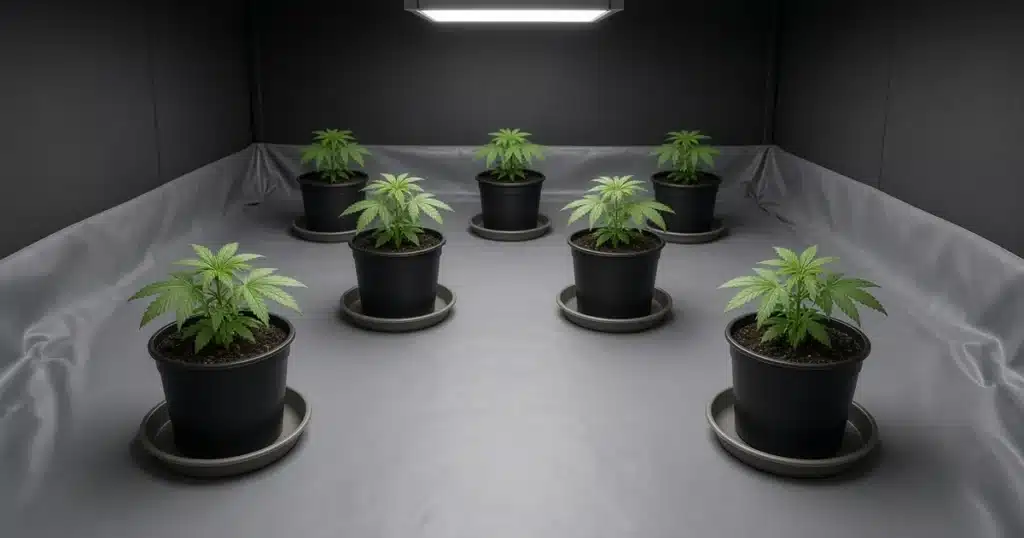
Quick answer: Put every pot on a removable drip tray, empty the runoff soon after watering and keep a waterproof liner under the whole grow. Extension houseplant guides set clear limits. UConn Extension says to empty saucers within about an hour of watering, and Virginia Tech says a pot in a drainage tray should not sit in water for more than 60 minutes. Raise cords and power strips above the floor, and use GFCI protection for anything plugged in near water. Those steps protect both the roots and the room.
Why Do Grow Rooms Need Drip Trays?
Water always finds the floor. Every time you water to runoff, some of it drains out through the pot holes. Without a tray, it soaks the tent floor, spreads under other pots and reaches cords. With a tray, you control where it goes.
Trays also protect the plants. The UConn Extension guide to watering houseplants explains that container plants cannot shed excess water the way garden soil does. Water left in a saucer keeps the potting mix saturated and pushes out the oxygen roots need, so roots stop working well and the plant can look wilted even though it has plenty of water.
Wisconsin Extension describes what follows when that water stays put. Roots short of air struggle, root rot problems become more likely, and foliage can yellow and wilt. Illinois Extension is blunter, noting that waterlogged soil favors root rot and that plants seldom bounce back once it sets in. A tray that gets emptied on time prevents that chain from starting.
These sources address houseplants and container gardens, not cannabis. Cannabis in containers faces the same drainage physics, so the guidance carries over. For how much runoff to aim for in the first place, read our cannabis runoff guide.
How Long Can a Pot Sit in Drip Tray Water?
Not long. The Extension sources agree on a short window.
The Virginia Tech guide to properly watering container houseplants says to let a container drain until water stops dripping from the bottom, and that a pot in a drainage tray should not stay in water for more than 60 minutes. UConn suggests emptying saucers or outer pots within an hour or so of watering.
The University of Wisconsin Extension houseplant care guide gives an even shorter window. It advises giving the pot a short drain of a quarter hour or so before you pour off what collected or lift the pot clear of it. It adds that plants should not stand in water unless they specifically need it.
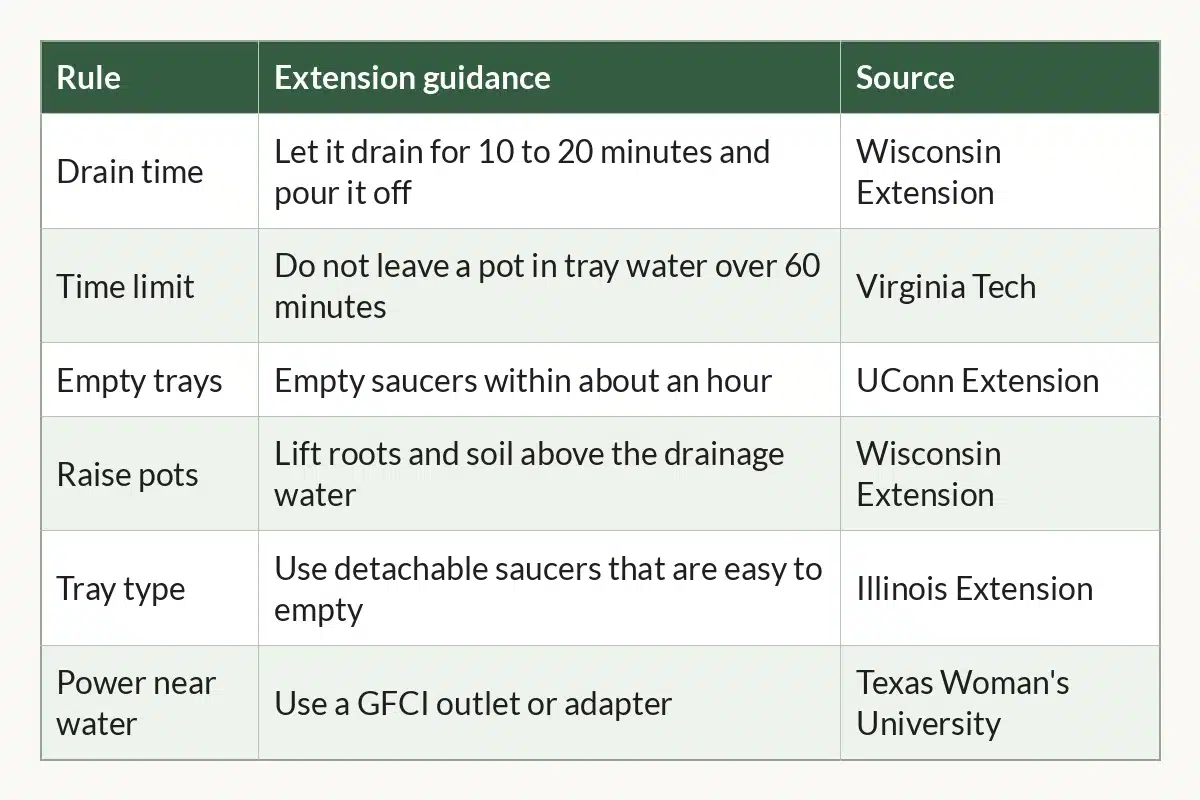
Drip Tray Rules at a Glance
| Rule | Extension guidance | Source |
|---|---|---|
| Drain time | Let it drain for 10 to 20 minutes and pour it off | Wisconsin Extension |
| Time limit | Do not leave a pot in tray water over 60 minutes | Virginia Tech |
| Empty trays | Empty saucers within about an hour | UConn Extension |
| Raise pots | Lift roots and soil above the drainage water | Wisconsin Extension |
| Tray type | Use detachable saucers that are easy to empty | Illinois Extension |
| Power near water | Use a GFCI outlet or adapter | Texas Woman’s University |
What Kind of Drip Tray Works Best?
One you can empty easily. The Illinois Extension guide to container drainage options cautions against pots whose saucers are fixed in place, since the water that collects in them is hard or even impossible to pour off. Its author describes waterlogged roots from exactly that setup and recommends pots with detachable saucers instead.
A good tray is wide enough to catch the full runoff from one watering and shallow enough to tip out or wipe dry. Rigid trays are easier to lift than flexible ones when full. Raised inserts or small risers inside the tray let the pot sit above any leftover water, which matches Wisconsin’s advice to lift roots and soil above the drainage.
Illinois also makes a point about the hole itself. It calls a drainage hole in the base of a container critical, since it lets water drain freely so roots get enough air. A pot without one turns any tray into a reservoir.
How Do You Protect a Grow Room Floor From Spills?
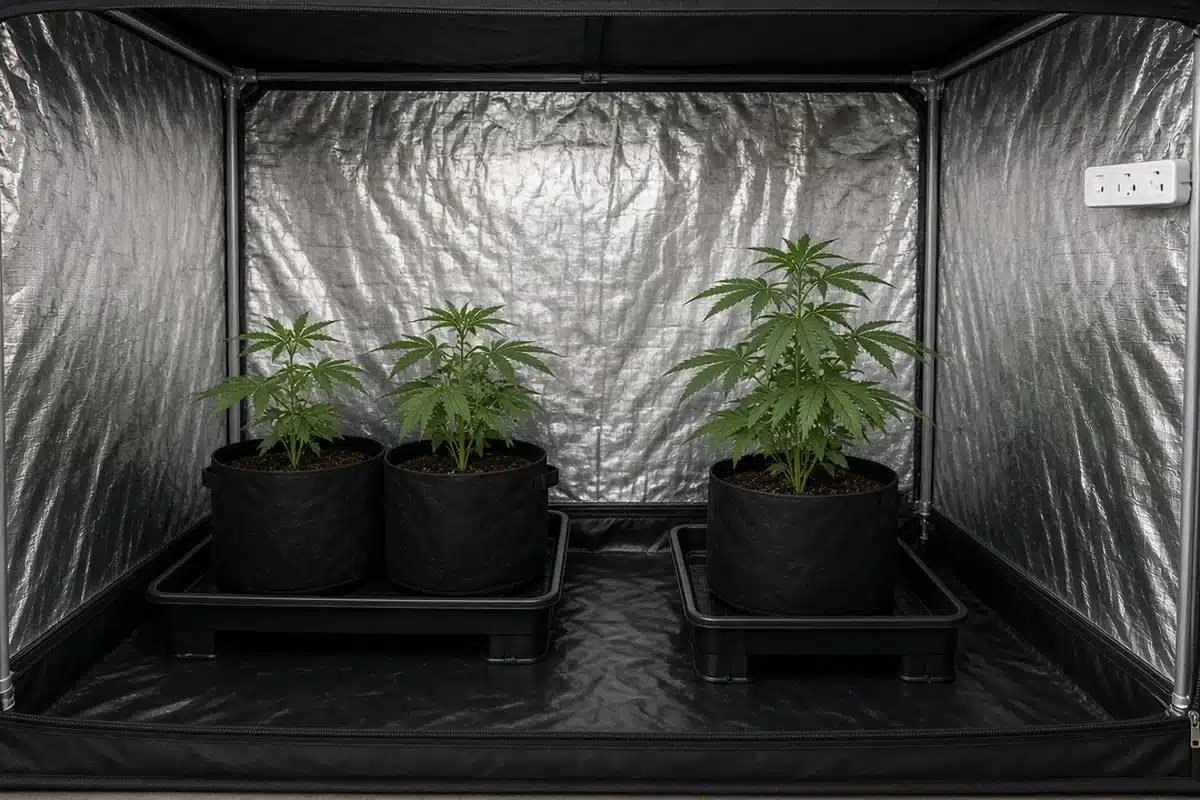
- Lay a waterproof liner under the whole grow. Most tents have a built in floor tray, but a second liner catches leaks at seams.
- Give each pot its own tray. One shared tray spreads runoff from one plant to the roots of another.
- Rewet dry mix gently. UConn notes that very dry mix sheds water down the pot walls, which overfills trays fast.
- Empty trays within the guide windows. Aim for 10 to 20 minutes, and never beyond the hour that Virginia Tech and UConn set.
- Raise pots above leftover water. Wisconsin suggests lifting roots and soil above the drainage.
- Use a wet vacuum or sponge for big spills. Removing water quickly keeps it from spreading under the liner.
- Keep a towel and a spare tray nearby. Spills are easier to control when the tools are within reach.
Our complete grow tent setup guide shows how to lay out pots, liners and cords from the start.
How Do You Keep Water Away From Electrical Gear?
Raise it and protect it. The Texas Woman’s University extension cord and power strip guide requires GFCI protection for any electrical gear used around moisture, either built into the outlet or from an adapter plugged straight into the wall. In a grow room, that covers pumps, fans and lights that share space with trays and reservoirs.
Placement matters as much as protection. Mount power strips on the tent frame or a wall, well above the floor. Route cords up and over rather than along the floor where runoff collects. Keep reservoirs and buckets on the opposite side of the space from your power connections when the layout allows.
Moisture raises the stakes. The Michigan State University Extension farm electrical hazards guide, hosted by the University of Arkansas, explains that electrical risks rise in the presence of moisture. It describes a GFCI as a breaker designed to cut power before a person gets a serious shock and recommends a portable GFCI when tools are used in damp or wet areas. A grow room that is watered several times a week counts as damp.
The same guide warns against grounding adapters, because older two wire circuits have no ground for the adapter to connect to. If the outlet near your grow takes only two prong plugs, have an electrician update it rather than forcing a three prong cord into it with an adapter.
How Do You Water to Reduce Runoff?
Water thoroughly but less often. Virginia Tech notes that overwatering is about how often you water, not how much you apply at once. Watering until a little drains out and then waiting for the mix to dry somewhat keeps runoff volumes predictable.
UConn adds that potting mix that dries out too far pulls away from the pot walls, so water runs straight down the sides into the saucer without wetting the roots. That fast runoff can overflow a tray. Rewetting dry mix slowly, or soaking the pot in a basin, avoids the problem. Our guide to watering marijuana plants covers timing and volume in more detail.
Troubleshooting Drip Tray Problems
Trays overflow every watering. You may be watering too fast, or the mix may be too dry. UConn notes that dry mix lets water rush down the sides into the saucer.
Pots stay soggy for days. Water may be wicking back up from the tray. Empty it within the hour, as Virginia Tech and UConn advise.
Water collects under the tent floor. The trays are overflowing faster than you empty them. Empty saucers within the hour, as UConn advises, and raise pots above the drainage water, as Wisconsin Extension suggests.
A GFCI trips after watering. Water may have reached a connection. TWU requires GFCI protection for electrical equipment near any source of moisture, so the device did its job. Switch off, dry the area and raise the cords before resetting.
Algae grows in trays. Virginia Tech advises cleaning self watering containers periodically to keep algae and waterborne diseases from growing in them, and the same habit suits drip trays.
Sources
- UConn Extension, Watering Houseplants: https://extension.uconn.edu/2013/12/24/watering-houseplants/
- Virginia Cooperative Extension, Properly Watering Container Houseplants (SPES-804): https://www.pubs.ext.vt.edu/content/dam/pubs_ext_vt_edu/spes/spes-804/SPES-804.pdf
- University of Wisconsin Extension, Houseplant Care: https://hort.extension.wisc.edu/articles/houseplant-care/
- Illinois Extension, Container Drainage Options: https://extension.illinois.edu/container-gardens/container-drainage-options
- Texas Woman’s University, Extension Cord and Power Strip Use: https://twu.edu/health-safety/fire-safety/extension-cord-and-power-strip-use/
- Michigan State University Extension, Electrical Hazards on the Farm, hosted by University of Arkansas Cooperative Extension: https://www.uaex.uada.edu/farm-ranch/special-programs/safety-services/farm_safety_docs/Electrical%20Hazards%20on%20the%20Farm.pdf
FAQ
Should cannabis pots sit in drip trays?
Yes, if you empty the trays. Virginia Tech says not to leave a pot in tray water for more than 60 minutes.
How soon should I empty a drip tray?
Wisconsin Extension suggests letting water drain for 10 to 20 minutes and then removing the excess.
Can pots share one big tray?
They can, but runoff from one plant reaches the roots of others. Individual trays keep each plant separate.
Do I need GFCI outlets in a grow room?
TWU requires GFCI protection for electrical equipment used near moisture.
Are attached saucers a problem?
Illinois Extension warns that attached saucers make emptying overflow difficult and recommends detachable ones.