Measuring Leaf Temperature With an Infrared Thermometer
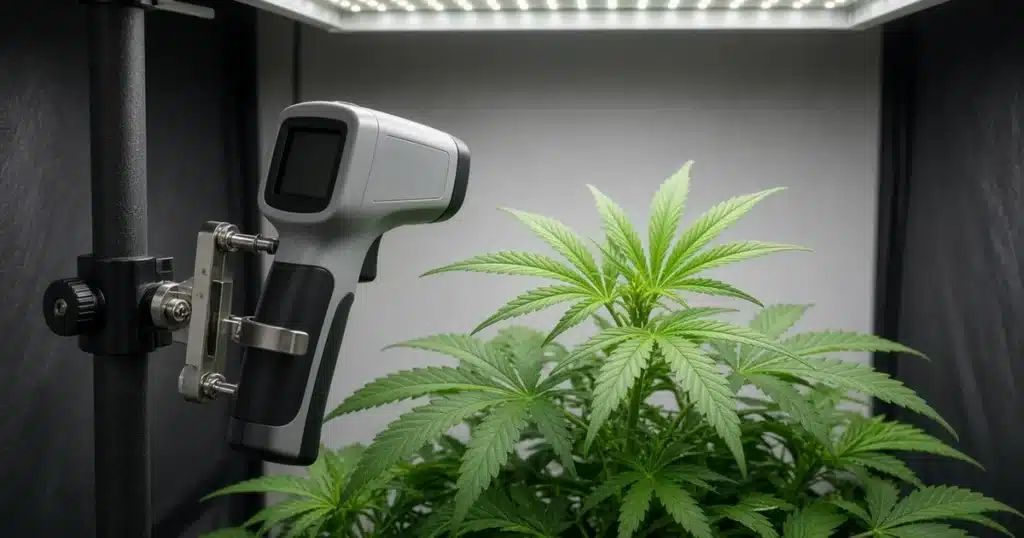
Quick answer: An infrared thermometer measures the surface temperature of whatever it is pointed at, without touching it. To read leaf temperature, hold it close enough that its sensing spot falls only on leaves, aim at lit leaves high in the canopy and take several readings. Rutgers Cooperative Extension explains that the spot an infrared thermometer reads grows wider with distance, so standing too far back mixes in the pots, floor or walls behind the leaf. UMass Extension suggests infrared sensors for tracking leaf temperature alongside air readings at the canopy.
Why Measure Leaf Temperature?
Air readings tell you about the room. Leaf readings tell you about the plant. The Rutgers fact sheet on instruments for monitoring the greenhouse environment says leaf surface temperature is a key sign of how much radiation a plant is taking in and giving off. It adds that leaf temperature has a significant effect on photosynthesis, so leaf readings reveal useful information about plant status.
Leaves rarely match the air exactly. Under strong light they can run warmer. In a dark, cool room they can run cooler. That gap is what makes leaf temperature useful for decisions about heat and humidity.
Growers who track VPD often use leaf temperature instead of air temperature in the calculation. Our cannabis VPD chart explains how leaf temperature fits into those numbers.
How Does an Infrared Thermometer Work?
It reads heat given off by a surface. Rutgers describes it as a line of sight instrument that detects the radiant temperature of whatever it can see. It does not touch the surface. Instead it senses the thermal energy coming from that surface and shows it as a temperature.
That cuts both ways. You can check a leaf in seconds without disturbing it. But the tool has no way of knowing whether it is looking at a leaf, a pot or a wall. It simply averages everything inside its sensing spot.
Rutgers describes the typical handheld model as shaped a little like a hair dryer, with a small round sensor at the front that you aim at the surface. Its 2001 price table listed infrared surface thermometers from about $80 to $600. Prices and features have changed since then, but the basic design has not. Most models show a single number for whatever sits inside the spot, and many add a laser dot to help you aim.
The tool is not a replacement for an air sensor. It answers a different question. An air thermometer tells you how warm the space is, while an infrared reading tells you how warm a particular surface has become under the light, the fan and the room around it.
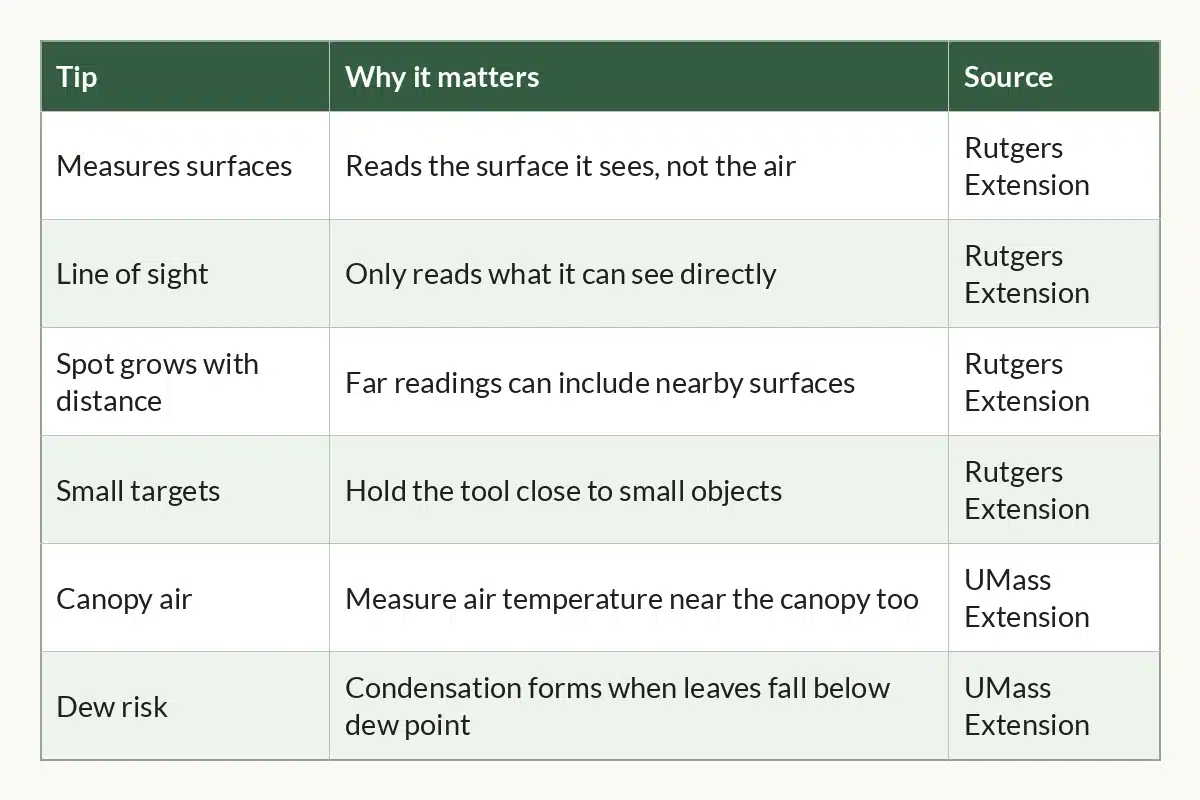
Infrared Thermometer Tips at a Glance
| Tip | Why it matters | Source |
|---|---|---|
| Measures surfaces | Reads the surface it sees, not the air | Rutgers Extension |
| Line of sight | Only reads what it can see directly | Rutgers Extension |
| Spot grows with distance | Far readings can include nearby surfaces | Rutgers Extension |
| Small targets | Hold the tool close to small objects | Rutgers Extension |
| Canopy air | Measure air temperature near the canopy too | UMass Extension |
| Dew risk | Condensation forms when leaves fall below dew point | UMass Extension |
How Far Away Should You Hold an Infrared Thermometer?
Close to the leaf. Rutgers explains that the field of view widens as the distance between the instrument and the object grows. It warns that you should make sure the reading is not also picking up adjacent surfaces. For small objects, it says, the instrument needs to be held close, while a large surface such as a ceiling can be read from several feet away.
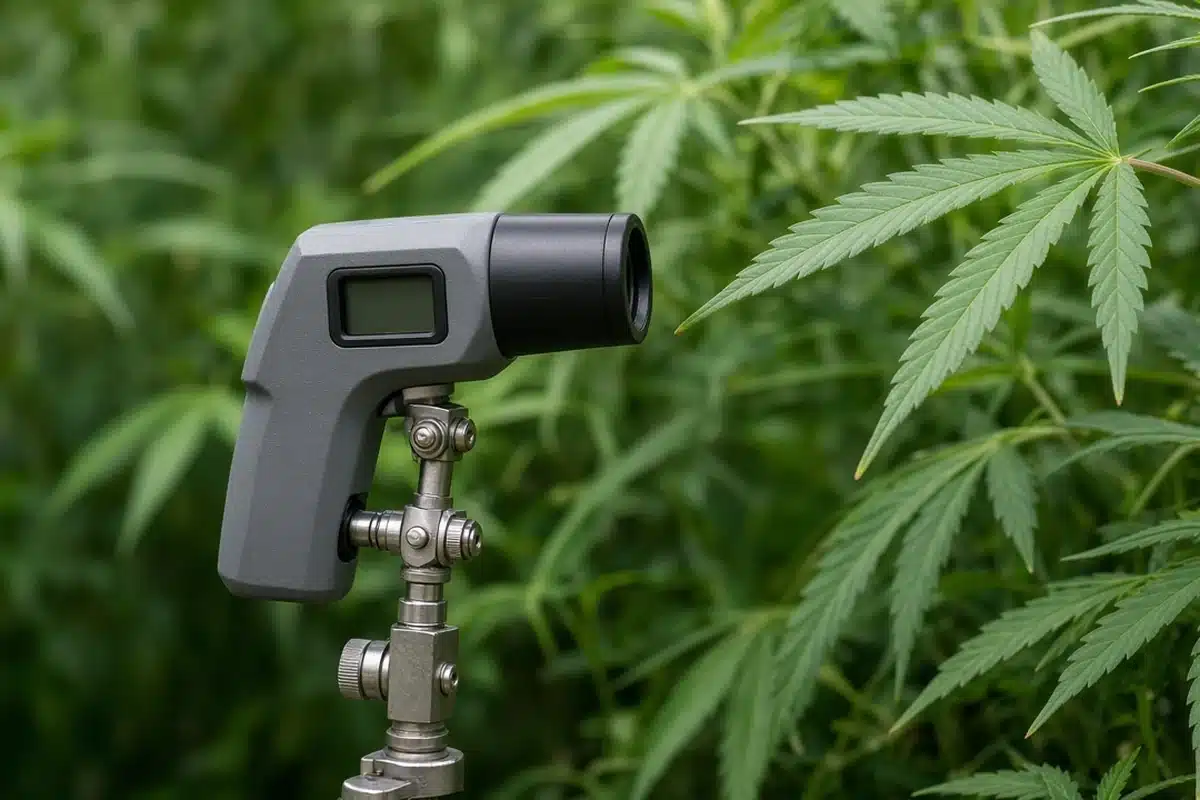
A cannabis leaf is a small target. Hold the thermometer a short distance from it so the sensing spot fits inside the leaf. If your model has a laser pointer, remember that the laser marks the center of the spot, not its edge. The actual reading area is a circle around that dot, and it grows as you step back.
Rutgers also recommends checking all the surfaces plants can see from their position. It explains that walls, glazing and floors affect plants even when the plants barely touch them, because those surfaces trade heat with the leaves by radiation. A quick scan of the tent walls and the underside of the light shows where heat is coming from.
How Do You Take a Good Leaf Reading?
- Pick the right leaves. Choose fully exposed leaves high in the canopy, where light and heat hit hardest.
- Get close. Rutgers says small objects need a close measurement so the spot stays on the target.
- Check what is behind the leaf. If the spot spills past the edge, the reading includes whatever lies beyond.
- Take several readings. Sample leaves in the center and at the edges of the canopy.
- Read the air at the same height. UMass recommends monitoring air temperature at the plant canopy.
- Compare leaf and air. The difference tells you whether leaves run warmer or cooler than the space.
- Repeat at the same times each day. Readings at lights on and late in the light period show the daily range.
- Check walls and fixtures too. Rutgers suggests evaluating all surfaces the plants can see.
What Do Leaf Readings Tell You?
Warm leaves under lights point to heat building at the canopy. Track how the gap between leaf and air changes as the light period goes on. Our guide to cannabis heat stress covers the signs and fixes once readings run high.
Cool leaves matter too, especially when humidity is high. UMass Extension’s Reducing Humidity in the Greenhouse explains that condensation forms on surfaces at or below the dew point, and on the coldest surfaces first. It gives a greenhouse example: at 85 percent relative humidity and 60°F, condensation forms when leaf temperature drops below 55°F. At 95 percent and 60°F, a leaf only one degree cooler than the air will get wet.
That example comes from a greenhouse, but the physics is the same in any growing space. An infrared reading at lights off shows how close your leaves are to that line. If they are close, warming the air slightly or lowering humidity reduces the risk.
UMass also advises in its Mastering Moisture Management handout that the air gets warmer the higher you go in a greenhouse. It suggests separate sensors for plants hanging high up, and it also recommends considering infrared sensors to monitor leaf temperature. In a tall tent, take readings at more than one height.
For broader temperature targets, read our climate targets for grow rooms.
How Do You Keep Readings Consistent?
Use the same method every time. Hold the thermometer the same distance from the leaf, aim at the same part of the canopy and read at the same times each day. Consistency matters more than any single number, because the trend tells you whether a change you made is working.
Write readings down next to the air temperature and humidity from your room sensor. Over a week, a simple log shows whether leaves run warm at the end of the light period or cool before lights on. That record makes it easier to decide whether to adjust heat, airflow or humidity, rather than guessing from one reading.
Troubleshooting Infrared Leaf Readings
Readings jump around on the same leaf. The spot may be catching the edge of the leaf and what lies behind it. Move closer, as Rutgers advises for small objects.
Leaf readings match the floor or pot. You are likely reading the background. Get closer and aim at the middle of a larger leaf.
Leaves read cooler than the air at lights off. That is common. Compare the leaf reading with the dew point, as UMass explains, if humidity is high.
Upper leaves read much warmer than lower ones. UMass notes that temperatures climb higher up in a greenhouse. Measure at canopy height, not at the floor.
Readings differ between two thermometers. Check each one on the same surface. Recalibrate or replace a unit that disagrees.
Sources
- Rutgers Cooperative Extension, Instruments for Monitoring the Greenhouse Aerial Environment (E276): https://horteng.envsci.rutgers.edu/factsheets/e276.pdf
- UMass Extension, Reducing Humidity in the Greenhouse: https://www.umass.edu/agriculture-food-environment/greenhouse-floriculture/fact-sheets/reducing-humidity-in-greenhouse
- UMass Extension, Mastering Moisture Management: https://www.umass.edu/agriculture-food-environment/sites/ag.umass.edu/files/pdf-doc-ppt/handoutlight_temperature_relative_humidity_1_12_2016.pdf
FAQ
Does an infrared thermometer measure air temperature?
No. Rutgers explains that it measures surface temperature. Use a separate air sensor at canopy height.
How close should I hold it to a leaf?
Close enough that the sensing spot fits on the leaf. Rutgers notes the field of view widens with distance.
Why use leaf temperature for VPD?
Leaves can be warmer or cooler than the air. Rutgers says leaf temperature reveals important information about plant status.
When should I take readings?
Check at lights on, late in the light period and at lights off to see the full daily range.
Can leaf temperature warn me about wet leaves?
Yes. UMass explains that condensation forms when leaves fall to or below the dew point.