Power Outage During Flowering: What to Do
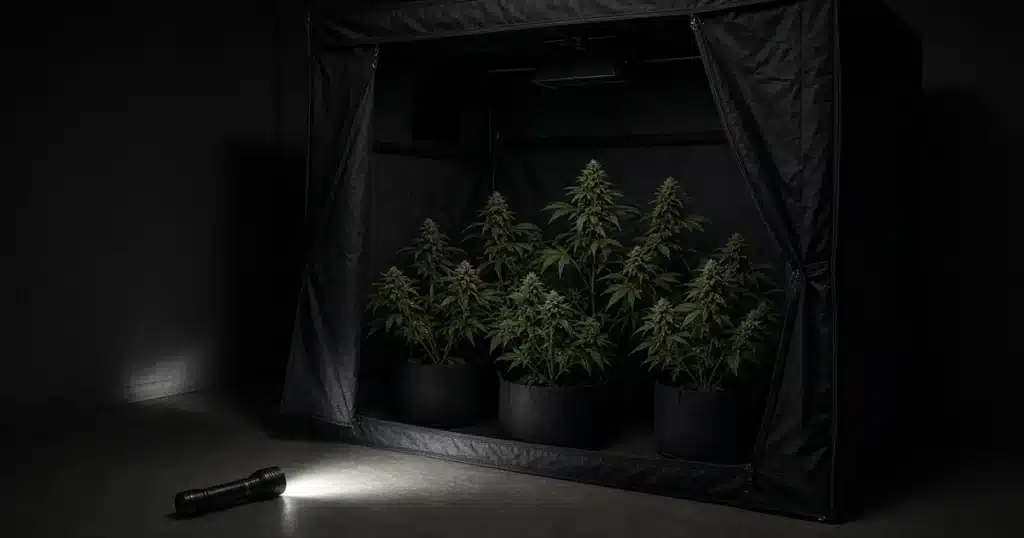
Quick answer: An outage during flowering mostly adds unplanned darkness, which flowering photoperiod plants handle far better than unplanned light. The bigger risks come afterward. Timers can lose their schedule and switch lights on in the middle of the night, and flashlights or open doors can leak light into the dark period. Purdue Extension explains that it is the uninterrupted dark period that controls photoperiod responses, so check your timer, keep the room dark and get back on schedule. If you run a generator, keep it outdoors and away from doors and windows, as Illinois Extension advises.
Is a Power Outage Bad for Flowering Cannabis?
Usually less than growers fear. Photoperiod cannabis flowers in response to long, unbroken nights, which is why indoor growers switch to a 12 hour dark period. Our guide to the cannabis light cycle explains that schedule.
The Purdue Extension guide to managing photoperiod in the greenhouse makes a key point about how plants keep time. While growers talk about day length, it says, the uninterrupted period of darkness is what actually controls the plant’s response. Purdue explains that stretching the natural dark period makes for a shorter day, while shortening it or interrupting it with light makes for a longer one.
An outage during the light period extends the night. That shortens the day, which pushes in the same direction a flowering plant already wants to go. The guide is written for floriculture crops rather than cannabis, but the timing principle is the same.
What Should You Do When the Power Goes Out?
- Note the time. Write down when the outage started so you can work out how much light the plants missed.
- Keep the tent closed. Opening it to check plants is the most common way to leak light into a dark period.
- Do not shine flashlights on the plants. South Dakota State Extension notes that even walking down a greenhouse aisle with a flashlight at night can disturb a photoperiodic crop.
- Switch off or unplug lights and fans. That way nothing surges back on at a random hour when power returns.
- Watch temperature. Without fans or heat, the room drifts toward the house temperature.
- Decide on a generator only if the outage is long. Most short outages need nothing but patience.
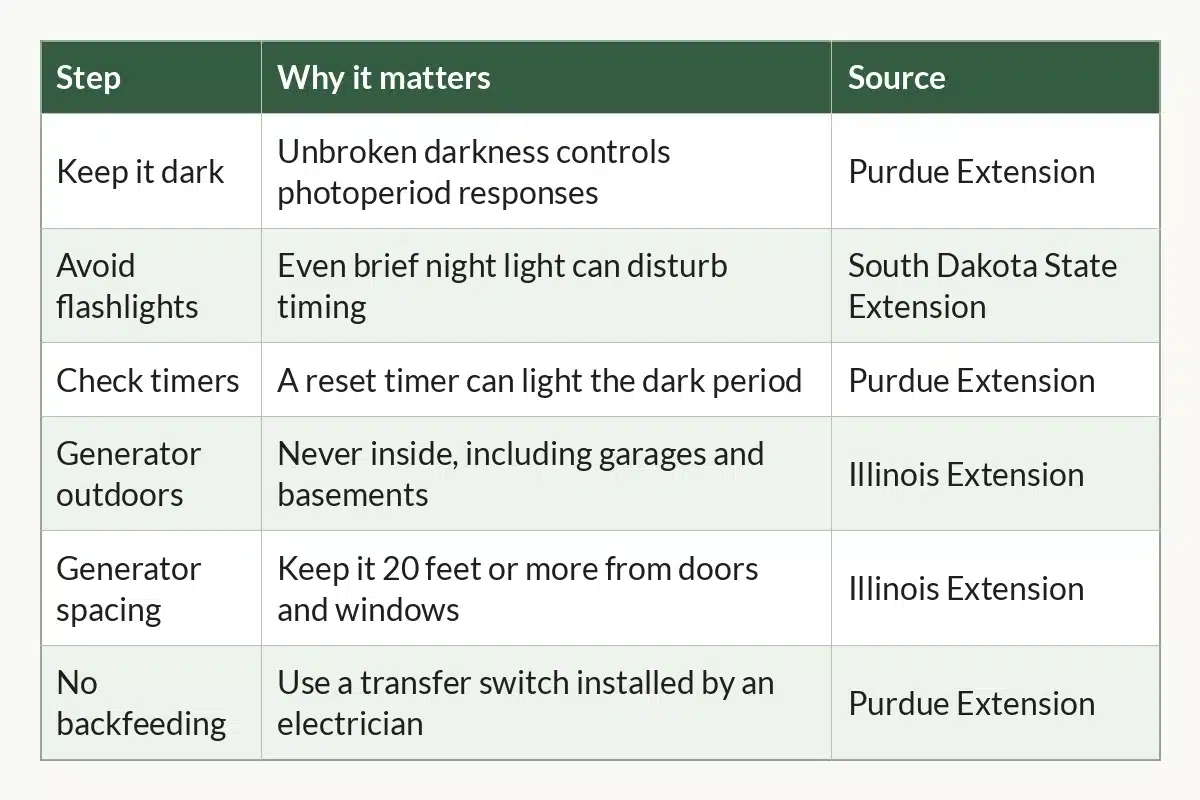
Power Outage Steps at a Glance
| Step | Why it matters | Source |
|---|---|---|
| Keep it dark | Unbroken darkness controls photoperiod responses | Purdue Extension |
| Avoid flashlights | Even brief night light can disturb timing | South Dakota State Extension |
| Check timers | A reset timer can light the dark period | Purdue Extension |
| Generator outdoors | Never inside, including garages and basements | Illinois Extension |
| Generator spacing | Keep it 20 feet or more from doors and windows | Illinois Extension |
| No backfeeding | Use a transfer switch installed by an electrician | Purdue Extension |
Why Is Light During the Dark Period the Bigger Risk?
Because a short burst of light can break the night. The South Dakota State Extension article on photoperiodic poinsettias describes how commercial growers cover poinsettias with blackout cloth to guarantee long nights. It notes that stray light from nearby homes and businesses can delay a poinsettia crop for several weeks, and that even a flashlight in a greenhouse aisle can disturb the timing.
Purdue shows how little light it takes. To create artificial long days through night interruption, it says growers need to deliver at least 10 foot candles of light at plant level. That is far dimmer than a grow light. A lamp switching on at 2 a.m. after a timer reset delivers much more than that.
Both sources address floriculture crops rather than cannabis. Their shared lesson still fits a flowering tent. The danger in an outage is not the dark. It is light arriving when the plants expect night.
How Do You Get Back on Schedule After an Outage?
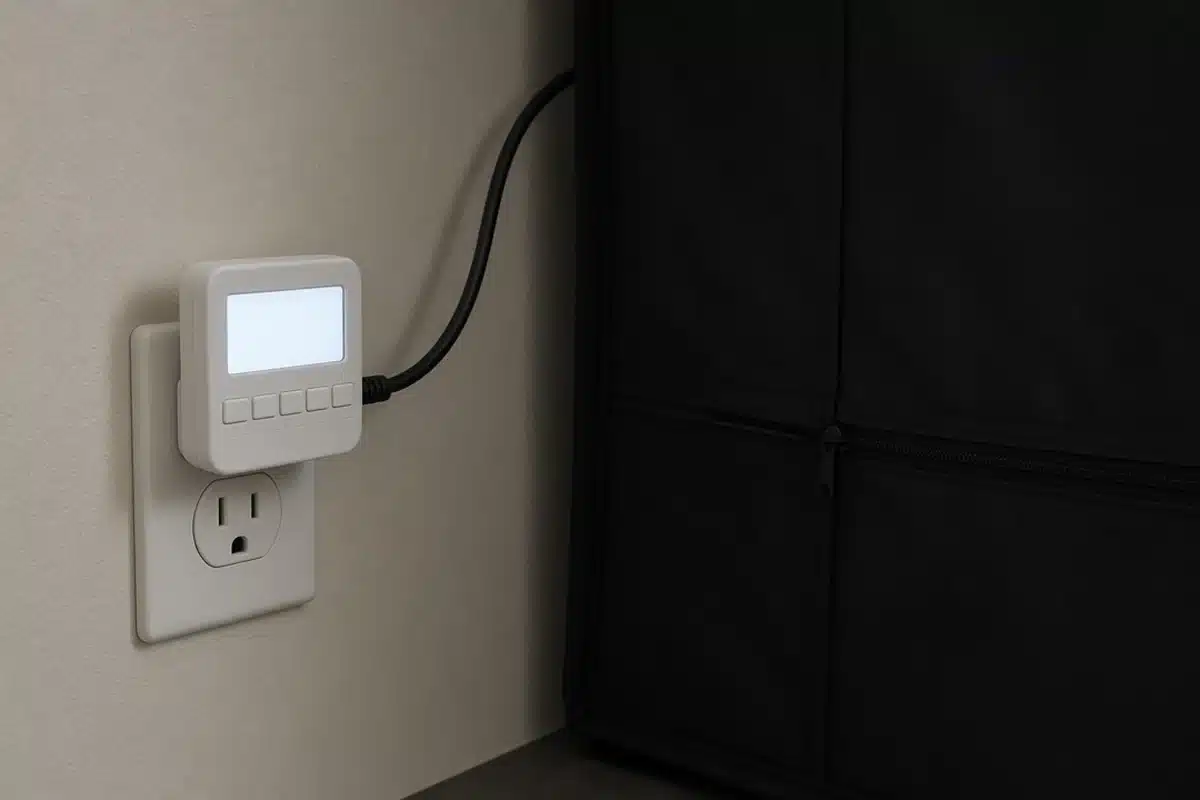
Start with the timer. Mechanical timers stop when power stops and pick up from that point when it returns, so they run behind by the length of the outage. Some digital timers keep time with a battery, while others reset. Check the clock on yours against the real time and fix it before the next scheduled switch. Our guide to grow light timers covers the types and their quirks.
Then decide how to restart. If the outage hit during the light period, the plants simply had a long night. Let the next dark period begin at its normal time so the schedule stays anchored. If the outage hit during the dark period, the plants noticed nothing unless something lit up when power returned.
Purdue notes that commercial growers using blackout cloth sometimes adjust when they pull and retract it to manage heat, while still keeping the night intact. That flexibility suggests that the length and continuity of darkness matter more than the exact clock time. Keep your nights long and unbroken, and small shifts in timing are less of a concern.
Is a Generator Worth It for Indoor Plants?
Only with care, and never inside. The Illinois Extension generator safety release is firm that a generator never runs inside a home or any closed space. It names garages, even with the big door up, along with crawl spaces and basements. The unit needs a few feet of open space on every side and a spot no closer than 20 feet to any door or window. It also says not to plug a generator into a wall outlet or directly into home wiring.
The Purdue Extension guide to using portable generators safely covers the electrical side. It says never to attach a generator to a building’s electrical system unless a qualified electrician has installed it with a transfer switch. It advises plugging appliances directly into the generator with grounded, undamaged cords rated for the load, never overloading the unit and using GFCIs where equipment is used in wet or damp locations.
A generator is worth it only for long outages in hot or cold weather. For a short outage, keeping the tent closed and dark is usually enough.
If you do run one, decide in advance what it needs to power. Fans and a small heater or cooler protect the plants from temperature swings, while lights can usually wait. Purdue warns that overloading a generator can make it overheat, so add up the wattage of what you plan to plug in and stay below the unit’s rating. Keep the cords out of puddles and walkways, and use GFCI protection outdoors where the ground may be wet.
What If Plants Stop Flowering Properly Afterward?
Look for signs that the dark period was broken. If buds stall or new growth looks leafy weeks later, light may have leaked in during the outage or after a timer reset. Our guide to what to do when indoor cannabis won’t flower covers the causes and fixes.
Most crops come through an outage fine. The ones that struggle usually suffered repeated light leaks rather than a single long night.
Keep a short record of what happened. Note when the power failed, when it came back, whether any light reached the plants and what the temperature did. If problems show up weeks later, that record helps you tell an outage effect apart from a feeding, watering or genetics issue.
Troubleshooting After a Power Outage
The lights came on in the middle of the night. The timer reset or fell behind. Correct the clock and keep the next dark period unbroken.
The room got very hot or cold. Without fans or heat, it drifted toward the house temperature. Check plants for heat or cold stress once power returns.
You opened the tent during the dark period. Keep it closed from now on. SDSU notes that even brief light can disturb photoperiod timing.
The generator cannot run everything. Do not overload it. Purdue warns that overloading can overheat the unit and create a fire hazard.
You are unsure whether light leaked in. Watch the plants over the next weeks for stalled buds or leafy growth.
Sources
- Purdue Extension, Managing Photoperiod in the Greenhouse (HO-253-W): https://www.extension.purdue.edu/extmedia/HO/HO-253-W.pdf
- South Dakota State University Extension, Are You Photoperiodic? Poinsettias Are: https://extension.sdstate.edu/are-you-photoperiodic-poinsettias-are-explanation-unique-plant-process
- Illinois Extension, Surviving Disaster Includes Using Home Generators Safely: https://extension.illinois.edu/news-releases/surviving-disaster-includes-using-home-generators-safely
- Purdue Extension, Using Portable Generators Safely: https://www.extension.purdue.edu/news/inprepared/2021/02/using-portable-generators-safely.html
FAQ
Will a power outage ruin my flowering plants?
Rarely. An outage adds darkness, and Purdue explains that unbroken darkness is what drives photoperiod responses.
Should I add light hours to make up for an outage?
It is safer to let the next dark period start on time than to extend the light into the night.
Can I check on my plants with a flashlight?
Avoid it during the dark period. SDSU notes that even a flashlight can disturb a photoperiodic crop.
Where should a generator go?
Outdoors only. Illinois Extension wants it 20 feet or more from doors and windows, and never inside a garage or basement.
Do I need to reset my timer?
Check it. Mechanical timers stop during an outage and run behind afterward.