Drying Cannabis in a Grow Tent: Setup, Airflow and Timing
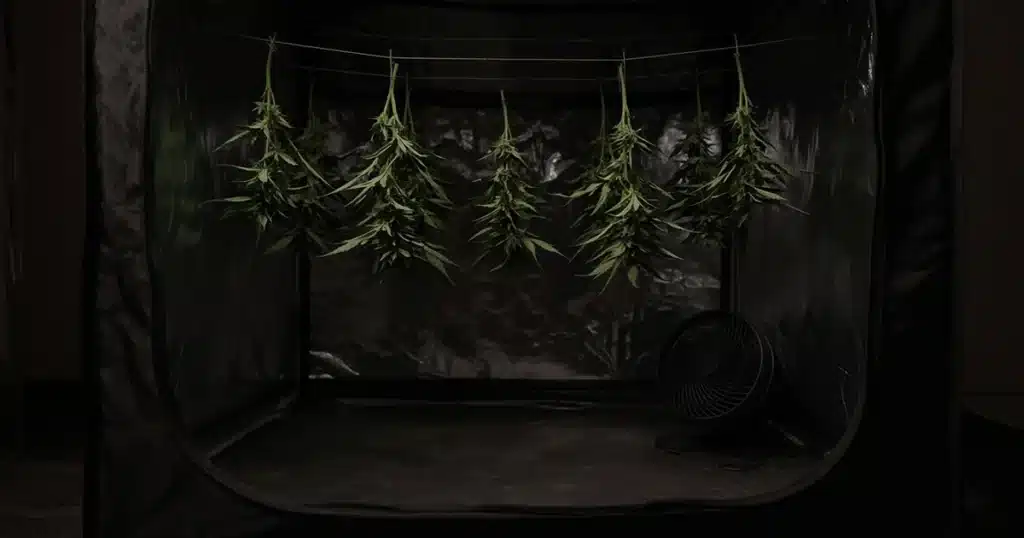
Quick answer: Yes, a grow tent makes a good drying space once the plants are out of it. Keep the light off, keep a small fan and the exhaust running, and hold the air near 64 to 70°F with relative humidity around 50 to 55 percent. Those are the slow drying targets Oregon State University Extension gives for hemp flowers. At room temperature with a fan running, buds in a University of Vermont trial took about four to six days to dry.
Can You Dry Cannabis in a Grow Tent?
Yes. A tent is a small, closed room that you already know how to run. The Oregon State University Extension review of hemp post harvest work says slow drying is the most common method, done in a dark room with the help of fans, dehumidifiers or heaters. A tent with the light off gives you the dark room, and its fan ports give you the air control.
Control is the whole point. Oregon State warns that when temperature and relative humidity are poorly controlled, drying can drag on and the flowers can come out poor in quality. A tent lets you change one thing at a time and watch what happens.
One limit is easy to miss. A tent can’t grow one crop and dry another at once. Drying needs the dark, and a flowering crop needs its light schedule. Plan the dry for after the last plants come out, or use a second space.
The research behind these targets was done on hemp. Hemp is Cannabis sativa, the same species home growers raise, so the drying basics carry over. None of these trials tested a home tent, though, so use the numbers as starting points and let your own readings guide you.
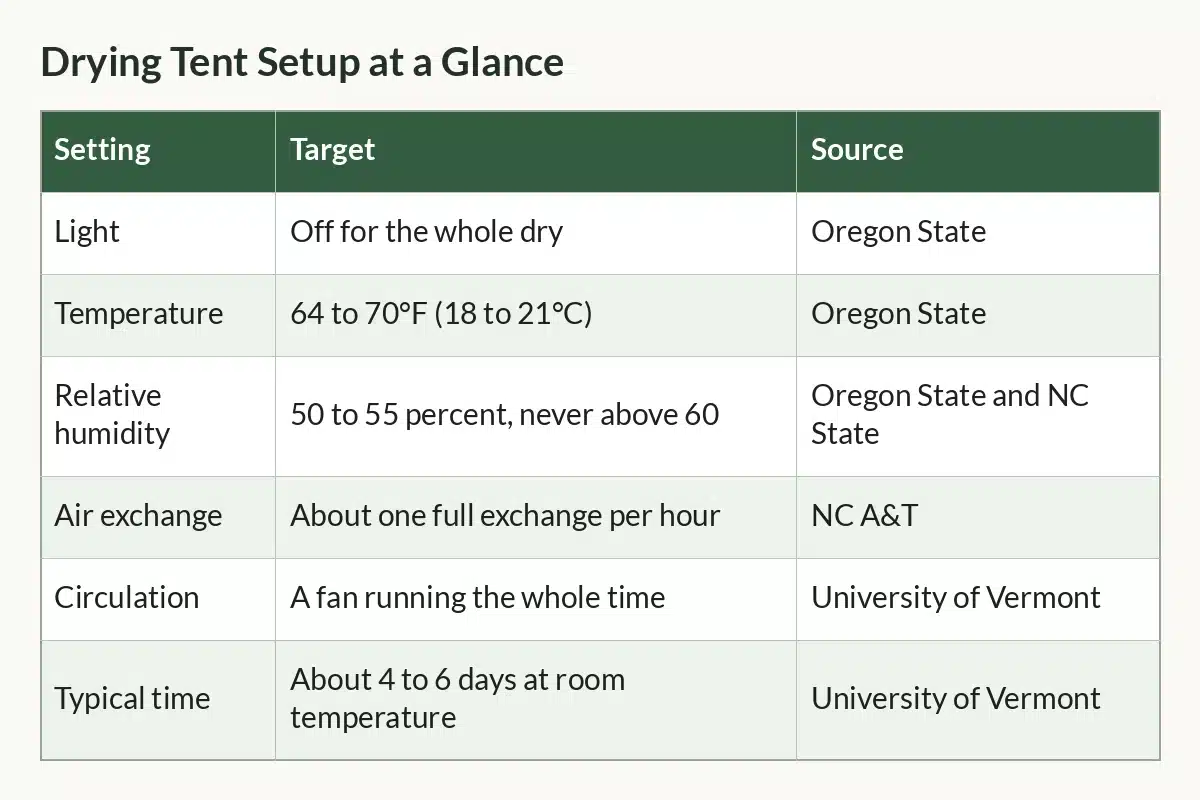
Drying Tent Setup at a Glance
| Setting | Target | Source |
|---|---|---|
| Light | Off for the whole dry | Oregon State |
| Temperature | 64 to 70°F (18 to 21°C) | Oregon State |
| Relative humidity | 50 to 55 percent, never above 60 | Oregon State and NC State |
| Air exchange | About one full exchange per hour | NC A&T |
| Circulation | A fan running the whole time | University of Vermont |
| Typical time | About 4 to 6 days at room temperature | University of Vermont |
How to Set Up a Grow Tent for Drying
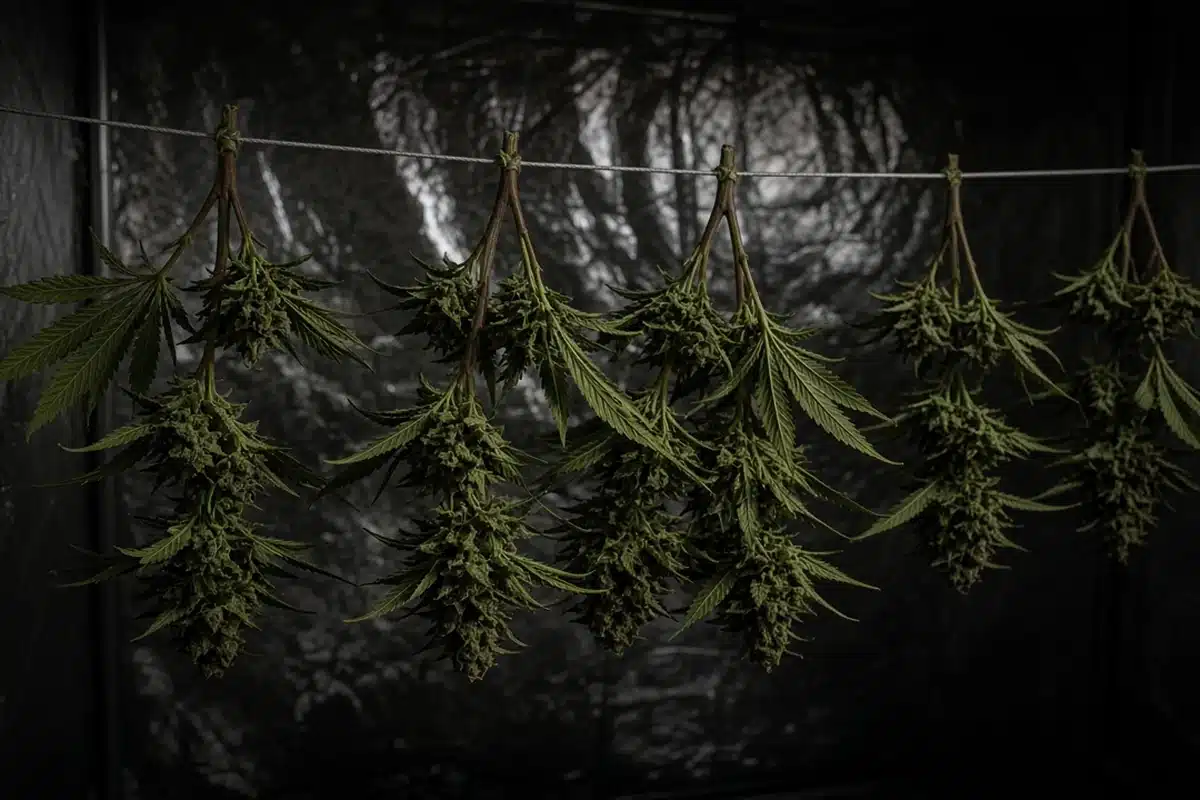
- Turn the grow light off and leave it off. Oregon State describes slow drying as drying in a dark room.
- Hang lines or a rack near the top. The North Carolina A&T hemp program dries plants by hanging them upside down inside a shipping container. A tent works the same way on a smaller scale.
- Give every branch some room. The National Center for Home Food Preservation warns that large bunches of herbs can mold. Hang single branches or small bunches with gaps between them.
- Keep a circulation fan running. In the University of Vermont drying trial, every drying setup got airflow from a fan, and the fans ran for the whole drying period.
- Run the exhaust for steady air exchange. NC A&T lists one air exchange per hour as its ventilation target for drying.
- Put a hygrometer at bud height. The Vermont team lost its temperature and humidity data to technical errors and noted that humidity gauges could help growers monitor and control drying time.
- Add a dehumidifier or a small heater only if the readings call for it. Oregon State names both as normal parts of slow drying.
If you have not trimmed yet, decide that before you hang anything. Oregon State says trimming the small sugar leaves before or after drying is up to the grower. Our guide to wet vs dry trimming your cannabis plants walks through both choices.
Where Should the Fans Point?
Point the fan so air drifts past every branch, not straight at the buds. The sources describe air that keeps moving, not air that blasts the buds. For tobacco, the University of Kentucky guide to tobacco curing sets a minimum airflow of 15 feet per minute, which is about 0.17 miles per hour. That is a slow drift, and it gives a sense of how little force is needed.
The goal is air that reaches every bud. The Vermont trial found that flowers dried at room temperature on trays showed some slight molding in the first few days and had to be turned to get air across them. Hanging branches in a tent avoids most of that, but dense spots still need air to reach them.
The exhaust fan handles the air exchange. It pulls damp air out of the tent and draws drier room air in. If you are not sure your fan is the right size, our guide to inline fan CFM for a grow tent shows how to work it out.
Too much air can do harm too. The Vermont team noted that over dried flowers are more likely to lose leaf and trichome material when they are handled. A strong fan that dries the outside of buds too fast pushes you toward that problem.
How Long Does Tent Drying Take?
About a week at room temperature, give or take a couple of days. In the Vermont trial, bucked buds dried at room temperature with a fan started on October 8. The batch with a dehumidifier came out on the afternoon of October 12. The batch without one came out on the afternoon of October 14.
North Carolina A&T gives a wider range of 1 to 12 days for hemp hung in a container. It says the time depends on how much moisture the buds start with, along with their size and density. Big, dense colas sit at the long end of that range. Small, airy buds sit at the short end.
Herb drying guides give a simple test for done. The National Center for Home Food Preservation says herbs are dry when leaves crumble and stems break when bent. Once your buds reach that point, they are ready for jars. Our guide to curing and storing cannabis flowers covers the next step.
No Tent? Drying in a Closet or Spare Room
A closet or spare room can work on the same rules. Oregon State says slow drying can be done in a simple structure, and its targets apply to any room. The University of Maryland Extension advises drying herbs in a warm, well ventilated, dry indoor room for best quality.
A closet has no exhaust port, so air exchange is the weak spot. NC A&T’s target of about one air exchange per hour still applies, so the room needs a way for damp air to leave. A dehumidifier helps too. In the Vermont trial, buds dried at room temperature with a dehumidifier finished about two days sooner than buds dried without one. Across the whole trial, buds dried with a dehumidifier also tested higher in total cannabinoids, at 20.7 percent against 18 percent.
Light is the other problem. Close blinds, cover windows and keep the door shut against hallway light. According to Oregon State, light exposure during storage may reduce certain cannabinoid levels, so a dark room is worth the effort.
Troubleshooting Tent Drying Problems
Humidity stays above 60 percent. NC State Extension says growers succeed when they keep good airflow and humidity at 60 percent or less. Add a dehumidifier or move fewer branches into the tent.
Buds feel crisp after a day or two. The air is too dry or moving too fast. Turn the fan down and check the humidity reading. That is the over drying the Vermont team warned about, where buds lose material as soon as they are handled.
Gray fuzz shows up on a bud. Pull that bud right away and check the rest of the branch. Vermont saw slight molding on room temperature samples in the first few days, so the early days need the closest watch. Vermont turned those samples to help air move around them.
The temperature drifts below the target. Oregon State lists heaters as a normal drying tool. NC State says it would not go above 100°F when adding heat until more research is done.
Dry buds turn soft again. NC State warns that dried hemp will absorb moisture and may mold if it is not kept dry. Move dry buds into sealed jars soon after they finish.
Sources
- Oregon State University Extension, Post harvest processing of hemp flowers: https://extension.oregonstate.edu/catalog/post-harvest-processing-hemp-flowers
- NC State Extension, Hemp Harvest Timing and Drying: https://hemp.ces.ncsu.edu/hemp-harvest-timing-and-drying/
- University of Vermont, 2021 Hemp Cannabidiol Drying Trial: https://www.uvm.edu/d10-files/documents/2024-08/2021_Hemp_Cannabidiol_Drying_Trial.pdf
- North Carolina A&T, Hemp harvest and post harvest considerations: https://ncat.edu/caes/agricultural-research/industrial-hemp-program/hemp-conference/files/ivey.pdf
- National Center for Home Food Preservation (University of Georgia), Drying Herbs: https://nchfp.uga.edu/how/dry/herbs
- University of Maryland Extension, Harvesting and Preserving Herbs: https://extension.umd.edu/resource/harvesting-and-preserving-herbs
- University of Kentucky, AGR 177 Proper Curing Management to Minimize Green Tobacco: https://darktobacco.mgcafe.uky.edu/sites/darktobacco.ca.uky.edu/files/agr177.pdf
FAQ
Should the grow light be on while buds dry?
No. Oregon State describes slow drying as drying in a dark room.
How many plants fit in a tent for drying?
Fewer than you think. North Carolina A&T says most field plants take 3 to 5 square feet each unless they are bucked from the stalk.
Do I need a dehumidifier in the tent?
Only if humidity stays above 60 percent. In the Vermont trial, buds dried with a dehumidifier finished sooner than buds dried without one.
Can I add heat to speed things up?
Some growers do. NC State says it would not go above 100°F until there is more research.
How long does tent drying take?
Plan on about four to six days at room temperature, based on the Vermont trial, and longer for large, dense buds.