
Purslane in Cannabis Gardens: Succulent Mats and Seed Control
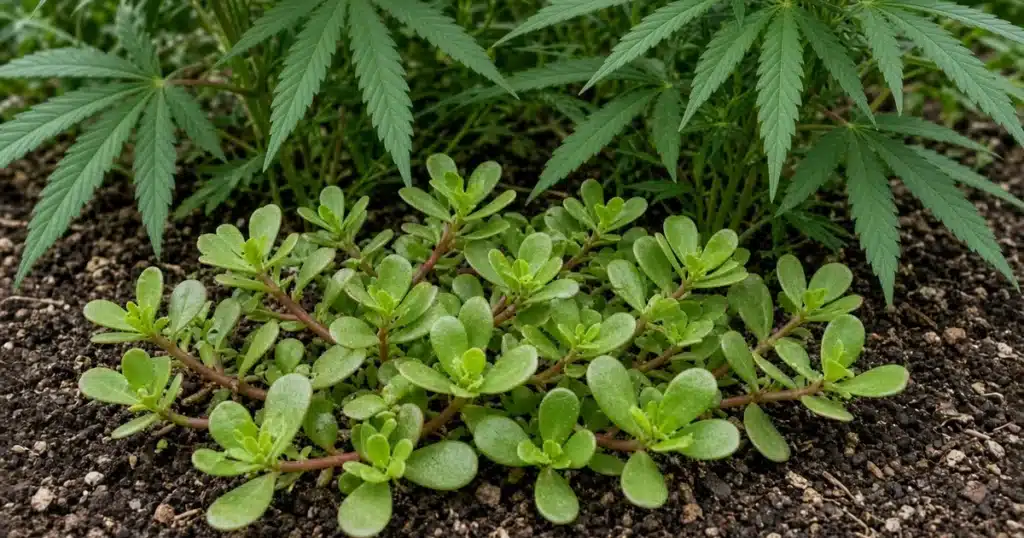
Quick answer: Common purslane is a summer annual weed with fleshy, reddish stems and small succulent leaves that forms flat mats in warm, moist soil. Guides from UC IPM, Colorado State and Nevada Extension all say the key is stopping seed, since one plant can make hundreds of thousands. Pull or hoe seedlings before they flower, bag what you pull so it cannot reroot, cover bare soil with thick mulch and consider summer solarization before planting.
What Is Common Purslane?
A low, succulent summer annual. The UC purslane guide says common purslane invades vegetable gardens, bare areas, lawns and landscapes, and is especially suited to warm, moist irrigated sites. Colorado State describes it as a spreading annual related to the moss rose grown in flower gardens. Nevada notes it is native to Europe and has naturalized across much of the United States.
The UC purslane guide adds that purslane is grown as a salad green in some places. In a garden bed, though, it can quickly take over warm, moist ground and crowd out other plants.
How Do You Identify Purslane?
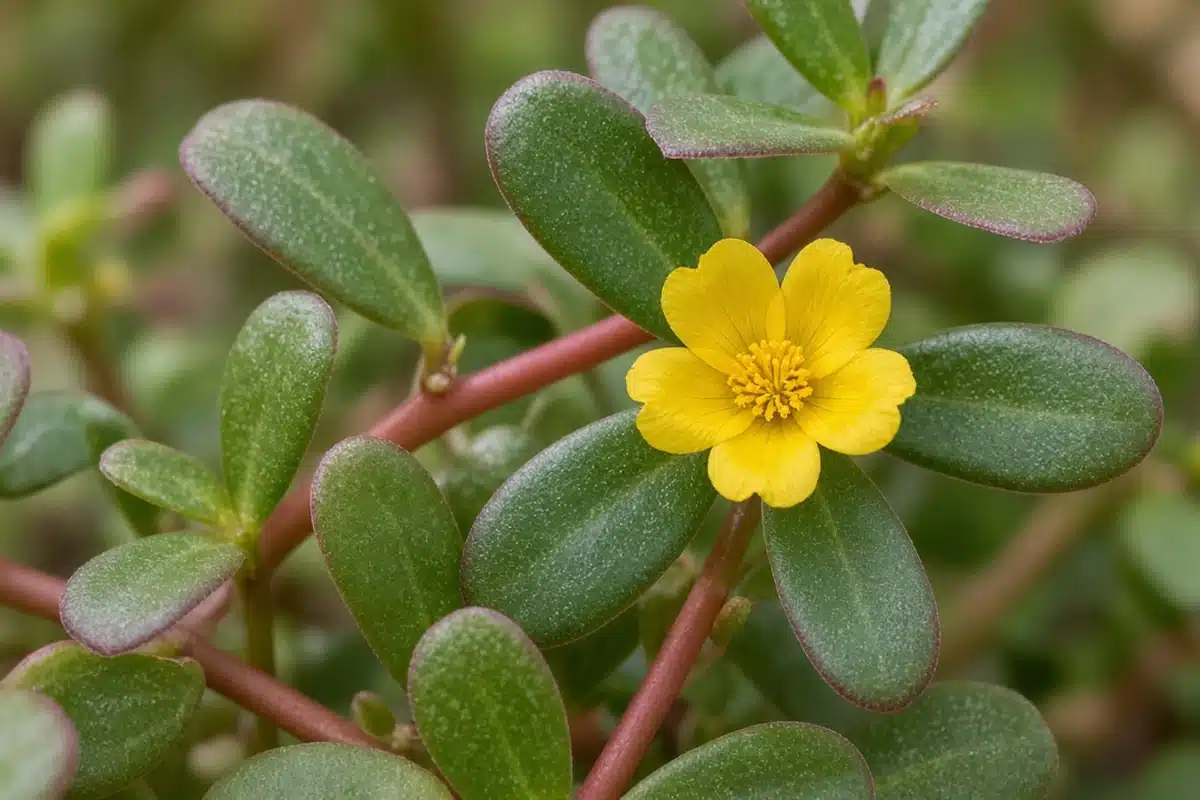
Look for a flat mat of fleshy leaves on reddish stems. The UC purslane guide says stems radiate from a central point like spokes, reaching up to about 12 inches long. Leaves are stalkless, oval, smooth and shiny, from 1/2 to 2 inches long.
Other clues:
- Stems and leaves with a reddish purple tint, as Colorado State describes
- Teardrop shaped leaves that may have red edges, according to Nevada
- Small yellow flowers with five petals that open only in sunshine
- Clumps that can reach about 2 feet across, Colorado State says
- A short taproot, as Nevada notes
The UC purslane guide adds that seeds form in a tiny pod with a top that lifts off like a lid.
Why Is Purslane So Hard to Get Rid Of?
It makes huge numbers of seeds and regrows from pieces. The UC purslane guide and Nevada both say one plant can make as many as 240,000 seeds. The UC purslane guide reports seed can stay alive in soil 5 to 40 years, and Colorado State gives up to 40 years.
The UC purslane guide explains that fleshy stems stay moist for days after hoeing and can reroot when the garden is watered. That turns hoeing into transplanting, it warns, unless pieces are removed or allowed to dry fully. It also notes that pulled plants can keep ripening seed for about a week.
How Does Purslane Affect a Cannabis Bed?
It takes water and nutrients and shades the soil. Colorado State says purslane competes with desirable plants for moisture in flower and vegetable gardens. The UC purslane guide says its dense mats use up moisture and nutrients and shade the soil surface, which keeps other seedlings from coming up.
The UC purslane guide adds that a few scattered plants one year can become an almost solid carpet the next. Catching it early matters.
When Does Purslane Appear?
After soil warms. The UC purslane guide says it sprouts once soil reaches about 60 degrees F, very near the surface and in large numbers after rain or irrigation. Colorado State says it comes up after soil warms in early summer. Nevada lists it as a summer annual that sprouts in spring and summer and blooms from summer to fall.
The UC purslane guide notes that most tiny seedlings die, but survivors grow fast and can flower within a few weeks.
How to Control Purslane in Cannabis Beds
- Use clean materials. The UC purslane guide advises weed free planting stock and cleaning tools used in infested areas.
- Pull or hoe before flowering. Colorado State says to remove purslane as soon as you spot it and before it flowers. Nevada agrees that control should focus on seedlings before bloom.
- Work after watering. The UC purslane guide says cultivating small seedlings soon after irrigation reduces the population.
- Bag pulled plants. Colorado State says to bag and discard pulled plants, since those left on moist soil can reroot. Nevada also stresses removing pulled material.
- Or let pieces dry fully. The UC purslane guide says hoed plants must be removed or dried completely before the next watering.
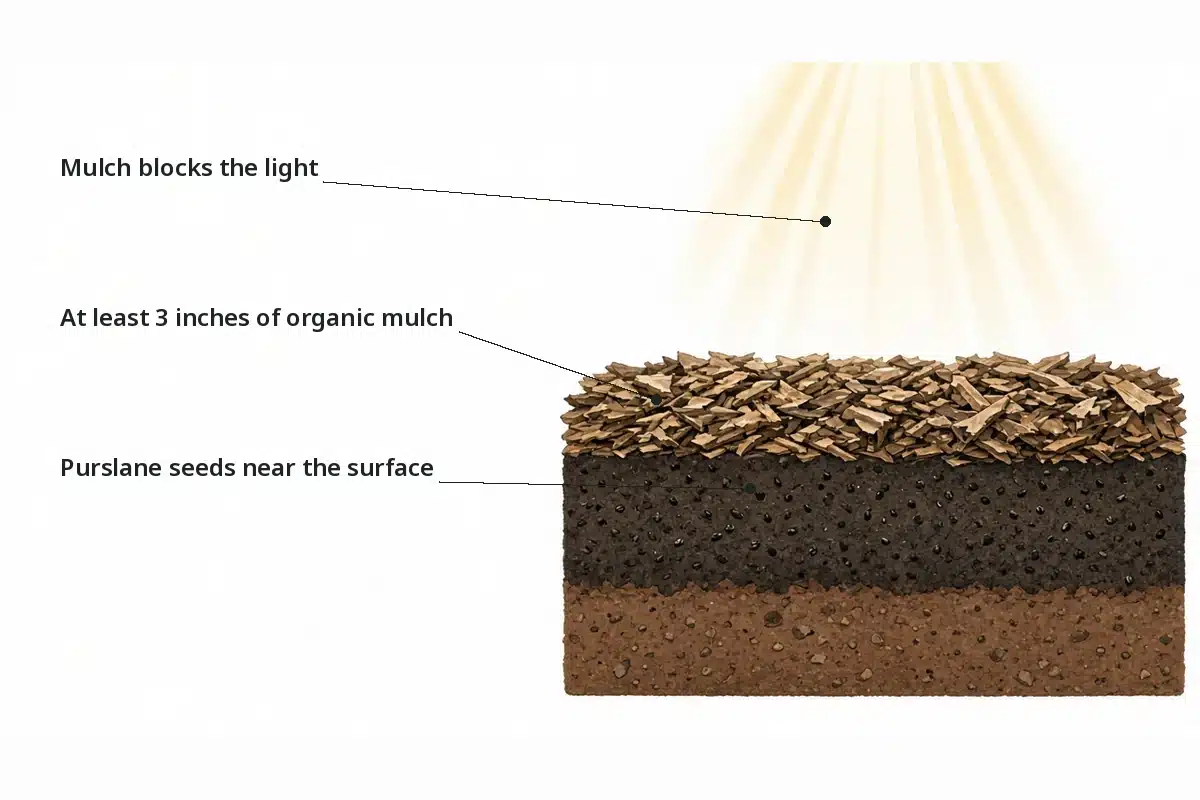
- Mulch thickly. The UC purslane guide and Nevada recommend at least 3 inches of organic mulch or a landscape fabric to block light. Our cannabis bed mulch guide explains choices.
- Check after each watering. The UC purslane guide recommends watching for new seedlings after every irrigation.
- Solarize before planting. The UC purslane guide says clear plastic on moist soil for 4 to 6 weeks in summer can kill purslane and its seed.
Ways to Stop Purslane
| Method | Best timing | Note from sources |
|---|---|---|
| Hand pulling | Before flowering | Bag plants so they cannot reroot |
| Hoeing | Soon after watering | Remove or fully dry the pieces |
| Organic mulch | Before seedlings emerge | At least 3 inches thick |
| Solarization | July to August | 4 to 6 weeks under clear plastic |

Does Solarization Work on Purslane?
Yes, in high summer. The UC purslane guide says covering moist soil with clear plastic for 4 to 6 weeks in summer can kill common purslane and its seed. It is done before planting, ideally in July and August when heat and light peak. Nevada says solarization can reduce seed numbers in infested beds during hot months.
The UC purslane guide advises preparing the bed first and not cultivating afterward, since that can bring deeper seeds to the surface. Our guide to soil solarization for cannabis beds walks through setup.
Does Mulch Smother Purslane?
Usually. Colorado State says purslane rarely develops in mulched areas and that mulch placed over it usually smothers it. The UC purslane guide says organic mulch must be at least 3 inches thick to work. It adds that fabric mulches are preferred over plastic because they let water and air reach roots.
Do Insects Control Purslane?
Not enough to rely on. The UC purslane guide says the purslane sawfly eats the leaves but usually builds up too late, after seeds have formed. Nevada says the sawfly has not given good control in its region. Colorado State mentions a hornworm that eats purslane, though it seldom causes real harm.
Is Purslane Safe to Leave as a Salad Green?
Only if you manage it closely. The UC purslane guide says purslane is a minor food crop in the United States, known as verdolaga in Spanish, and is eaten as a crunchy salad green. Nevada cautions that large amounts can be toxic to livestock and people. Colorado State and Nevada both advise removing plants before they flower, since each one can shed thousands of seeds.
Troubleshooting Purslane Problems
Hoed purslane came back. The UC purslane guide says fleshy pieces reroot after watering. Rake them up or let them dry before irrigating.
Seeds kept ripening after pulling. The UC purslane guide notes seed can mature for a week after a plant is pulled. Bag pulled plants right away.
A carpet of seedlings appeared after irrigation. The UC purslane guide says seedlings come up in large numbers after watering. Hoe them while small.
Purslane grows through thin mulch. The UC purslane guide says organic mulch needs at least 3 inches. Add more.
New weeds appeared after solarizing. The UC purslane guide warns that digging after solarization brings up deeper seeds. Leave the soil undisturbed.
Sources
- UC Statewide IPM Program, University of California, Pest Notes: Common Purslane: https://ipm.ucanr.edu/home-and-landscape/common-purslane/
- Colorado State University Extension, PlantTalk Colorado, Purslane: https://planttalk.colostate.edu/topics/weeds-cultural-problems/2110-purslane/
- University of Nevada, Reno Extension, A Northern Nevada Homeowner’s Guide to Identifying and Managing Common Purslane: https://extension.unr.edu/publication.aspx?PubID=3399
FAQ
How many seeds does purslane make?
Up to 240,000 per plant, the UC purslane guide and Nevada say.
How long does purslane seed last?
Up to 40 years, according to Colorado State. The UC purslane guide gives 5 to 40 years.
Can pulled purslane regrow?
Yes. Colorado State says pulled plants left on moist soil can reroot.
When do purslane flowers open?
Only in sun. The UC purslane guide and Colorado State say the yellow flowers open on bright, sunny days.
Does purslane like dry or wet soil?
Moist soil. Colorado State says it thrives with plenty of moisture but can survive dry spots with smaller leaves.


