How Long to Dry Cannabis and What Changes the Drying Time
Quick answer: Most slow dries at room temperature take about four to seven days. In a University of Vermont trial, buds dried at room temperature with a fan took four days with a dehumidifier and six days without one. North Carolina A&T gives a wider range of 1 to 12 days, depending on how wet, big and dense the buds are. Buds are dry when small stems snap instead of bending.
How Long Does Cannabis Take to Dry?
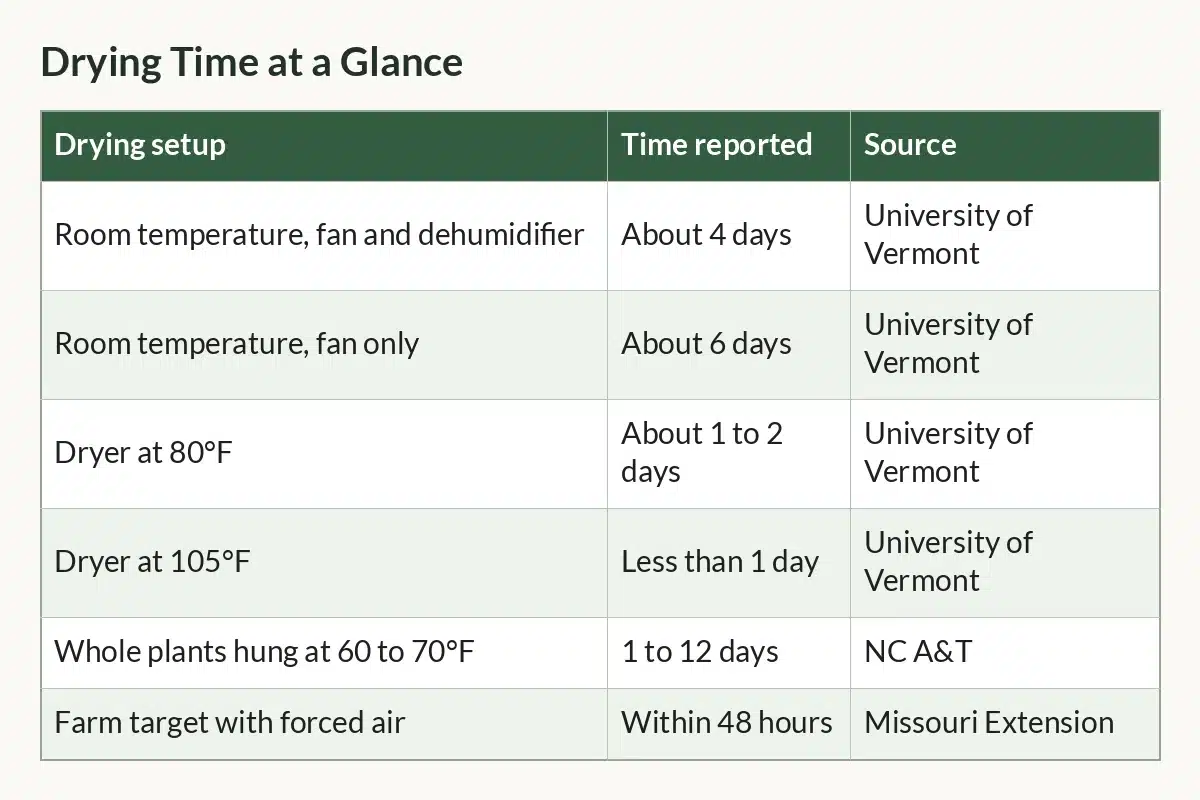
About a week for most home setups. The clearest timing comes from the University of Vermont drying trial. Bucked buds dried on trays at room temperature, with a fan running, went in on October 8. The batch with a dehumidifier came out on the afternoon of October 12. The batch without one came out on the afternoon of October 14.
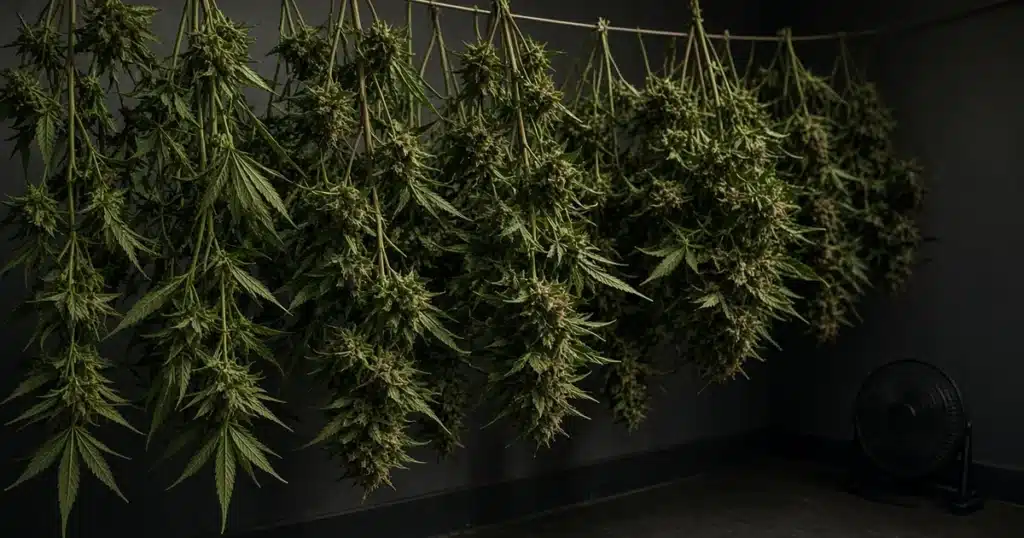
The North Carolina A&T hemp program hangs whole plants upside down in a shipping container at 60 to 70°F. It says buds may take 1 to 12 days to dry. The spread depends on the starting moisture, the size of the buds and how dense they are.
Commercial dryers move much faster. The University of Missouri Extension harvest guide says CBD hemp should be dried to 10 to 12 percent moisture within 48 hours to prevent mold, using barns, sheds or forced air dryers. That pace fits large farm equipment, not a closet with a box fan.
Some growers dry on purpose more slowly than that. NC A&T says that when its hemp is headed for curing, drying runs at a much slower rate and usually takes 2 to 4 weeks. Only after that do the buds go into airtight containers, where the program says proper curing takes about 1 to 3 months. It aims for the humidity inside those containers to settle at 62 percent, and it opens them to let moisture out if the reading climbs higher. So a long dry is not always a problem. It depends on whether you planned for it. NC A&T draws the line by end use. It says buds bound for extraction only need to be dried, while smokable flower has more steps after drying.
Drying Time at a Glance
| Drying setup | Time reported | Source |
|---|---|---|
| Room temperature, fan and dehumidifier | About 4 days | University of Vermont |
| Room temperature, fan only | About 6 days | University of Vermont |
| Dryer at 80°F | About 1 to 2 days | University of Vermont |
| Dryer at 105°F | Less than 1 day | University of Vermont |
| Whole plants hung at 60 to 70°F | 1 to 12 days | NC A&T |
| Farm target with forced air | Within 48 hours | Missouri Extension |
What Changes the Drying Time?
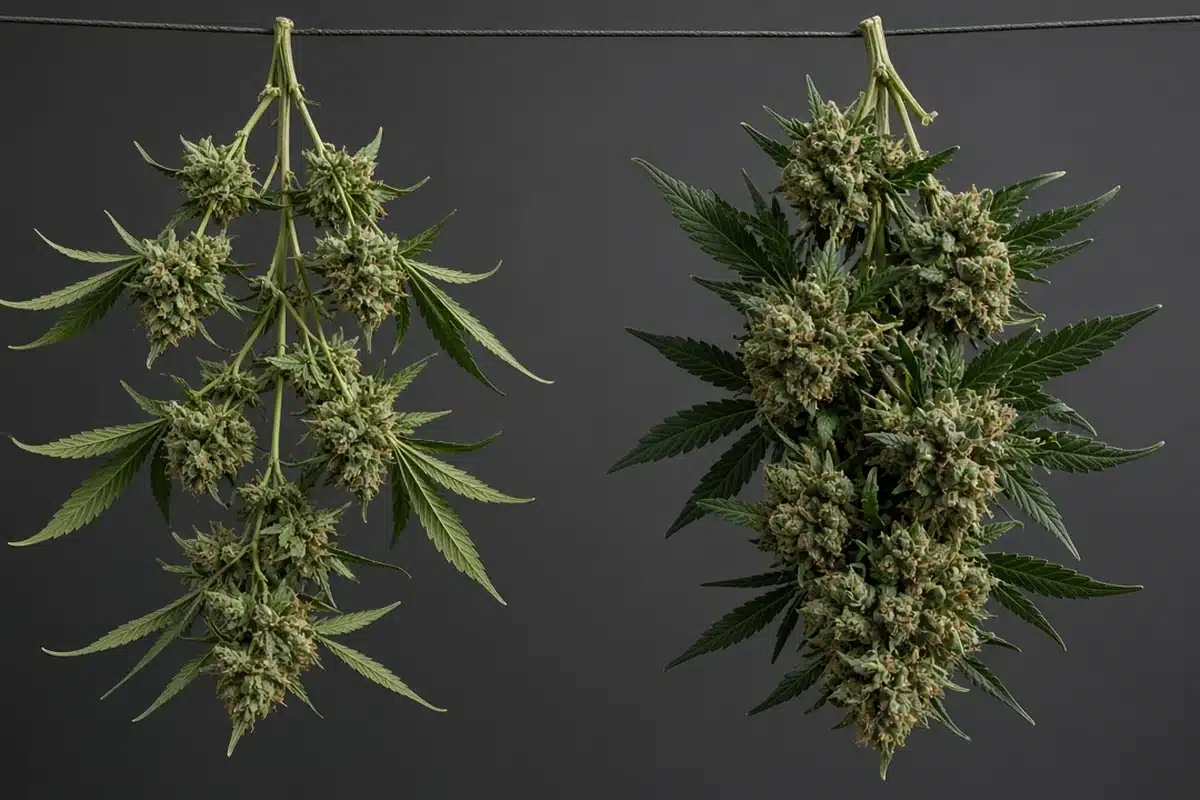
Four things set the pace.
Bud size and density. NC A&T names starting moisture, bud size and density as the reasons its drying time ranges from 1 to 12 days. A fat, tight cola holds water in its center long after the outside feels dry.
Humidity. Damp air slows drying. In the Vermont trial, the dehumidifier cut about two days off room temperature drying. NC State Extension says drying works when growers keep humidity at 60 percent or less.
Temperature. Heat speeds things up. Vermont dried buds in under a day at 105°F and in one to two days at 80°F. The same report warns that many terpenes are highly volatile, with the greatest losses starting at drying temperatures of 70°F. Faster is not always better.
Airflow. Every Vermont setup had a fan. Even so, room temperature trays showed slight molding during the first few days and had to be turned to get air across the flowers. Still air means slow, uneven drying.
Weather matters if you dry in a garage or barn. Room conditions follow the outdoor air, so a humid week can stretch the dry. If buds come in soaked from rain, start with our guide on how to deal with wet weed.
How to Track Drying Day by Day
- Log the room twice a day. Write down temperature and humidity in the morning and evening. The Vermont team lost its own readings to technical errors and noted that humidity gauges could help control drying time.
- Weigh one sample branch. The University of Minnesota Extension explains, for freeze dried food, that the weight lost during drying is the moisture removed. The same simple math lets you watch water leave a branch.
- Bend a small stem each day after day three. Use the snap test below. Maryland gives the same test for every drying method: leaves crumble and stems break when bent.
- Squeeze the largest bud gently. The outside dries first. If the center still feels spongy, give it more time.
- Pull branches as they finish. Small branches finish before big ones, so you don’t have to wait for the whole batch.
The Stem Snap Test: How to Tell Buds Are Dry
Bend a thin stem until it breaks or folds. The National Center for Home Food Preservation says herbs are dry when leaves crumble and stems break when bent. The University of Maryland Extension uses the same test for every herb drying method it describes.
Those guides were written for kitchen herbs, not cannabis buds. Still, the idea carries over. A stem that folds and stays bendy still holds water. A stem that snaps cleanly has dried through. The National Center adds a leaf check. Leaves that feel crispy and crumble easily between your fingers are ready to package and store.
Test thin stems, not the main stalk. Thick stalks hold water much longer than the buds around them. A clean snap on a small stem near the buds is the sign you want.
After the snap test, buds usually go into jars. Our guide to curing and storing cannabis flowers covers that step, and our post on burping your jars explains how to let trapped moisture out.
Whole Plant, Branch or Bud: Which Dries Fastest?
Loose buds dry fastest, and whole plants dry slowest. None of the sources timed all three side by side, but the pattern shows up across them. Vermont dried bucked buds on trays in four to six days at room temperature. NC A&T hung whole plants, and its range runs as long as 12 days.
Herb guides show the same split. The Iowa State University Extension guide to drying herbs says bundles of stems hung in a warm, dark place take 2 to 4 weeks. It describes tray drying of short stems or single leaves as a separate, simpler method. Smaller pieces give water a shorter path out.
Space plays a part too. NC A&T notes that a field plant takes 3 to 5 square feet until it is bucked from the stalk. Hanging branches instead of whole plants saves room and lets air reach more of each bud.
Troubleshooting Drying Time
Buds dried in two days. The room is too warm or too dry. Vermont notes that over dried flowers lose leaf and trichome material when handled.
Buds are still soft after ten days. Check humidity first. NC State ties drying success to keeping humidity at 60 percent or less. NC A&T gives a range of 1 to 12 days, so ten days is near the slow end.
Outsides are dry, centers are wet. Big, dense buds hold water inside. Give them more time. NC A&T ties drying time to bud size and density, which is why the biggest buds tend to finish last.
Gray fuzz appears in the first few days. Pull that material and raise airflow. Vermont saw slight molding on room temperature samples early in its trial. Those samples also needed turning so air could move across the flowers.
Dry buds turned soft in storage. NC State warns that dried hemp absorbs moisture and may mold if not kept dry. The National Center suggests airtight containers kept in a cool, dry, dark area.
How to Cure Cannabis After Drying
Seal the dry buds in airtight jars, keep the air inside them near 62 percent humidity and give them one to three months. That slow second stage is the cure, the part of how to dry and cure cannabis that starts after the snap test.
Curing cannabis is gentler than drying. An agricultural engineering post from UVM Extension separates the two by the air the crop sits in. Drying runs at 90°F or above with humidity at 50 percent or below. Curing runs at 90°F or below with humidity at 50 percent or above. UVM matches curing to crops where aroma and appearance are critical.
Jars and how full to fill them. NC A&T moves its dried buds into airtight containers for the cure. In a 2025 McGill University study on cannabis for smoking, each sealed jar held about 50 grams of dried flower with a two way humidity regulator rated for up to 67 grams. That seems a sensible fill guide to me. Keep the load in each jar under what its humidity pack is rated to handle.
The first weeks. Read the humidity inside the jar, not the room. NC A&T aims for the air in its containers to level off at 62 percent. The McGill team cured flower at 55, 62 and 69 percent. The study recommends 62 percent, to avoid the harsher smoke that comes with over drying at lower humidity and the microbial contamination that comes with higher humidity. Venting jars on a schedule is called burping, and I cover it in this burping walkthrough.
When the cure is ready. Most of a cannabis cure is waiting. NC A&T says proper curing takes about one to three months, and the McGill trial ran for three months. To me, a batch is ready to store after about one to three months in the jar, provided the reading inside has held steady near 62 percent through that time.
After that the jars go into storage, where my tips for keeping cured flower take over.
Sources
- University of Vermont, 2021 Hemp Cannabidiol Drying Trial: https://www.uvm.edu/d10-files/documents/2024-08/2021_Hemp_Cannabidiol_Drying_Trial.pdf
- North Carolina A&T, Hemp harvest and post harvest considerations: https://ncat.edu/caes/agricultural-research/industrial-hemp-program/hemp-conference/files/ivey.pdf
- University of Missouri Extension, MX79 Harvesting Industrial Hemp: https://extension.missouri.edu/publications/mx79
- National Center for Home Food Preservation (University of Georgia), Drying Herbs: https://nchfp.uga.edu/how/dry/herbs
- University of Maryland Extension, Harvesting and Preserving Herbs: https://extension.umd.edu/resource/harvesting-and-preserving-herbs
- NC State Extension, Hemp Harvest Timing and Drying: https://hemp.ces.ncsu.edu/hemp-harvest-timing-and-drying/
- Iowa State University Extension, Growing, Harvesting and Drying Herbs: https://yardandgarden.extension.iastate.edu/how-to/growing-harvesting-and-drying-herbs
- University of Minnesota Extension, Preserving food at home: Freeze drying: https://extension.umn.edu/food/preparing/cooking-at-home/food-preservation/freeze-drying
- University of Vermont Extension Ag Engineering, Drying and Curing Herbs and Flowers: https://blog.uvm.edu/cwcallah/2021/02/23/drying-and-curing-herbs-and-flowers-hops-hemp-and-everything-else/
- McGill University, Department of Bioresource Engineering, Santander (2025), Optimizing post harvest processing of cannabis for smokable products (MSc thesis): https://mcgill.scholaris.ca/handle/20.500.14905/91760
FAQ
How many days does it take to dry cannabis?
About four to six days at room temperature with a fan, based on the Vermont trial. NC A&T reports 1 to 12 days for whole hanging plants.
Can buds dry in 24 hours?
In a heated dryer, yes. Vermont dried buds at 105°F in under a day, but it warns that heat costs terpenes.
How long does it take to cure cannabis?
Plan on about one to three months, based on NC A&T. Hold the air inside each jar near 62 percent humidity, which is the level a 2025 McGill University study recommended for curing.
How do I know buds are dry?
Small stems should snap instead of bend. That is the test herb drying guides use.
Does a dehumidifier shorten drying time?
Yes. In the Vermont trial it cut about two days off room temperature drying.