
Cannabis Greenhouse Humidity Control: Venting and Condensation

Quick answer: Greenhouse humidity is controlled mainly by swapping moist inside air for drier outside air and warming it, by keeping air moving through the canopy and by stopping water from collecting where it can evaporate or drip. UMass Extension recommends short heat and vent cycles, two or three each hour after sunset and again around sunrise. UConn adds that every 20°F rise in air temperature doubles how much water the air can hold, which is why warmed outside air soaks up moisture so well. For cannabis, the goal is simple: keep water from condensing on leaves and buds overnight.
Why Does Humidity Build Up in a Greenhouse?
Plants release water vapor through their leaves all day. Wet soil, damp floors and puddles add more through evaporation. On a sunny afternoon, the warm air keeps all that moisture as vapor you cannot see.
The trouble starts once the sun goes down. The UConn IPM page on reducing greenhouse humidity explains that once night air chills enough to reach saturation, water condenses into droplets on the coolest surfaces, such as leaves and the glazing. Those wet films give mold and mildew spores the moisture they need. UConn notes that spring and fall are when these humidity problems usually peak, because warm days are followed by cool nights.
Our greenhouse growing overview covers the structure itself, and humidity ranks among the biggest ways a greenhouse differs from an indoor room. A greenhouse also traps moisture in the plant canopy itself. UConn reports that relative humidity inside a dense canopy can run 20 to 40 percent higher than the air above it, because the air layers stratify. Our explainer on cannabis transpiration shows how much water a leafy plant moves into the air each day.
How Does Heating and Venting Lower Humidity?
The idea behind it is simple: warm air can carry more water. UConn puts it plainly: air at 70°F can carry double the water vapor of air at 50°F. Each 20°F of warming doubles the air’s capacity and cuts relative humidity roughly in half.
So the method is to push out moist greenhouse air, pull in cooler outside air and then warm that new air. As it warms, it absorbs moisture from leaves and surfaces, and the next vent cycle carries that moisture away.
The UMass Extension humidity fact sheet explains why both steps matter. Venting alone chills the crop. Heating alone raises temperatures and fuel bills without removing water. Combined, they lower humidity efficiently.
In houses with roof or side vents, turn the heat on and crack the vents about an inch so warm moist air escapes. In houses with exhaust fans, run the fans for a few minutes, then switch them off and let the heater bring the temperature back up. UMass suggests a relay so the heater and fans never run together, which keeps flue gases from being pulled back into the house.
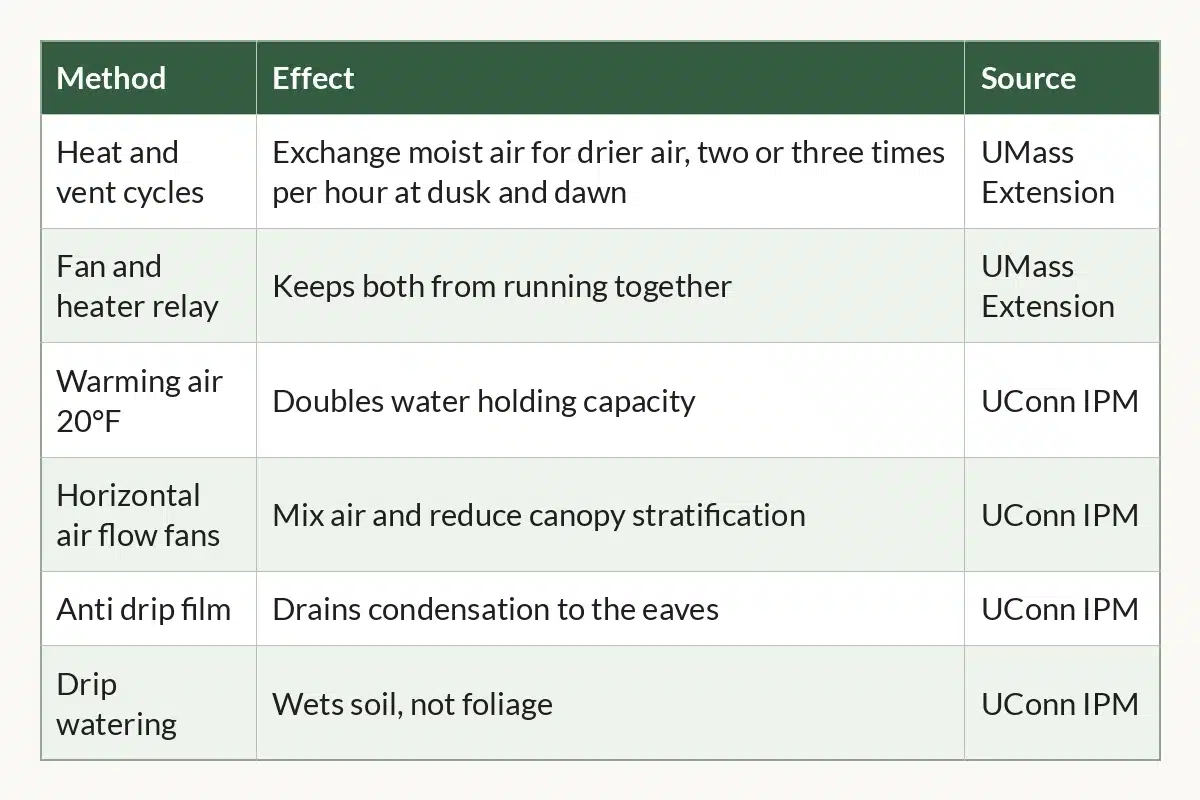
Humidity Control Methods at a Glance
| Method | Effect | Source |
|---|---|---|
| Heat and vent cycles | Exchange moist air for drier air, two or three times per hour at dusk and dawn | UMass Extension |
| Fan and heater relay | Keeps both from running together | UMass Extension |
| Warming air 20°F | Doubles water holding capacity | UConn IPM |
| Horizontal air flow fans | Mix air and reduce canopy stratification | UConn IPM |
| Anti drip film | Drains condensation to the eaves | UConn IPM |
| Drip watering | Wets soil, not foliage | UConn IPM |
When Should You Run Heat and Vent Cycles?
Think of the day in three parts. Through the late morning and afternoon on most days, vents and fans run for temperature, and that airflow carries moisture out as a side effect. In the late afternoon, as vents close to hold heat, humidity starts to climb. After dark the air cools and relative humidity rises toward saturation. That third period is where deliberate cycling earns its keep.
When you run the cycles matters more than how long they run. UMass recommends two or three cycles each hour once the sun has set, then another round near sunrise. Those are the hours when cooling air is most likely to hit its dew point.
UConn adds that this works even when it is cool and raining outside, because outdoor air warmed inside the house still picks up moisture. Some growers leave vents cracked all night, but UConn notes that a time clock or humidistat is more energy efficient.
UConn also offers a cost example. For a small house with roughly 10,000 cubic feet of air, each cycle took about 4,000 Btu to warm the incoming air by 20°F, which worked out to a few cents per cycle at the fuel prices in that example. Your cost will vary with fuel and climate, but the method stays affordable for small houses.
Why Does Air Movement Matter So Much?
In still air, moisture pools in the canopy and cold spots form where condensation starts. UConn describes horizontal air flow, or HAF, as small fans placed so air moves one direction down one side of the house and back along the other. Running these fans continuously, except when exhaust fans are on, keeps the air mixed and leaf temperatures closer to the air around them.
UMass adds that bottom heat improves circulation inside the canopy, because rising warm air creates gentle movement around the plants. It also keeps plant surfaces a little warmer, which helps prevent water from condensing on them.
Cannabis grows broad, layered leaves that shade one another, so a dense canopy can hold moisture near the leaves. For dense cannabis plants, thinning crowded lower growth and spacing pots so air can pass between them supports the same goal. Our article on what drives humidity in a grow space covers related factors in indoor rooms.
How Can You Stop Condensation From Dripping on Plants?
Condensation on the covering only becomes a problem once it drips onto the crop. UConn and UMass both describe anti drip plastic. A wetting agent, sprayed on the inside of the film or built into it, makes water sheet off toward the eaves instead of forming drops. Glass with a roof pitch of 6 in 12 sheds water on its own.
Double glazing also helps, and it trims heating costs too. If your frame accepts a second layer of film with an inflation fan between the layers, the inner surface stays warmer on cold nights. UMass notes that single layer coverings reach the dew point sooner, so they collect more condensation than double layers.
Finally, cut the water you add. UMass advises watering just enough to avoid runoff on the floor and early enough in the day for surfaces to dry before evening. Keep floors well drained and free of weeds, which hold moisture and add more through their own leaves. UConn favors drip irrigation that wets only the soil instead of overhead watering that soaks foliage.
How to Control Greenhouse Humidity Step by Step

- Measure first. Hang a hygrometer at canopy height, not near the roof.
- Water in the morning. Give surfaces the whole day to dry.
- Clear standing water. Fix low spots in the floor and pull weeds.
- Run HAF fans. Keep air moving through the night.
- Cycle heat and vent. Two or three short cycles per hour after sunset and near sunrise.
- Add a relay. Prevent fans and heater from running together.
- Use anti drip film. Replace old plastic with an anti drip covering when it is due.
- Automate. A time clock or humidistat keeps cycles consistent.
Troubleshooting Greenhouse Humidity Problems
Leaves are wet at dawn. Condensation formed overnight. Add or lengthen the late night and sunrise heat and vent cycles.
Drops fall from the roof. The film is shedding water as droplets. Use a wetting agent or anti drip covering.
Humidity spikes after watering. Too much water is evaporating. Water earlier and use drip lines instead of overhead spray.
Mold appears in dense plants. Air is stagnant inside the canopy. Increase spacing and run circulation fans continuously.
Heating bills jumped. Vents may be left open all night. Switch to timed cycles or a humidistat.
Sources
- UMass Extension, Reducing Humidity in the Greenhouse: https://www.umass.edu/agriculture-food-environment/greenhouse-floriculture/fact-sheets/reducing-humidity-in-greenhouse
- UConn Integrated Pest Management, Reduce Greenhouse Humidity: https://ipm.cahnr.uconn.edu/reduce-greenhouse-humidity/
FAQ
Can I lower greenhouse humidity when it is raining?
Yes. UConn notes that heating and venting still works, because outside air warmed inside picks up moisture.
How many vent cycles per night?
UMass suggests two or three heat and vent cycles per hour in the evening and around sunrise.
Does a dehumidifier work in a greenhouse?
It can in a small, tight house, but venting with heat is the standard method in Extension guides.
Why does my plastic drip more than glass?
Flat or plain film lets drops form. Anti drip film and a steeper roof help the water run off.
Should fans run all night?
UConn advises running HAF fans continuously except when exhaust fans are on.


