Grow Box vs Grow Tent: Which Fits a Small Home Grow?
The short answer
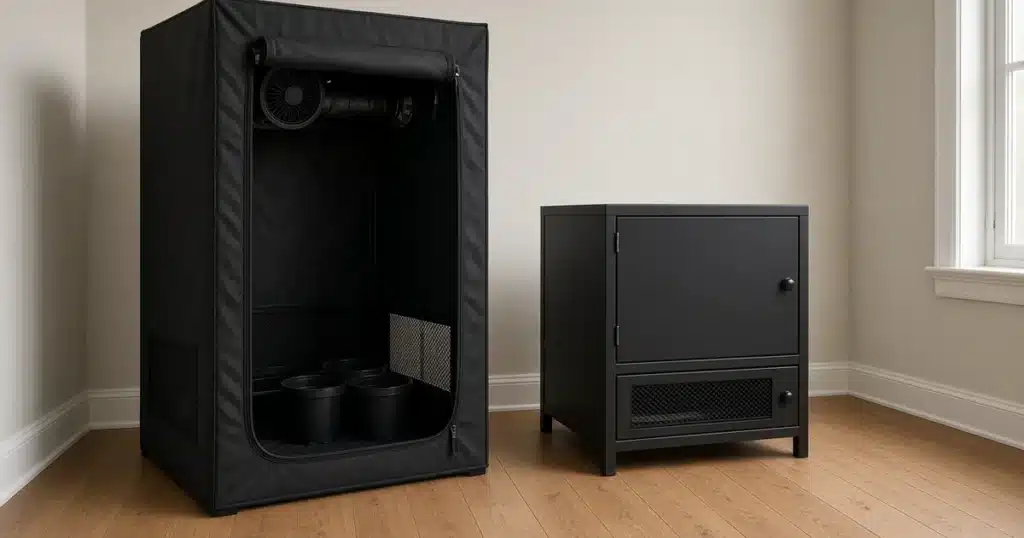
In the grow box vs grow tent choice, the main split is the build. A grow tent is a fabric enclosure on a metal frame that you fill with your own light, fan and filter. A grow box is a rigid cabinet. It usually arrives with those parts built in and sized to work together.
Pick a tent if you want flexibility, room to upgrade and a lower starting cost. Pick a box if you want a closed, furniture style unit that is quicker to set up and blends into a living space. Both can grow healthy plants when light, air and humidity are managed well.
What each enclosure really is
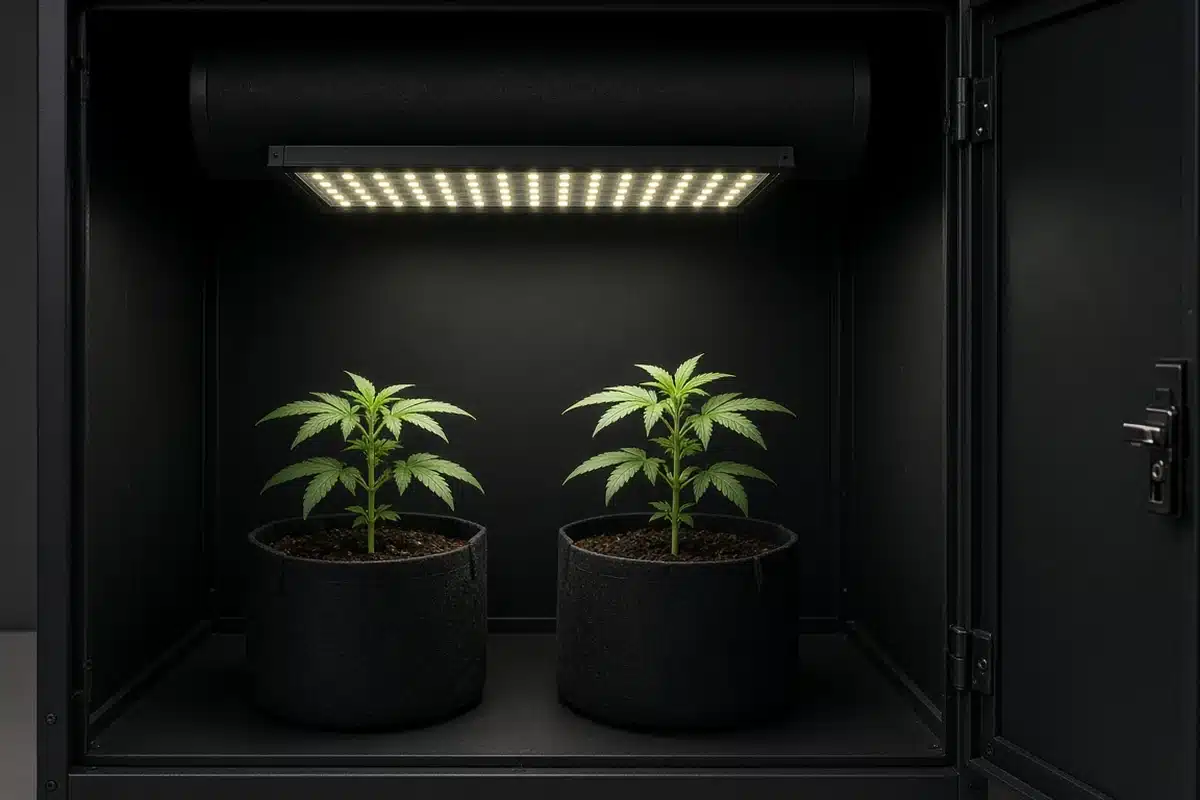
A tent is a kit of poles, connectors and a reflective fabric shell. It has zippered doors and ports for ducting and cords. It ships flat and goes together in under an hour. You then choose every piece of gear that goes inside. That freedom is the main reason so many home growers start with one.
A box is a cabinet built from metal, wood or rigid panels. Most come with a light, an exhaust fan, a carbon filter and sometimes a timer already mounted. Some look like a wardrobe or a filing cabinet. You trade choice for convenience, and you pay for that convenience up front.
Side by side comparison
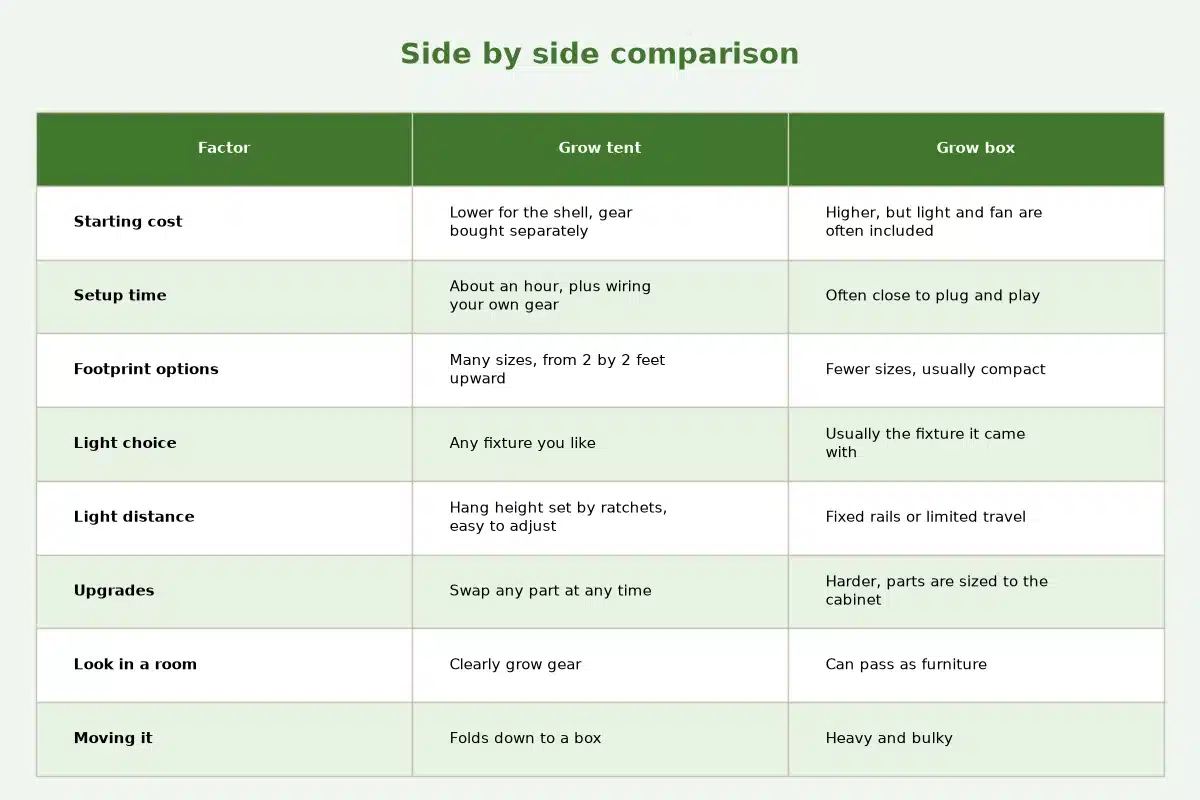
The table below compares the two on the points that matter most in a small grow.
| Factor | Grow tent | Grow box |
|---|---|---|
| Starting cost | Lower for the shell, gear bought separately | Higher, but light and fan are often included |
| Setup time | About an hour, plus wiring your own gear | Often close to plug and play |
| Footprint options | Many sizes, from 2 by 2 feet upward | Fewer sizes, usually compact |
| Light choice | Any fixture you like | Usually the fixture it came with |
| Light distance | Hang height set by ratchets, easy to adjust | Fixed rails or limited travel |
| Upgrades | Swap any part at any time | Harder, parts are sized to the cabinet |
| Look in a room | Clearly grow gear | Can pass as furniture |
| Moving it | Folds down to a box | Heavy and bulky |
Source: How to Set Up Supplemental Lights for Indoor Plants, Iowa State University Extension and Outreach, light distance guidance used for the hang height rows.
Light and hang height
Light is where the two differ most in daily use. That Iowa State guide says LED fixtures can sit 12 to 24 inches from the foliage in most cases and that the distance changes how much light plants receive. It also notes that reflectors help send light down into the canopy.
A tent makes that easy. You hang the light from adjustable ratchet straps and raise it as plants grow. Boxes often use fixed rails or short travel, so tall plants can run out of room sooner. If you plan to grow plants that stretch, measure the usable height inside a box before you buy. Our guide on how to control and prevent stretching in cannabis plants explains why spacing to the light matters.
Airflow and humidity
Both enclosures are closed spaces, so moist air builds up fast. Plants release water through their leaves, and that water needs a path out. A tent depends on the exhaust fan and duct you add. A box relies on the fan it came with, which may be sized for a light load only.
The US EPA guide A Brief Guide to Mold, Moisture and Your Home recommends keeping indoor humidity below 60 percent, ideally between 30 and 50 percent. It also points out that condensation on walls or windows is a sign of high humidity. A small hygrometer inside the enclosure tells you whether your fan is keeping up.
With a tent, you can size the fan to the space. Our post on inline fan CFM for a grow tent walks through the math. Before you buy a box, check the fan rating against the cabinet volume.
Odor and noise
Many boxes ship with a carbon filter matched to the fan. The rigid walls also dampen sound, so a box can be quieter in a bedroom or office. Tents leak a bit more sound through the fabric, though a good fan speed controller and some padding help.
If noise is a concern in a tent, our guide to grow tent noise reduction covers simple fixes.
Cost over time
A tent shell is cheap, but the full kit adds up once you buy a light, fan, filter, ducting and timer. A box has a higher sticker price, yet much of that gear is already inside. Over several grows, a tent often costs less because you can replace one worn part instead of the whole unit.
Think about what you will want a year from now. A tent leaves room if you plan to upgrade the light or add a second fan. If you want one unit that stays the same, a box is simpler.
How to choose in five steps
- Measure the floor space and the ceiling height of the room where the enclosure will live.
- Decide how many plants you want to run at once and how tall they may get.
- Set a budget for the full setup, not only the shell or cabinet.
- Check the light distance range you will have inside, using 12 to 24 inches for LED as a rough guide.
- Confirm the fan can move the air in the space at least once every few minutes.
Setting up a tent
If you pick a tent, assemble the frame on a flat floor, slide the fabric over it and zip the doors shut. Hang the light and fan before plants go in. Our full grow tent set up guide covers each step, from ducting to timers.
Leave a little space around the outside of the tent so you can reach the zippers and ports. Leave the floor tray clean and dry between grows.
Setting up a box
A box needs less work on day one. Place it near an outlet, level it and run the fan before you add plants to check for rattles or light leaks. Read the manual for the maximum plant height and the light schedule the built in timer supports.
Because parts are matched, avoid adding a much stronger light without checking whether the fan and power supply can handle the extra heat.
Troubleshooting
- Heat builds up near the top. Raise the light, increase fan speed or run lights during the cooler part of the day.
- Humidity stays high. Check that the exhaust is pulling air out and that the intake is not blocked.
- Plants stretch toward the light. Lower the light carefully within the safe range for the fixture.
- Light leaks at night. Look for gaps at zippers, seams or cord ports and cover them.
- Fan noise is too loud. Lower the speed with a controller or set the fan on a soft pad.
- Water pools on the floor. Empty saucers and wipe the tray after each watering.
Which one wins
Neither enclosure is better in every case. A tent rewards growers who like to tinker and want room to grow. A box suits growers who want a neat, quiet unit that works with little setup. Measure your space, think about your plans, then pick the one that fits your room and habits.
For more help building out your first setup, see the grow guides from Kind Seed Co and start with the gear list that matches your space.
Sources
- Iowa State University Extension and Outreach, How to Set Up Supplemental Lights for Indoor Plants
- US Environmental Protection Agency, A Brief Guide to Mold, Moisture and Your Home
FAQ
Is a grow box or a grow tent cheaper?
A tent shell costs less, but you buy the gear separately. A box costs more up front and often includes the light and fan.
Which is quieter, a grow box or a grow tent?
A box is often quieter because rigid walls dampen fan noise.
Can I upgrade the light in a grow box?
Sometimes, but parts are sized to the cabinet, so check heat and fan capacity first.
How far should an LED sit from plants in either enclosure?
About 12 to 24 inches from the foliage in most cases, adjusted as plants grow.
What humidity should I aim for inside the enclosure?
Below 60 percent, and ideally between 30 and 50 percent, measured with a hygrometer.