Grow Tent Noise Reduction
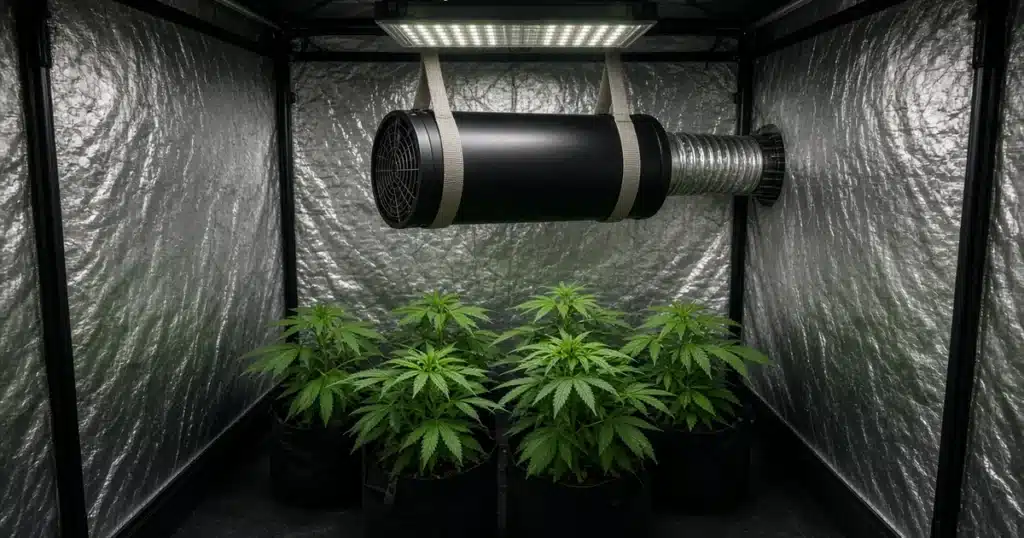
Quick answer: Most grow tent noise comes from the exhaust fan, both from the turbulent air moving through it and from the vibration it passes into whatever holds it. University of Florida Extension explains that airstream turbulence is the main source of airborne fan noise and that the most efficient fan for the job will also be the quietest. Run a fan near its efficient operating point and keep it isolated from the frame and duct with a flexible connector. Rutgers adds that direct drive fans tend to be noisier and more prone to vibration, and that centrifugal fans usually run more quietly than axial designs moving a similar volume.
Why Is My Grow Tent So Loud?
Mostly because of the fan and the air it moves. A UF/IFAS Extension publication on greenhouse fans says fan noise depends on fan design, the volume of air moved, total pressure and efficiency. It names airstream turbulence as the primary source of airborne fan noise. So the air itself, not just the motor, makes much of the sound you hear.
Vibration is the second part. The same UF/IFAS guide links dust buildup and an unbalanced impeller to excessive vibration, and the Yale air distribution design standard requires ductwork to stay free of vibration in every operating condition. Yale wrote that standard for campus buildings, so read it as general ventilation guidance rather than tent advice.
If you are growing in a rental, our guide to setting up a grow room in a rented space covers the wider picture.
Noise Sources at a Glance
| Noise source | What helps | Source |
|---|---|---|
| Airstream turbulence | Choose and run a fan near peak efficiency | UF/IFAS Extension |
| Fan type comparison | Compare sound power at the needed flow and pressure | UF/IFAS Extension |
| Fan speed claims | Rotational speed alone is not a fair noise comparison | UF/IFAS Extension |
| Unsteady airflow | Avoid running a fan left of its peak pressure | UF/IFAS Extension |
| Drive type | Direct drive fans are noisier and vibrate more | Rutgers |
| Vibration path | Flexible connectors isolate fans from ducts | Yale facilities standard |

How Do You Choose a Quieter Grow Tent Fan?
Pick on efficiency at your real working conditions. UF/IFAS states that once you have chosen the right type of fan, the best specific model should be picked on efficiency, and that the fan running most efficiently will make the least noise. It adds that low outlet air speed alone does not guarantee quiet operation.
The same guide warns against judging noise by rotational speed. It says comparing fan types by rpm is wrong, and that the only valid comparison is the sound power each fan produces while delivering the airflow you need at your static pressure. Ask for that data. UF/IFAS notes that manufacturers can supply sound power levels at rated conditions as part of normal fan data. Yale takes the same approach in its own fan rules and bases fan size selections partly on the published sound level.
Drive type matters too. The Rutgers fact sheet on HAF greenhouse fans reports that direct drive fans usually beat belt drives on efficiency yet make more noise and shake more. It also says centrifugal blowers tend to run quieter than axial fans that move a similar amount of air.
Size still matters, but sizing is its own topic. Our guide to matching inline fan CFM to a tent covers how much air you actually need. WSU Extension notes in a home cooling fact sheet that an oversized fan in a central system adds noise in the ducts.
Which Inline Fan Types Run Quietest?
Centrifugal inline fans with airfoil blades are the quiet pick in the Yale standard. It describes centrifugal inline fans with backward curved blades as the most efficient type, and it says an airfoil version of that blade gives quiet and efficient operation within its range.
Axial inline fans get a different verdict. Yale says the turbulence inside this design makes them a poor pick for quiet running at large volumes unless silencers are added. It also says propeller fans pushing against real resistance at high speed are generally not suited for quiet operation because of their high tip speeds. Yale limits propeller fans to places with low static pressure where noise does not matter, and it notes that adding ductwork cuts the air they move and raises the power they draw.
Those rules line up with Rutgers, which rates centrifugal designs as usually quieter than axial ones of matching size. Both sources were written for greenhouses and campus buildings, not grow tents, but the fan types are the same ones sold for tent exhaust.
In a small room, the fan type matters even more, since there is little distance between you and the fan. Our guide to growing in tight spaces covers small room layouts.
Does Fan Speed Affect Noise?
Yes, and so does where the fan operates on its curve. UF/IFAS explains that the peak pressure point on a fan’s performance curve is where that fan runs most efficiently and also where it will be quietest. It warns that a fan should never be run to the left of that peak, because the airflow over the blades becomes unsteady and may produce pressure swings and noise.
UF/IFAS also shows that airflow drops as static pressure rises, so a fan facing a long duct and a dense filter moves less air than its rating suggests. A fan pushed against heavy resistance can therefore get louder, not quieter.
UF/IFAS adds that a drive that lets you change fan speed easily within recommended limits is important, because system pressure needs are never exactly known in advance. That flexibility lets you find the setting where the fan runs smoothly in your setup. Watch temperature and humidity as you adjust it.
How Do You Stop Fan Vibration Noise?
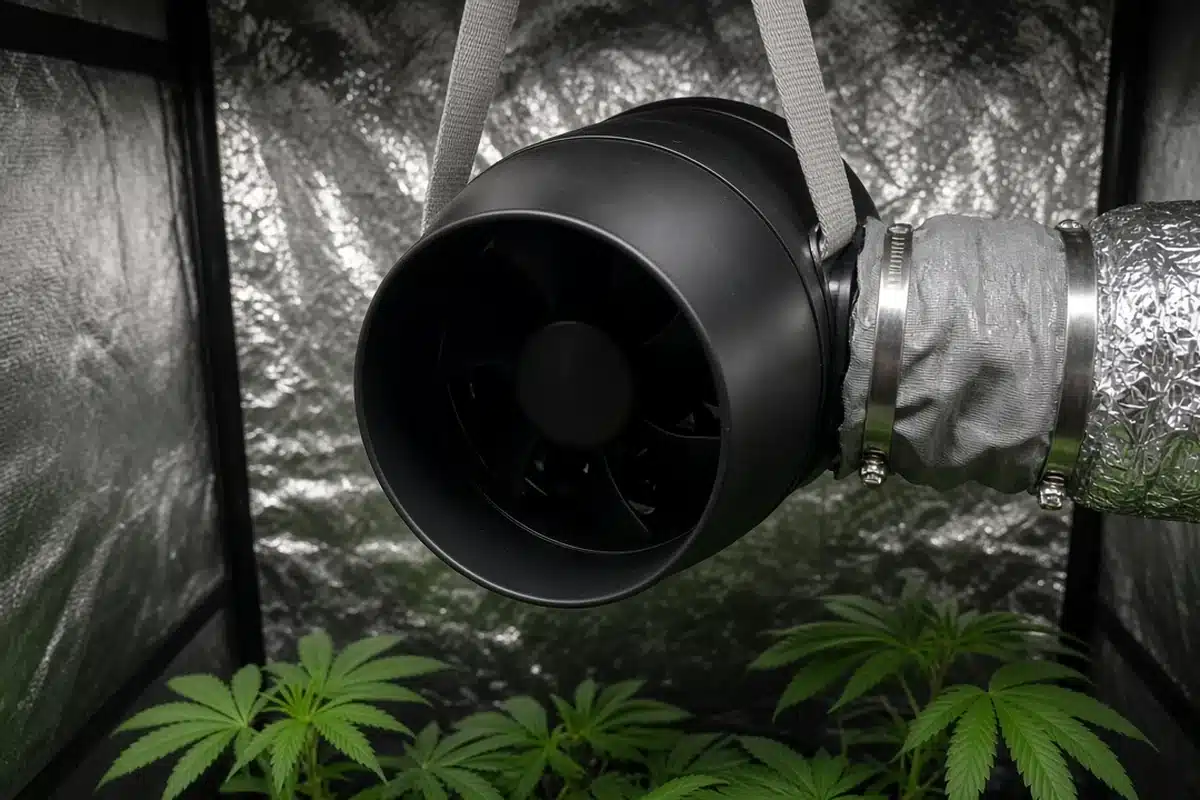
- Isolate the fan from the frame. Yale calls for vibration isolation in its fan rules. For a tent, the practical version is a separate hanger or padded support that keeps the fan body off the poles.
- Add a flexible connector. The Yale standard asks for flexible connectors between fans and ductwork, so shaking does not travel down the line.
- Keep the fan clean. UF/IFAS warns that dust on fan blades and housings causes vibration, and that an unbalanced impeller can cut airflow by 30 or 40 percent.
- Check the impeller balance. UF/IFAS recommends regular cleaning to keep the impeller in balance and prevent excessive vibration.
- Keep the duct path smooth. Yale lists fan inlet and outlet effects among the factors that cause performance loss and increased noise.
What About Silencers and Other Appliances?
Silencers have a place with some fan types. Yale pairs axial inline fans with silencers when quiet operation at high capacity is needed, and it says sound attenuation is usually required for vaneaxial fans. The sources here do not test the duct silencers sold for grow tents, so check that any one you add does not cut airflow.
Other appliances add to the total. WSU Extension’s home cooling fact sheet notes that room air conditioners are noisier than systems with a remote compressor. If your tent shares a room with a portable cooler, that machine may be louder than the fan.
Troubleshooting Grow Tent Noise
The tent hums even when the fan seems quiet. Vibration is likely reaching the frame. Isolate the fan and add a flexible connector, as the Yale standard calls for.
The fan roars or surges. It may be running left of its peak pressure, where UF/IFAS says airflow gets unsteady and noisy. Cut resistance or choose a better matched fan.
A new fan is louder than the old one. Compare sound power data at your airflow and pressure, not rpm, as UF/IFAS advises.
Noise crept up over the months. Dust may have unbalanced the impeller. UF/IFAS links dust buildup to vibration, so clean the blades and housing.
The room is still loud after fixing the fan. Look at the other equipment. WSU Extension notes that room air conditioners are noisier than remote compressor systems.
Sources
- University of Florida IFAS Extension, Fans for Greenhouses (AE020): https://ask.ifas.ufl.edu/publication/AE020/pdf
- Rutgers NJ Agricultural Experiment Station, HAF Greenhouse Fan: https://rucore.libraries.rutgers.edu/rutgers-lib/47268/PDF/1/
- Yale University Facilities, Air Distribution Design Standard: https://facilities.yale.edu/sites/default/files/files/Design%20Standards/Central%20Campus%20Standards/15000/15800%20Air%20Distribution-2.pdf
- Washington State University Extension, Energy Efficient Home Cooling: https://wpcdn.web.wsu.edu/cahnrs/uploads/sites/60/2026/04/ARCHIVE_AHT_Energy-Efficient-Home-Cooling.pdf
FAQ
What is the quietest type of grow tent fan?
Rutgers says centrifugal blowers tend to run more quietly than axial fans of a similar size. Yale describes backward curved centrifugal inline fans as the most efficient type.
Why should a fan's speed be adjustable?
UF/IFAS says system pressure needs are never exactly known, so an easily adjusted drive helps you match the fan to the setup.
Will a duct silencer help?
Yale pairs silencers with axial inline fans for quiet operation at high capacity. The sources do not test tent silencers.
Why does my fan vibrate more than it used to?
UF/IFAS links dust on the blades and an unbalanced impeller to vibration. Clean the fan and check its balance.
Is a belt drive fan quieter?
Rutgers reports that direct drive fans tend to be noisier and vibrate more than belt drives, though belt drives need more maintenance.