How Much Electricity Do Grow Lights Use
Quick answer: A grow light uses its wattage multiplied by the hours it runs. Divide the watts by 1,000, multiply by hours per day and by days, and you get kilowatt hours. Multiply that by your power rate to get the cost. University of Alaska Fairbanks Extension gives exactly this formula for any home appliance. For example, a 300 watt light running 12 hours a day for 30 days uses 108 kilowatt hours, which costs about $16 at an example rate of 15 cents per kilowatt hour. Fans, dehumidifiers and heaters add to that total.
How Do You Calculate Grow Light Electricity Use?
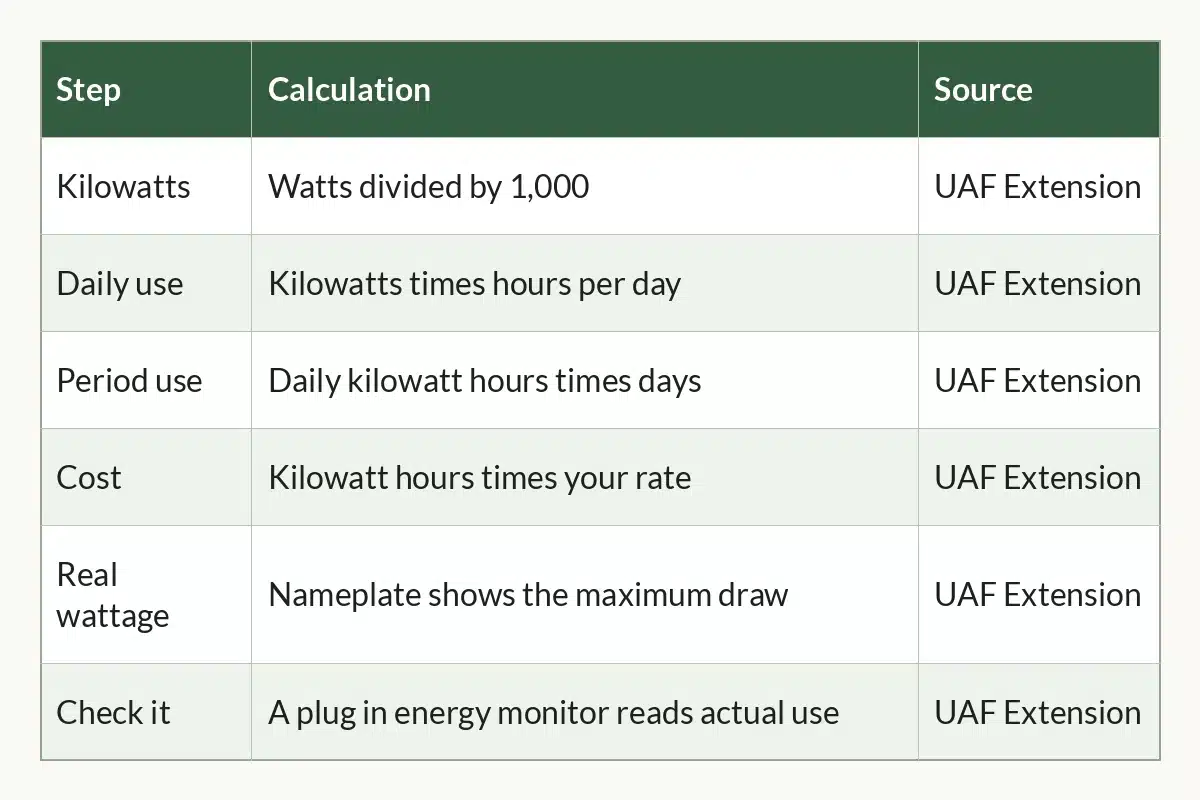
With a simple formula. The UAF Cooperative Extension guide to calculating appliance energy costs sets it out in steps. Divide the appliance’s average wattage by 1,000 to get kilowatts. Multiply by the hours it runs per day to get daily kilowatt hours. Multiply by the days it runs per year to get annual kilowatt hours. Finally, multiply by your utility’s rate per kilowatt hour to get the annual cost.
UAF works through a sample with a 60 watt bulb left on all day, every day. That comes to 525 kilowatt hours a year, or about $120 at the Fairbanks rate it uses of 23 cents per kilowatt hour.
The same steps work for a grow light, a fan or a dehumidifier. The only numbers you need are the wattage, the hours and your rate.
Grow Light Electricity Math at a Glance
| Step | Calculation | Source |
|---|---|---|
| Kilowatts | Watts divided by 1,000 | UAF Extension |
| Daily use | Kilowatts times hours per day | UAF Extension |
| Period use | Daily kilowatt hours times days | UAF Extension |
| Cost | Kilowatt hours times your rate | UAF Extension |
| Real wattage | Nameplate shows the maximum draw | UAF Extension |
| Check it | A plug in energy monitor reads actual use | UAF Extension |
How Much Does a Grow Light Cost to Run?
A 300 watt light running 12 hours a day costs about $16.20 over 30 days at an example rate of 15 cents per kilowatt hour, using the UAF formula. That rate is an example only. Check your own bill for your real rate.
A 300 watt light in flowering. At 12 hours a day, it uses 0.3 kilowatts times 12 hours, or 3.6 kilowatt hours a day. Over 30 days that is 108 kilowatt hours, about $16.20 at the example rate.
The same light in the vegetative stage. At 18 hours a day, it uses 5.4 kilowatt hours a day, or 162 over 30 days. That is about $24.30 at the example rate.
A 600 watt light in flowering. At 12 hours a day, it uses 7.2 kilowatt hours a day and 216 over 30 days, about $32.40 at the example rate.
The vegetative stage often costs more per day than flowering, simply because the lights run longer. Our guide to grow light watts per square foot helps you choose a wattage for your space, which is the first number in the formula.
What Does a Full Grow Cycle Cost?
Add up each stage. The durations below are examples only, since every plant and schedule differs. Apply the UAF formula to each stage and then combine them.
Vegetative stage. A 300 watt light running 18 hours a day for 28 days uses 5.4 kilowatt hours a day, or 151.2 kilowatt hours in total. The example rate puts that at about $22.68.
Flowering stage. The same light running 12 hours a day for 63 days uses 3.6 kilowatt hours a day, or 226.8 in total. That is about $34.02 at the example rate.
Fan. A 40 watt exhaust fan running 24 hours a day for all 91 days uses 0.96 kilowatt hours a day, or about 87.4 in total. That adds roughly $13.10.
The light and fan together come to about 465 kilowatt hours and roughly $70 for the cycle at the example rate. Add a dehumidifier or heater and the total grows. Running the numbers before you start shows which device is worth upgrading first.
Is the Wattage on the Label Accurate?
It shows the maximum, not always the real draw. UAF notes that the wattage stamped on an appliance or its nameplate is the maximum power it draws. Appliances with several settings use less at lower settings. A dimmable grow light running at 75 percent draws less than its full rating.
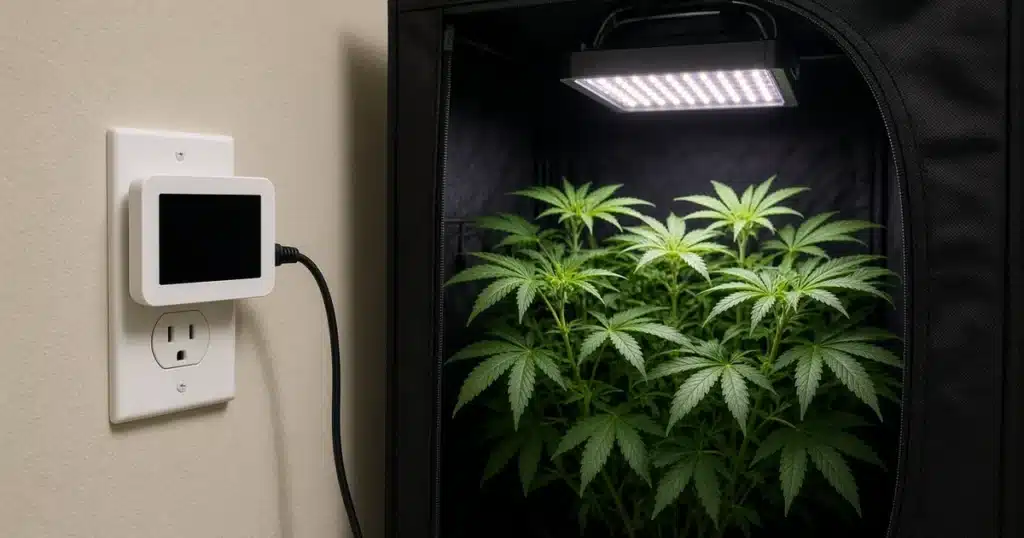
For a true reading, UAF highly recommends a plug in energy monitoring device. It sits between the outlet and the appliance and shows actual watts and total kilowatt hours over time. Running one on your light for a few days gives a number you can trust.
According to UAF, many devices keep drawing power when switched off. It calls these phantom loads and says most add a few watts. Timers, controllers and power supplies in a grow setup often fall into this group.
What Else Uses Electricity in a Grow Space?
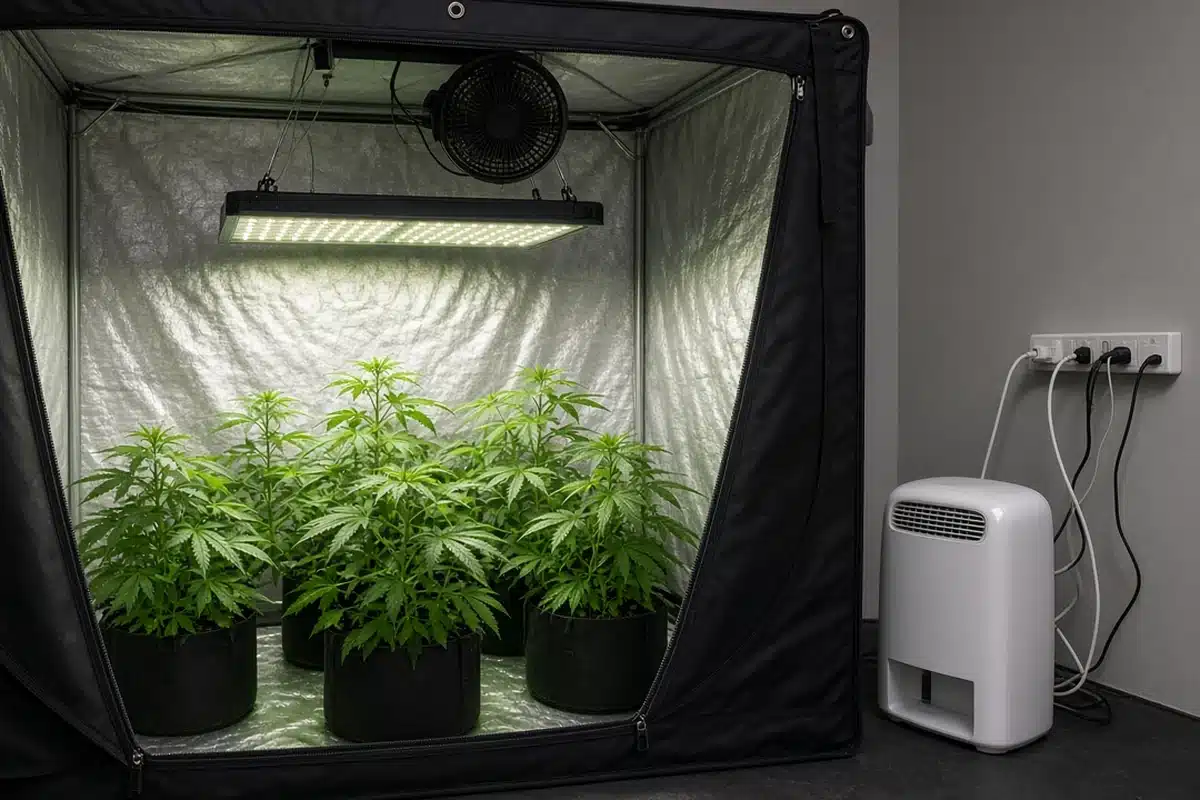
Lights are only one of the loads in a grow space. Run each device through the same formula.
- Exhaust and circulation fans. They often run around the clock, so their hours are high even when their wattage is low.
- Dehumidifiers. These can draw several hundred watts and cycle many hours a day.
- Heaters. Writing for Alaska homes, UAF notes that the biggest energy costs usually come from using electricity as heat.
- Air conditioners. Cooling a hot room adds a large load in summer.
- Pumps and controllers. Small individually, but they add up.
- Phantom loads. UAF says these add a few watts to most devices.
Add the monthly kilowatt hours for every device and multiply the total by your rate. That total is what the grow room really costs you.
Do More Efficient Lights Use Less Electricity?
They give you more light for the same power. The Utah State University Extension analysis of greenhouse lighting measures fixtures by how many micromoles of light they produce per joule of electricity. In its tests, the top pair of LED fixtures and the top pair of double ended HPS fixtures came out almost even, each near 1.7 micromoles per joule, while some older magnetic ballast HPS fixtures were far less efficient.
USU adds that as electricity becomes more expensive, better lighting becomes more valuable. A more efficient fixture can deliver the same light at a lower wattage, which lowers the first number in the formula.
The Oklahoma State University Extension LED fact sheet lists energy efficiency among the advantages of LEDs and says they lower operating costs. It also lists a higher initial cost among the disadvantages, so any lower running cost OSU describes builds over time rather than at purchase. Those sources were written for greenhouse production, but the efficiency gap between lamp types holds for home grow lights too.
What Changes Grow Room Electricity Costs?
The UAF formula has three inputs, so the bill only moves when watts, hours or the rate change. These are levers to test against your own bill, not a promise of a lower one. Use a fixture sized to your space rather than one far larger than you need. Keep schedules tight, since every extra hour adds cost. Check whether your utility offers lower rates at night, and if it does, consider running the light period then.
Plan the whole setup with costs in mind. Our guide to setting up a grow room on a budget covers lower cost equipment choices. For the bigger picture, see our breakdown of the cost and profit of growing cannabis.
Troubleshooting Grow Room Power Costs
The bill is higher than your estimate. Other devices may be adding more than you think. Measure each one with an energy monitor, as UAF recommends.
The light seems to draw less than its label. That is normal. UAF notes the label shows maximum draw.
Costs jumped in winter. Heaters may be running. In Alaska homes, UAF says electric heat is usually the biggest energy cost.
Costs jumped in summer. Cooling and dehumidifying use more power in hot, humid weather.
You are unsure of your rate. Check your bill for the price per kilowatt hour, including any delivery charges.
Sources
- University of Alaska Fairbanks Cooperative Extension Service, Calculating Appliance Energy Costs in Alaska: https://www.uaf.edu/ces/publications/database/energy/calculating-appliance-energy.php
- Utah State University Extension, Economic Analysis of Greenhouse Lighting: https://extension.usu.edu/apec/files/publications/publication/pub__8264567.pdf
- Oklahoma State University Extension, LED Grow Lights for Plant Production (HLA-6450): https://pods.okstate.edu/fact-sheets/HLA-6450pod.pdf
FAQ
How do I work out what my grow light costs to run?
Use the UAF formula. Watts divided by 1,000, times hours per day, times days, times your rate per kilowatt hour.
Does veg cost more than flower?
Often, yes, because lights run longer in the vegetative stage.
Are LED grow lights cheaper to run?
USU found the best LED and double ended HPS fixtures nearly equal in efficiency, while some older HPS fixtures were much less efficient.
Do timers and controllers use power?
UAF says many devices draw a few watts even when switched off.
What does one full cycle cost?
Run each stage and each device through the formula and add the results. Our worked example came to about $70 at an example rate.
How can I measure actual use?
UAF recommends a plug in energy monitor that records watts and kilowatt hours.