When to Replace Grow Lights for Cannabis
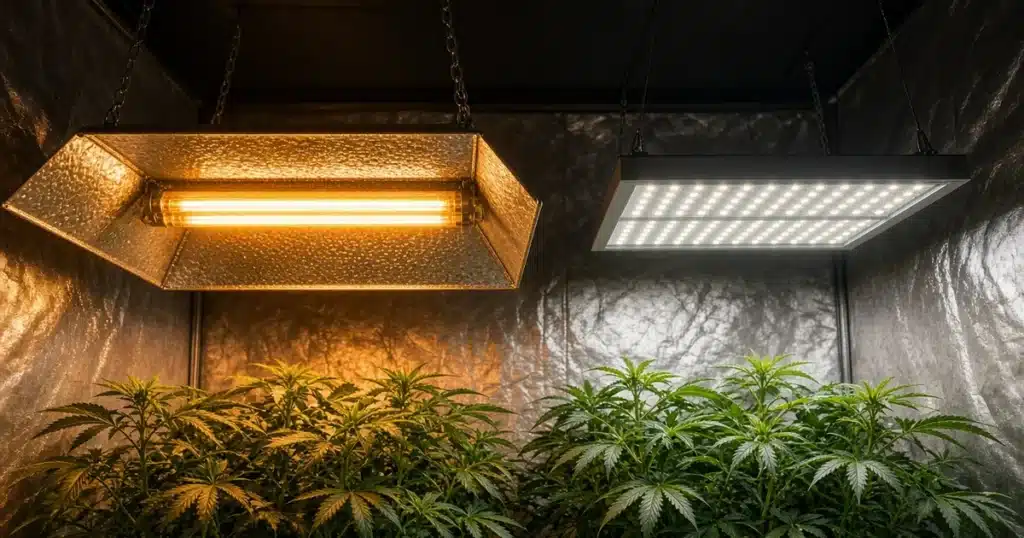
Quick answer: Replace a grow light when its output has dropped too far, not only when it stops working. Utah State University Extension reports that double ended HPS lamps last about 10,000 hours to 90 percent survival, while individual LEDs are predicted to reach 70 percent of their starting output at about 50,000 hours under favorable temperatures. Track your hours, measure light at the canopy, and watch for failing power supplies and fans, which USU says can quit long before the LEDs themselves.
How Long Do Grow Lights Last?
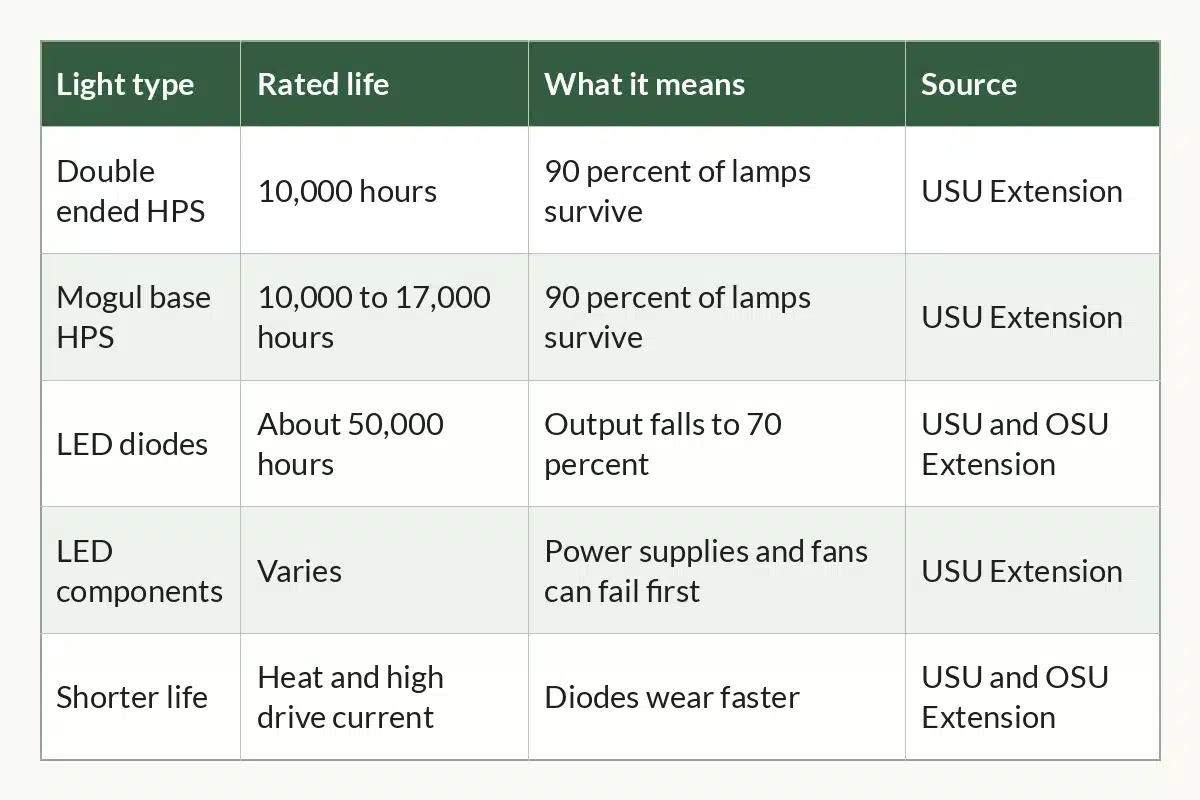
It depends on the type. The USU Extension greenhouse lighting analysis gives these figures, based on manufacturer and industry data.
Double ended HPS lamps. USU rates a 1000 watt double ended lamp at 10,000 hours, the point where 90 percent of lamps are still working. USU says that at 3,000 hours a year this comes to about 3.3 years.
Mogul base HPS lamps. Older mogul base lamps fall in a range of 10,000 to 17,000 hours by industry reports, measured at the same 90 percent survival point.
LEDs. Individual diodes run at favorable temperatures are predicted to keep 70 percent of their initial light output for about 50,000 hours. USU puts that at about 16.7 years at 3,000 hours a year.
The Oklahoma State University Extension LED fact sheet gives a matching picture. It says LEDs can run up to 50,000 hours and dim to about 70 percent of their output from installation, rather than failing suddenly. Both sources were written for greenhouse growers, but the lamp figures describe the lights themselves.
Grow Light Lifespan at a Glance
| Light type | Rated life | What it means | Source |
|---|---|---|---|
| Double ended HPS | 10,000 hours | 90 percent of lamps survive | USU Extension |
| Mogul base HPS | 10,000 to 17,000 hours | 90 percent of lamps survive | USU Extension |
| LED diodes | About 50,000 hours | Output falls to 70 percent | USU and OSU Extension |
| LED components | Varies | Power supplies and fans can fail first | USU Extension |
| Shorter life | Heat and high drive current | Diodes wear faster | USU and OSU Extension |
How Long Will a Light Last on a Cannabis Schedule?
Shorter than the greenhouse figures suggest, because cannabis lights run long days. USU based its years on 3,000 hours a year, about 8 hours a day. Indoor cannabis schedules run longer, often 18 hours a day in the vegetative stage and 12 hours in flowering.
Here is how the USU hour ratings play out on a longer schedule. If a light averages 15 hours a day across the year, it runs about 5,475 hours annually. At that pace, a 10,000 hour double ended HPS lamp reaches its rating in under two years. A diode rated near 50,000 hours would reach its 70 percent point in a little over nine years. These are our own calculations from the USU figures, not numbers USU gives for cannabis.
Our grow lights for cannabis guide compares light types if you are weighing a switch.
How Can You Tell a Grow Light Is Fading?
Measure it, because your eyes adapt and will not notice a slow drop. The MU Extension guide to grow lights explains how to measure light intensity at plant level with a meter. It takes readings at the four corners and the center of the growing area and averages them to get an average PPFD.
Use the same method to track a light over time.
- Take a baseline reading when the light is new, at a set hanging height.
- Record the five points and the average. Note the date and the hours on the light.
- Repeat every few months at the same height and setting.
- Compare the averages. A steady fall shows the light is aging.
Our page on the best PAR for cannabis lists the light levels plants need at each stage. Once your readings can no longer reach those levels at a sensible height, plan a replacement.
What Parts of an LED Light Fail First?
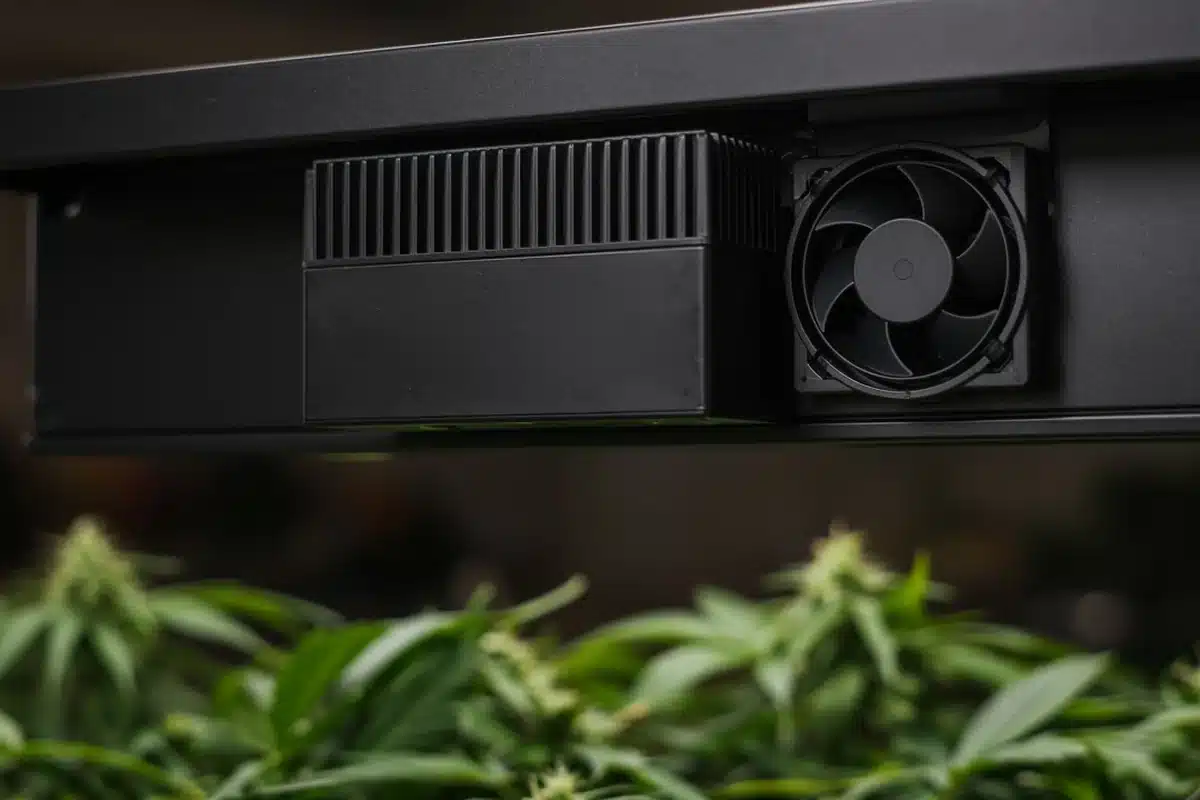
Often not the diodes. USU warns that the power supply, the fans and other parts of an LED fixture often give out long before the diodes do, and the grower may not notice. The researchers report premature failures of LED power supplies and circuit boards in their own work.
Check these parts during routine cleaning.
- Fans. Listen for grinding or silence where a fan should run.
- Drivers. Look for flicker, uneven brightness or sections that stay dark.
- Diode boards. Look for dead patches or color changes across the board.
USU notes these components can be replaced, though the labor adds to operating costs. A failed driver may be cheaper to swap than a whole fixture.
What Shortens Grow Light Life?
Heat and hard driving. USU says LED life expectancy drops when diodes are driven at higher amperage to get more output, or when they are exposed to high temperatures. A cooler diode, it adds, lasts longer. OSU also lists design, materials and heat release among the factors that affect LED life.
In practice, the advice comes down to keeping the room within a normal temperature range and leaving space around the fixture for airflow. Running a dimmable LED below its maximum may also help, based on the USU point about drive current.
Should You Replace HPS Lamps on a Schedule?
It can make sense, because an HPS lamp gives little warning before it fails. The USU rating describes the point where 90 percent of lamps are still working, which means some fail sooner. A lamp that fails in the middle of flowering leaves plants without light until you can swap it.
A simple plan helps. Note the date you install each lamp and keep a running total of its hours. When a lamp nears its rated life, replace it between crops instead of waiting. Keep a spare on hand if your setup relies on a single fixture.
The same logs help with LEDs. Even though diodes last far longer, the power supply and fan can fail at any time, as USU notes. A record of when each fixture was installed makes it easier to judge whether a fault is early or expected.
Is Upgrading Better Than Replacing?
Sometimes. USU found that the most efficient LED and double ended HPS fixtures it tested were nearly even in light per watt, while older magnetic ballast HPS fixtures produced far less light for the same power. If an old fixture needs a new lamp and ballast, it may be worth comparing the cost against a newer, more efficient light.
OSU lists a higher initial cost among the drawbacks of LEDs, so an upgrade costs more up front. Weigh that against the longer life and the lower operating costs OSU also describes.
How Do You Budget for Replacement?
Use the MU Extension method. MU divides the total kilowatt hours over a period by the kilowatt hours each bulb uses over its rated life to find how many replacements you will need. Multiply that by the number of bulbs and the price per bulb to get the replacement cost.
USU found that lamp replacement added only about 5 percent to the five year cost of running an HPS fixture, since electricity is the bigger expense. When choosing a new fixture, our article on how to choose the right LED lights for your cannabis grow covers what to compare.
Troubleshooting Aging Grow Lights
Plants stretch more than they used to. Light output may have dropped. Take a fresh PPFD reading and compare it with your baseline.
Part of the LED panel is dark. A driver or board section may have failed. USU says these parts can fail before the diodes.
The fixture runs hotter than before. Check the fan. Heat shortens LED life, according to USU.
An HPS lamp is near its rated hours. Plan a replacement before a crop rather than in the middle of flowering.
Readings vary from month to month. Keep the height, setting and points the same each time, as in the MU method.
Sources
- Utah State University Extension, Economic Analysis of Greenhouse Lighting: https://extension.usu.edu/apec/files/publications/publication/pub__8264567.pdf
- Oklahoma State University Extension, LED Grow Lights for Plant Production (HLA-6450): https://pods.okstate.edu/fact-sheets/HLA-6450pod.pdf
- University of Missouri Extension, Controlled Environment Agriculture: Understanding Grow Lights: https://extension.missouri.edu/publications/g6987
FAQ
How long does an HPS lamp last?
USU gives about 10,000 hours for double ended lamps and a range of 10,000 to 17,000 hours for mogul base lamps, both at 90 percent survival.
Do LED grow lights suddenly stop working?
OSU says they dim over time rather than failing suddenly, reaching about 70 percent of their output at up to 50,000 hours.
What fails first in an LED fixture?
USU says power supplies and fans can fail well before the diodes.
How do I know my light is weaker?
Measure PPFD at five points using the MU Extension method and compare it with your baseline.
Does heat shorten grow light life?
Yes. USU and OSU both say high temperatures shorten LED life.