Grow Room Ducting Basics: Bends, Length and Airflow
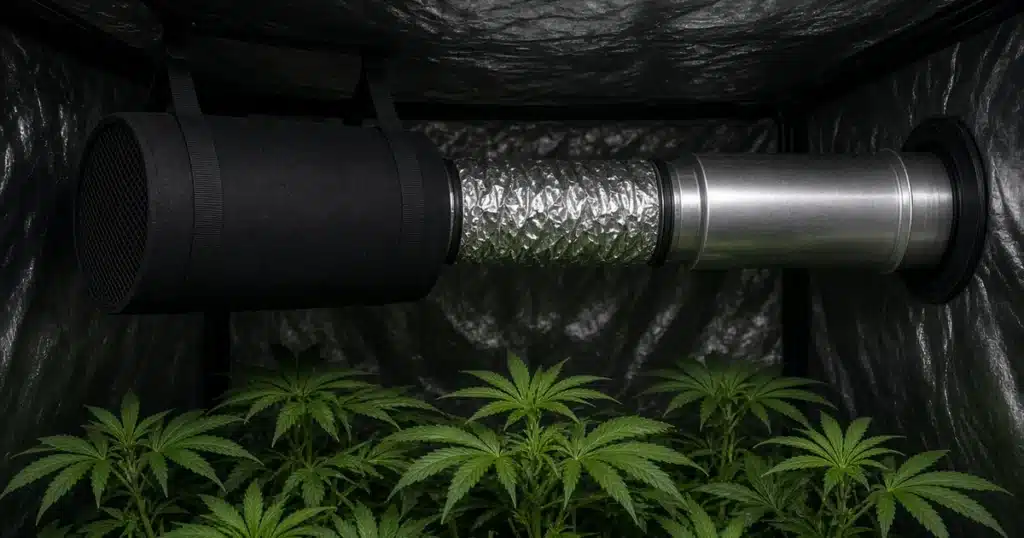
Quick answer: Keep grow room ducting as short and straight as you can, use gentle curves instead of sharp corners, pull flexible duct tight and seal every joint. Each bend, extra foot and sag adds resistance, and University of Florida Extension explains that a fan moves less air as that resistance climbs. University facilities standards from Penn and Yale, written for campus buildings, cap flexible duct runs at about six feet and favor long radius elbows over square ones. They cover general ventilation, not plants or tents, but the airflow physics is the same.
Why Does Ducting Change Airflow?
Every duct pushes back on the air moving through it. Engineers call that push static pressure. A UF/IFAS Extension guide titled Fans for Greenhouses describes a fan as an air pump that creates a pressure difference to make air flow. As the system adds resistance, the fan has to work against more pressure and delivers fewer cubic feet per minute.
UF/IFAS gives a rating example to show how steep that slide can be. One fan in its table moves 10,200 cubic feet per minute in free air, 9,200 at an eighth of an inch of static pressure and only 4,300 at three eighths of an inch. Same fan, same motor, less than half the air.
The same guide shows why the problem snowballs faster than people expect. In a normal duct system the air is turbulent, so pressure loss rises with the square of the flow. Doubling the airflow takes four times the pressure. That is why a long, twisting duct run can swallow most of the gain from a stronger fan.
Lost airflow shows up as climate trouble. Heat from the lights lingers, humidity creeps up after watering and the air near the canopy stops moving. Before you blame the fan or the weather, compare your readings with the ideal grow room climate ranges and then look hard at the duct path. A cheap fix in the ducting often closes the gap.
How much air your space needs is a different question. Our inline fan CFM guide covers sizing. Here the focus is only the path the air travels once the fan is chosen.
Ducting Rules at a Glance
| Rule | What the guide says | Source |
|---|---|---|
| Resistance | Airflow falls as static pressure rises | UF/IFAS Extension |
| Flow and pressure | Pressure loss rises with the square of the flow | UF/IFAS Extension |
| Typical limit | Greenhouse systems rarely exceed 0.10 to 0.15 inch | UF/IFAS Extension |
| Elbows | Radius 1.5 times duct width preferred to square elbows | Penn facilities standard |
| Flexible duct | Six feet or less, as short and straight as possible | Penn and Yale standards |
| Fan connection | Flexible connectors isolate fans from ductwork | Yale facilities standard |

How Do Bends Affect Grow Room Ducting?
Sharp bends cost the most. When air hits a tight corner it piles up, swirls and loses speed before it finds its way out. The University of Pennsylvania ductwork design standard prefers curved elbows whose radius is 1.5 times the width of the duct over square corners. Where a square elbow cannot be avoided, it calls for turning vanes inside to guide the air around the turn.
A grow tent rarely has room for metal elbows with vanes, but the idea carries over. Let flexible duct sweep around a corner in a wide arc instead of folding it at a right angle. A 6 inch duct curving through a radius of about 9 inches follows the same 1.5 ratio the Penn standard uses.
Count every turn before you hang anything. A route with one gentle curve will usually outperform a shorter route with three hard corners. If the duct must change direction, place the curve where it has the most space, often above the tent rather than squeezed against a wall.
How Long Can a Duct Run Be?
As short as the layout allows. Both university facilities standards set a firm cap on flexible duct. The Penn standard says flexible duct runs should in general be six feet or less and kept as short and straight as possible, and it calls for rigid sheet metal for the remaining branch ductwork. The Yale air distribution design standard sets the same six foot maximum.
Those are building codes for offices and labs, not grow room advice, and a home tent setup does not have to meet them. Still, they point to something real. Flexible duct has a ribbed inner wall that drags on the air, and any sag or kink adds more drag. The longer the run, the more of that drag you pay for.
If your exhaust has to travel farther, two fixes help. Use smooth rigid duct for the long straight stretch and keep flexible duct for the short connections at each end. Then make sure every flexible section is pulled taut so the ribs lie flat.
How Should You Route Grow Room Ducting?
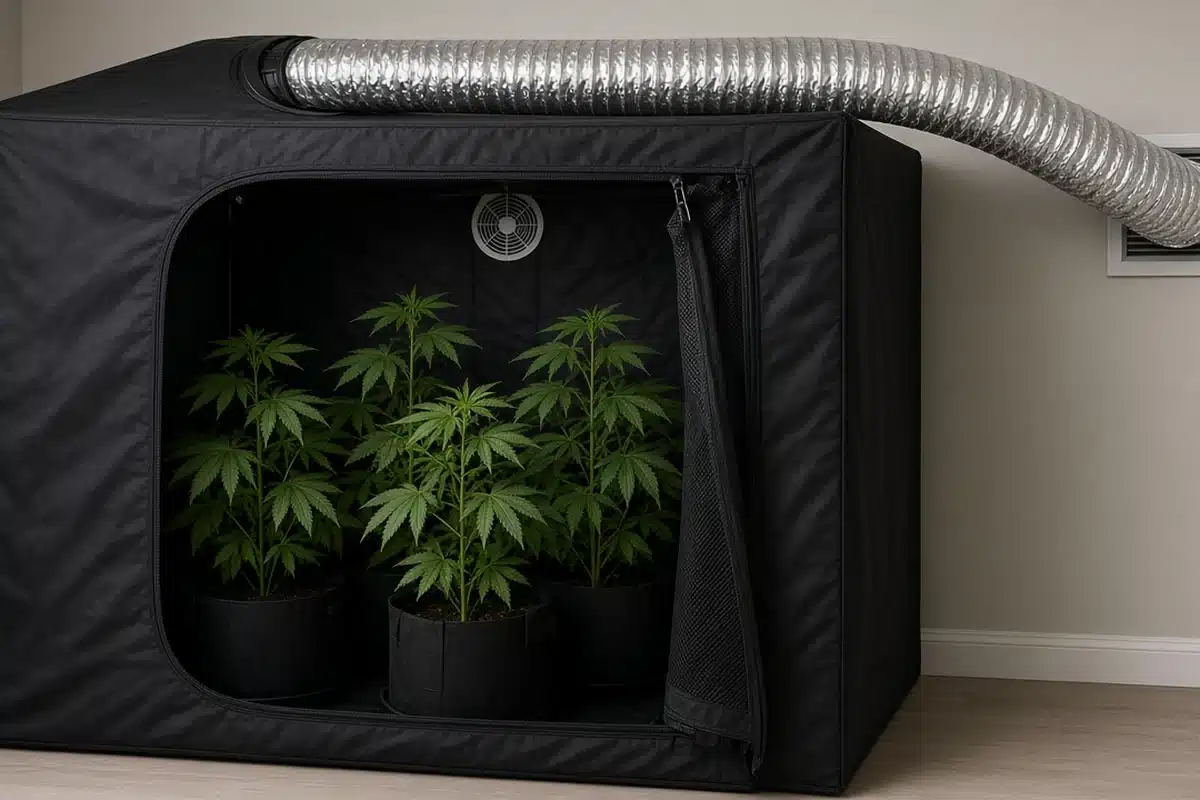
- Plan the shortest path first. Sketch the route from filter to fan to exhaust point before you buy duct.
- Keep the filter, fan and duct in a straight line where possible. Each change of direction adds resistance.
- Use wide curves, not folds. Aim for a bend radius of about 1.5 times the duct width, the ratio in the Penn standard.
- Stretch flexible duct fully. Sagging or bunched duct adds drag along its whole length.
- Support long runs. Hang the duct every few feet so it cannot droop between supports.
- Seal every joint. Yale tells designers to make fan discharge ducts completely airtight and to guard against leaks at fan connections.
- Isolate the fan. Yale also calls for flexible connectors between fans and ductwork, which keeps vibration from spreading down the line.
- Check airflow after setup. If leaves barely move or the tent stays hot, look at the duct path before changing fans.
If your system uses a carbon filter, our guide to building a DIY carbon filter explains how filter depth adds its own resistance to the line.
What Static Pressure Is Normal?
Lower is better, and greenhouses offer a useful benchmark. UF/IFAS estimates that most greenhouse ventilation systems face a resistance of 0.10 to 0.15 inch of water at most. A tent with a carbon filter and a long duct may run higher than that, which is one reason growers often find their fan delivering far less than the box rating.
Upkeep matters as well, UF/IFAS adds. It warns that an unbalanced impeller can cut the volume of air a fan moves by 30 or 40 percent. Dust buildup on blades is a common cause, so wipe the fan housing and impeller when you change filters.
These numbers come from greenhouse fan selection, not from tents. Use them to understand the trend, not as a target your meter must hit.
Air speed belongs in the same picture. The Yale standard limits air velocity in low pressure systems, allowing up to 1,800 feet per minute in branch exhaust ducts and 2,500 in a main exhaust line. Squeezing the same airflow through a narrower duct raises its speed, and faster air meets more friction along the walls. That is why a reducer between the fan and the duct often costs more airflow than it seems to save in space.
Troubleshooting Grow Room Ducting Problems
The tent stays hot even with a strong fan. Count the bends and measure the run. UF/IFAS shows how sharply airflow falls as resistance rises.
The duct whistles or rattles. Air may be squeezing through a kink or a loose joint. Straighten the run and seal it.
The fan seems weaker than it used to. Check for dust on the impeller. UF/IFAS says an unbalanced impeller can cut airflow by 30 or 40 percent.
The tent walls pull inward too hard. Exhaust is pulling against a restricted intake. Open another port or shorten the intake duct.
Vibration spreads through the frame. Add a flexible connector at the fan, as the Yale standard recommends, and hang the fan on its own support.
Sources
- University of Florida IFAS Extension, Fans for Greenhouses (AE020): https://ask.ifas.ufl.edu/publication/AE020/pdf
- University of Pennsylvania Facilities, Ductwork Design Standard: https://facilities.upenn.edu/sites/default/files/pdfs/233100_-_ductwork_-_mechanical_design_guide_0.pdf
- Yale University Facilities, Air Distribution Design Standard: https://facilities.yale.edu/sites/default/files/files/Design%20Standards/Central%20Campus%20Standards/15000/15800%20Air%20Distribution-2.pdf
FAQ
Is rigid duct better than flexible duct?
For long straight runs, smooth rigid duct adds less drag. Penn and Yale both limit flexible duct to six feet in their buildings.
How many bends are too many?
There is no fixed count for tents. Each bend adds resistance, so use as few as possible and make each one a wide curve.
Should the duct get smaller to speed up the air?
A narrower duct pushes air faster, and the Yale standard sets velocity limits for that reason. Match the duct to the fan outlet whenever you can.
Does duct length matter if the fan is powerful?
Yes. UF/IFAS explains that doubling flow takes four times the pressure, so extra length eats into any fan.
How should the fan connect to the duct?
Yale calls for flexible connectors on the fan discharge, sealed carefully against leaks. That also keeps fan vibration out of the duct.