Passive Intake for Grow Tents: When You Need a Fan
Quick answer: Passive intake means the exhaust fan pulls fresh air in through open vents, with no second fan pushing it. It works well when the openings are large enough for the exhaust fan to draw through easily. UMass Extension advises greenhouse growers to make intake openings at least one and a quarter times the area of the exhaust fan. If the tent walls suck inward hard or the door zipper strains when the fan runs, your intake is too small. Open more vents first, and add an intake fan only if the openings cannot keep up.
How Does Passive Intake Work Inside a Tent?
The exhaust fan creates a slight vacuum inside the tent, and outside air rushes in through any opening to fill it. Rutgers engineers call this a negative pressure system. The Rutgers fact sheet on HAF greenhouse fans explains that most agricultural ventilation works this way, with fans exhausting air and replacement air entering through inlet vents.
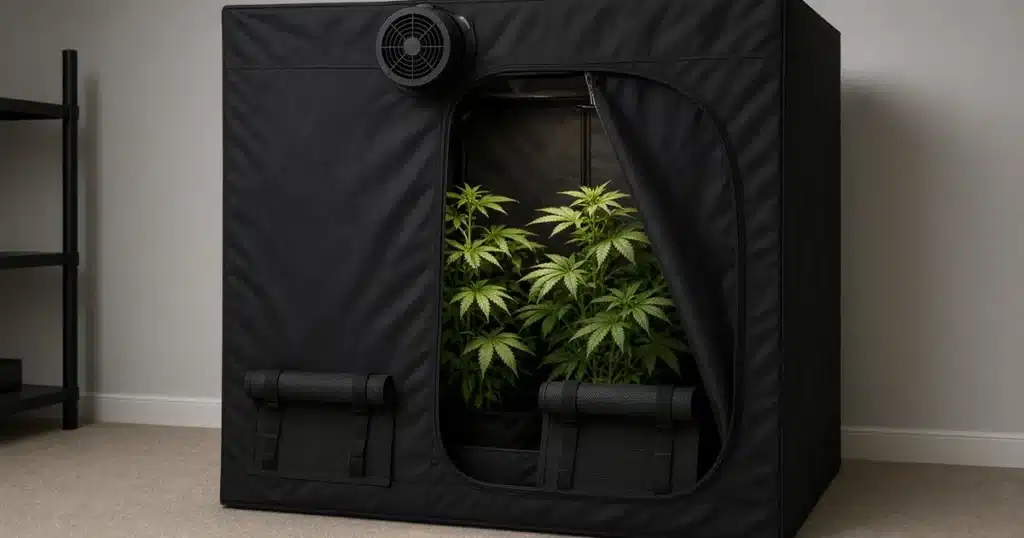
A tent behaves like a very small greenhouse in this respect. Its lower vent flaps and duct ports act as inlets, while the inline fan near the top acts as the exhaust. Nothing has to push air in, provided the openings let it flow freely.
Rutgers also notes that the size of the inlet and outlet vents compared with fan capacity determines static pressure and the speed of the air through the openings. A small opening forces the incoming air through faster and makes the fan work harder. A large opening lets air in gently and lets the fan move closer to its rated flow.
Choosing the exhaust fan is a separate step. Our guide to inline fan CFM sizing covers that, and everything here assumes your exhaust is already in place.
How Big Should Passive Intake Openings Be?
Bigger than the fan opening. UMass Extension, in its greenhouse ventilation fact sheet, recommends intake louvers with at least one and a quarter times as much open area as the fan, a point it stresses for houses covered with plastic film. That guidance was written for greenhouse exhaust fans, but a grow tent has the same flexible walls that show the problem.
For a tent, compare the open area of your vents with the face of your exhaust fan. A 6 inch round fan has an opening of roughly 28 square inches. By the UMass ratio, you would want at least 35 square inches of open intake. One small mesh window may not reach that. Two lower flaps or a pair of open duct ports usually will.
Spread matters as well as size. UMass notes that a continuous louver or several smaller louvers give more uniform temperatures than one opening. In a tent, using intake points on two sides tends to pull air more evenly across the canopy than one port in a corner.
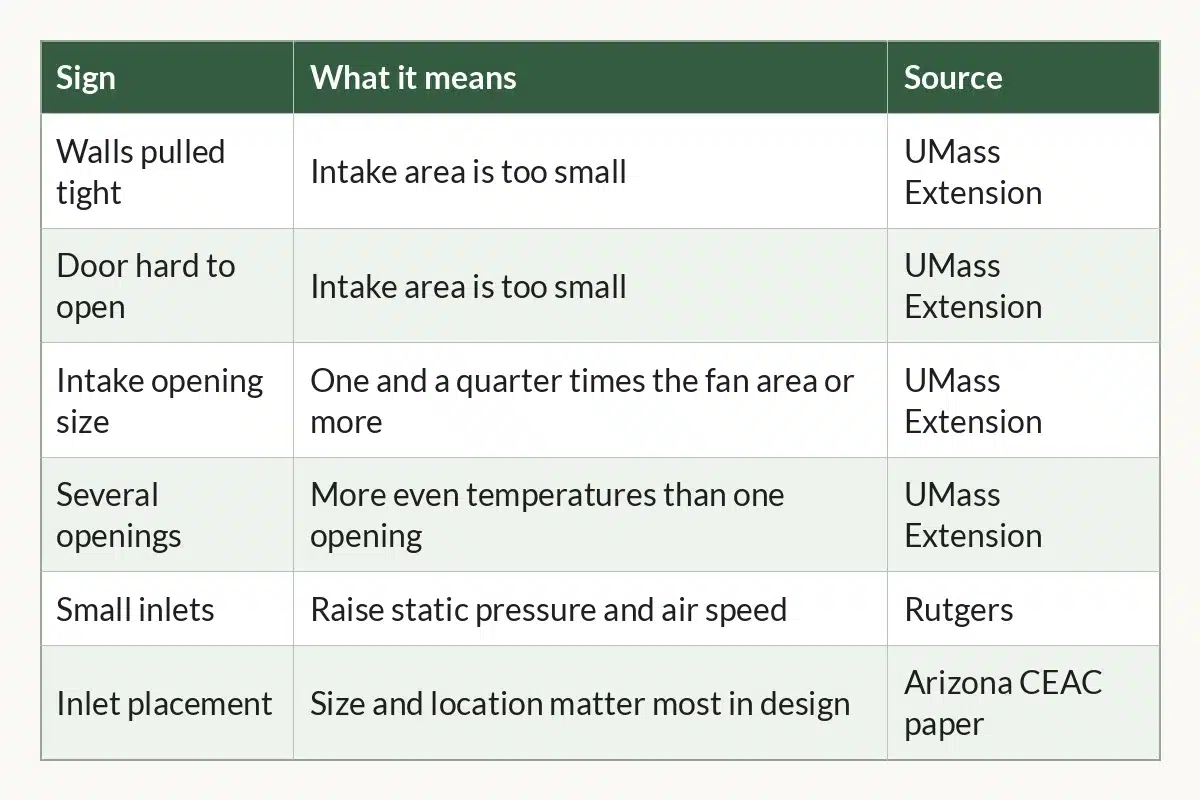
Passive Intake Signs at a Glance
| Sign | What it means | Source |
|---|---|---|
| Walls pulled tight | Intake area is too small | UMass Extension |
| Door hard to open | Intake area is too small | UMass Extension |
| Intake opening size | One and a quarter times the fan area or more | UMass Extension |
| Several openings | More even temperatures than one opening | UMass Extension |
| Small inlets | Raise static pressure and air speed | Rutgers |
| Inlet placement | Size and location matter most in design | Arizona CEAC paper |
How Can You Tell Passive Intake Is Not Enough?
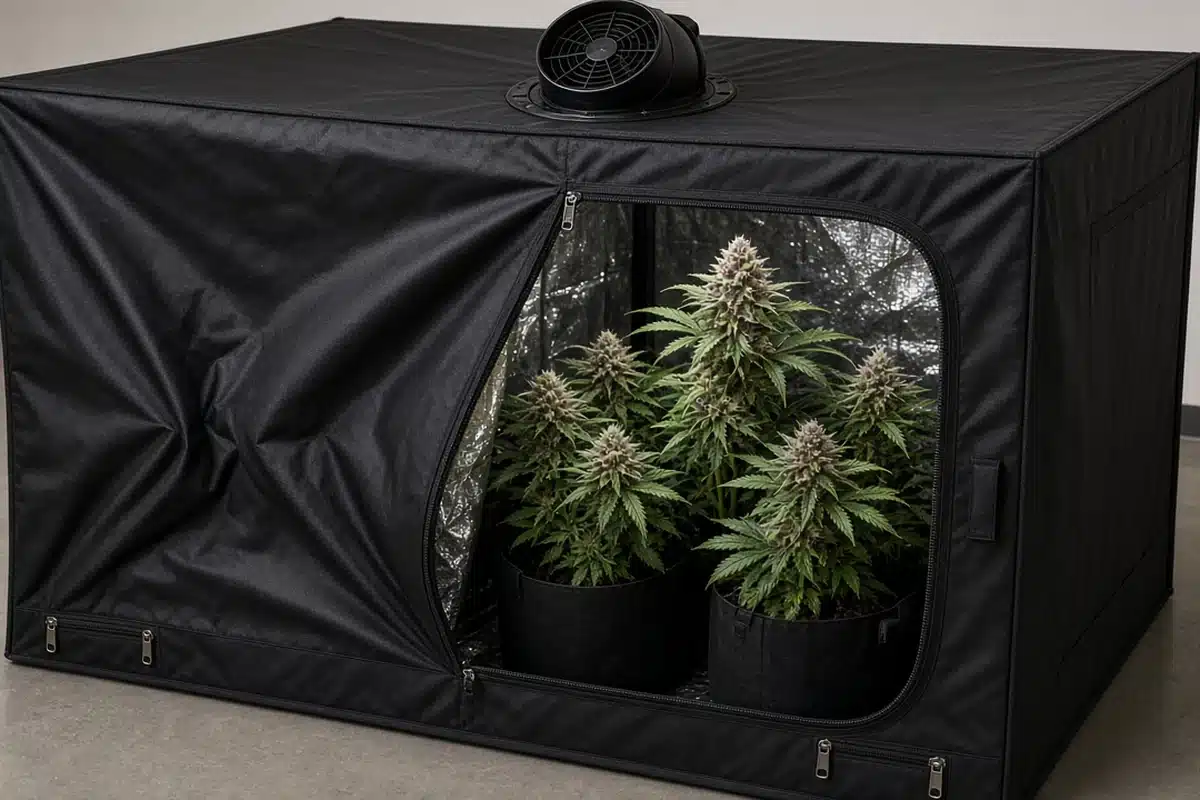
Watch the tent walls. UMass gives a simple test for greenhouses that works just as well on a tent. When running fans pull the plastic tight against the frame, or the door resists opening, the openings are too small for the fans.
On a tent, that looks like walls bowing sharply inward, zipper flaps snapping shut or a door that resists when you try to open it. A slight inward pull is normal and helps keep odors inside. A hard, drum tight pull means the fan is starving for air.
Pay attention to the fan itself as well. UMass recommends placing fans so the moving air passes across and through the canopy, and that the bottom of a fan or louver sit about 3 feet above the floor in a greenhouse. A tent is far smaller, but the aim is the same: air should cross the plants on its way out.
The readings offer other clues. If the tent runs hot even with a strong exhaust fan, or the fan sounds strained, starved intake may be the cause. The fan cannot pull out more air than can get in.
How Do You Fix a Starved Passive Intake?
- Open more vents. Lower flaps and spare ports are the cheapest fix. Start here before you buy anything.
- Use openings on more than one side. UMass notes that spreading intake gives more even temperatures.
- Keep intake low and exhaust high. UMass describes buoyancy, the tendency of warm, moist air to rise, among the forces that move air through a greenhouse. Intake low and exhaust high works with it.
- Clear anything blocking the openings. Pots, bags and cords pushed against a vent cut its open area.
- Account for mesh. Fine screens slow airflow. Rutgers lists the difficulty of fitting effective insect screening among the drawbacks of natural ventilation, a reminder that screens and airflow trade off.
- Slow the exhaust a little. A speed controller lets the fan match what the intake can supply.
- Recheck the walls. Repeat the UMass test after each change until the pull is gentle.
For the full layout of ports, fans and filters, see our tent setup walkthrough.
When Should You Add an Intake Fan?
When enlarging the openings is not possible or not enough. Some tents have only a few ports. Some growers need fine screens over every opening. Others pull intake air through a long duct from another room. In each case, a fan on the intake side can help push replacement air in.
Rutgers lays out the alternatives. Positive pressure systems use fans to push outside air in, while neutral pressure systems use supply and exhaust fans of about equal capacity. For a tent that should stay slightly negative to hold odors, the intake fan should move less air than the exhaust. That keeps the setup closer to the negative pressure design Rutgers describes as the most common one.
Placement still counts. The Arizona CEAC paper on greenhouse ventilation and cooling, written by Rutgers engineer William Roberts, states that the size and location of inlets are the most important design consideration in any ventilation system. It explains that incoming air should mix well with the inside air so that cold spots do not form. In a tent, aim incoming air across the floor or into a circulation fan rather than straight onto plants.
Moving air inside the tent is a separate job from bringing it in. Our oscillating fan guide covers canopy airflow once fresh air is entering.
Troubleshooting Grow Tent Intake Problems
The walls pull in hard. The intake is too small. UMass says pulled tight walls and a hard to open door both mean inadequate intake area.
One corner stays warm. Air may be entering from a single opening. Add intake on another side, as UMass suggests for more even temperatures.
Cold air spills onto plants in winter. Incoming air is not mixing. The Arizona CEAC paper stresses mixing inlet air to avoid cold spots.
The tent leaks odor after adding an intake fan. The intake may now match or beat the exhaust. Slow the intake fan so the tent stays slightly negative.
The exhaust seems weaker on windy days. UMass reports that a fan exhausting into the wind loses 10 percent or more of its output. If your exhaust duct ends at a window facing the wind, the tent may need more intake area to compensate.
The fan starts before a damper opens. UMass notes that small, tight houses can build negative pressure so fast that a motorized damper stays shut, and it suggests a time delay relay so the fan waits for the louver. The same logic applies to any tent with a powered vent flap.
Sources
- UMass Extension, Ventilation for Greenhouses: https://www.umass.edu/agriculture-food-environment/greenhouse-floriculture/fact-sheets/ventilation-for-greenhouses
- Rutgers NJ Agricultural Experiment Station, HAF Greenhouse Fan: https://rucore.libraries.rutgers.edu/rutgers-lib/47268/PDF/1/
- University of Arizona Controlled Environment Agriculture Center, Ventilation and Cooling of Greenhouses: https://ceac.arizona.edu/sites/default/files/ventilation_and_screening_of_ghs.pdf
FAQ
Is passive intake enough on its own?
Often, yes. If the walls draw in only slightly and the tent holds temperature, the openings are doing their job.
How much intake do I need?
UMass advises greenhouse intake openings with at least one and a quarter times the open area of the fan. Use that ratio as a rough guide for tent vents.
Should the intake fan be the same size as the exhaust?
Rutgers notes that equal supply and exhaust gives neutral pressure. For odor control, keep the intake fan smaller or slower.
Where should passive intake be located?
Low on the tent, ideally on more than one side, so air sweeps across the plants on its way to the exhaust.
Do mesh screens on vents matter?
Yes. Screens slow airflow, so screened openings need to be larger to let the same amount of air through.