Induction Grow Light Guide: How They Work and Why They Faded

The short answer
An induction grow light uses a magnetic field to excite gas inside a sealed tube with no electrodes. That design gave very long lamp life. Induction lamps were once sold as an option beside fluorescent and HID lamps. Lighting guides now point growers to LEDs, which offer better efficiency, more spectrum control and wider choice.
You may still find induction fixtures on resale sites or in older grow rooms. Knowing how they work helps you decide whether one is worth holding on to.
How do induction grow lights work?
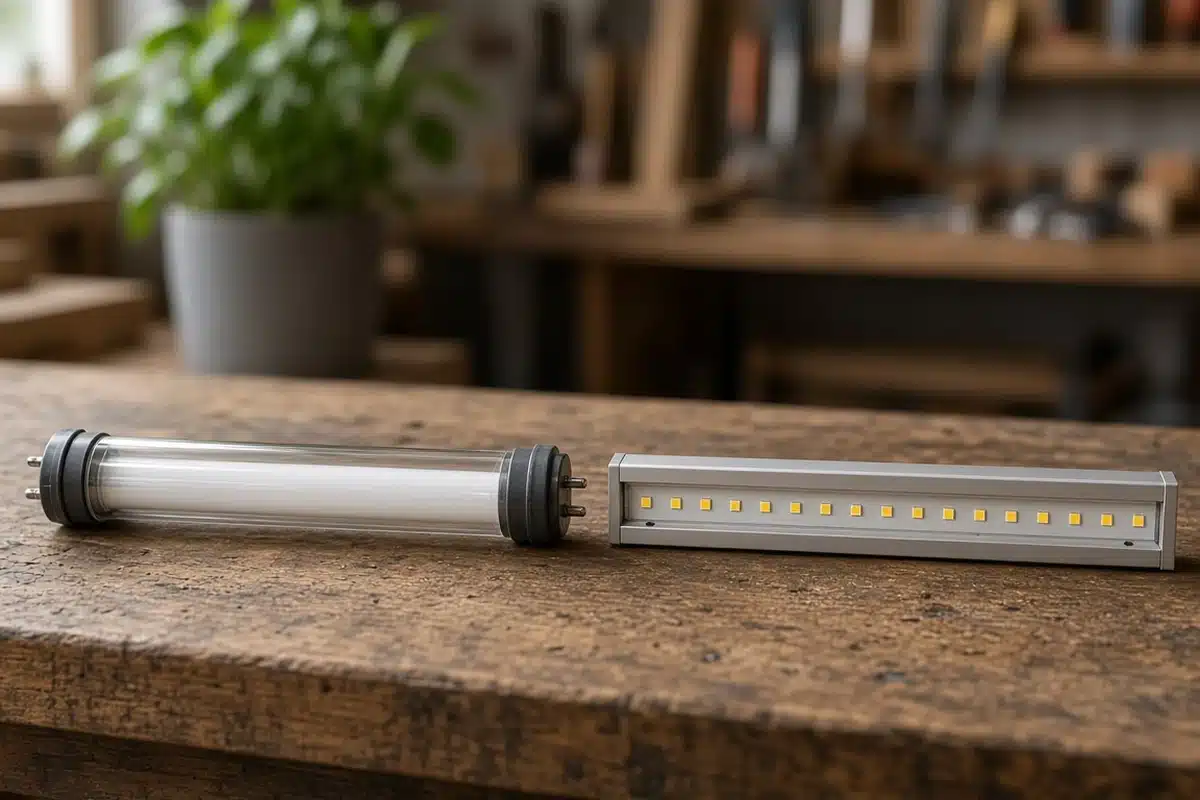
Most lamps that use gas have metal electrodes inside the tube. Current flows between them and excites the gas. Over time, the electrodes wear out, and the lamp fails.
Induction lamps skip the electrodes. Coils wrapped around the tube create a magnetic field. That field drives current through the gas inside without any wire touching it.
The excited gas gives off ultraviolet light. A phosphor coating on the inside of the tube turns that into visible light, much like a fluorescent tube.
With no electrodes to wear out, the lamp can run for a long time. That long life was the main selling point.
Where were they used?
Induction lamps found early use in streetlights, warehouses and tunnels, places where changing a bulb was hard or costly.
Some makers adapted them for growing. Induction grow lights were marketed for long life, low heat at the lamp surface and a broad spectrum.
The University of Missouri Extension guide to understanding grow lights describes the main lamp types used in controlled environment growing. Fluorescent, high intensity discharge and LED lamps each have their own place. The guide explains that light quantity and quality both shape plant growth.
Why did LEDs replace them?
LEDs improved quickly, and each year new diodes made more light from the same power. Induction lamps fell behind.
The Resource Innovation Institute lighting guide focuses on efficacy, measured in micromoles per joule. It shows how modern LED fixtures lead in plant usable light per watt. Higher efficacy means lower power bills for the same light.
LEDs allow spectrum control. Makers can mix diodes to tune the light for different stages. Induction lamps have a fixed spectrum set by the phosphor.
LEDs are compact and come in many shapes. Bars, boards and strips fit tents, shelves and large rooms. Induction fixtures tend to be bulky.
The University of Vermont Extension tips for choosing grow lights suggest comparing efficacy, light output and coverage when shopping. Those numbers favor LEDs in most current product lines.
| Type | Traits | Notes |
|---|---|---|
| Induction | No electrodes, long lamp life | Fixed spectrum, bulky fixtures |
| Fluorescent | Low heat, good for seedlings | Lower output for large plants |
| High intensity discharge | High output | More heat, shorter lamp life |
| LED | High efficacy, spectrum control | Wide product choice |
Sources: University of Missouri Extension, Resource Innovation Institute, University of Vermont Extension.
Is an old induction fixture still worth using?
It depends on its condition and your needs. A working fixture can still grow seedlings, herbs and leafy greens.
Check its output. Over many years, phosphor coatings fade, and the lamp gives less light even while it still glows. Our post on when to replace grow lights explains how light output drops with age.
Think about parts. Many induction lines are no longer made. If the lamp or ballast fails, a match may be hard to find.
Compare power use. An older fixture may use more power than a modern LED for the same light. Over a few years, the savings from an LED can cover part of its price.
How to: step by step
- Learn the basic design of induction lamps.
- Compare spectrum and output with modern LEDs.
- Check efficiency figures on spec sheets.
- Consider replacement part availability.
- Look at LED options for the same space.
- Decide whether an old fixture is still worth using.
Our guide to choosing the right LED lights for your grow explains how to compare spec sheets.
What can you learn from induction lamps?
Induction lamps show that long life alone doesn’t make a good grow light. Efficacy, spectrum and coverage matter more over the life of a fixture.
They show how fast lighting changes. A product that looked advanced can fall behind within a few years.
When you shop, look at measured data, not marketing words. Ask for light maps and efficacy figures.
Our post on grow lights for cannabis compares light types in more detail.
Troubleshooting
Dim old fixture. The lamp is aging. Replace it or switch to LED.
Hard to find parts. The line is discontinued. Plan a replacement.
Slow growth. Intensity is low. Add light or upgrade.
Buzzing sound. The ballast is aging. Have it checked or replace the fixture.
Uneven light. The fixture is too high or too small. Adjust height or add another light.
Induction lamps had their moment, and LEDs carried the idea of long life further. Kind Seed Co carries cannabis seeds for growers planning a new light setup.
Sources
- Controlled environment agriculture: understanding grow lights (G6987), University of Missouri Extension, Controlled environment agriculture
- Lighting for controlled environment agriculture, best practices guide, Resource Innovation Institute, Lighting for controlled environment agriculture
- Tips for choosing grow lights, University of Vermont Extension, Tips for choosing grow lights
FAQ
Are induction lights still sold?
Some are, but choice is limited. Most grow light makers now focus on LEDs.
Do induction lamps run cool?
The lamp surface runs cooler than HID bulbs, but the fixture still makes heat that needs airflow.
Is induction better than fluorescent?
Induction lamps last longer. Output and spectrum are similar, since both use phosphor coatings.
Can you retrofit an induction fixture?
Some people swap in LED parts, but it often makes more sense to buy a new LED fixture.
How long do induction lamps last?
They last a long time because they have no electrodes, though light output fades with age.