
LED Light Distance for Cannabis: Set It by Intensity
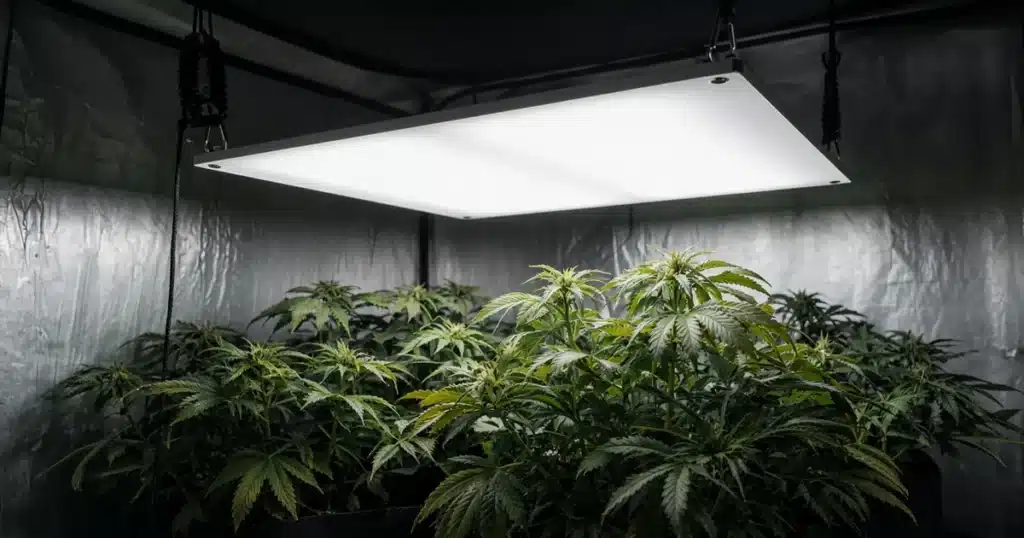
There is no single correct LED light distance for cannabis, because fixtures differ in output. Growers set hanging height by the light intensity (PPFD) reaching the canopy, using the maker’s PPFD map or a meter. In a University of Guelph study of one cultivar in flowering, yield rose steadily as canopy PPFD increased from 120 to 1,800.
How Far Should an LED Be From Cannabis Plants?
The answer depends on the fixture, so growers work from intensity at the canopy rather than inches. The Guelph researchers note that small changes in distance from the light can make large differences in light at the leaves. They also say fixture power alone cannot tell you canopy light, because of unknowns such as hang height, light spread and fixture efficacy (Rodriguez-Morrison et al.). Start with choosing LED lights that publish a PPFD map.
Why Does PPFD Matter More Than Inches?
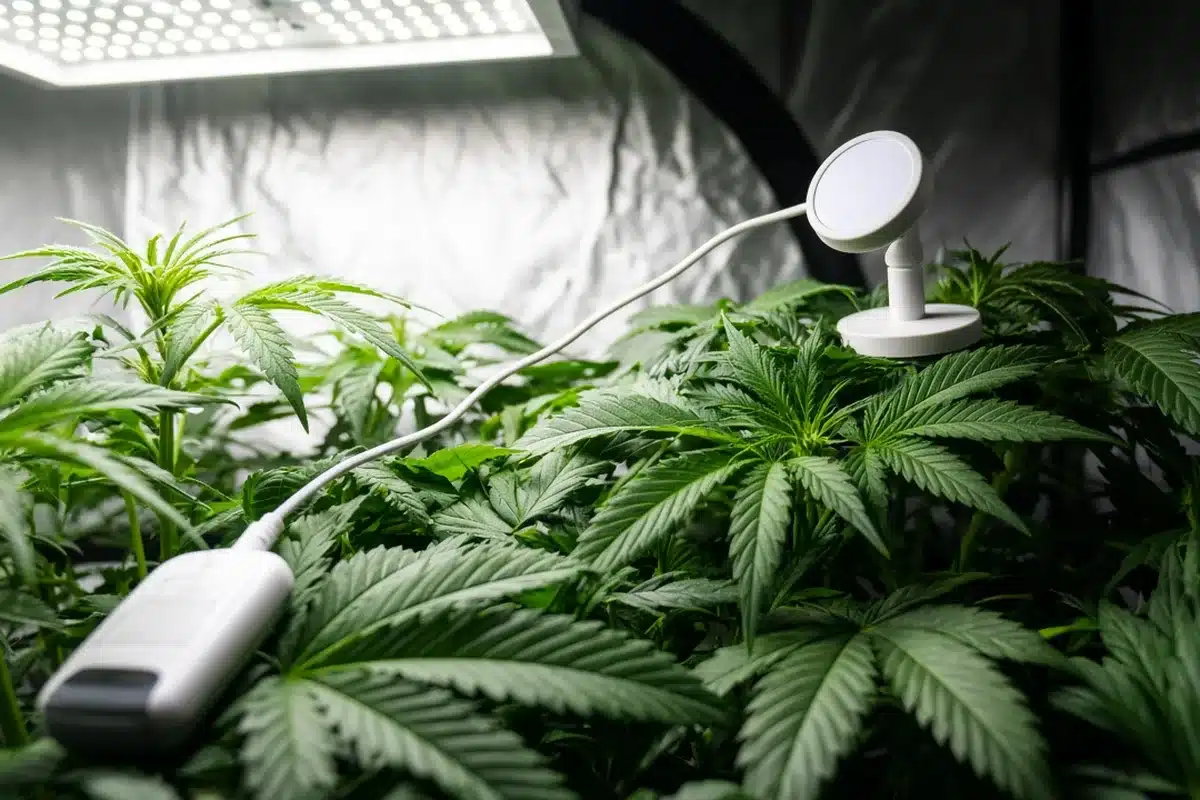
PPFD is the light that actually reaches the plant, in µmol/m²/s. In the Guelph study, the team set each rack’s height so about 1,600 µmol/m²/s reached the top of the tallest plant in the brightest plot, whose average canopy level was about 1,800, then dimmed the other plots to their targets (Rodriguez-Morrison et al.). Height and dimming were tools to hit a PPFD. More on light levels is in our guide to PAR for cannabis.
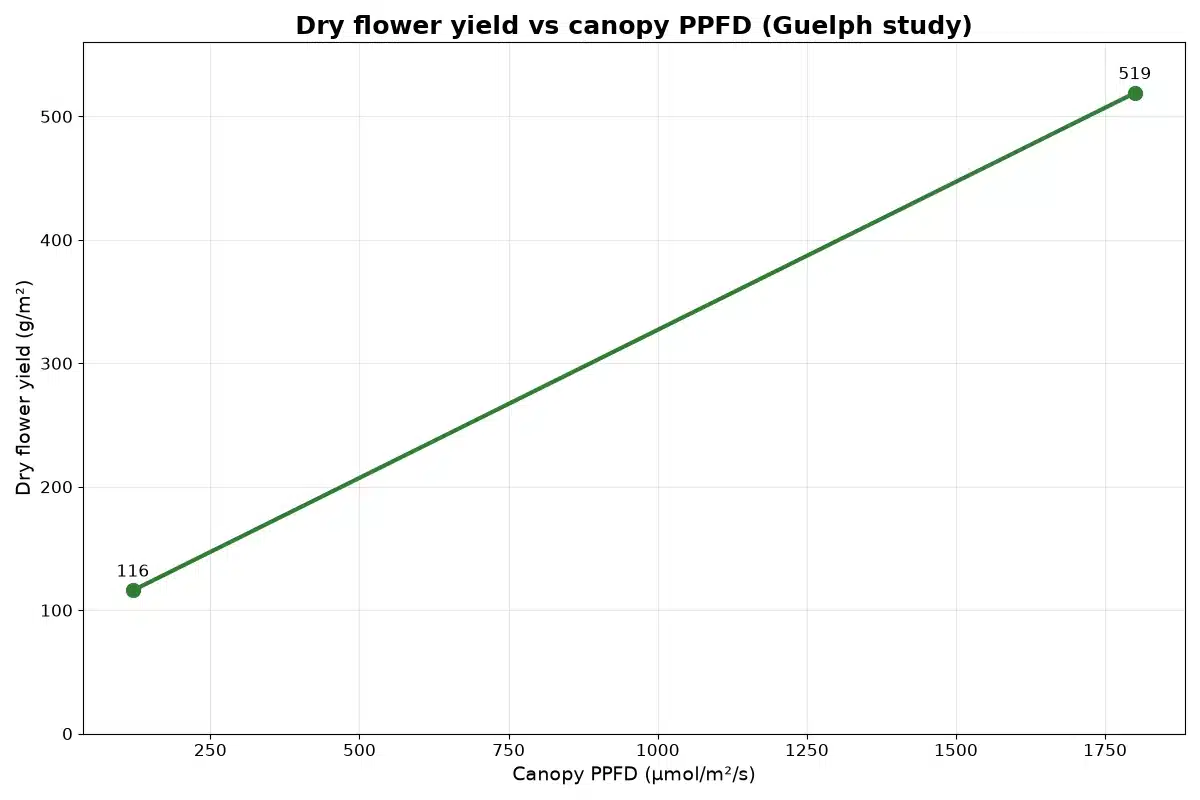
Source: Rodriguez-Morrison, Llewellyn and Zheng 2021. Endpoints and linear trend only. One indoor cultivar, 12-hour flowering photoperiod.
Data for this chart:
| Canopy PPFD (µmol/m²/s) | Dry flower yield (g/m²) | Source |
|---|---|---|
| 120 | 116 | Rodriguez-Morrison et al. 2021 |
| 1,800 | 519 (4.5 times higher) | Rodriguez-Morrison et al. 2021 |
DLI from PPFD and hours of light
Computed with DLI = PPFD × hours × 0.0036 (Virginia Cooperative Extension SPES-720).
| PPFD (µmol/m²/s) | Hours of light | DLI (mol/m²/d) | Basis |
|---|---|---|---|
| 400 | 18 | 25.9 | Computed, VT formula |
| 600 | 18 | 38.9 | Computed, VT formula |
| 600 | 12 | 25.9 | Computed, VT formula |
| 900 | 12 | 38.9 | Computed, VT formula |
How Does Hanging Height Relate to Daily Light?
Daily light integral (DLI) is the total light a plant gets in a day. Virginia Cooperative Extension gives DLI = PPFD × 3,600 × hours ÷ 1,000,000, which is the same as PPFD × hours × 0.0036 (Virginia Extension). So 600 µmol/m²/s for 18 hours gives about 38.9 mol/m²/d. Raising a light lowers PPFD and DLI. Our page on DLI for autoflowers goes further.
What Did Research Find About Light Intensity and Yield?
In the Guelph study, plants flowered under a 12-hour photoperiod at canopy PPFDs from 120 to 1,800 µmol/m²/s. Dry flower yield rose in a straight line from 116 to 519 g/m², 4.5 times higher. There were no light intensity effects on the potency of any measured cannabinoid (Rodriguez-Morrison et al.). These were indoor study conditions with one cultivar, not a promise for every grow.
Growing a quick indoor crop under LEDs? Our autoflower seeds are listed here.
Sources
Some sources below studied hemp or other crops, or give general garden guidance, rather than studying drug-type cannabis. Their findings are reported as results for those crops or settings.
- Rodriguez-Morrison, Llewellyn and Zheng 2021, Frontiers in Plant Science 12:646020: Cannabis Yield, Potency, and Leaf Photosynthesis Respond Differently to Increasing Light Levels in an Indoor Environment
- Virginia Cooperative Extension SPES-720: Calculating and Using Daily Light Integral (DLI)
This LED height page leans on the light research above, and Kind Seed Co aims it at general growing information.
FAQ
Can LED lights burn cannabis?
The Guelph study found yield still rising at about 1,800 µmol/m²/s at the canopy, although a leaf stress measure (Fv/Fm) fell as light increased. The authors note cannabis leaves appear to tolerate very high light. Light far above that level, or heat from a fixture hung too close, was not tested.
Should you raise LEDs during flowering?
The Guelph team measured plant height and canopy PPFD twice a week and adjusted to keep each plot at its target as plants grew. Growers do the same in practice: as plants stretch, raise the light or dim it to hold the intended PPFD at the top of the canopy.
What is a PPFD map?
A PPFD map shows how much light a fixture delivers at points across an area at a set height. The Guelph authors note that fixture power cannot tell you canopy light because of hang height, light spread and efficacy, so a measured map or meter reading is more useful than wattage.
Does a dimmer replace changing height?
Partly. In the Guelph study, rack height was set once for the brightest plot, and the other light levels were reached by dimming. Dimming changes PPFD without moving the fixture, while the study notes distance also changes light at the leaves, so growers often use both.


