
Kelp for Cannabis: Kelp Meal and Seaweed Extract
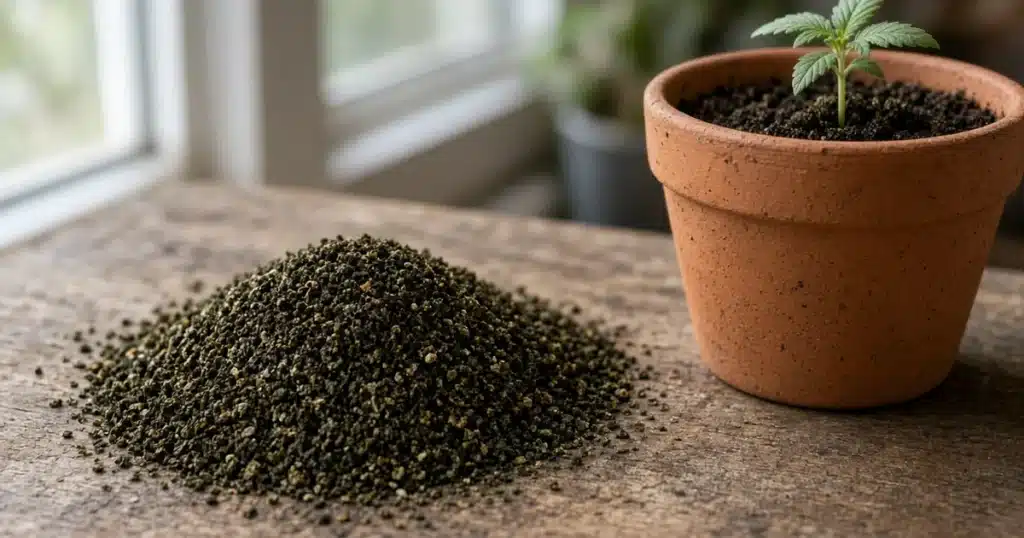
Kelp for cannabis comes as dry kelp meal mixed into soil or as liquid kelp added to water. Kelp meal is a mild organic amendment that Iowa State lists at about 1.5-0.5-2.5, as a source of potash and trace minerals. Colorado State values kelp mainly for micronutrients rather than nitrogen, phosphorus or potassium.
What Is Kelp Fertilizer?
Kelp is the most common seaweed fertilizer. Colorado State Extension says it is valued for micronutrients rather than its nitrogen, phosphorus and potassium, and is often mixed with fish products (Colorado State). Organic fertilizers like kelp usually need soil microbes to convert nutrients before plants can use them, so they release slowly. This is general garden guidance, not a cannabis study. For how kelp fits a wider plan, see organic vs synthetic fertilizer.

Is Kelp Meal the Same as Liquid Seaweed?
No. Colorado State lists three forms: extracts sold as kelp meal or powder, cold-processed liquid, and enzymatically digested liquid. It ranks them for quality and plant availability as enzymatically digested first, cold-processed second and extracts third. Kelp meal releases over 4+ months, while kelp powder is fine enough to mix into water and releases nutrients immediately to within about a month (Colorado State).
Kelp products: analysis and garden rates
Sources: Iowa State University Extension and Colorado State University Extension (general garden guidance, not cannabis studies).
| Product | Typical NPK | Release time | Garden rate | Source |
|---|---|---|---|---|
| Kelp meal | 1.5-0.5-2.5 (potash, trace minerals) | Not listed | 20, 10 or 5 lbs per 1,000 sq ft (low, medium, adequate fertility) | Iowa State |
| Kelp meal | Negligible | 4+ months | 1 lb per 100 sq ft, tilled in | Colorado State |
| Kelp powder | 1-0-4 | Immediate to 1 month | ¼ to ½ teaspoon per gallon of water | Colorado State |
What Nutrients Does Kelp Contain?
Sources differ on kelp meal’s analysis. Iowa State lists it at 1.5-0.5-2.5, with potash and trace minerals (Iowa State). Colorado State calls kelp meal’s NPK negligible and lists kelp powder at 1-0-4 (Colorado State). Either way, kelp is a light source of potassium. For a plant that is short on it, see our guide to potassium deficiency.
How Do Growers Use Kelp in Soil?
Iowa State gives kelp meal rates of 20, 10 or 5 lbs per 1,000 sq ft for low, medium or adequate fertility soil, worked into the top 6 to 8 inches, and advises being conservative with any organic fertilizer (Iowa State). Colorado State suggests about 1 lb per 100 sq ft for kelp meal and ¼ to ½ teaspoon per gallon for kelp powder (Colorado State). Kelp suits a natural growing approach. Bag and bottle analyses vary. Check the product label and local rules.
Sources
The sources below give general garden or container guidance rather than studying cannabis. Their findings are reported as results for those settings.
- Iowa State University Extension: Selecting and Using Organic Fertilizers
- Colorado State University Extension: Organic Fertilizers
These kelp notes give general growing information only, with Kind Seed Co citing the two extension guides above.
FAQ
Is kelp high in potassium?
Not very. Iowa State lists kelp meal at 1.5-0.5-2.5, and Colorado State lists kelp powder at 1-0-4, so potassium is the largest of the three numbers but still low. Colorado State says kelp is valued mainly for micronutrients rather than nitrogen, phosphorus and potassium.
Can kelp replace a regular fertilizer?
Not on its own. Colorado State says kelp's nitrogen, phosphorus and potassium are insignificant and that it is often combined with fish meal to add nitrogen, phosphorus and potassium. Iowa State lists kelp meal as a source of potash and trace minerals.
How much kelp meal goes in soil?
Iowa State lists 20, 10 or 5 lbs per 1,000 square feet for low, medium or adequate fertility soil, mixed into the top 6 to 8 inches. Colorado State suggests about 1 pound per 100 square feet. Both are general garden rates, and a soil test helps decide which applies.
What is kelp powder?
Colorado State describes kelp powder as similar to kelp meal but ground fine enough to dissolve in water, so it can be sprayed on leaves or run through irrigation. It lists a typical analysis of 1-0-4, release from immediate to one month, and about ¼ to ½ teaspoon per gallon.


