
CO2 Levels for Cannabis: What PPM Plants Use
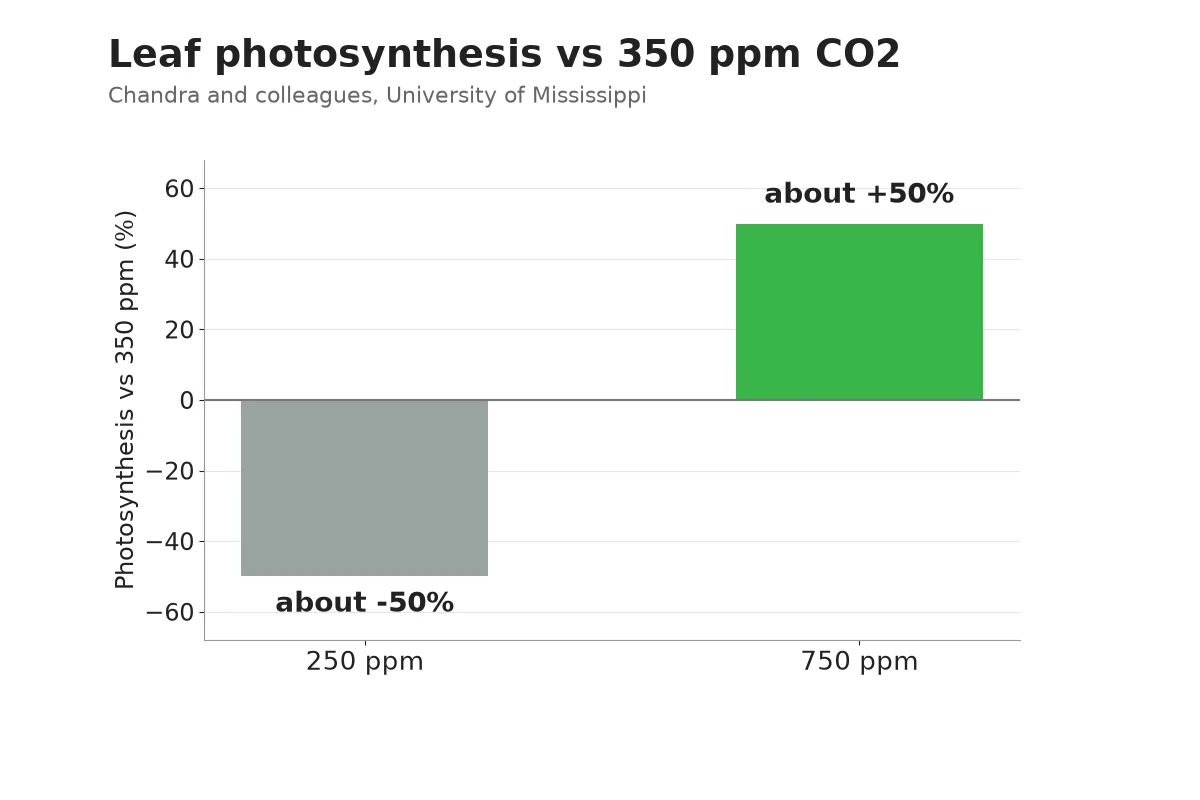
Cannabis uses CO2 from the air to make sugars, and more CO2 can raise photosynthesis when light and temperature are also high. In a study on cannabis leaves, raising CO2 from 350 to 750 ppm increased photosynthesis by about 50 percent, while dropping it to 250 ppm cut photosynthesis by about 50 percent. Fresh air exchange matters most for most home grows.
What did research on cannabis find?
Chandra and colleagues at the University of Mississippi measured cannabis leaves at six CO2 levels, from 250 to 750 ppm, under their best light and temperature.
| CO2 compared with 350 ppm | Photosynthesis | Water use efficiency | Transpiration |
|---|---|---|---|
| 250 ppm | about 50% lower | about 53% lower | about 7% higher |
| 750 ppm | about 50% higher | about 111% higher | about 29% lower |
Source: Chandra et al., Physiology and Molecular Biology of Plants, 2008.
The same team found the best conditions for photosynthesis were 25 to 30°C and a light level of about 1,500 micromoles per square meter per second. Above 30°C, the leaves’ pores started to respond badly, and high heat with very high light cut photosynthesis.
A follow-up study by the same group tested four high-THC varieties at 390, 545 and 700 ppm.
| Variety | Photosynthesis gain at 700 ppm vs 390 ppm |
|---|---|
| HPM | about 48% |
| K2 | about 45% |
| MX | about 44% |
| W1 | about 38% |
Source: Chandra et al., Physiology and Molecular Biology of Plants, 2011.
Two points stand out. First, the gain at 700 ppm held across all four varieties, though the size varied. Second, the smaller step to 545 ppm made no significant difference in most of the measured traits. A small bump above outdoor air may not be worth much.
Note what these studies measured. They tracked leaf gas exchange, not harvest weight. A leaf making sugars faster is a good sign, but it is not the same as a proven yield gain.
What greenhouse research says about target levels
Greenhouse growers have used CO2 for decades, and the Ontario Ministry of Agriculture, Food and Rural Affairs (OMAFRA) sums up the general rules for crops. These figures are for greenhouse crops in general, not cannabis trials.
| Point | OMAFRA guidance |
|---|---|
| Outdoor air when written | About 340 ppm |
| Net photosynthesis rises across | 340 to 1,000 ppm for most crops |
| Saturation for most crops | About 1,000 to 1,300 ppm in ideal conditions |
| Raising seedlings of tomato, cucumber, pepper | 800 to 1,000 ppm |
| Daytime level with vents closed | 1,000 ppm |
| Vents open about 10% | Shut enrichment off or reduce it to 400 to 600 ppm |
| Night | Not needed without lights, as there is no photosynthesis |
Source: OMAFRA, Supplemental carbon dioxide in greenhouses.
Outdoor CO2 has risen since OMAFRA first wrote that guidance, so check your own outside reading rather than assuming one number.
CO2 targets stage by stage
Seedlings and clones. Young plants have little leaf area and draw down only a small amount of CO2. Fresh air at outdoor levels is the practical target for home growers. OMAFRA gives 800 to 1,000 ppm for raising vegetable seedlings in greenhouses, but no cannabis research has set a seedling figure, so treat enrichment at this stage as optional.
Vegetative growth. As plants fill the tent, they pull CO2 down faster while lights are on. Keep CO2 from dropping below the outside reading with steady fresh air. If you run a sealed room with strong light, the cannabis leaf research points to large gains around 700 to 750 ppm, and greenhouse crops in general level off around 1,000 to 1,300 ppm.
Flowering. The canopy is at full size and demand is highest. The same rules apply, with light and temperature setting the ceiling. Cannabis-specific CO2 targets for each week of bloom have not been confirmed in published research, so keep the plan simple: enough light and good temperature first, then CO2 if the room is sealed.
Lights off. Plants do not photosynthesize in the dark, so there is no reason to add CO2 at night. OMAFRA notes CO2 often builds up on its own overnight from plant respiration, and early morning readings of 500 to 600 ppm are not unusual in a closed greenhouse. It adds that organic media such as coconut coir can push night levels as high as 1,200 ppm, which drops quickly once light returns.
How CO2 gets into the leaf
CO2 enters a leaf through stomata, the tiny pores found mostly on the underside of leaves. OMAFRA explains that it moves in by diffusion, and the higher the CO2 outside the leaf, the faster the plant takes it up. Light, leaf and air temperature, humidity and water stress all affect how wide those pores open.
Air movement matters as much as the reading on your monitor. OMAFRA notes that CO2 does not travel far by diffusion alone, and that a dense canopy can run low inside it even when the air above looks fine. Gentle air moving through the plants thins the still layer of air that sits on each leaf, which brings CO2 closer to the pores. In a tent, that means a small fan moving air across and through the canopy, not only an exhaust pulling air out at the top.
In greenhouse crops, OMAFRA reports that raised CO2 can shorten the growing period by 5 to 10 percent and increase leaf size and thickness. Those are general crop results, not cannabis trials, but they show why growers with sealed rooms pay attention to CO2.
Why can low CO2 be a problem in a tent?
Plants pull CO2 down in a closed space when lights are on. Without fresh air, levels can drop. OMAFRA notes that an actively growing crop in a tight greenhouse with little ventilation can pull daytime CO2 down to as low as 200 ppm. It adds a rule of thumb: a drop below outdoor levels hurts more than raising CO2 above them helps. Steady exhaust keeps CO2 near outdoor air. See inline fan CFM for a grow tent.
When is extra CO2 worth it?
Extra CO2 helps most when light is strong, temperature is in range and the room is sealed. In a vented tent, added CO2 is pulled out by the fan. For equipment, see CO2 generators.
Light, heat and CO2 work as a set. Raising CO2 without strong light gives only a small gain, so get light and temperature right before thinking about enrichment. OMAFRA also notes that for some crops the cost of enriching to 1,000 ppm is not worth it at low light.
Ask yourself three questions before adding CO2:
- Is the room sealed, or close to it, while lights are on?
- Is light at the canopy strong enough that plants could use more CO2?
- Is temperature steady in the range plants like?
If any answer is no, fix that first. Added CO2 will mostly be wasted until it is.
OMAFRA’s own strategy ties the CO2 target to light. For vegetable crops, it suggests 1,000 ppm on sunny days with the vents closed, but only 400 ppm on cloudy days when light falls below 40 watts per square meter. It also notes that the infrared analyzers used to control CO2 need routine calibration to stay accurate. For a tent, the same logic applies. Check your monitor against fresh outdoor air now and then, and match any enrichment to how strong your light is.
How do you check CO2 levels?
- Place a CO2 monitor at canopy height.
- Read it with lights on and the fan running.
- Compare with the reading outside the tent.
- Take readings at the start, middle and end of the light period for a few days.
- Keep temperature and humidity in range too, using the Kind Seed Co VPD chart.
Where CO2 is added, ventilate the room before working in it. Log levels for a few days before adding any CO2.
Watering and feeding changes with more CO2
Higher CO2 makes leaf pores close partway. In the 2008 cannabis study, transpiration ran about 29 percent lower at 750 ppm than at 350 ppm. OMAFRA notes that lower transpiration can reduce calcium and boron uptake in some greenhouse crops, and that faster growth under CO2 may call for slightly stronger feed. Watch for slower drying of the mix and adjust watering to the plants, not the calendar.
Common mistakes with CO2
- Adding CO2 in a vented tent. The exhaust pulls it out almost as fast as it goes in.
- Enriching under weak light. Without strong light, plants cannot use the extra CO2.
- Ignoring low CO2. A packed tent with poor air exchange can let CO2 fall below the outdoor level while lights are on, which costs more than skipping enrichment.
- Running CO2 at night. Plants do not use it in the dark.
- Letting heat climb. In the cannabis research, temperatures above 30°C hurt leaf gas exchange.
- Measuring at the wrong spot. A monitor near the floor or the exhaust does not show what the canopy gets.
- Running enrichment nonstop. OMAFRA reports that long, unbroken CO2 use in tomatoes made plants respond less over time.
Sources
- Chandra S, Lata H, Khan IA, ElSohly MA. Photosynthetic response of Cannabis sativa L. to variations in photosynthetic photon flux densities, temperature and CO2 conditions. Physiology and Molecular Biology of Plants. 2008;14(4):299-306. https://pmc.ncbi.nlm.nih.gov/articles/PMC3550641/
- Chandra S, Lata H, Khan IA, ElSohly MA. Photosynthetic response of Cannabis sativa L., an important medicinal plant, to elevated levels of CO2. Physiology and Molecular Biology of Plants. 2011;17:291-295. https://pmc.ncbi.nlm.nih.gov/articles/PMC3550578/
- Ontario Ministry of Agriculture, Food and Rural Affairs. Supplemental carbon dioxide in greenhouses. https://www.ontario.ca/page/supplemental-carbon-dioxide-greenhouses
FAQ
What is the best CO2 level for cannabis?
Research on cannabis leaves found photosynthesis about 50 percent higher at 750 ppm than at 350 ppm, under strong light and an ideal temperature. Without strong light, the gain is smaller. For most vented home grows, keeping CO2 near outdoor levels with good fresh air is the practical target.
Do I need to add CO2 to my grow tent?
Most home tents with steady fresh-air exhaust do not need added CO2. Added CO2 pays off mainly in sealed rooms with strong lights. In a vented tent, the exhaust fan pulls added CO2 out. Check levels with a monitor before deciding.
Can CO2 be too low in a grow room?
Yes. Plants use CO2 while lights are on, so a closed space with weak air exchange can fall below outdoor levels. Research found photosynthesis about 50 percent lower at 250 ppm than at 350 ppm. Good exhaust and intake keep levels from dropping.
Does more CO2 change how much water plants use?
In research, transpiration was about 29 percent lower at 750 ppm and water use efficiency was about twice as high compared with 350 ppm. Plants may drink a little less, so watch soil moisture and adjust watering rather than keeping the same schedule.


