
Mushrooms in Cannabis Pots: Harmful or Harmless?
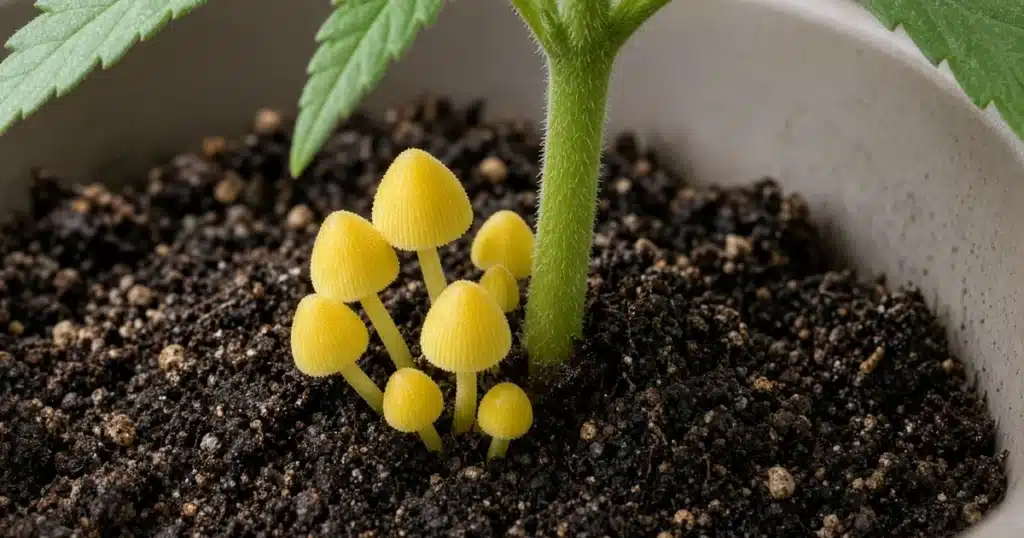
Mushrooms in cannabis pots tend to appear overnight, often after a stretch of warm, humid weather and steady watering. The sight can be alarming, but in most cases the plant is not under attack. Iowa State University Extension explains that the common yellow houseplant mushroom breaks down dead organic matter in potting soil and does not harm living plants. The real questions are why it showed up, whether it signals a watering problem, and how to keep curious pets and children away from it.
What a mushroom in a pot really is
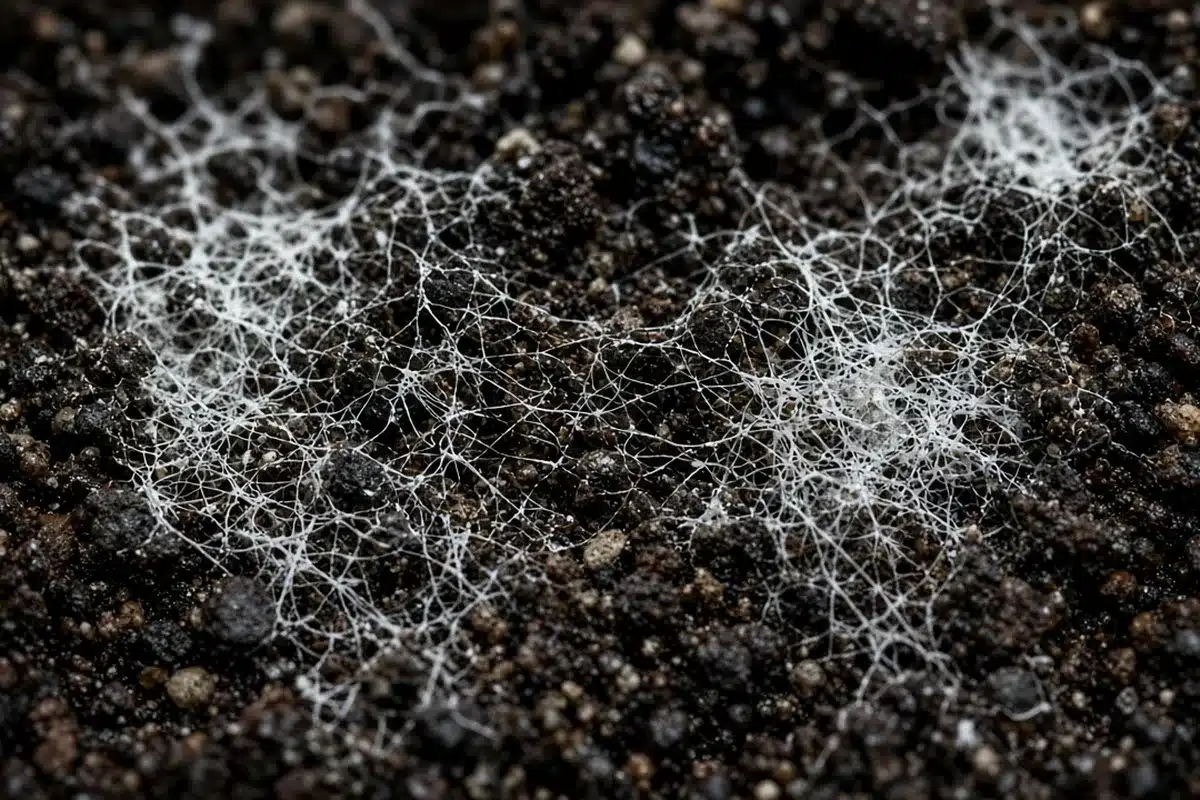
A mushroom is only the visible part of a much larger organism. UF/IFAS explains that most fungi grow as microscopic threads called hyphae, and when those threads bunch into a mat they form a mycelium that can be seen as white, yellow or brown strands. The mushroom itself is the reproductive structure, a fruiting body that appears when temperature, light and moisture are right.
Iowa State Extension notes that the mycelium may have arrived in the potting mix itself, or a spore may have drifted in on the air and started a new colony. UF/IFAS adds that fungal spores are everywhere and can also come from mix components such as peat moss or sphagnum. In other words, a mushroom does not mean you did something wrong when you filled the pot.
Why potting mix suits fungi so well
Many potting mixes are made largely of organic material, and that is exactly what many mushroom-forming fungi feed on. UF/IFAS describes most of these fungi as saprotrophic, meaning they live on decaying plant material such as bark, wood chips, peat or leaves. Blends with a lot of woody material are ideal for them.
Conditions inside a cannabis pot can push things further. UF/IFAS lists high moisture, high humidity, poor drainage and high organic matter as the conditions that favor fungal growth and fruiting. It also notes that warm temperatures, low light and overwatering encourage mushrooms to form. Mushrooms may push up from the surface or even out of the drainage holes.
The mushrooms growers see most
Exact identification usually needs an expert, but a few types are common enough to describe.
- Yellow houseplant mushroom. UF/IFAS calls this the most common mushroom on indoor potting soils. Iowa State Extension describes it as lemon yellow, about 1 to 3 inches tall, with oval or bell-shaped caps 1 to 2 inches across, appearing alone or in clusters. Both sources regard it as poisonous.
- Bird’s nest fungi. UF/IFAS describes these as tiny cups holding small seed-like structures, often on mulch or the sides of pots. They are not pathogenic or toxic.
- Inky caps. These gilled mushrooms grow in mulch and lawns and sometimes in pots. UF/IFAS notes that they produce black spores and turn to liquid as they age.
- Slime molds. UF/IFAS explains that these are not true fungi. One common type looks like bright yellow scrambled eggs on wet mulch, then turns crusty. It is harmless to people and pets.
UF/IFAS stresses that there is no easy way to tell whether a mushroom is toxic just by looking at it, so treat every unknown mushroom as unsafe to eat.
Are mushrooms bad for cannabis plants?
Usually not. Iowa State Extension says the yellow houseplant mushroom does not harm living plants and does not need to be removed for the plant’s sake. UF/IFAS agrees that most mushroom-forming fungi in pots are not plant pathogens.
One exception matters. UF/IFAS describes how some fungi build a dense mat of mycelium that repels water, which can stop water and nutrients from reaching the roots. In that case a plant may decline even though the fungus never attacks its roots directly. If a cannabis plant in a pot with heavy white matting starts to droop or the mix stays dry under a wet surface, that mat may be the cause.
Mushrooms are also a useful warning light. UF/IFAS points out that the hot, wet conditions that favor mushrooms also favor fungi and bacteria that cause root and stem rots. A pot that is producing mushrooms is often a pot that is staying too wet.
Keeping pets and kids safe
This is the main reason to act. Iowa State Extension says the yellow houseplant mushroom is regarded as poisonous to people and animals and suggests removing mushrooms as they appear in homes with pets or small children. UF/IFAS notes that touching and handling mushrooms is not dangerous, but no one should ever eat an unknown fungus.
- Check pots daily while mushrooms are fruiting, since new ones can appear overnight.
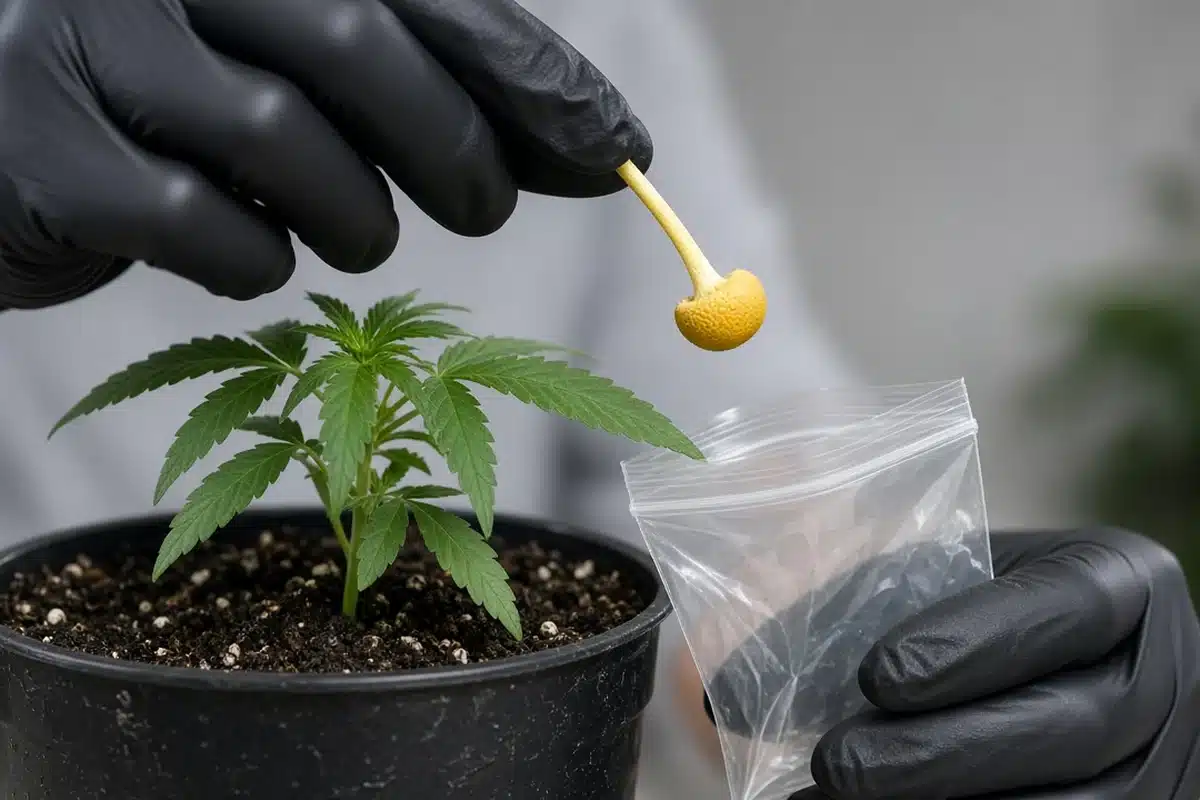
- Pick them off at the base and put them in the trash, not the compost.
- Wear gloves if you prefer, and wash your hands after handling.
- Move pots out of reach of pets and children until the flush stops.
Treat every mushroom in a pot as off limits. Keep kids and pets away from pots that are fruiting, and remove new mushrooms as soon as they appear.
Getting an unknown mushroom identified
If you want to know what is growing in a pot, a local Extension office or plant clinic can often help. UF/IFAS explains how to prepare a sample so the experts have what they need.
- Pick the mushroom fresh and deliver it as soon as possible after picking.
- Include several specimens when you can, since one mushroom may be damaged or immature.
- Photograph what it is growing from, such as bark, wood chips or bare potting mix.
- Take close-up photos of the top of the cap, the side of the mushroom showing the full stalk, and the underside of the cap so the gill color shows.
- Put a pen, pencil or coin in the photo for scale.
Small details often decide the answer. UF/IFAS notes that the green-spored parasol mushroom, a poisonous species that sometimes turns up in outdoor pots, has white gills when young that turn green as its spores mature. A clear photo of the gills, ideally on more than one mushroom, makes that kind of clue easy to spot. Until an expert has seen it, keep treating the mushroom as unsafe.
How to reduce mushrooms in cannabis pots, step by step
UF/IFAS notes that fungicides are not the first answer and recommends cultural changes. Iowa State Extension adds that fungicide treatments are generally not effective against mushrooms. These steps follow that advice.
- Remove every mushroom you can see and bag it for the trash.
- Let the top of the mix dry before the next watering, and water at the base of the plant rather than from above.
- Make sure drainage holes are clear and that pots are not sitting in saucers of water.
- Lightly rake the top layer of mix. UF/IFAS notes this helps aerate and dry the surface and slows new mushrooms.
- Improve airflow and, indoors, move pots to a less humid or cooler spot if possible.
- Scrape off and replace the top layer of mix where mycelium is thick. If a mat has taken over the whole pot, repot into fresh mix.
- Keep watching. Spores remain in the mix, so mushrooms may return when conditions are right again.
Troubleshooting
Mushrooms keep coming back. That is expected. The fungus lives in the mix, and fruiting bodies return whenever moisture and warmth line up. Focus on watering habits rather than removal alone.
The surface is fuzzy and white but no mushrooms are showing. This may be mycelium, or it may be a different growth entirely. Green surface growth is a separate issue, explained in the Kind Seed Co post on algae on cannabis soil, while molds on the plant itself fall under pathogenic mold.
The plant is drooping and the mix is matted. Check whether water soaks in or runs off the top. If it runs off, a water-repelling mat may be blocking roots. Repot into fresh mix.
Mushrooms appear in outdoor pots near mulch. Mulch and wood chips can carry many fungi. Keep pots off heavily mulched ground and refresh the top layer of mix.
Sources
- UF/IFAS Extension. A Basic Guide to Mushrooms Commonly Encountered in Potted Plants (PP377). https://ask.ifas.ufl.edu/publication/PP377
- Iowa State University Extension and Outreach, Yard and Garden. Will yellow mushrooms harm my houseplant? https://yardandgarden.extension.iastate.edu/faq/will-yellow-mushrooms-harm-my-houseplant
FAQ
Are mushrooms in my cannabis pot harmful to the plant?
Usually not. Iowa State Extension says the common yellow houseplant mushroom breaks down dead organic matter and does not harm living plants. The exception is a thick, water-repelling fungal mat that can block water from reaching roots. Mushrooms also suggest the mix is staying wet, which can favor root rots.
Why are yellow mushrooms growing in my potting soil?
Most likely the yellow houseplant mushroom. Its threads can arrive in the potting mix or as airborne spores, then fruit when the mix is warm, moist and rich in organic material. UF/IFAS lists high moisture, humidity, poor drainage and organic matter as the conditions that trigger mushrooms in pots.
Should I remove mushrooms from my plant pots?
Remove them if pets or children could reach them. Iowa State Extension notes the yellow houseplant mushroom is regarded as poisonous to people and animals. Pick mushrooms off at the base and bin them. Removal will not stop new ones, so also let the mix dry between waterings and improve airflow.
Will a fungicide get rid of mushrooms in potting mix?
Generally no. Iowa State Extension says fungicide treatments are generally not effective against mushrooms, and UF/IFAS recommends changing cultural practices instead. Water less often, water at the base, keep drainage clear and rake the top layer of mix. Repot into fresh mix if fungal threads have matted the entire root zone.


