
Windbreaks for Outdoor Cannabis: A Design Guide
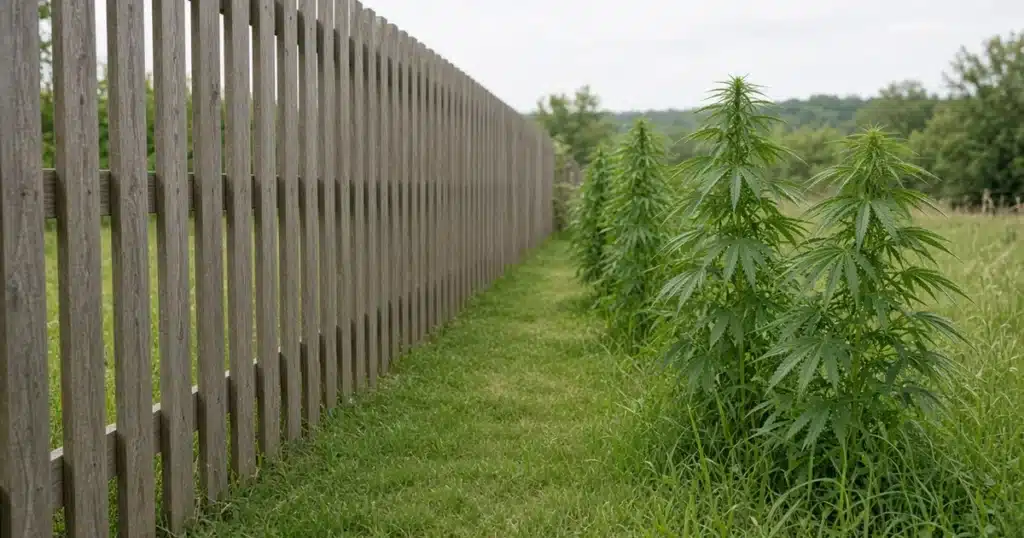
A windbreak for outdoor cannabis is one of the few garden structures that keeps paying off all season. Wind dries soil, stresses young stems and can flatten tall plants late in the year. A well-planned barrier slows that wind across the whole bed, not just the plant closest to it. The trick is that a windbreak is a design problem more than a building project. Height, density, length and placement decide how much shelter you get, and getting them right matters more than the material you choose.
The focus below is designing and placing a windbreak. If your plants already show leaf damage from wind, start with the Kind Seed Co write-up on cannabis wind burn, then come back here to plan the fix.
How a windbreak changes the wind
A windbreak does not stop wind. It slows it. University of Nebraska Extension explains that as wind reaches a barrier, most of it is pushed up and over, creating a zone of slower wind on the sheltered side. Some wind passes through gaps in the barrier, and some flows around the ends.
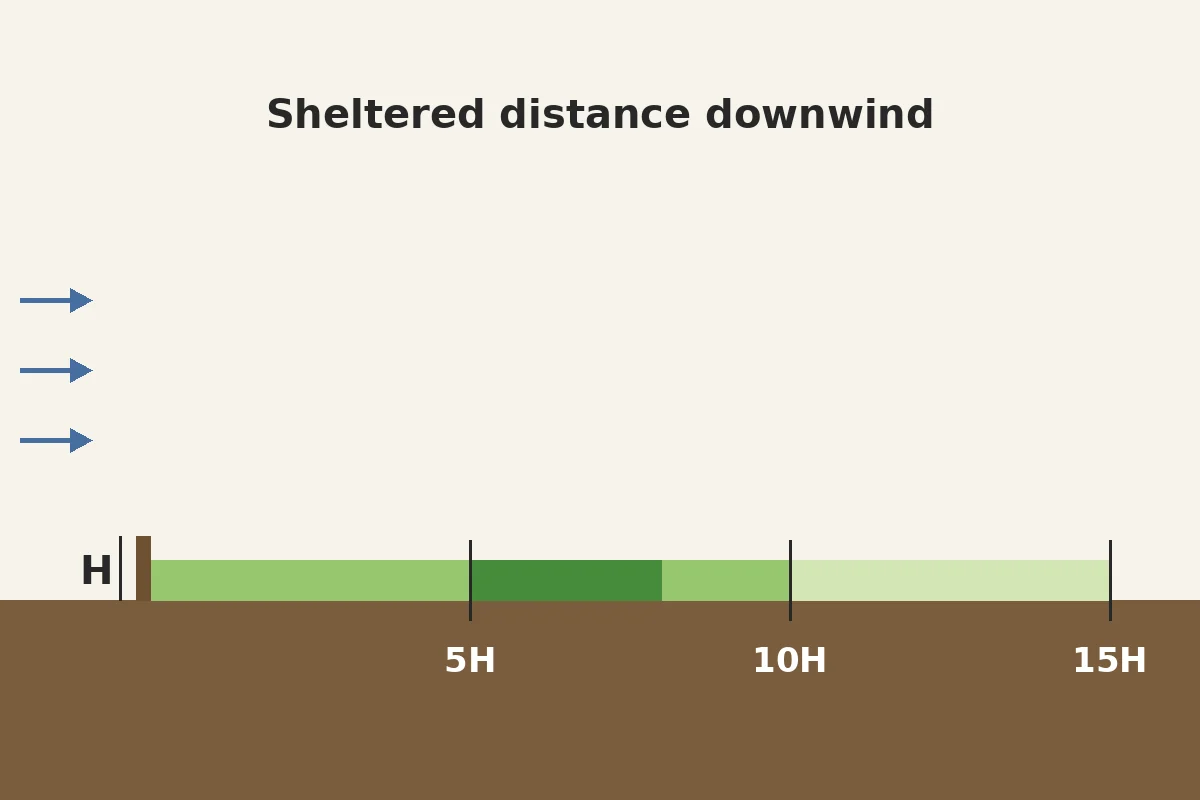
Nebraska Extension notes that the strongest reduction in wind speed occurs at a distance of five to eight times the windbreak’s height, with smaller reductions reaching up to 15 times the height. That is why windbreak distances are always given in multiples of height, written as H. A 6-foot fence is 1H tall, so 5H is 30 feet downwind.
The height-to-distance rule
University of Minnesota Extension gives the broad rule. Windbreaks typically reduce downwind wind speed over a distance of 10H to 30H, and they also offer some protection upwind, typically 2H to 5H. A 10-foot windbreak, for example, slows wind for roughly 100 to 300 feet downwind.
For a garden, the tighter numbers matter more. Nebraska Extension notes that fruit and vegetable crops are extremely sensitive to direct wind and wind-blown soil, so for those crops the distance between windbreaks should be no more than 10 times the windbreak’s height. Cannabis grown for flowers fits that sensitive, high-value profile.
Use these rules of thumb when sizing a barrier for a bed:
- Measure the depth of your bed in the direction the wind blows.
- Divide that depth by 10 to find the minimum barrier height that keeps the whole bed within 10H.
- Keep the plants that matter most within about 5H to 8H, where Nebraska Extension places the strongest wind reduction.
- Do not place plants hard against the barrier where its shade or root competition will affect them.
For example, a bed 30 feet deep needs a barrier about 3 feet tall to stay within 10H, and a 6-foot barrier puts the whole bed well inside the best zone.
Porosity: why solid is not best
It is tempting to build a solid wall, but more density is not always better. Nebraska Extension explains that dense windbreaks give greater wind speed reductions but protect a slightly shorter area, while less dense windbreaks let more wind through and extend protection farther downwind.
For vegetable crops, Nebraska Extension recommends a density of 40 to 60 percent early in the growing season to protect emerging seedlings and transplants. In practice that means a barrier that is roughly half solid and half open. University of Minnesota Extension offers a simple way to judge density. Stand facing the windbreak and look through it. The harder it is to see through, the denser it is.
Practical ways to hit that range:
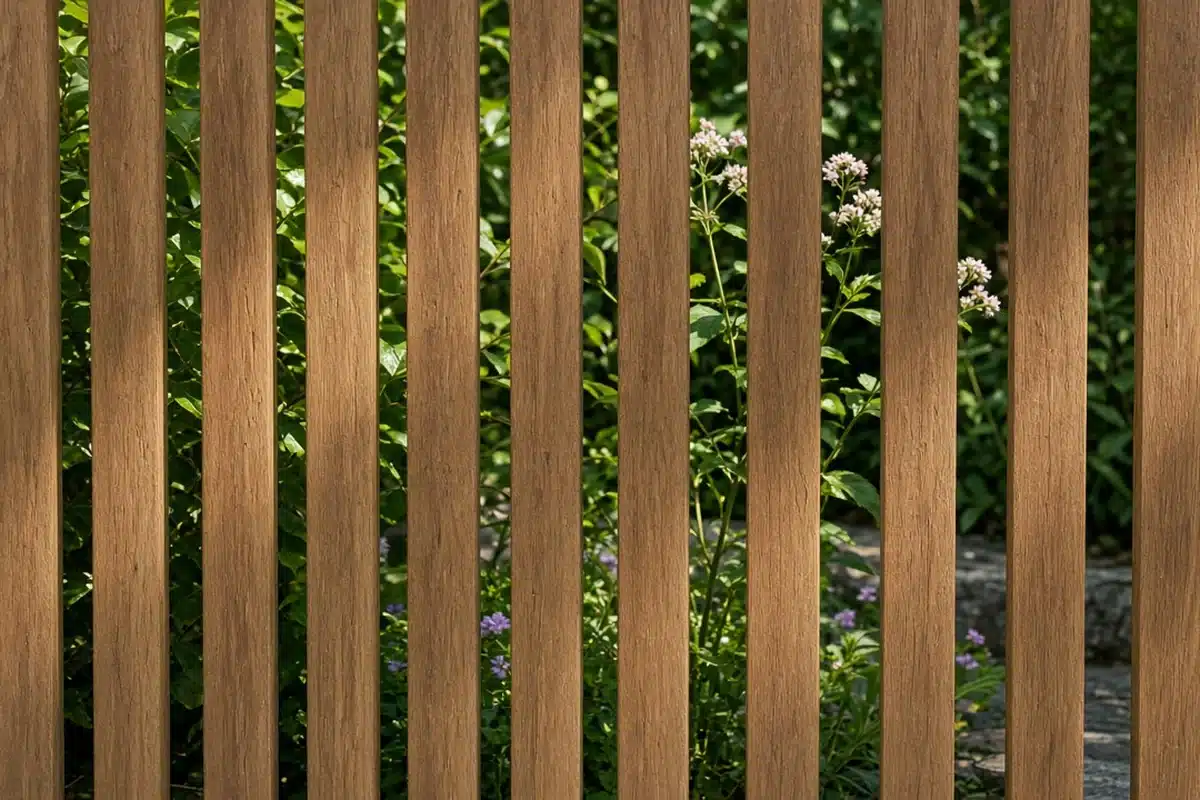
- Slat or board fencing with gaps about as wide as the boards.
- Woven or knitted windbreak fabric rated for partial blockage.
- A row of shrubs or tall plants with some space between stems.
- Lattice panels backed by nothing, set on sturdy posts.
Choosing materials
Nebraska Extension notes that tree or shrub windbreaks, tall annual crops and artificial barriers such as slat fence can all provide wind protection. For a home cannabis grow, the choice usually comes down to time and permanence.
- Slat or board fence. Quick, durable and easy to set at the right porosity. Good for a permanent bed.
- Windbreak fabric on posts. Light, cheap and easy to move. Must be stretched tight and anchored well.
- Living shrubs or trees. Nebraska Extension notes that a single row of densely planted shrubs provides excellent protection but, being shorter, needs more barriers across a field. Living windbreaks take years to grow and compete with nearby plants. University of Minnesota Extension notes that windbreaks may compete with crops for water, nutrients and light.
- Annual plant strips. Nebraska Extension describes two or three rows of sweet corn or sunflowers as good protection for a later crop, and tall grass strips as protection for newly seeded areas. These suit a temporary or first-year setup.
Whatever you use, build it strong enough for the strongest winds you expect. A fabric screen that tears loose in a storm can do more harm than no barrier at all.
Placement and orientation
University of Minnesota Extension explains that a windbreak should run perpendicular to the prevailing wind for the greatest effect. The closer it lines up with the wind direction, the more easily wind slips around it and the smaller the sheltered area becomes.
Length matters as much as height. Because wind wraps around the ends, University of Minnesota Extension advises that a windbreak be at least 10 times as long as it is tall to reduce this end effect. Nebraska Extension agrees that windbreaks should be at least 10 times longer than tall and should have no gaps or openings. It also notes that wind moving around the ends creates two small zones of faster wind near each end. Keep your best plants away from the tips of a short barrier.
If wind arrives from more than one direction, Nebraska Extension suggests a network of windbreaks. A small grow might use an L-shaped barrier on the two worst sides.
Build a garden windbreak, step by step
- Find the prevailing wind. Watch a flag or tape on a stake over several breezy days and note the direction.
- Measure the bed depth and pick a barrier height using the 10H rule.
- Plan a length at least 10 times the height, extending past both ends of the bed.
- Choose a material that gives roughly 40 to 60 percent density.
- Set posts deep enough to hold in high wind, and brace the corners.
- Attach slats or fabric with no large gaps, especially at the base.
- Leave a working path between the barrier and the first plants.
- Recheck tension and fixings after every strong storm.
Microclimate effects to plan for
A windbreak changes more than wind. Nebraska Extension reports that within about 8H downwind, daytime air temperatures are several degrees warmer than in open ground, soil temperatures tend to be warmer and humidity rises while plant water loss falls. University of Minnesota Extension also notes higher humidity and warmer air and soil in the lee of a windbreak.
One drawback is worth planning for. Nebraska Extension warns that on very still nights, sheltered areas can cool more than open ground, and in early spring and late fall this can lead to frost in sheltered spots. Watch the forecast early and late in the season. Protection tips for cold snaps are in frost damage on cannabis.
Troubleshooting a windbreak that underperforms
Plants at the ends still get battered. The barrier is likely too short. Extend it so it reaches past the bed on both sides, or add a short return section.
Shelter fades out partway across the bed. A very dense barrier protects a shorter area. Open it up toward 40 to 60 percent density so protection reaches farther downwind.
The far end of the bed gets no shelter. The bed is deeper than about 10H. Raise the barrier or add a second one partway across.
Plants near a hedge are smaller. Roots and shade from living windbreaks compete with crops. Leave more space or switch to a fence on that side.
Sources
- University of Minnesota Extension. Windbreaks. https://extension.umn.edu/agroforestry/windbreaks
- University of Nebraska-Lincoln Extension. Windbreaks for Fruit and Vegetable Crops (EC1779). https://extensionpubs.unl.edu/publication/ec1779/2006/pdf/view/ec1779-2006.pdf
FAQ
How tall should a windbreak for a cannabis garden be?
Size it from the bed depth. University of Nebraska Extension advises that for sensitive crops, the protected distance should be no more than 10 times the windbreak height. A bed 30 feet deep needs about a 3-foot barrier, and taller is better. The strongest wind reduction falls at five to eight times the height.
Is a solid fence or an open fence better for wind?
A partly open fence usually works better. Nebraska Extension notes that dense barriers reduce wind more but shelter a shorter area. For vegetable crops it recommends 40 to 60 percent density early in the season. A slat fence with gaps about as wide as the boards is an easy way to reach that range.
How long should a garden windbreak be?
At least 10 times its height. University of Minnesota Extension explains that wind flows around the ends of a barrier, so a short one leaves gaps in protection. Nebraska Extension adds that wind speeds up near the ends. Extend the barrier past both sides of the bed and avoid gaps along its length.
Which direction should a windbreak face?
Run it across the prevailing wind, at a right angle to the direction it usually blows. University of Minnesota Extension notes that the more closely a windbreak lines up with the wind, the more easily wind flows around it. Watch a flag or ribbon on a few windy days before you set posts.


