
Plant Cages for Garden Cannabis: Size, Setup and Care
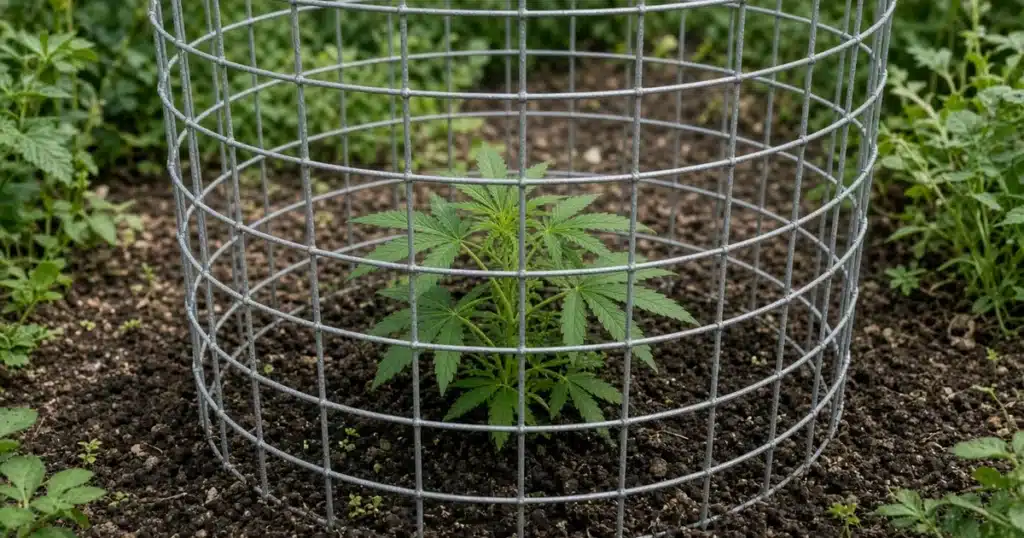
Outdoor cannabis plants can grow large and heavy by late summer. Wind, rain and the weight of the plant itself can bend or split branches that grew without support. A plant cage is one of the simplest ways to keep a plant upright. It is a cylinder of sturdy wire or wood that surrounds the plant, so branches can rest against it as they grow. Gardeners have used cages for vegetables for years, and the same ideas carry over well to cannabis. Below: why cages help, how to choose height, width and mesh size, how to build a wire cage, when to set it, how to anchor it in wind and how to store it after the season. Netting and horizontal screens belong to a different post, cannabis trellising.
Why use a plant cage
University of Wisconsin-Madison Extension lists several benefits of giving plants vertical support. It notes that support can protect plants from physical damage, allow better air movement through stems and leaves, which can reduce disease pressure, reduce weeding effort, especially with mulch, and make harvesting easier because the crop sits within arm’s reach and in plain view.
For cannabis, the air movement point matters a great deal. A plant that sprawls on the ground or folds in on itself traps moisture inside the canopy. A cage holds branches apart and up, letting air move through.
University of Minnesota Extension adds that even plants that reach a set height and stop growing benefit from cages. A cage is not only for the tallest plants in the garden.
Choose cages that are big enough
The most common mistake with cages is choosing one that is too small. University of Minnesota Extension notes that the common cone-shaped metal cages sold for tomatoes cannot always support and contain sprawling plants. Taller plants grow past the top, and long branches grow out through the sides. Minnesota Extension points instead to heavier-duty square cages, which are taller than the old cone shape and fold flat for storage, or a homemade cage of heavy wire mesh.
For cannabis, pick a cage that is taller and wider than you think you need. A plant that looks small at planting time can outgrow a short cage in a few weeks of strong summer growth. If you grow compact plants in small spaces, a smaller cage may be enough, but for full-size outdoor plants, plan for the size of the plant at harvest, not at planting.
Width and mesh size
University of Wisconsin-Madison Extension notes that cages about two feet across allow easy training and harvest. It explains how the length of wire sets the width:
- About six feet of wire makes a cage roughly two feet across.
- About nine feet of wire makes a cage roughly three feet across.
University of Minnesota Extension gives a similar figure, noting that cutting heavy mesh at 56 to 60 inches makes a cage about 18 inches across.
Mesh size matters as much as width. Both sources point to wire with four-inch square openings, such as concrete reinforcing mesh or woven wire panels. Openings this large let you reach into the cage easily. For cannabis, that means you can reach inside to check branches, tie in a stray stem or harvest without lifting the whole cage off. Smaller openings are harder to work through once the plant fills in.
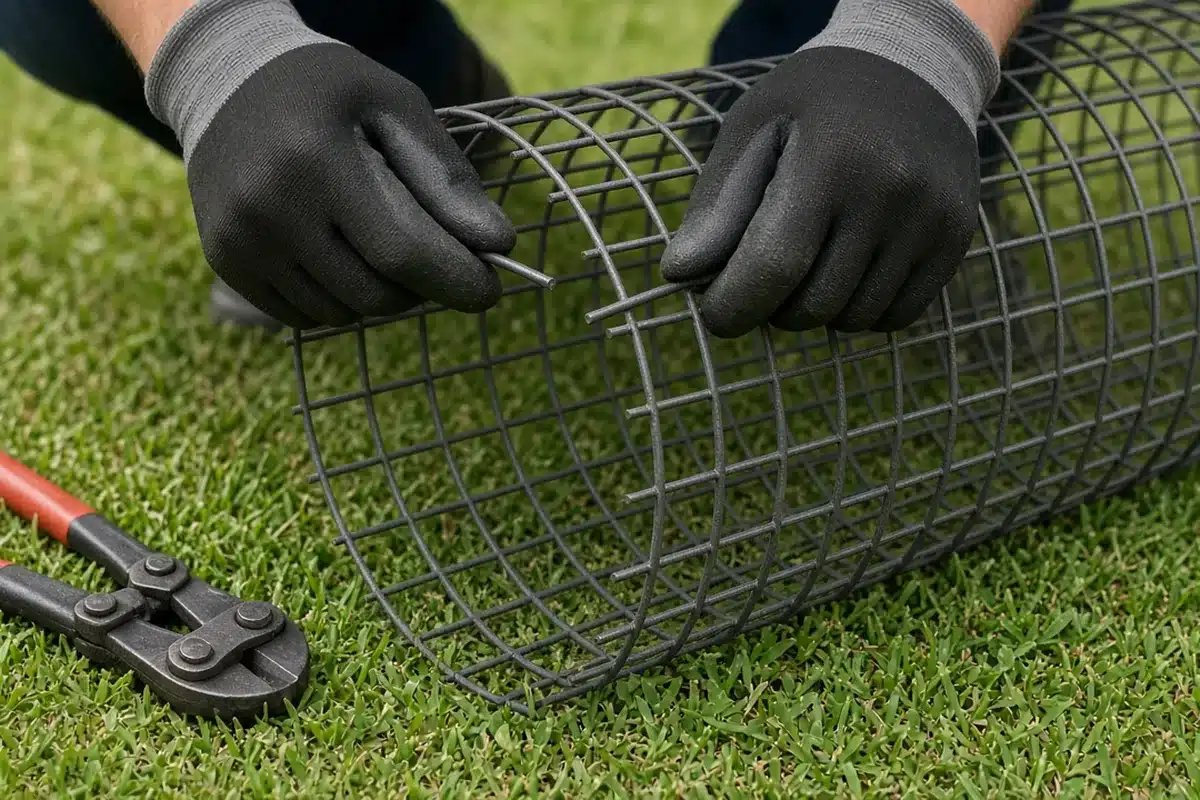
How to make a wire plant cage, step by step
University of Minnesota Extension says reinforcing mesh is an excellent material for homemade cages because it is strong and has large square holes. It also warns that the mesh is stiff and hard to work with. Here is how to make one:
- Put on gloves, a long-sleeved shirt, long pants and safety glasses. University of Minnesota Extension recommends gloves and long clothing to prevent scratches from cut wire, and it also advises wearing eye protection.
- Unroll the mesh on a flat surface and weigh down the ends.
- Measure the length for the width you want, using the figures above.
- Cut the mesh with heavy-duty wire cutters or bolt cutters, as Minnesota Extension suggests.
- Cut along a vertical wire so you leave short horizontal wire ends sticking out on one edge.
- Roll the mesh into a cylinder.
- Join the edges. University of Minnesota Extension suggests either tying them with lengths of lighter wire or bending the cut horizontal ends into hooks with pliers and hooking them onto the vertical wire on the other side.
- File or bend any sharp ends inward so they do not snag you or the plant.
University of Minnesota Extension notes that well-made cages like this last for many years.
When to set cages
Timing makes cages much easier to use. University of Wisconsin-Madison Extension recommends caging plants at planting time and training growth to the inside of the cage as it grows. Setting the cage early has a few advantages:
- You avoid breaking branches by forcing a cage over a large plant later.
- Roots are less likely to be damaged by anchor posts driven in early.
- Branches grow naturally into the openings, so the cage supports them from the start.
As the plant grows, gently guide branches that poke out back inside the cage, or let them rest on the wire. Check every few days during fast summer growth.
Anchor cages against wind
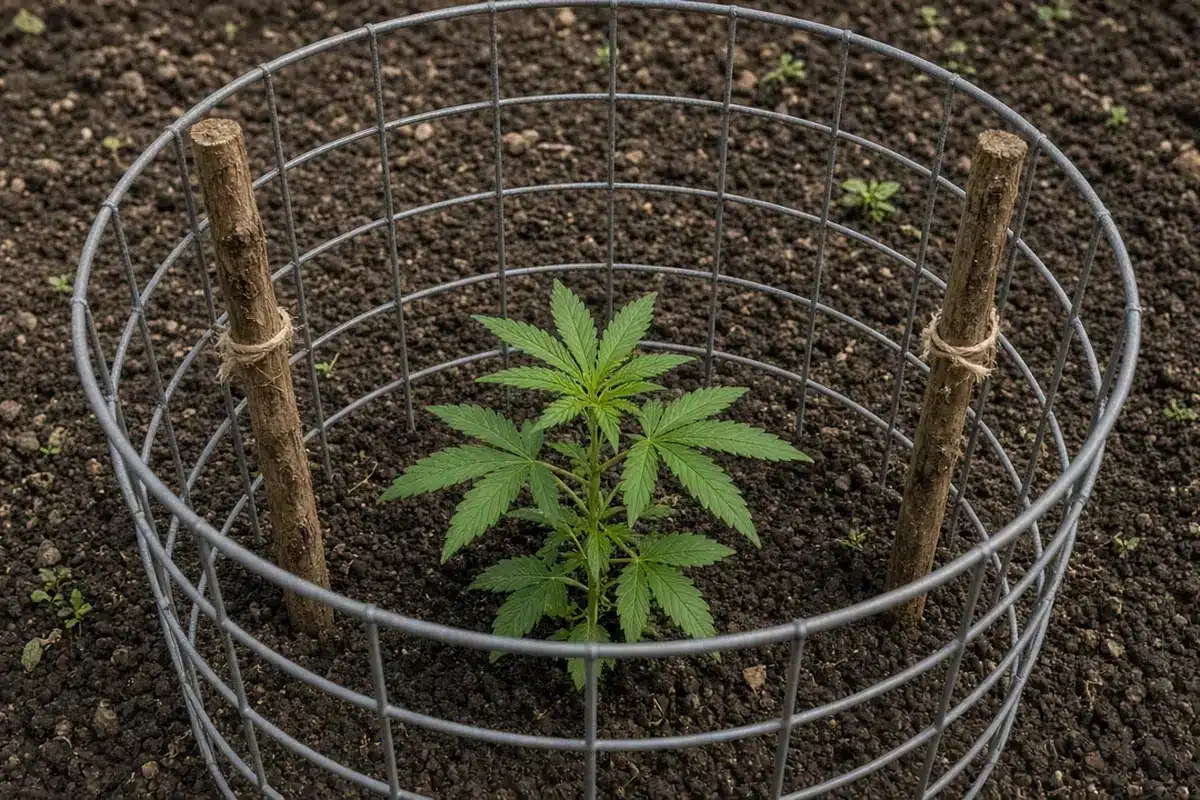
A cage full of leafy branches catches a lot of wind. A loose cage can tip over and take the plant with it. Both sources recommend anchoring cages with posts. University of Minnesota Extension suggests securing homemade cages with two posts on opposite sides inside the cage. University of Wisconsin-Madison Extension also says two posts driven into the ground are used to support a cylindrical cage.
Drive the posts deep enough to hold firm in wet soil, and tie the cage to each post at several heights. Check the ties after strong wind or heavy rain, and tighten any that have loosened. In a very exposed garden, a windbreak helps cages do their job, and windbreaks for outdoor cannabis shows how to set one up.
Caring for cages through the season
Cages need little attention once they are in, but a quick check now and then helps:
- Look for branches pinched against the wire as they thicken, and ease them free.
- Make sure the cage still stands straight after storms.
- Watch for any sharp wire ends rubbing on stems.
University of Wisconsin-Madison Extension also notes that supported plants are easier to mulch around and keep weeded, so add mulch under and around the cage early in the season.
Storing cages after the season
University of Wisconsin-Madison Extension says that taking supports down at the end of the season is a matter of choice, but that removing them reduces winter wear, especially for wooden structures. Pulling them out also lets you move cages to another part of the garden next year.
To store cages:
- Remove all plant material and ties.
- Brush off soil and let the wire dry.
- Fold flat cages flat, as University of Minnesota Extension notes the square styles allow.
- Nest round cages inside one another or stand them upright in a dry spot.
- Store them off the ground to keep rust down.
Other tools worth keeping on hand are in Kind Seed Co’s list of cannabis growing tools.
Troubleshooting
The plant has grown past the top of the cage. The cage was too short. Next season, choose a taller cage. For now, let top branches rest on the rim.
Branches grow out through the sides. Gently tuck them back inside while they are still flexible.
The cage tipped over in a storm. It needs stronger anchoring. Drive two posts inside the cage and tie it at several heights.
You cannot reach inside to work on the plant. The mesh openings are too small. Use mesh with about four-inch openings next time.
A branch is pinched against the wire. Ease it free, or cut away one section of wire to give it room.
Cages are rusting in storage. Dry them before storing and keep them off the ground.
Sources
- University of Minnesota Extension. Trellises and Cages to Support Garden Vegetables. https://extension.umn.edu/garden-and-home/yard-and-garden/gardening-in-minnesota/trellises-and-cages
- University of Wisconsin-Madison Extension. Trellising, Staking and Caging: Vertical Gardening Techniques for Vine-Type Vegetables. https://hort.extension.wisc.edu/articles/trellising-staking-and-caging-vertical-gardening-techniques-vine-type-vegetables/
FAQ
How big should a plant cage be for cannabis?
Choose a cage that is taller and wider than you think you need, sized for the plant at harvest. University of Wisconsin-Madison Extension notes cages about two feet across allow easy training and harvest. Full-size outdoor plants often outgrow small cone-shaped cages, which University of Minnesota Extension says cannot always contain sprawling plants.
What mesh size is best for a plant cage?
Both University of Minnesota and UW-Madison Extension point to wire with four-inch square openings, such as concrete reinforcing mesh or woven wire panels. Openings that size are large enough to reach through, so you can check branches, tie in stems and harvest without lifting the cage off the plant.
When should I put a cage around a plant?
At planting time. University of Wisconsin-Madison Extension recommends caging plants when you plant them and training growth inside as it grows. Setting the cage early avoids breaking branches later, keeps anchor posts away from established roots and lets branches grow naturally into the cage for support.
How do I keep a plant cage from blowing over?
Anchor it with posts. University of Minnesota Extension suggests driving two posts on opposite sides inside the cage. Drive them deep enough to hold in wet soil, tie the cage at several heights and check the ties after storms. A windbreak can also help in very exposed gardens.


