
Slow Release Fertilizer for Cannabis: How It Works
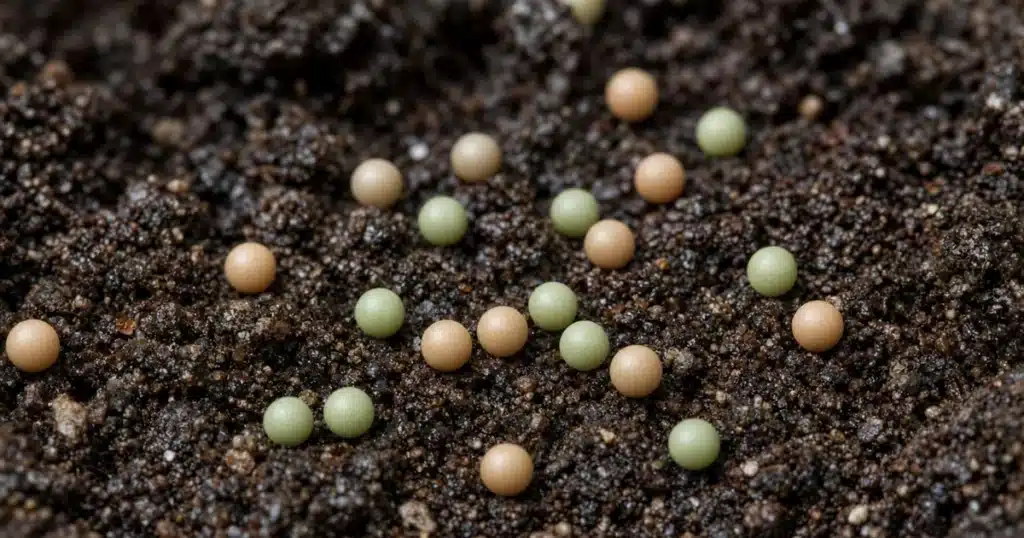
Slow release fertilizer for cannabis feeds plants a little at a time instead of all at once. That can mean fewer feedings, steadier growth and less risk of burning roots. The tradeoff is control. Once the granules are in the soil, temperature and moisture decide how fast nutrients come out, not your feeding calendar. University of Florida IFAS Extension also makes a point many labels skip: "slow release" and "controlled release" are not the same thing. Knowing the difference helps you pick the right product and avoid a late-season surprise.
What is the difference between slow and controlled release?
| Type | How it releases | What drives the rate |
|---|---|---|
| Quick release | Dissolves right away | Water |
| Slow release | Breaks down gradually | Soil microbes, moisture and temperature |
| Controlled release | Diffuses through a coating | Mainly temperature and moisture, by design |
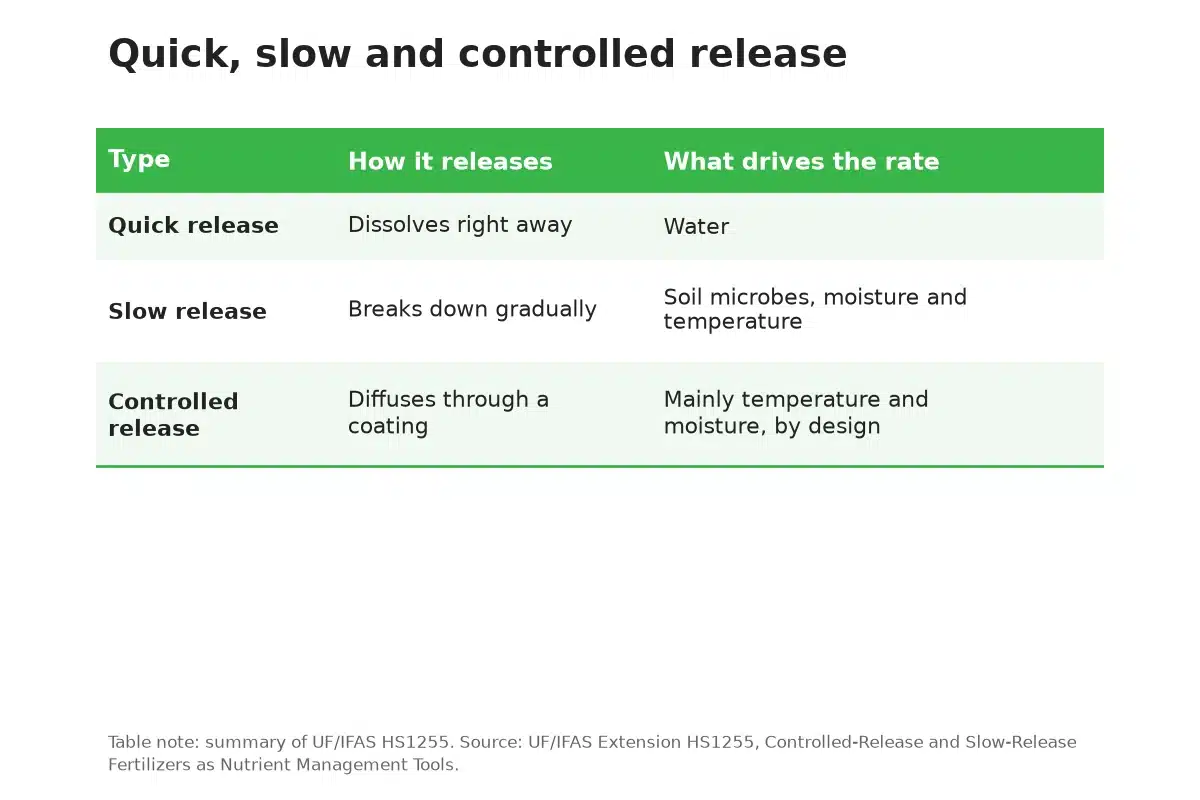
Table note: summary of UF/IFAS HS1255.
Source: UF/IFAS Extension HS1255, Controlled-Release and Slow-Release Fertilizers as Nutrient Management Tools.
Controlled-release fertilizers are coated or encapsulated, usually with a polymer, so water moves in and dissolved nutrients move out at a designed pace. UF/IFAS says the release rate is meant to follow the crop’s changing needs.
Slow-release fertilizers release nutrients more slowly than soluble products, but the rate, pattern and duration are not controlled. UF/IFAS explains that many depend on microbes, which work faster in warm, moist soil. Natural slow-release sources include manures and compost. Synthetic ones include sparingly soluble nitrogen compounds. UF/IFAS notes that synthetic slow-release products can last anywhere from 20 days to 18 months, depending on soil temperature and moisture.
University of Maryland Extension adds a home-garden view. Slow-release fertilizers provide nutrients in small amounts over a long period, are less likely to leach out of the soil, and often come as clay- or polymer-coated granules, spikes or tablets.
Why does temperature matter so much?
A coated granule works by letting water in and dissolved nutrients out. A 2020 study in PLOS ONE notes that this diffusion speeds up with temperature, with the rate doubling for every 10°C rise, based on earlier research it cites. Release times printed on many coated products are based on lab tests at a steady 20°C, which is 68°F.
The same study tested polymer-coated urea rated for 45 to 180 days. Buried in soil under daily temperature swings, the products released their nitrogen fairly close to the expected timing. Left on the soil surface, they released most of their nitrogen within about 35 days, no matter the rating. The researchers found that daily swings and high peak temperatures drove release more than average temperature did.
Two practical lessons follow:
- In a hot pot or a sunny outdoor bed, expect release to run faster than the label suggests.
- Mix granules into the growing medium instead of scattering them on top.
The same study also tested sulfur-coated urea and a sulfur-plus-polymer product. Both released more than 80 percent of their nitrogen before the first sampling date, so in that test they behaved much like quick-release fertilizer.
How do you spot slow release on a label?
The guaranteed analysis gives the clue. The University of Massachusetts Amherst turf program explains that many labels list water-insoluble nitrogen (WIN) along with total nitrogen. WIN is the slow share. Divide it by total nitrogen to see how much of the product feeds slowly. A label with 18 percent total nitrogen and 9 percent WIN has half its nitrogen in slow form, so it gives some quick response and some lasting feed.
For coated products, UF/IFAS describes how Florida rules define controlled release. At soil temperatures below 77°F, a product must release less than 15 percent of its nutrients in 24 hours, less than 75 percent in 28 days, and at least 75 percent by its stated release time, which can range from 40 to 360 days. That gives a sense of what the rating on a bag actually promises, and why it shifts once soil runs warmer.
What are the advantages?
UF/IFAS lists several:
- Lower nutrient losses and better use of what you apply. Its review cites reports that these products can cut fertilizer use by 20 to 30 percent of the usual rate for the same yield.
- Less risk of leaf burn and runoff, because the level of available nutrients in the soil stays lower.
- Fewer applications and less labor.
For a home grower, the biggest benefit is a buffer. A slow feed in the mix keeps a base level of nutrients available between waterings, which suits growers who cannot feed on a tight schedule.
What are the drawbacks?
- Less control late in the season. Nutrients keep coming out on the product’s schedule, even when you want to taper feeding.
- Weather dependence. UF/IFAS notes that shortages can occur if release lags in cold, flooded or very dry soil, and that slow-release products can release very quickly when heat and moisture arrive together.
- Cost. UF/IFAS says coated products cost considerably more to make than conventional fertilizers.
- pH shifts. UF/IFAS warns that sulfur-coated urea almost always lowers soil pH, which can lead to calcium or magnesium shortages without good nutrient management.
How do you use slow release fertilizer in containers?
- Choose a release period that matches your plan. A product rated for about 3 months is a better fit for most of one indoor cycle than a 9-month product.
- Read the label rate for containers and measure it. Do not guess by the handful.
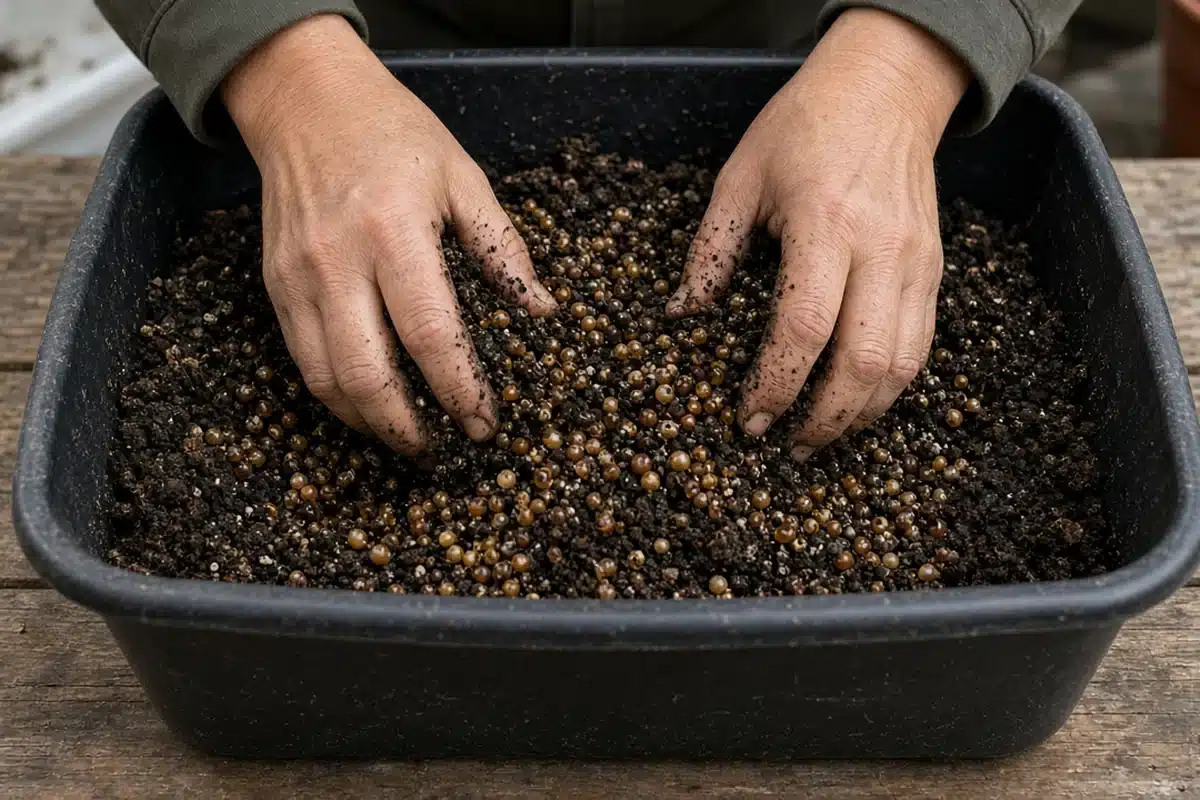
- Mix the granules evenly through the potting mix before planting, rather than packing them in one layer.
- Keep granules away from direct contact with seedling roots and stems.
- Water as usual. Coated products need moisture to release.
- Watch the plants, not the calendar. Pale lower leaves may mean release is lagging. Dark, clawed leaves or burnt tips may mean it is running ahead.
- Supplement with a weak liquid feed only if plants clearly need it.
For full feeding plans, see the feeding schedule for cannabis in soil.
How do you use it outdoors?
In beds, work slow-release granules into the top few inches of soil at planting time. University of Maryland Extension advises mixing fertilizers into the top few inches when possible and watering them in. Side-dressing a little more around established plants mid-season is another option, but scratch it in lightly. The PLOS ONE results suggest surface granules in summer heat will release much faster than planned.
Organic slow-release sources such as compost and manure behave differently again. University of Maryland Extension notes that plant-based compost releases only about 5 to 10 percent of its nutrients in the season it is applied. Choosing between organic and synthetic is its own decision, and the Kind Seed Co article organic vs synthetic fertilizer for cannabis sets out the tradeoffs.
What if plants look underfed or overfed?
Pale lower leaves soon after planting. Release may be lagging in cool soil. Give the plants time to warm up, or add a light liquid feed until growth picks up.
Dark, glossy leaves with curled tips mid-season. Release is likely running ahead, often because of heat. Stop any extra liquid feeding and water to a little runoff.
Sudden hunger late in the grow. The product may be spent early. Switch to a light liquid feed for the remaining weeks.
What changes by stage?
Seedlings. Young plants need little. Use a light rate in the mix or wait until the first true leaves are well established.
Vegetative growth. Slow release fits this stage well, since plants are growing steadily and use nutrients at a steady pace.
Flowering. Plan ahead so the product is mostly spent by late flower. A long-rated product placed at planting can keep supplying nitrogen when you would rather taper it.
Late flower. You cannot pull granules out of the mix. If leaves stay very dark late in the season, ease off any extra liquid feeding and water normally.
What are the common mistakes?
- Adding slow-release granules and then feeding a full liquid schedule on top.
- Scattering granules on the surface of a hot container.
- Choosing a long release period for a short indoor cycle.
- Assuming every coated product releases slowly. The PLOS ONE study found sulfur-coated urea released most of its nitrogen very quickly.
- Ignoring salt buildup. Leftover nutrients can accumulate in the mix, so check runoff now and then. See salt buildup in cannabis soil.
Sources
- University of Florida IFAS Extension. Controlled-Release and Slow-Release Fertilizers as Nutrient Management Tools (HS1255). https://edis.ifas.ufl.edu/publication/HS1255
- Ransom, C. J., Jolley, V. D., Blair, T. A., Sutton, L. E., and Hopkins, B. G. Nitrogen release rates from slow- and controlled-release fertilizers influenced by placement and temperature. PLOS ONE, 2020, 15(6): e0234544. https://journals.plos.org/plosone/article?id=10.1371/journal.pone.0234544
- University of Maryland Extension. Garden Fertilizer Basics. https://extension.umd.edu/resource/garden-fertilizer-basics
- University of Massachusetts Amherst, Center for Agriculture, Food, and the Environment. Understanding a Turf Fertilizer Label. https://www.umass.edu/agriculture-food-environment/turf/fact-sheets/understanding-turf-fertilizer-label
FAQ
How long does slow release fertilizer last?
It depends on the product and the conditions. UF/IFAS reports synthetic slow-release fertilizers can last from about 20 days to 18 months. Coated products list a release period, but that rating is usually based on lab tests at about 68°F, so warmer soil can shorten it.
Is slow release fertilizer good for cannabis in pots?
It can be, as long as you match the release period to the length of the grow and mix it evenly into the potting mix. It gives a steady base feed between waterings. Watch the plants closely, since hot containers can speed up release and leave little room to adjust late in flower.
Can I use slow release fertilizer with liquid nutrients?
Yes, but cut back the liquid feed. The granules already supply a base level of nutrients, so a full liquid schedule on top can push plants into overfeeding. Start with no liquid feed or a weak one, and add more only if the plants show clear signs of hunger.
Does slow release fertilizer burn plants?
It is less likely to burn than soluble fertilizer, because it keeps the level of available nutrients lower, according to UF/IFAS. Burn can still happen if you use too much, place granules against roots or stems, or let heat speed up release. Measure the label rate and mix it in evenly.


