
How to Read a Fertilizer Label: NPK Numbers Explained

Knowing how to read a fertilizer label saves money and prevents overfeeding. Every bag or bottle sold as fertilizer carries a guaranteed analysis, a set of numbers that tells you how much of each nutrient is inside by weight. The three big numbers on the front, such as 10-5-5, are nitrogen, phosphorus and potassium, always in that order. Only the first number is the pure element. The second and third are shown as oxide compounds, so the real amounts of phosphorus and potassium are lower than they look. Once you know that and a little simple math, you can compare any two products side by side.
What do the three numbers mean?
University of Maryland Extension explains that the three numbers are the percentage by weight of nitrogen (N), phosphorus expressed as phosphate (P2O5) and potassium expressed as potash (K2O). A 5 pound bag of 10-5-5 holds 0.5 pound of nitrogen, 0.25 pound of P2O5 and 0.25 pound of K2O.
The rest of the weight is not wasted space by design. University of Maryland Extension notes that fillers prevent caking, cut dust and help the product pour smoothly. What each nutrient actually does inside the plant is the subject of the Kind Seed Co cannabis nutrients crash course.
A product that contains all three is called a complete fertilizer. Products with only one or two, such as a 16-0-0 nitrogen source, are called incomplete, and they are useful when a soil test shows the soil already has enough of the others. University of Maryland Extension gives nitrate of soda (16-0-0) as a good choice when a soil test shows high phosphorus and potassium, and cottonseed meal (6-2-1) as an example of a complete organic product. Its own worked example is a 10 pound bag of 5-4-3 poultry-based fertilizer, which holds 0.5 pound of nitrogen.
Why are phosphorus and potassium shown as oxides?
It is a labeling convention, and it trips up a lot of growers. The University of Massachusetts Amherst turf program explains that only nitrogen is shown on an elemental basis. Phosphorus is shown as P2O5, which is about 44 percent actual phosphorus, and potassium as K2O, which is about 83 percent actual potassium.
University of Maryland Extension gives the conversion factors:
- P2O5 x 0.44 = P
- K2O x 0.83 = K
- P x 2.3 = P2O5
- K x 1.2 = K2O
In practice, this means a "high phosphorus" label overstates the elemental phosphorus by more than double. That matters most when you compare a label with a nutrient recipe written in elemental terms. The nutrient itself gets its own post in phosphorus for cannabis plants.
How do you work out what a bag contains?
The University of Massachusetts Amherst example uses a 50 pound bag of 18-6-12.
| Nutrient | As labeled | Actual element |
|---|---|---|
| Nitrogen | 9 lb N | 9 lb N |
| Phosphorus | 3 lb P2O5 | about 1.3 lb P |
| Potassium | 6 lb K2O | about 5 lb K |
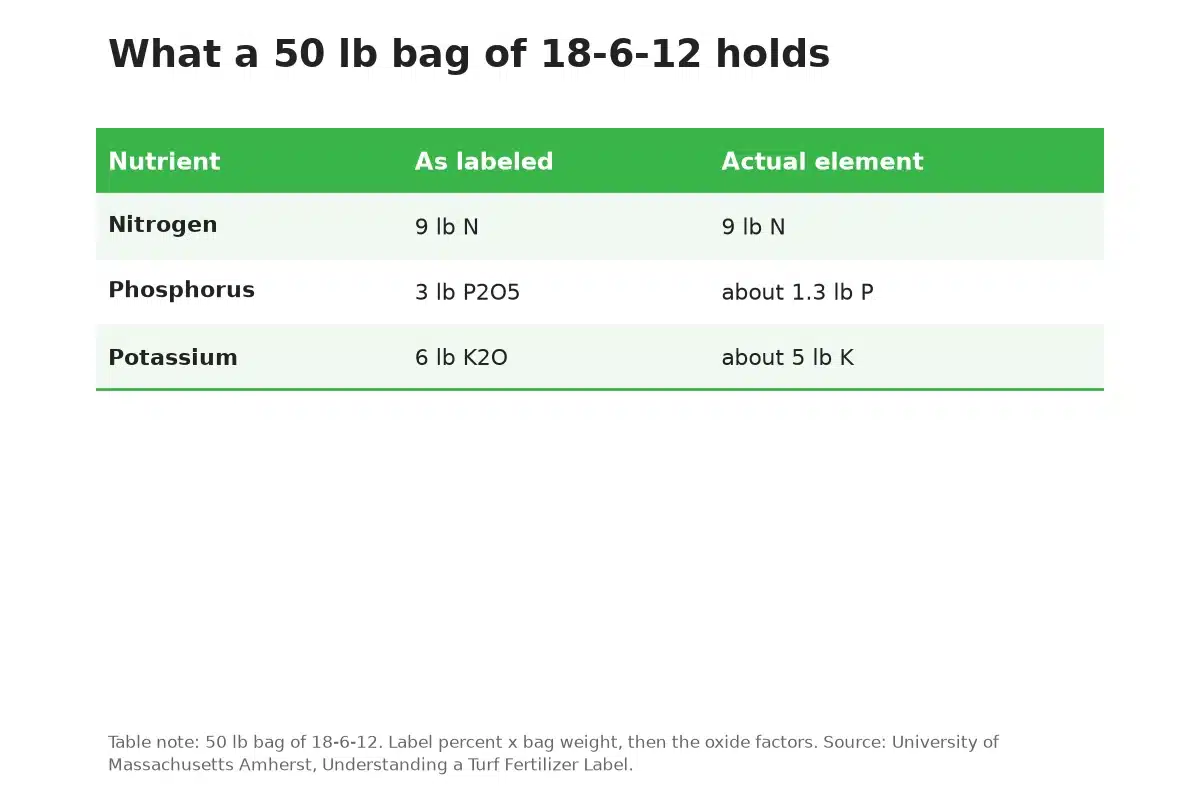
Table note: 50 lb bag of 18-6-12. Label percent x bag weight, then the oxide factors.
Source: University of Massachusetts Amherst, Understanding a Turf Fertilizer Label.
The steps work for any product:
- Write down the three numbers and the net weight.
- Multiply each number, as a decimal, by the weight. For 18-6-12 in a 50 pound bag, that is 0.18 x 50 = 9 pounds of N.
- Multiply the P2O5 result by 0.44 and the K2O result by 0.83 if you need elemental amounts.
- To compare cost, divide the price by the pounds of the nutrient you care about.
The same math works in reverse. If you want to apply 0.1 pound of nitrogen to a bed and the bag reads 10-5-5, you need 0.1 / 0.10 = 1 pound of product.
What does the ratio tell you?
The ratio is the relationship between the three numbers. The University of Massachusetts Amherst program points out that 18-6-12, 36-12-24 and 9-3-6 all share a 3-1-2 ratio. The difference is strength. Pound for pound, 36-12-24 holds twice the nutrients of 18-6-12, so you would use half as much to supply the same amount.
That is why a weak organic product and a strong synthetic one can feed the same way at very different rates. Compare by ratio first, then by strength, and always read the rate on the label before you measure.
What else is on the label?
Beyond the big three, a guaranteed analysis can list more:
- Secondary nutrients and micronutrients. University of Maryland Extension notes these show up in the guarantee too. Its example is potassium-magnesium sulfate, labeled 0-0-22-22S-11Mg.
- Water-insoluble nitrogen (WIN). The University of Massachusetts Amherst program explains that WIN releases slowly over weeks to years, while water-soluble nitrogen acts fast. To find the slow share, divide WIN by total nitrogen. A label with 18 percent total N and 9 percent WIN is 50 percent slow-release nitrogen.
- Potential acidity. Some labels list a calcium carbonate equivalent, which estimates how much lime it would take to offset the acidifying effect of a ton of the product.
- Derived from. This line names the raw materials, which tells you whether the nitrogen comes from urea, ammonium, nitrate or an organic source.
Does the label tell you how a product affects soil pH?
Partly. The "derived from" line and any potential acidity figure are the clues. Purdue Extension rates common fertilizers against elemental sulfur for acidifying power. Ammonium sulfate (21-0-0) and urea (46-0-0) both lower soil pH over time, while calcium nitrate and potassium nitrate raise it. If your soil already tests acidic, a heavy ammonium source can push it further.
How do organic labels differ?
Organic products follow the same guaranteed analysis rules, but the numbers are usually lower and more variable. University of Maryland Extension lists blood meal at about 15-1-0 and dried poultry litter at about 4-3-3, and notes that organic products usually release nutrients more slowly. That makes them gentler but slower to correct a shortage. For the tradeoffs, see organic vs synthetic fertilizer.
How do you follow the label’s directions?
The guaranteed analysis tells you what is inside. The directions tell you how to use it, and they matter just as much. University of Maryland Extension makes several points that apply to any garden fertilizer:
- Synthetic fertilizers do not burn plants when applied according to the label. Burn happens when too much salt sits against roots or leaves.
- Water granular products in after applying, so the nutrients dissolve and reach the roots instead of sitting on the surface.
- Mix dry products into the top few inches of soil when possible.
- Do not fertilize plants that are drought stressed. Water first, then feed.
The label’s form also hints at speed. University of Maryland Extension describes soluble powders and liquids as quick-release products that are mixed with water, while slow-release products are often coated granules, spikes or tablets. It also gives a useful contrast for organic products. Plant-based compost releases about 5 to 10 percent of its nutrients in the season it is applied, compared with about 85 percent for fish emulsion. Two products with similar numbers can therefore feed on very different timelines.
How should you read labels at each stage?
Seedlings and young plants. Look for low numbers and follow the lightest rate on the label. University of Maryland Extension notes that high-phosphorus "starter" fertilizers are widely sold, but research on container nursery plants does not support their use, and plants need about four times more nitrogen than phosphorus.
Vegetative growth. Nitrogen is in highest demand. A label with a larger first number suits this stage.
Flowering. Many growers shift to products with relatively less nitrogen. Check the oxide math before assuming a high middle number means much more phosphorus.
What are the common mistakes?
- Reading the middle number as pure phosphorus.
- Comparing products by price per bag instead of price per pound of nutrient.
- Doubling up two products without adding their numbers together.
- Ignoring the "derived from" line and missing a strong acidifying source.
- Skipping the soil test. University of Maryland Extension advises fertilizing based on soil test results whenever possible.
- Assuming more is better. University of Maryland Extension warns that overuse leads to weak, soft growth and more pest and disease trouble.
Sources
- University of Maryland Extension. Garden Fertilizer Basics. https://extension.umd.edu/resource/garden-fertilizer-basics
- University of Massachusetts Amherst, Center for Agriculture, Food, and the Environment. Understanding a Turf Fertilizer Label. https://www.umass.edu/agriculture-food-environment/turf/fact-sheets/understanding-turf-fertilizer-label
- Purdue Extension. Lowering Soil pH for Horticulture Crops (HO-241-W), Tables 1 and 2. https://www.extension.purdue.edu/extmedia/ho/ho-241-w.pdf
FAQ
What does NPK stand for on a fertilizer label?
N is nitrogen, P is phosphorus and K is potassium. The three numbers show each one as a percentage of the product's weight. Nitrogen is given as the pure element, but phosphorus is shown as phosphate (P2O5) and potassium as potash (K2O), so the actual amounts of those two are lower.
How much phosphorus is really in a fertilizer?
Multiply the middle number's weight by 0.44. University of Maryland Extension gives that factor to convert P2O5 to elemental phosphorus. A 50 pound bag of 18-6-12 holds 3 pounds of P2O5, which is about 1.3 pounds of actual phosphorus. Use 0.83 to convert potash to potassium.
Is a higher number always a stronger fertilizer?
Yes, by weight. A 36-12-24 product holds twice the nutrients of 18-6-12, so you need half as much for the same feeding. That is why rates differ between products. Always measure by the label rate, not by habit, and compare products by the pounds of nutrient they supply.
What is water-insoluble nitrogen on a label?
It is nitrogen in a slow-release form that becomes available over weeks or longer. Divide the water-insoluble nitrogen by total nitrogen to find the slow share. A label showing 18 percent total nitrogen and 9 percent water-insoluble nitrogen has half its nitrogen in slow-release form.


