
When to Start Feeding Cannabis Seedlings (Guide)
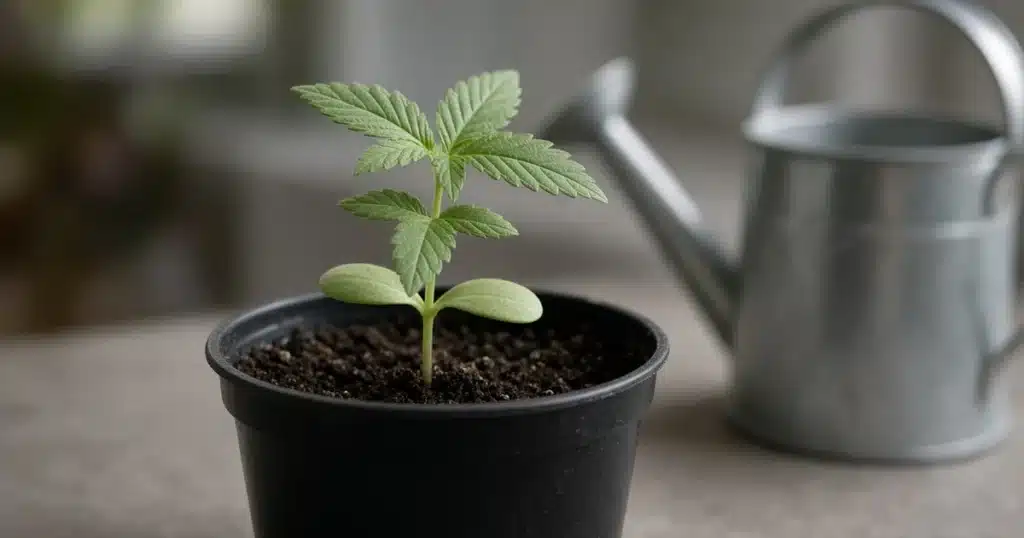
When to start feeding cannabis seedlings depends mostly on what they are growing in. A seedling in a bagged seed-starting or potting mix usually has enough nutrition for its first few weeks, because those mixes carry a small charge of added fertilizer. A seedling in plain coco, perlite or another inert medium has almost nothing to draw on once its seed leaves are spent. So the first feed is a decision about the medium, the plant’s growth and its leaf color, not a date on a calendar. Below you will find how to make that call, how strong the first feed should be, and how to fix problems when the timing is off.
Do cannabis seedlings need nutrients right away?
Usually not. A sprouted seed carries its own food store in the cotyledons, the two round seed leaves that open first. Those leaves feed the young plant while the root system gets started. Adding fertilizer during this window rarely helps and can easily hurt, because the root tips are small and sensitive to salts.
University of Maryland Extension puts it plainly in its guide to caring for vegetable seedlings: hold back on fertilizing. It notes that most potting mixes contain enough fertilizer to grow a seedling for 5 to 6 weeks. The same guide explains that soilless mixes contain a small amount of added soluble nutrients, and that if transplants are grown for more than 6 weeks you may need to feed them with a soluble fertilizer. That research is on vegetable transplants, not cannabis, but the logic carries over to any seedling in a similar mix.
The practical takeaway is simple. If your mix lists added fertilizer on the bag, you can usually wait. If it lists none, plan on an earlier, very light feed.
How do you tell when a seedling is ready for its first feed?
Watch the plant rather than counting days alone. These signs, taken together, point to a seedling that is ready:
- At least one or two sets of true leaves have opened. True leaves are the serrated leaves that form above the cotyledons. Unsure which is which? Kind Seed Co shows the difference in cannabis seedling true leaves.
- The cotyledons are starting to fade or yellow evenly while the new growth stays green.
- Roots are showing at the drainage holes, or the plant has been moved into a bigger pot.
- Growth has slowed even though light, water and temperature are steady.
- The newest leaves are turning pale green across the whole leaf.
One sign on its own is not enough. Cotyledons yellow naturally as they are used up, and pale new growth can come from low light or cold roots as well as hunger. The other causes are worked through in yellow leaves on cannabis seedlings.

What should the first feed look like?
The first feed should be weak. University of Maine Extension, in its bulletin on starting seeds at home, advises watering newly potted-up seedlings with a half-strength solution of a water-soluble, all-purpose plant food, either synthetic or organic. It gives a clear example: if the label says 1 tablespoon per gallon of water, use half a tablespoon per gallon instead.
University of Maryland Extension adds a warning that matters here. Young seedlings are easily damaged by too much fertilizer, especially when they are under any moisture stress. It also advises washing off any liquid fertilizer that lands on the leaves. A seedling that is already dry or wilted should be watered first and fed later, after it perks up.
Many growers go even lighter than half strength for the very first feed and build up from there. That approach costs little and leaves room to adjust.
How do you give the first feed, step by step?
- Check the bag of your mix. Note whether it lists added fertilizer and for how long it claims to feed.
- Water the seedling with plain water a day or so before feeding if the mix is dry. Never feed a dry root zone.
- Mix a water-soluble fertilizer at half the label rate or less for seedlings or indoor plants.
- Stir well and let the solution reach room temperature.
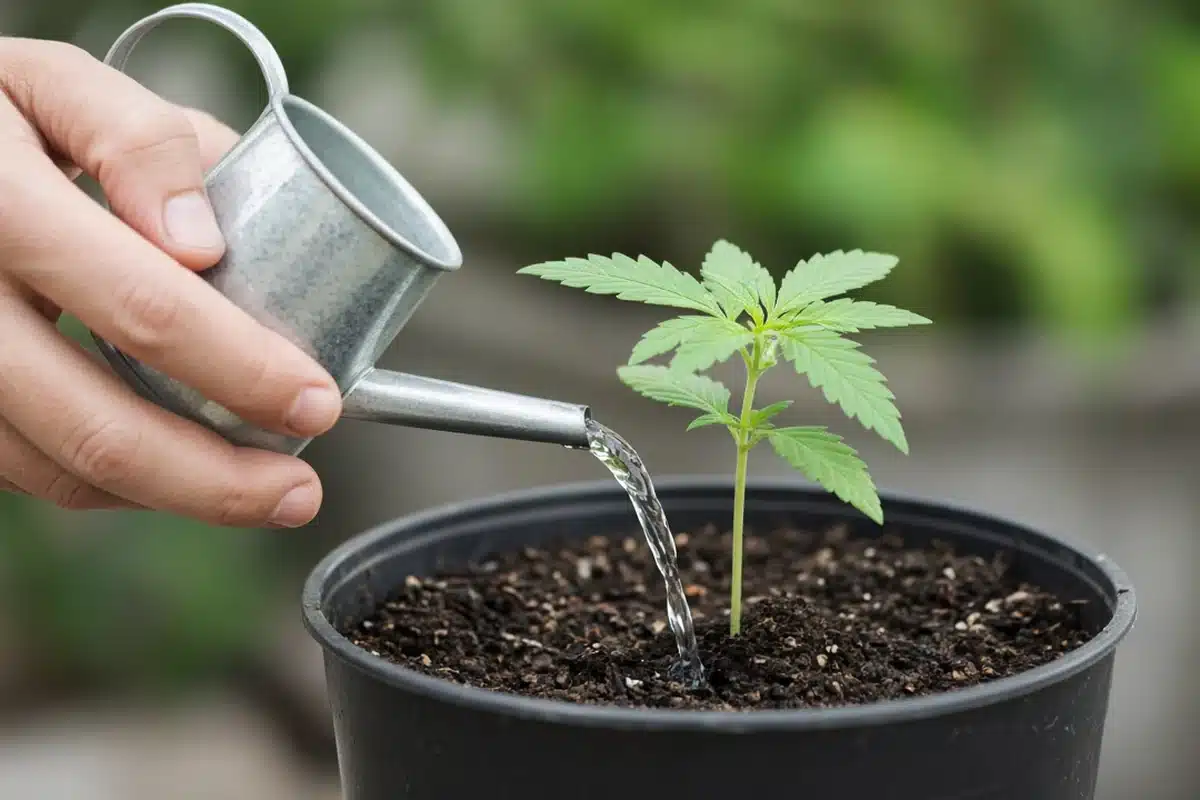
- Water slowly at the base of the stem until the whole root zone is moist. Avoid splashing the leaves, and rinse any that get wet.
- Go back to plain water for the next watering, then watch the new growth for several days.
- If the new growth darkens and speeds up with no tip burn, keep feeding at that strength. Raise it only gradually.
How does the growing medium change the timing?
Seed-starting mix or light potting mix. These usually include a small starter charge of nutrients. Most seedlings can go a few weeks on plain water before needing a feed. Follow the extension guidance above and watch for fading new growth.
Soil with compost or added amendments. Richer mixes can carry a seedling longer still. Feeding too early in these mixes is a common cause of burnt tips. When in doubt, wait and watch. Our feeding schedule in soil covers what comes after the first feeds.
Coco and other inert media. Coco and perlite hold very little usable nutrition. Seedlings in these media often need a light feed much sooner, sometimes as soon as the first true leaves appear. Keep it dilute and consistent rather than strong and occasional.
Garden soil in small pots. University of Maryland Extension advises against using garden soil for transplants at all, because it is too dense, about 75 pounds per cubic foot, and may carry weed seeds and plant pathogens. A soilless mix, by comparison, weighs about 10 pounds per cubic foot. If you are starting in garden soil, the bigger issue is the medium, not the feeding schedule.
How strong should feeding get after the seedling stage?
Strength rises as the plant grows. A study on vegetative cannabis by Caplan, Dixon and Zheng gives a sense of how far that range can go. They grew 17-day-old rooted cuttings in two coir-based organic substrates and fed them a liquid organic fertilizer at five rates, from 117 to 585 mg of nitrogen per liter. Flower yield peaked at a rate supplying about 389 mg of nitrogen per liter during the vegetative stage, which was 1.8 times the yield at the lowest rate.
That figure is for rooted cuttings already moving into vegetative growth, in one type of substrate with one fertilizer. It is not a seedling target. What it shows is that cannabis can use far more nutrition later than it needs early on. The same study found that the plants tolerated substrate EC up to 3.0 mS/cm without losing yield. Seedlings are much more sensitive, so the early feeds should stay a small fraction of that.
What are the signs of feeding too early or too strong?
| Symptom | Likely cause | Fix |
|---|---|---|
| Brown, crispy leaf tips on new leaves | Feed too strong for young roots | Water with plain water, then feed weaker |
| Very dark green, clawing leaves | Too much nitrogen | Skip feeds and let the plant use up the excess |
| Pale new growth across the whole plant | Mix has run out of nutrients | Start a light feed at half strength or less |
| Wilting after a feed in dry mix | Fertilizer added to a dry root zone | Water plain first, feed only once recovered |
| Slow growth with green leaves | Low light, cold roots or overwatering | Fix the environment before adding fertilizer |
Symptom guide summarizing the University of Maryland and University of Maine seedling feeding guidance cited below.
How do you fix a seedling that was fed too early?
Stop feeding first. For a seedling in a small pot, water with plain water until a little drains from the bottom, which helps move extra salts out of the root zone. Let the mix dry back to a normal moisture level before the next watering, since soggy media add a second stress. If the mix stays wet for days, turn to overwatering cannabis.
Leaves that are already burnt will not recover, so judge progress by the new growth. If the next leaves come in clean and green, the root zone is back in balance. Wait until the plant shows signs of hunger again before trying a weaker feed. Dark green clawing is a different problem, described in nitrogen toxicity.
What changes by stage?
Germination to cotyledons. No feeding. The seed’s own store carries the plant. Focus on gentle light, steady warmth and a mix that stays moist but not wet.
First and second sets of true leaves. In a mix with added fertilizer, keep using plain water and watch the plant. In inert media, start a very light feed. This is also when many growers pot up, which University of Maine Extension pairs with a half-strength feed.
Late seedling stage. As the plant adds leaf sets and roots fill the pot, the starter charge in most mixes runs down. Pale new growth is the cue to start or raise light feeding. University of Maryland Extension’s 5 to 6 week guideline for potting mixes is a sensible outer limit for when a plant in such a mix will likely need help.
Early vegetative growth. Feeding becomes a regular part of care. Raise strength step by step and use runoff readings to keep track of salt buildup. Taking those readings is covered in cannabis runoff.
What are common mistakes?
- Feeding at the full label rate on the first feed.
- Feeding a seedling in a pre-fertilized mix during its first week.
- Reading yellow cotyledons as a deficiency and feeding to fix them.
- Feeding a dry or wilted seedling before watering it with plain water.
- Leaving fertilizer splashed on the leaves.
- Raising strength quickly instead of watching each change for a few days.
- Feeding to fix a light, temperature or watering problem.
Write down the date and strength of every feed. A simple log makes it easy to see what worked when you start the next round of seeds.
Sources
- University of Maryland Extension. Care of Vegetable Seedlings. https://extension.umd.edu/resource/care-vegetable-seedlings
- University of Maine Cooperative Extension. Bulletin 2751, Starting Seeds at Home. https://extension.umaine.edu/publications/2751e/
- Caplan, D., Dixon, M. and Zheng, Y. 2017. Optimal Rate of Organic Fertilizer during the Vegetative-stage for Cannabis Grown in Two Coir-based Substrates. HortScience 52(9):1307-1312. https://doi.org/10.21273/HORTSCI11903-17
FAQ
When should I give cannabis seedlings their first nutrients?
In a mix with added fertilizer, most seedlings can wait several weeks and only need feeding when new growth starts to pale. In coco or other inert media, start a very light feed around the first true leaves. Let the plant's growth and leaf color guide you, not a fixed date.
How strong should the first seedling feed be?
Keep it at half the label rate or weaker. University of Maine Extension uses half strength as its example for newly potted seedlings, so a label calling for 1 tablespoon per gallon becomes half a tablespoon. Many growers start even lighter, then raise strength slowly while watching the new growth.
Do seedlings in potting soil need fertilizer?
Often not at first. Most bagged potting mixes contain a small charge of fertilizer that can carry a seedling for several weeks. Check the bag for added nutrients. Once the starter charge runs low, you will usually see paler new growth, and that is the point to begin light feeding.
Why are my seedling's first round leaves turning yellow?
The round seed leaves feed the plant early on, so they often yellow and fade as their store is used up. That is normal if the true leaves above stay green. If the new growth also turns pale, the plant may be hungry, or the cause may be light, water or temperature.


