
Square Foot Gardening: Grid Layout for Cannabis Beds
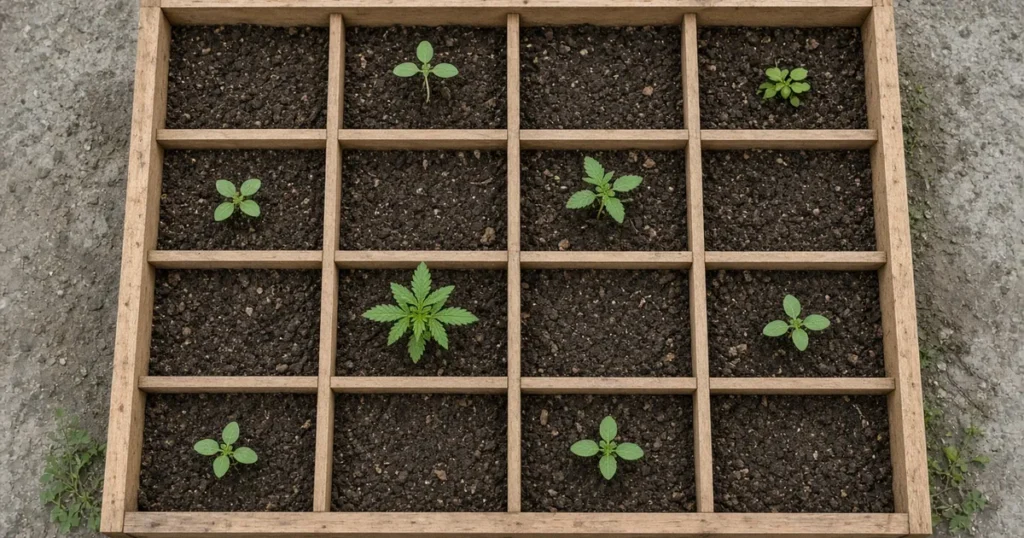
Most gardens are planted in rows. Square foot gardening takes a different approach. University of Florida IFAS Extension describes it as building a raised box and dividing the planting area into squares. University of California Cooperative Extension Master Gardeners of Tulare-Kings Counties sum it up as arranging the garden in squares, not rows. For an outdoor cannabis grower working in a small yard, the grid offers a tidy way to plan where every plant goes. Here you will learn how big to make the bed, how to mark the grid, how to space large plants and how to tend the bed from the edges.
Why use a grid
UF/IFAS Extension says the smaller footprint of square foot gardening makes it a good choice for beginners, for gardeners with smaller landscapes and for gardeners who find bending down to ground level difficult. It also says the method lets you make a garden efficient and more of a landscape feature. A planting box or two can be both productive and attractive in a front yard, where rows might not be welcome.
The grid also helps with weeds. UF/IFAS explains that plants in a square foot garden are placed close together to increase yield per square foot. The closely growing plants form a shady canopy that makes it harder for weeds to take over.
The Tulare-Kings Master Gardeners say a square foot grid on top of each box is a must.
How big to make the bed
UF/IFAS Extension says square foot gardens are generally built as a 4 by 4 foot planting area. It explains why that size works. It gives you a decent area to grow in without being so large that it is hard to reach the middle from the sides. You never want to step into the planting area, so you need to be able to reach the center to weed, plant and harvest.
Other sizes work too:
- Smaller. UF/IFAS notes that a 3 by 3 foot area gives you nine squares, which can feel less intimidating than sixteen.
- Rectangles. UF/IFAS says you are not limited to squares and can make a rectangular planting area instead.
- Longer boxes. The Tulare-Kings Master Gardeners suggest trying some 4 by 8 or 4 by 12 foot boxes for higher yields.
For the box itself, UF/IFAS says the building techniques are similar to those for any raised bed. Wood is the most popular choice, although some gardeners use bricks, stones, concrete blocks or synthetic materials. It notes that untreated lumber will start to rot within a year.
For a wider view of how beds fit into the whole growing area, turn to the Kind Seed Co post on planning an outdoor cannabis garden layout.
Choosing a spot for the bed
The Tulare-Kings Master Gardeners give a short set of siting rules:
- Pick an area that gets 6 to 8 hours of sunshine daily, which they say most plants need.
- Make sure it is not near trees and shrubs, and watch for roots and shade.
- Keep it as close as possible to the house for convenience and protection.
- Choose an area with no puddles after heavy rain, since drainage is important.
They also note that the existing soil is not very important, because a square foot garden is built as a box that holds its own soil. UF/IFAS says this is an advantage for gardeners dealing with poor native soil, such as sandy ground.
How to mark the grid
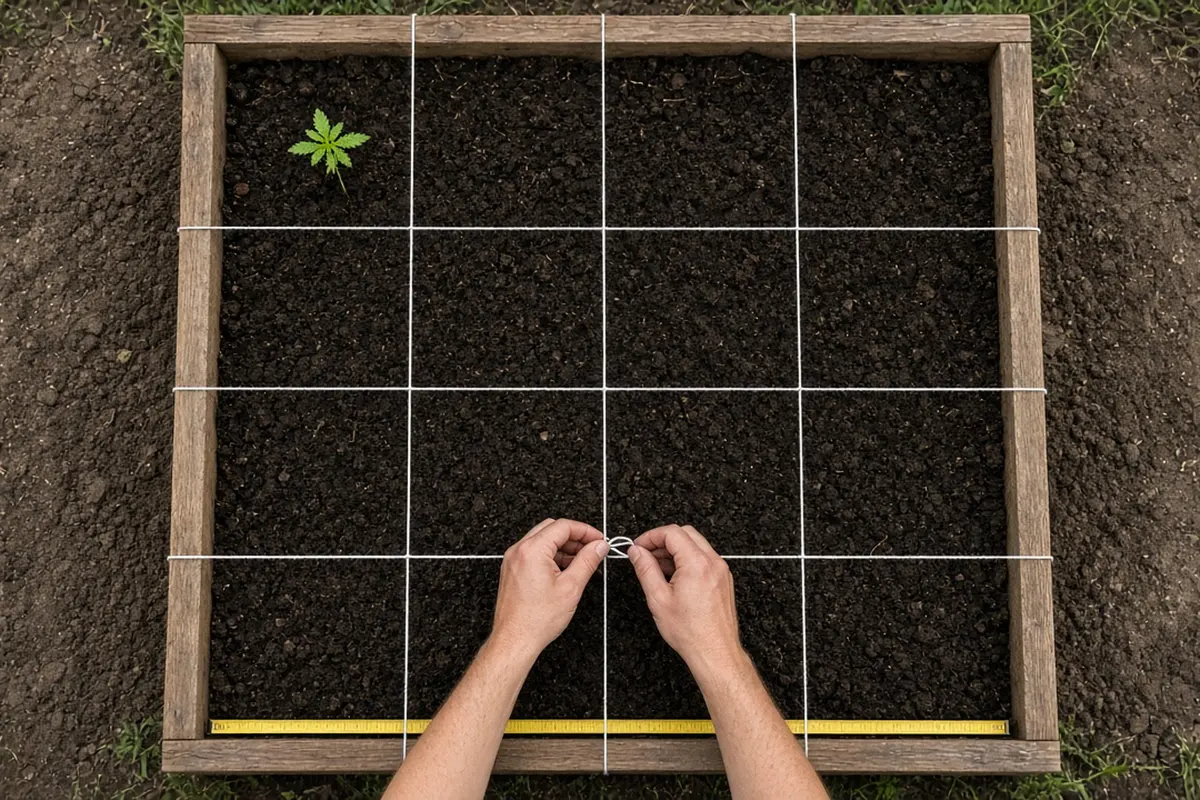
The grid can be as simple or as permanent as you like. UF/IFAS Extension says some gardeners build a reusable or even permanent grid, while others make a temporary one from whatever is on hand. It names sticks, string, twine and strips of wood as materials that work well and are easy to find.
The steps are simple:
- Build or set out the planting box.
- Divide each side into 1-foot sections.
- Lay sticks or strips of wood, or stretch string or twine, across the box at each mark in both directions.
- Lay the finished grid on top of the soil, as UF/IFAS describes, so it guides your planting.
UF/IFAS explains that a 4 by 4 foot area gives you sixteen 1 by 1 foot squares. The Tulare-Kings Master Gardeners use the same 4 by 4 layout of sixteen squares.
How many plants per square
Each square holds a set number of plants. UF/IFAS Extension and the Tulare-Kings Master Gardeners both use one, four, nine or sixteen plants per square, depending on the size of the plant.
The Tulare-Kings Master Gardeners tie the count to the spacing on the back of a seed packet. If the packet says to thin plants to:
- 12 inches apart, plant 1 per square.
- 6 inches apart, plant 4 per square.
- 4 inches apart, plant 9 per square.
- 3 inches apart, plant 16 per square.
UF/IFAS says that plants that take up more space, such as tomatoes, peppers, eggplants and cabbage, get one plant per square.
A few planting tips from the sources:
- Mix it up. UF/IFAS suggests variety in the box rather than filling all sixteen squares with the same plant, and the Tulare-Kings Master Gardeners suggest a different crop in each square.
- Save seed. The Tulare-Kings Master Gardeners say to plant only a pinch of 2 or 3 seeds per hole.
- Set transplants low. They say transplants go in a slight saucer-shaped depression.
Spacing large plants across several squares
Some plants are too big for a single square. The Tulare-Kings Master Gardeners chart puts the largest crops, such as watermelon, melon and winter squash, at one plant per 2 square feet. In other words, the biggest plants are given more than one square of the grid.
The same approach works for any plant that outgrows a single square. For guidance on how much room cannabis plants need, check the figures in how many cannabis plants you can grow per square metre.
Height matters as well as width. UF/IFAS advises placing a trellis for climbing plants on the outer edge on the north side of the bed, so it does not shade the rest of the garden.
Working from the edges
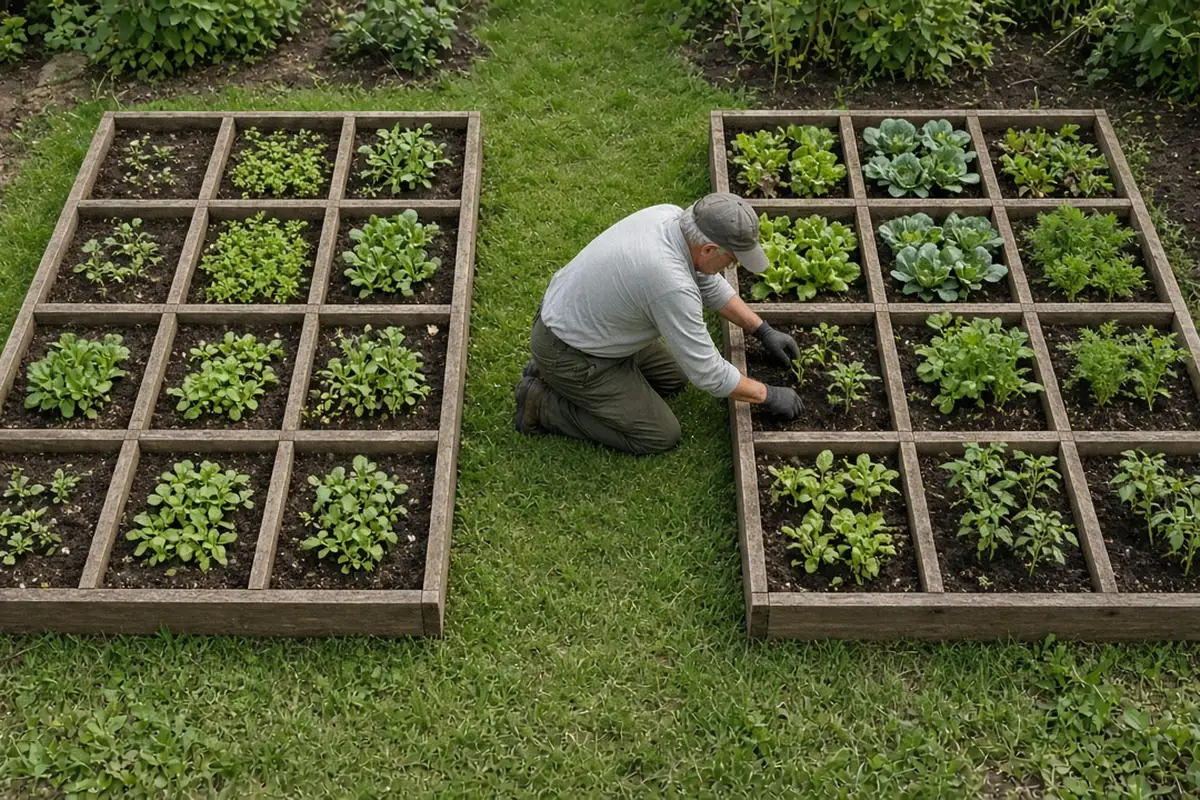
The most important rule of square foot gardening is about where you stand. The Tulare-Kings Master Gardeners put it in capital letters: never walk on your growing soil. Tend your garden from the aisles. UF/IFAS Extension explains why. Walking on the soil in the growing box compacts it and can hurt plant roots.
To make that easy, leave room to work. UF/IFAS says you do not have to limit yourself to one box, as long as you leave aisles large enough to work in, and it considers three feet a good width. The Tulare-Kings Master Gardeners also suggest spacing boxes 3 feet apart to form walking aisles.
Watering fits the same pattern. UF/IFAS notes that because the planting area is small, many gardeners can water adequately by hand, and it recommends watering in the morning to avoid rapid evaporation and help prevent some diseases. The Tulare-Kings Master Gardeners say to water by hand or with a drip system.
Troubleshooting
You are unable to reach the middle of the bed. The bed is too wide. UF/IFAS recommends 4 by 4 feet so the center is within reach from the sides.
The soil in the box is packed down. Someone is walking on it. Both sources say to tend the bed only from the aisles.
There is no room to kneel between boxes. The aisles are too narrow. UF/IFAS and the Tulare-Kings Master Gardeners suggest about 3 feet.
Tall plants shade the rest of the bed. UF/IFAS places trellises on the north edge so they do not shade other plants.
Water pools in the bed after rain. The Tulare-Kings Master Gardeners say to choose a spot with no puddles after heavy rain.
Sources
- University of Florida IFAS Extension, Gardening Solutions. Square foot gardening. https://gardeningsolutions.ifas.ufl.edu/design/landscaping-for-specific-sites/square-foot-gardening/
- University of California Cooperative Extension Master Gardeners of Tulare-Kings Counties. How to: square foot garden. https://www.ucanr.edu/sites/default/files/2022-03/365339.pdf
FAQ
What is square foot gardening?
It is a way of planting a raised bed in a grid instead of rows. University of Florida IFAS Extension describes building a raised box and dividing the planting area into squares. A 4 by 4 foot bed gives sixteen 1-foot squares, each planted with one, four, nine or sixteen plants depending on size.
How big should a square foot garden be?
UF/IFAS Extension says most square foot gardens are 4 by 4 feet, large enough to grow in but small enough to reach the middle from the sides. A 3 by 3 foot bed gives nine squares, and UC Master Gardeners suggest 4 by 8 or 4 by 12 foot boxes for higher yields.
How do I make a square foot garden grid?
UF/IFAS Extension says you can build a reusable grid or make a temporary one from sticks, string, twine or strips of wood. Divide the bed into 1-foot squares and lay the grid on top of the soil. UC Master Gardeners say the grid on each box is a must.
How do I fit large plants in a square foot garden?
Give them more than one square. The UC Master Gardeners chart puts the largest crops, such as watermelon and winter squash, at one plant per 2 square feet. UF/IFAS Extension puts trellises on the north edge of the bed so tall growth does not shade the other squares.


