
Armadillos in Cannabis Gardens: Holes, Fences and Trapping

Quick answer: Armadillos dig in gardens to find insects and grubs, and the shallow holes they leave can uproot young cannabis plants and loosen beds. Fact sheets from Clemson University Extension and the University of Missouri agree that no repellent or poison is proven to stop them. The tools that work are removing cover, fencing the garden with a buried barrier, a single low electric wire, and trapping with guide boards along their travel routes.
Do Armadillos Eat Cannabis?
No, they are after the animals in the soil. Clemson says armadillos feed mainly on insects, larvae, small vertebrates and eggs, and that most of their damage comes from rooting and digging for that food. Missouri adds that they search leaf litter for insects, grubs and other invertebrates and find prey by smell, since their eyesight is poor.
For a cannabis grower, though, the damage looks the same, since seedlings and transplants get uprooted. Missouri notes that armadillos uproot flowers and other plants as they dig. A fresh transplant with a small root ball is easy to flip out of the ground. If grubs are drawing them in, our post on white grubs in cannabis soil explains how to check a bed for them.
What Do Armadillo Holes Look Like?
They are small, shallow and cone shaped. Both Clemson and Missouri describe rooting holes that run 3 to 5 inches across and about 1 to 3 inches deep. You may find many of them scattered across a bed or lawn after a single night.
Other signs Clemson lists include uprooted flowers and ornamentals, torn up turf, broken insect mounds and dug out yellow jacket nests. Missouri says tracks show three toe prints with sharp claw marks. Burrows are larger, about 7 to 8 inches across. Missouri says they can run up to 15 feet long, and Clemson says up to 15 feet deep. Missouri says they are often placed in rock piles, around stumps, under brush piles and in dense woods.

Where Do Armadillos Live?
Mostly in the warm southern states, though their range is growing. Missouri explains that the nine banded armadillo moved into Texas from Mexico in the 1850s and has spread since. It is now becoming more common in southern and central Missouri. Clemson notes that this is the only armadillo species found in the United States.
Missouri says armadillos cannot handle freezing weather. Frozen ground keeps them from digging for food, and since they cannot hibernate, cold winters limit how far north they can live. Clemson adds that they prefer warm, wet climates with dense, shady cover.
When Are Armadillos Active?
Mostly at night. Missouri says armadillos are mainly nocturnal but sometimes move around during the day. Clemson notes that they tend to avoid activity in extreme heat or cold. Because the digging happens after dark, you may find the damage in the morning without ever seeing the animal.
Missouri also notes that armadillos often seem unaware of their surroundings while feeding and can come close to people before they notice. When startled, they jump straight up.
How to Keep Armadillos Out of Cannabis Beds
- Confirm the culprit. Match the holes to the shallow cone pattern both sources describe, and look for three toed tracks.
- Clear brush and debris. Clemson recommends removing cover near areas with activity, since armadillos prefer to dig burrows where they feel hidden. Missouri says removing brush near the home may discourage them.
- Build a buried fence. Clemson advises a fence at least 3 feet tall buried 12 to 18 inches deep, and deeper in sandy soil. Missouri suggests slanting the fence outward with part of it buried.
- Add a low hot wire for small areas. Missouri says a single electric strand 3 to 4 inches above the ground can protect a garden. Take care where children play.
- Check the fence often. Clemson warns that armadillos can jump at least 3 to 4 feet when provoked, so watch for weak spots.
- Trap along travel routes. Both sources recommend setting traps on paths to burrows and along fences and walls.
- Contact your wildlife agency. Rules on trapping, moving and removing armadillos differ by state.
Armadillo Control Methods Compared
| Method | What the sources say | Limits |
|---|---|---|
| Removing brush and cover | Makes the area less attractive | Brush also shelters songbirds |
| Buried fence | At least 3 feet tall, buried 12 to 18 inches | Armadillos climb and jump |
| Single hot wire | 3 to 4 inches above the ground | Use care around children |
| Live trap with wings | Boards guide the animal in | Relocation is discouraged |
| Repellents and toxicants | None proven or registered | Not a reliable option |
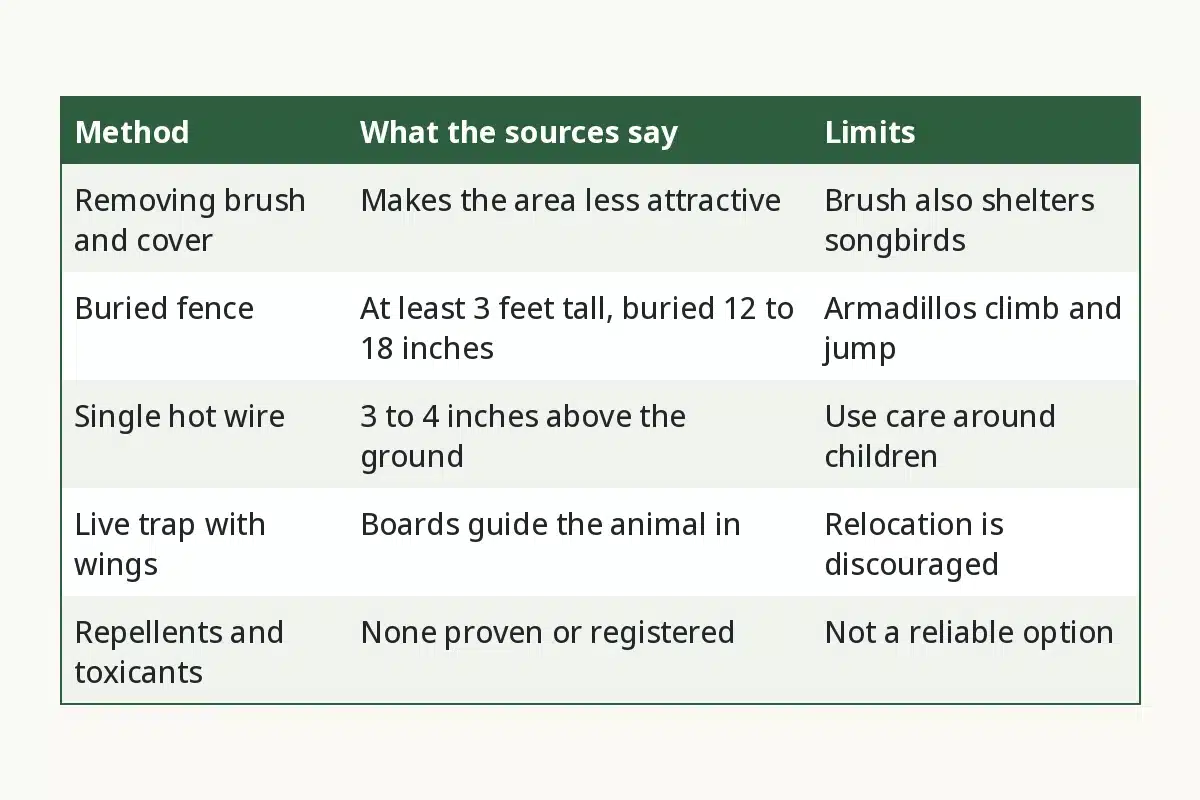
Missouri adds that clearing all the insects and grubs from soil to starve armadillos out is not practical and could harm plants and other life in the area. For extra protection on new transplants, our guide to plant cages for cannabis shows how to shield individual plants.
How Do You Trap an Armadillo?
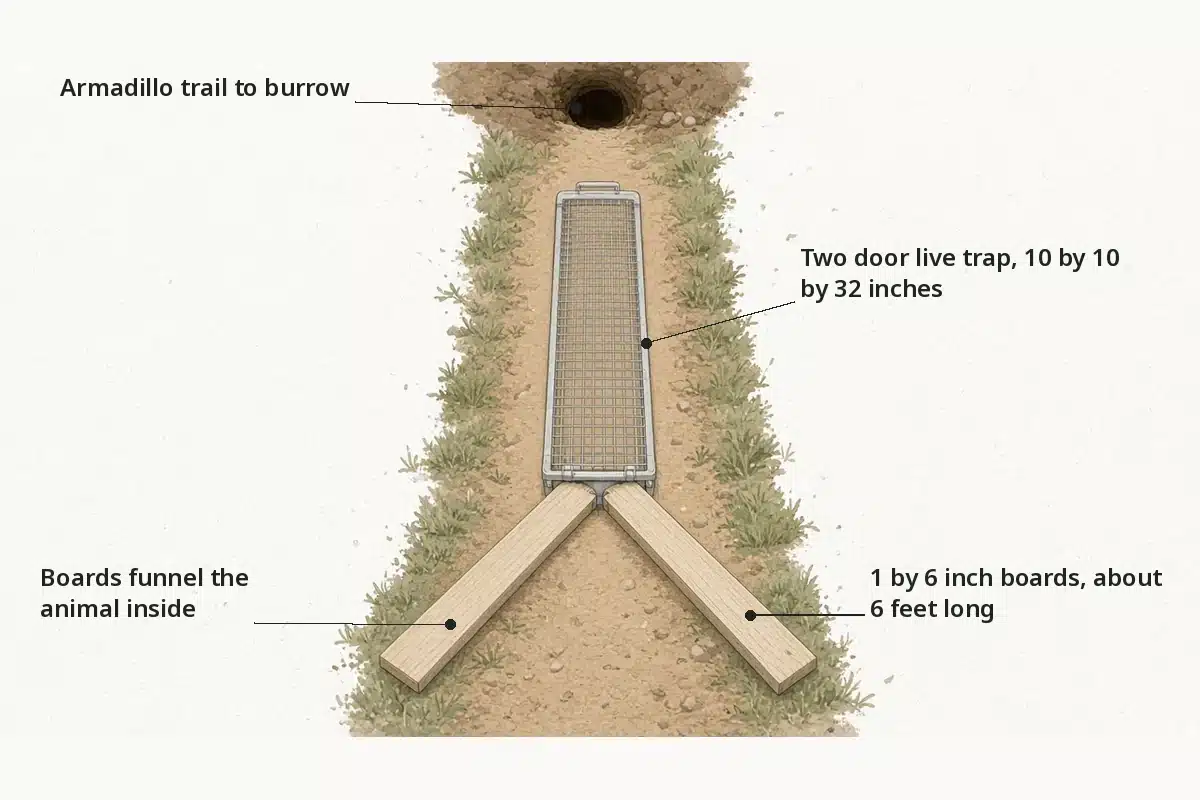
Use a cage trap with guide boards and skip the bait. Missouri recommends a live trap about 10 by 10 by 32 inches, ideally one that opens at both ends. Both sources suggest wings, boards about 1 by 4 or 1 by 6 inches, set like a funnel to steer the animal inside. Missouri describes wings about 6 feet long.
Missouri and Clemson both say bait is often unnecessary when wings are used. If you want bait, they mention overripe or spoiled fruit, rotten meat or mealworms. Set traps along trails to burrows or beside fences and buildings, where armadillos travel.
Can You Relocate a Trapped Armadillo?
Often not, and moving one is generally a poor idea. Clemson says South Carolina prohibits relocating or translocating trapped wildlife and that a trapped armadillo must be dispatched quickly and humanely. Missouri says relocation can cause several problems and is not recommended. Clemson points readers to state lists of wildlife removal services, and Missouri points to wildlife damage biologists at its state conservation agency. Check with your own state agency before you trap.
Do Repellents Work on Armadillos?
Not reliably. Missouri states that no toxicant or repellent is registered or known to work for armadillo control. Clemson agrees that no proven scare devices or repellents exist and that no toxicants are registered. Never put any repellent on flowers or buds.
Are Armadillos a Health Risk?
The risk is low, but use care. Missouri explains that armadillos can carry the bacterium linked to leprosy, though no conclusive evidence shows people catch it from contact with them. Its guide mentions a few cases among people who handled, skinned and ate armadillos for many years. Wear gloves if you must handle one, and wash your hands well afterward.
Troubleshooting Armadillo Problems
New holes keep appearing inside the fence. Check for gaps at the bottom. Clemson recommends burying the fence 12 to 18 inches deep, and deeper in sandy soil.
The armadillo jumped the fence. Clemson notes they can jump 3 to 4 feet when provoked. Add height or a low hot wire as Missouri describes.
The trap stays empty. Move it onto a known path to a burrow and add wings, both steps Missouri and Clemson recommend.
A burrow sits under a shed or walkway. Missouri says armadillos also damage structures by burrowing under foundations and driveways. Call a wildlife professional before you collapse it.
The lawn next to the garden is torn up too. That points to grubs or insects in the turf. Inspect the soil before deciding what to do.
Sources
- Clemson Cooperative Extension, Home and Garden Information Center, Armadillos: https://hgic.clemson.edu/factsheet/armadillos/
- University of Missouri Extension, Armadillos (G9456): https://extension.missouri.edu/publications/g9456
FAQ
Can armadillos climb fences?
Yes. Missouri says armadillos can climb as well as dig, which is why it suggests an outward slanted fence.
How deep do armadillo holes go?
Feeding holes are shallow. Both sources put the depth at roughly 1 to 3 inches.
What time do armadillos dig?
Mostly at night. Missouri says they are mainly nocturnal but sometimes move in daylight.
Do armadillos stay all winter?
They stay but slow down. Missouri says they retreat underground in cold weather and cannot hibernate.
How many young does an armadillo have?
Four. Missouri and Clemson both say a female has one litter of four identical young each year, all the same sex.


