
Opossums and Cannabis Gardens: Signs, Fences and Prevention
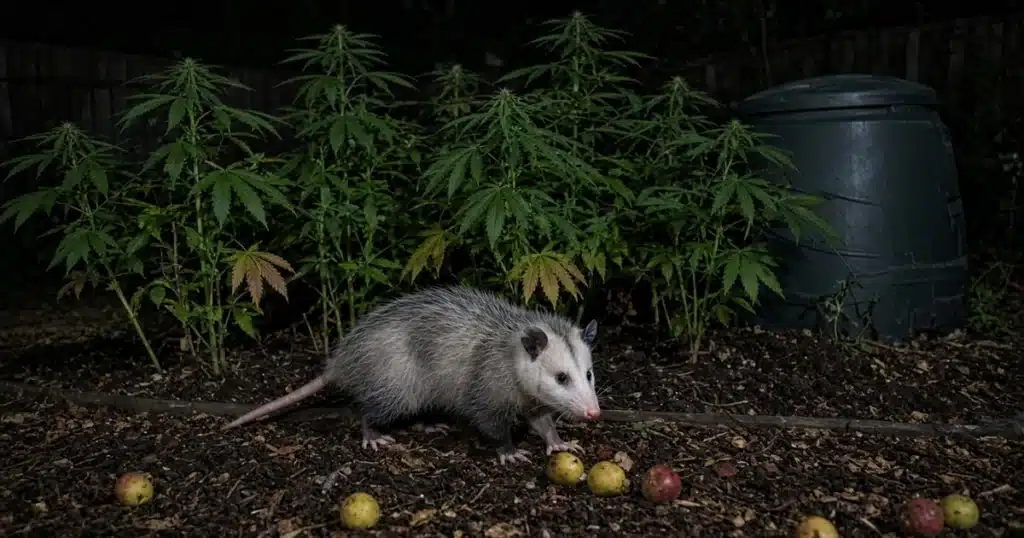
Quick answer: Opossums are night visitors that come into yards for easy food such as fallen fruit, pet food, garbage and open compost. UC IPM, the pest program of the University of California, and Mississippi State University Extension both point to the same plan. Clean up what draws them, seal off places where they can den, and protect the garden with a floppy topped wire fence that they cannot climb over.
Do Opossums Eat Cannabis Plants?
Probably not, since neither source lists cannabis among the foods opossums seek. UC IPM calls the opossum an omnivore and names fruit, berries, grapes and nuts in gardens as the crops it most often damages. Its full menu, per UC IPM, runs from fruits, nuts and green plants to insects, snails, frogs, eggs and small mammals such as voles and mice. Mississippi State sums it up by saying opossums eat almost anything.
That means harm in a cannabis bed is more likely to be indirect. An opossum searching a bed for insects or scraps might disturb young plants, and UC IPM notes that opossums defecate on garden paths and patios. If something is clipping stems cleanly, look at other animals as well. Our post on rabbits and cannabis covers one common culprit.
How Can You Tell an Opossum Is Visiting?
Look for clues left overnight. UC IPM notes that opossums are active only at night and in low light, so they may never be seen, and that barking dogs and pet food that vanishes overnight are often the first hints. Signs that point to an opossum include:
- Garbage cans that have been opened and searched
- Pet food bowls left outside and emptied by morning
- Fallen fruit under trees that has been chewed or carried off
- Compost that has been dug through
- Droppings left on walkways, patios or garden paths
- Scraps and remnants from a messy night of feeding
A visual check helps too. UC IPM describes an adult opossum as roughly the size of a house cat, about 2 to 3 feet long, and usually 4 to 7 pounds. It has coarse grayish fur, a pointed face, rounded hairless ears and a long hairless tail.
Why Are Opossums Coming Into the Garden?
Food and shelter bring them in. UC IPM says opossums living close to homes may check vegetable gardens, compost piles, trash cans and pet dishes for food. It adds that in towns they den under steps, porches, decks and garden sheds, and in the wild they use brush piles, tree cavities and old burrows.
A garden with fruit trees, a compost pile that holds kitchen scraps and a shed with a gap underneath can offer an opossum everything it needs. Take those lures away first. Often that alone solves the problem.
How to Keep Opossums Out of Cannabis Beds
- Pick up fallen fruit. UC IPM recommends collecting fruit that drops from trees so it does not become a nightly meal.
- Bring pet food inside by nightfall. Feed pets indoors, or pick up the bowls before dark, as UC IPM advises.
- Use cans with tight lids. UC IPM suggests garbage cans with lids that fit securely. Mississippi State also says to keep trash picked up and cans sealed.
- Keep food scraps out of open compost. UC IPM advises against adding food scraps to compost that animals can reach. Our guide to composting cannabis garden waste explains closed bin options.
- Lift stored lumber. UC IPM suggests stacking lumber and firewood at least 18 inches off the ground so it does not serve as a den.
- Trim limbs near the roof. Cut tree limbs back about 5 feet from the roof so opossums cannot climb onto the house, as UC IPM recommends.
- Screen openings under buildings. UC IPM recommends 1/4 inch mesh hardware cloth over openings under decks and sheds, buried up to 6 inches where possible.
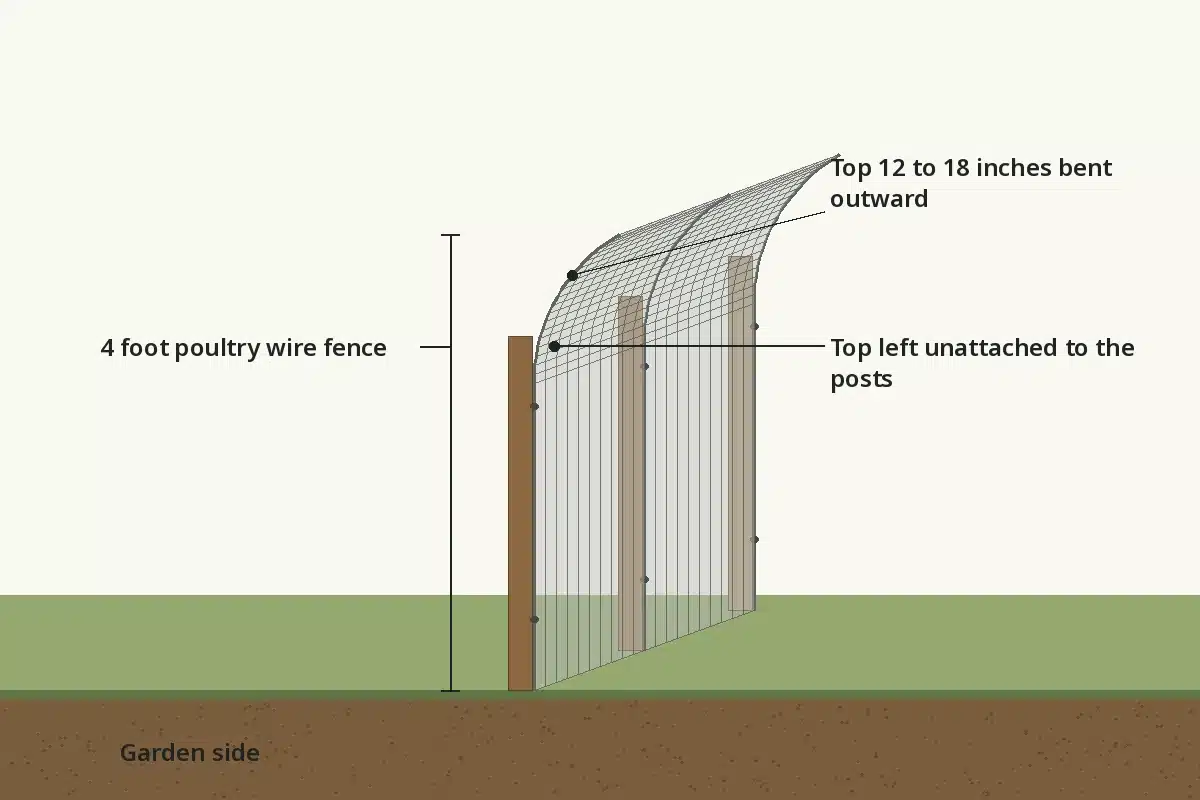
- Fence the garden. UC IPM describes a 4 foot poultry wire fence with the top 12 to 18 inches bent outward and left unattached so it wobbles when an opossum tries to climb.
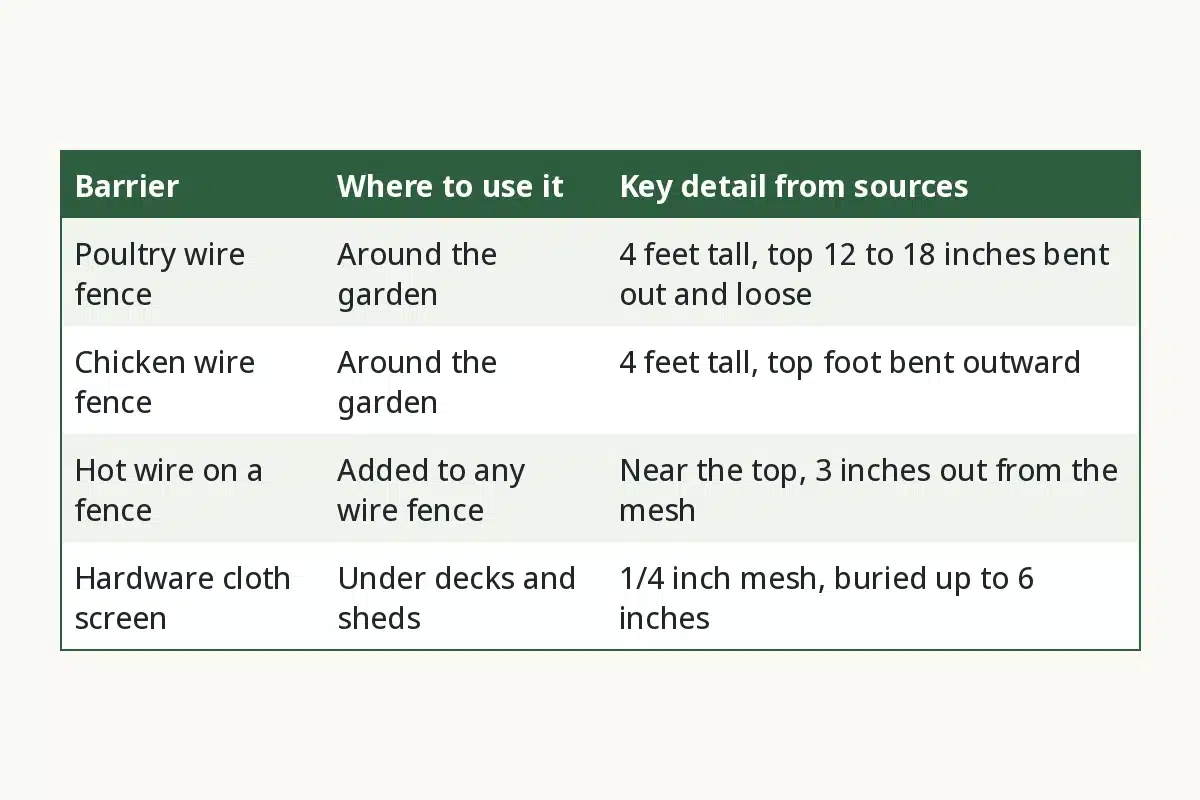
Opossum Barrier Options Compared
| Barrier | Where to use it | Key detail from sources |
|---|---|---|
| Poultry wire fence | Around the garden | 4 feet tall, top 12 to 18 inches bent out and loose |
| Chicken wire fence | Around the garden | 4 feet tall, top foot bent outward |
| Hot wire on a fence | Added to any wire fence | Near the top, 3 inches out from the mesh |
| Hardware cloth screen | Under decks and sheds | 1/4 inch mesh, buried up to 6 inches |
UC IPM explains why the loose top works. The unsupported section bends under the animal’s weight, so the opossum cannot pull itself over. Mississippi State gives a similar design, a 4 foot chicken wire fence with the top foot bent outward. For individual young plants, our post on plant cages for cannabis shows another way to add a physical shield.
How Do You Know an Opossum Has Left a Den?
Use a flour tracking patch. UC IPM suggests spreading flour in a smooth, thin layer, about 1/8 inch deep, in front of the opening under a deck or shed. Check it soon after dark. Footprints leading away tell you the animal has gone out, and the hole can then be closed.
UC IPM notes that opossums usually live alone. A mother carries her young in her pouch, so the family leaves together. That makes the tracking patch a simple way to avoid sealing an animal inside.

Do Repellents or Scare Devices Work on Opossums?
Not for long. UC IPM states that none of the chemical repellents marketed for wildlife have shown good results on opossums. It adds that mothballs and household ammonia are not legal to use this way and could send fumes into buildings. Mississippi State notes that garden animals adapt quickly to sounds and scents, so it advises rotating among several methods.
A motion activated sprinkler may startle an opossum, UC IPM says, but an animal that already visits the yard often ignores it within a few days. UC IPM also warns never to use rodent poison baits on opossums. No toxicants are registered for them, and pets are often the ones harmed.
Is It Legal to Trap and Move an Opossum?
It depends on the state. UC IPM says that in California, moving an opossum elsewhere without a permit is against the law, and it suggests hiring a licensed wildlife control operator. Mississippi State says live traps work and suggests bread and jelly as bait because it will not attract cats. Because rules differ, call your state wildlife agency before you set any trap.
UC IPM lists a box or cage trap of at least 10 by 12 by 32 inches placed along known travel routes. It notes that canned cat food works as bait but can also catch cats, so it suggests raw eggs, overripe fruit, or jam or peanut butter on bread instead.
Are Opossum Droppings a Health Concern?
Yes, they can carry disease and parasites, so handle them with care. UC IPM notes that opossums can carry fleas, ticks, mites and lice, and that they host cat and dog fleas in towns. Wear gloves to remove droppings from beds or paths, bag them for the trash and wash your hands well afterward.
UC IPM adds that an occasional visit may not be a concern unless pets stay outdoors at night, so bring pets in after dark if opossums are around. Never try to pick one up.
Troubleshooting Opossum Problems
Trash is still being raided. Check that lids lock or are held down with a cord. UC IPM recommends lids that fit tightly, and Mississippi State advises sealed cans.
The fence is up but tracks still appear inside. Make sure the top section is bent outward and not tied to a post. UC IPM says a rigid top gives the animal something to climb.
An opossum is living under the shed. Spread a flour patch at the opening, as UC IPM describes, and close the gap only after you see tracks leading out.
The sprinkler worked for a few nights and then stopped. That matches UC IPM’s report that the fright response fades quickly. Remove food and add a fence instead.
Compost is scattered every morning. Stop adding food scraps and switch to a closed bin, steps UC IPM recommends.
Droppings keep showing up on the deck. Look for a den under the structure and screen it with 1/4 inch hardware cloth after the animal has left, as UC IPM advises.
Sources
- UC Statewide IPM Program, University of California, Pest Notes: Opossum: https://ipm.ucanr.edu/home-and-landscape/opossum/
- Mississippi State University Extension, Vertebrate Pest Control in the Home Garden and Landscape (P3180): https://extension.msstate.edu/publications/vertebrate-pest-control-the-home-garden-and-landscape
FAQ
Will an opossum hurt my cannabis plants?
Rarely on purpose. Neither source names cannabis as food for opossums, and the damage they describe is mostly to fruit, berries, nuts and trash.
Do opossums climb fences?
Yes. UC IPM explains that a floppy top section of poultry wire stops them because it bends under their weight.
What bait catches opossums but not cats?
UC IPM suggests raw eggs, overripe fruit, or jam or peanut butter on bread. Mississippi State recommends bread and jelly.
Does ammonia keep opossums away?
No. UC IPM says ammonia and mothballs are not legal for this use and are not recommended.
How long does a scare device work?
Only a few days, in most cases. UC IPM reports that animals used to a site lose their fear quickly.


