
Cabbage Loopers on Cannabis: Spot the Inchworm and Stop It

Quick answer: The cabbage looper is a pale green caterpillar that arches its body as it crawls and chews jagged holes in leaves. Clemson University Extension and University of New Hampshire Extension both list a wide range of garden hosts, so loopers can wander onto cannabis in a mixed vegetable plot. The best plan is weekly scouting, picking off larvae, row covers where the pest returns each year and protecting the small wasps that attack looper eggs.
Do Cabbage Loopers Feed on Cannabis?
Neither source names cannabis as a host, but both describe a caterpillar with very broad tastes. Clemson lists beans, broccoli, cabbage, cauliflower, lettuce, parsley, spinach and tomato. New Hampshire adds beets, peas, celery, potatoes and some flowers to the list of plants it attacks.
Because loopers feed on so many crops, a cannabis plant growing beside cabbage or lettuce may also get chewed when moths are active nearby. Make sure of what you are looking at before you act. Other caterpillars cause similar holes, and our post on armyworms on cannabis covers one that is often confused with loopers.
How Do You Identify a Cabbage Looper?
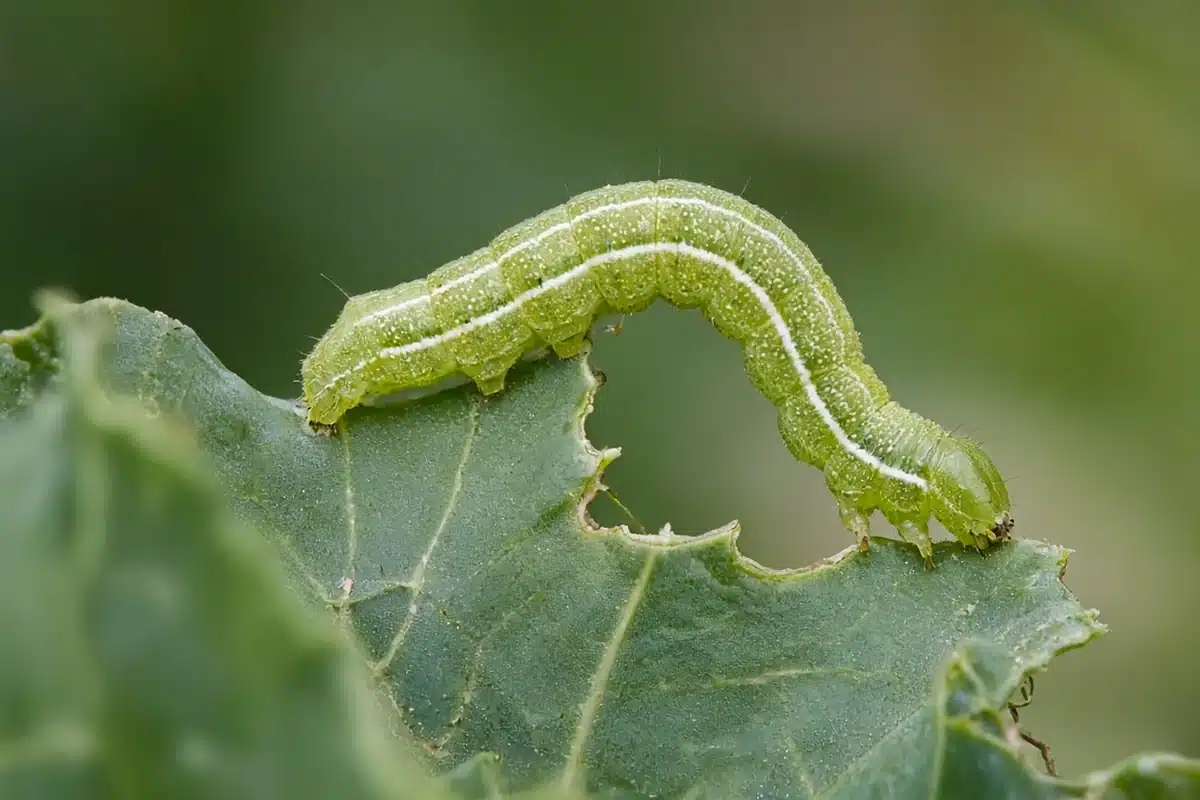
Watch how it moves. Clemson explains that the looper has only two pairs of prolegs on its abdomen, so the middle of the body humps into a loop as it crawls. New Hampshire notes that this looping motion gives the insect its name.
Key features from both sources:
- Pale green body about 1 to 1 1/2 inches long when grown
- A thin white or yellow stripe along each side
- A body that is narrow at the head and wider toward the rear
- A habit of rearing up when disturbed
The adult is a moth. New Hampshire describes it as gray brown, about 1 inch long, with a wingspan near 1 1/2 inches and a small silvery mark on each front wing shaped like a figure 8.
What Does Looper Damage Look Like?
Look for ragged holes in leaves. Clemson says jagged holes in the leaves are the main sign of looper feeding. New Hampshire suggests watching later in the season for large larvae and their droppings on and under leaves.
Damage is easy to miss at first because young larvae are small and pale. Clemson says newly hatched larvae start out a dusky white and turn pale green as they feed, with a lighter green head. New Hampshire adds two thin stripes down the center of the back and three pairs of true legs near the head.
Check both sides of the leaves. New Hampshire says the moth lays eggs one at a time on upper leaf surfaces, while Clemson describes small dome shaped eggs laid in clusters of seven or eight. New Hampshire notes that pupae form right on the plant, wrapped in loose white threads.
How Does the Looper Life Cycle Work?
It is short, with more than one generation each season. Clemson says eggs hatch in 1 to 10 days, depending on temperature. New Hampshire says each female lays 275 to 350 eggs, larvae finish growing in 2 to 4 weeks and adults emerge from pupae about 2 weeks later. It reports 2 to 3 cycles per season in that state.
New Hampshire also notes that the looper does not survive the winter outdoors there. Moths fly north from warmer areas. They can arrive as early as mid July, though late August arrivals are common.
How to Manage Cabbage Loopers on Cannabis
- Scout weekly, destroy larvae you find, use row covers where loopers return each year and protect natural enemies. Start scouting in midsummer. New Hampshire recommends checking leaves weekly for feeding damage from mid July onward.
- Inspect new plants. New Hampshire advises looking over transplants for larvae and destroying any you find before planting.
- Remove larvae you find. New Hampshire advises destroying looper larvae found during inspections, and later checks for large larvae and droppings help you find the ones you missed.
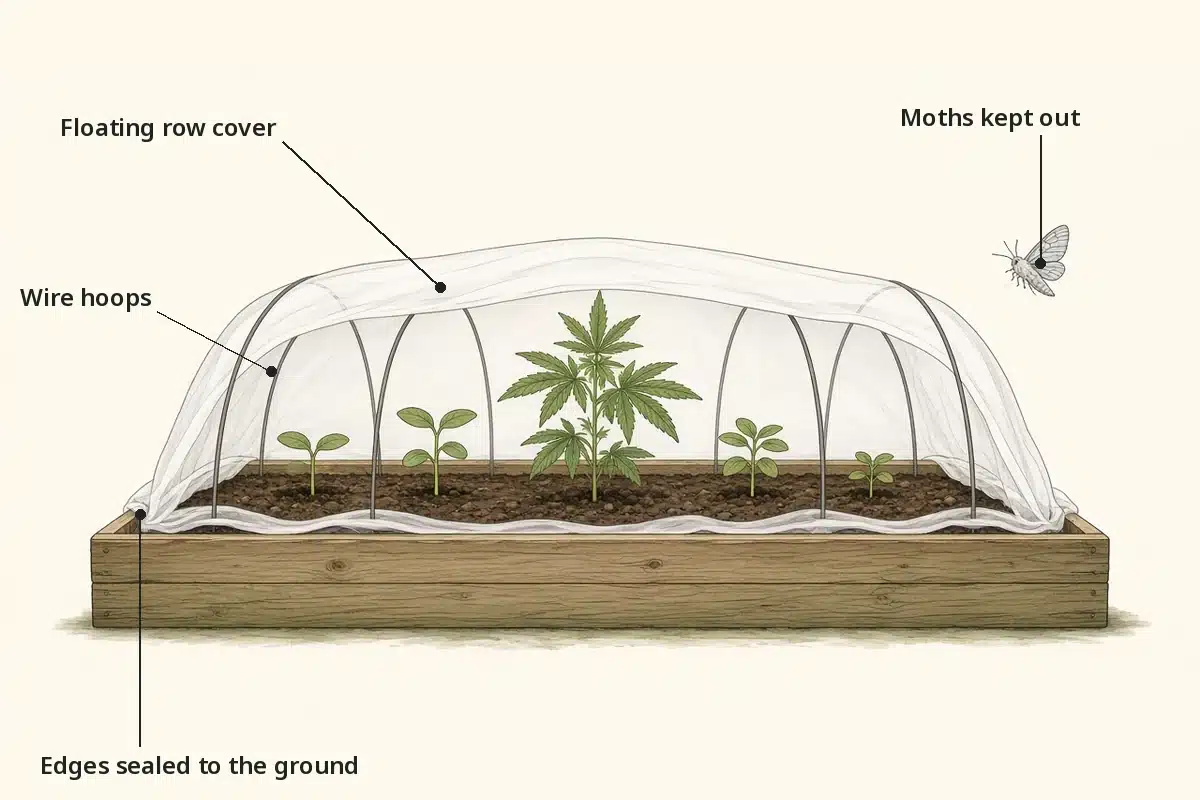
- Cover plants where loopers return each year. New Hampshire suggests floating row covers if loopers are a yearly pest. Our guide to row covers for cannabis explains setup.
- Grow flowers for natural enemies. Clemson recommends planting a mix of flowers to provide pollen and nectar for predators and parasites.
- Avoid broad spectrum sprays. Clemson says cutting back on broad spectrum insecticides preserves parasitic wasps, predators and other beneficial insects.
- Choose labeled options carefully. Clemson advises using chemical controls only when biological controls fail and choosing the least harmful option for pollinators. Use only products labeled for your crop and state, and start with the gentlest choice.
- Keep sprays off flowering tops. Never apply anything to buds on plants you plan to harvest.
Should You Grow Resistant Varieties?
It can help in a mixed garden. New Hampshire suggests considering resistant varieties of the vegetables loopers attack, which can reduce how many caterpillars build up near your cannabis. Neither source rates cannabis cultivars for looper resistance, so focus on scouting and covers for the cannabis plants themselves.
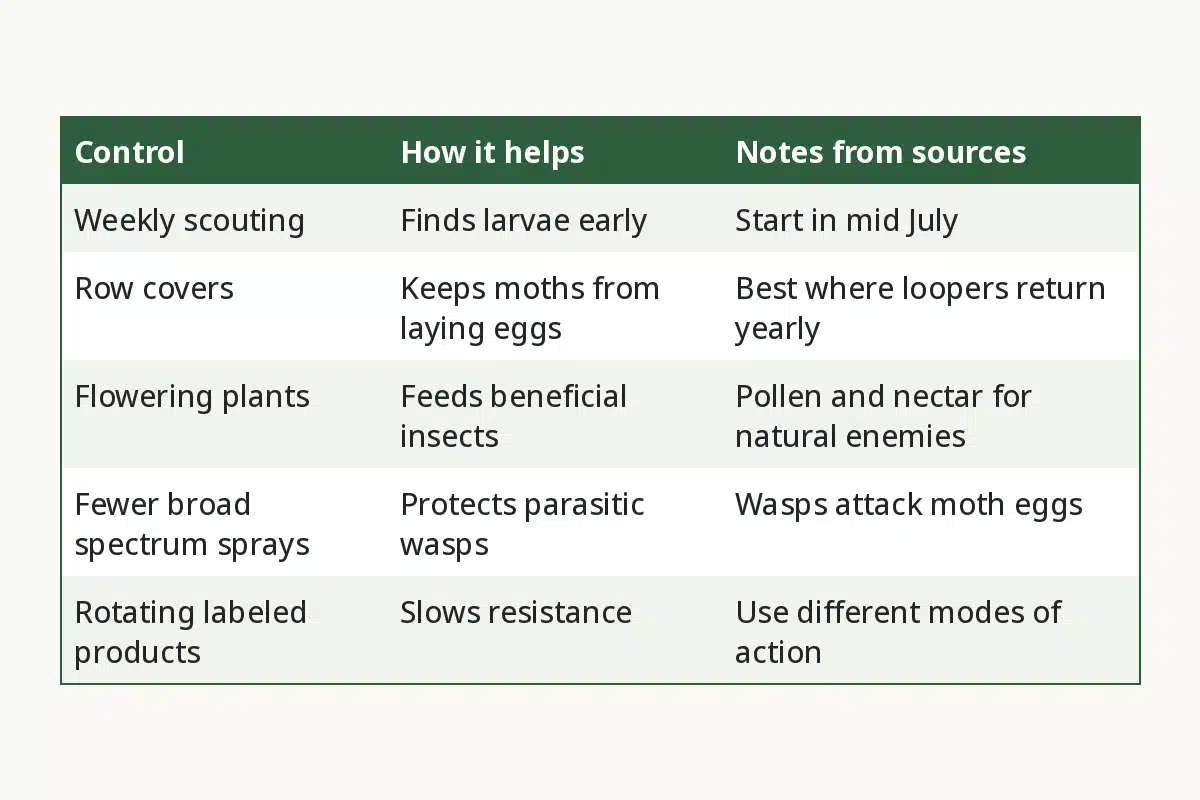
Looper Controls Compared
| Control | How it helps | Notes from sources |
|---|---|---|
| Weekly scouting | Finds larvae early | Start in mid July |
| Row covers | Keeps moths from laying eggs | Best where loopers return yearly |
| Flowering plants | Feeds beneficial insects | Pollen and nectar for natural enemies |
| Fewer broad spectrum sprays | Protects parasitic wasps | Wasps attack moth eggs |
| Rotating labeled products | Slows resistance | Use different modes of action |
New Hampshire warns that growers often need several applications to control loopers with insecticides and that they should rotate products with different modes of action. Using the same product again and again raises the chance that the insects become resistant.
What Natural Enemies Attack Cabbage Loopers?
Tiny parasitic wasps are the main allies. Clemson describes Trichogramma wasps, 1 millimeter long or less, that develop inside the eggs of more than 200 kinds of moths and butterflies. Clemson says no other biological control agent is released as widely across North America.
Clemson also names other predators and parasites that occur on their own in gardens. To keep them on the job, go easy on harsh sprays and give them flowers to feed on.
Do Insecticidal Soaps Help With Loopers?
Only on small caterpillars, and with caution. Clemson says soaps and oils work best on young larvae because they coat the insect, and they leave no residue once dry. It warns not to apply them to drought stressed plants or when temperatures reach 90 degrees F or higher. Use only products labeled for your crop and state. Our post on insecticidal soap for cannabis covers timing in more detail.
Troubleshooting Looper Problems
New holes appear but no caterpillars are visible. Check leaf undersides early in the morning and look for green droppings, which New Hampshire lists as a later sign.
Loopers return after hand picking. New Hampshire reports 2 to 3 cycles per season, so keep checking weekly until fall.
Row covers did not stop them. Make sure the edges are sealed to the ground and that no larvae were on the plants before covering. New Hampshire advises inspecting transplants first.
Sprays seem to work less each time. New Hampshire links repeated use of one product to resistance. Rotate between modes of action on the label.
Beneficial insects disappeared after spraying. Clemson warns that broad spectrum sprays kill parasitic wasps and predators. Switch to scouting, hand picking and covers.
Sources
- Clemson Cooperative Extension, Home and Garden Information Center, Integrated Pest Management (IPM) for Cabbage Looper: https://hgic.clemson.edu/factsheet/integrated-pest-management-i-p-m-for-cabbage-looper/
- University of New Hampshire Extension, Cabbage Looper Fact Sheet: https://extension.unh.edu/resource/cabbage-looper-fact-sheet
FAQ
Why is it called a looper?
Because of the way it crawls. New Hampshire explains that the body humps into a loop between its front and rear legs.
When do cabbage loopers show up?
Often from mid July into late summer in the North. New Hampshire says moths fly in from the South and do not survive winter there.
How many eggs does a looper moth lay?
Hundreds. New Hampshire says each female lays 275 to 350 eggs.
Where do loopers pupate?
On the plant itself. New Hampshire says the pupa rests on the plant inside a web of white threads, and the adult moth emerges in about 2 weeks.
What temperature is too hot for soap sprays?
90 degrees F and above. Clemson warns that soaps and oils can damage plants in that heat.


