
Best Time to Water Outdoor Cannabis: Morning or Night?
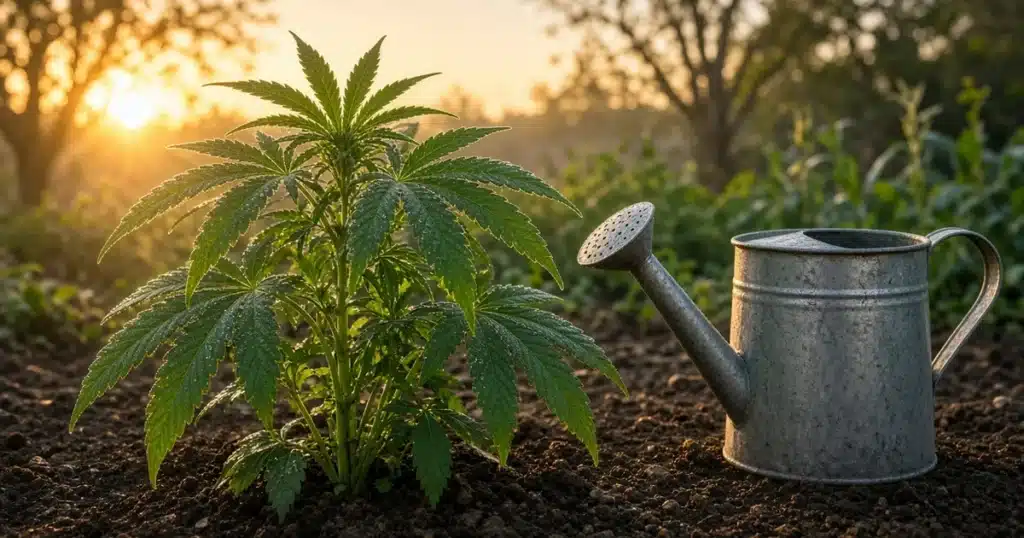
Most watering advice for outdoor cannabis is about how much and how often. When you water matters too, and it matters most for one reason. Water sitting on leaves gives disease a chance to start. Iowa State University Extension names early morning, from 5:00 to 9:00 am, as the best time to water a garden with a sprinkler, hose or anything else that wets the foliage. Mississippi State University Extension explains the science behind that advice and how to plan watering around dew. Here is how to put both to work in an outdoor cannabis garden.
Why wet leaves matter more than the clock
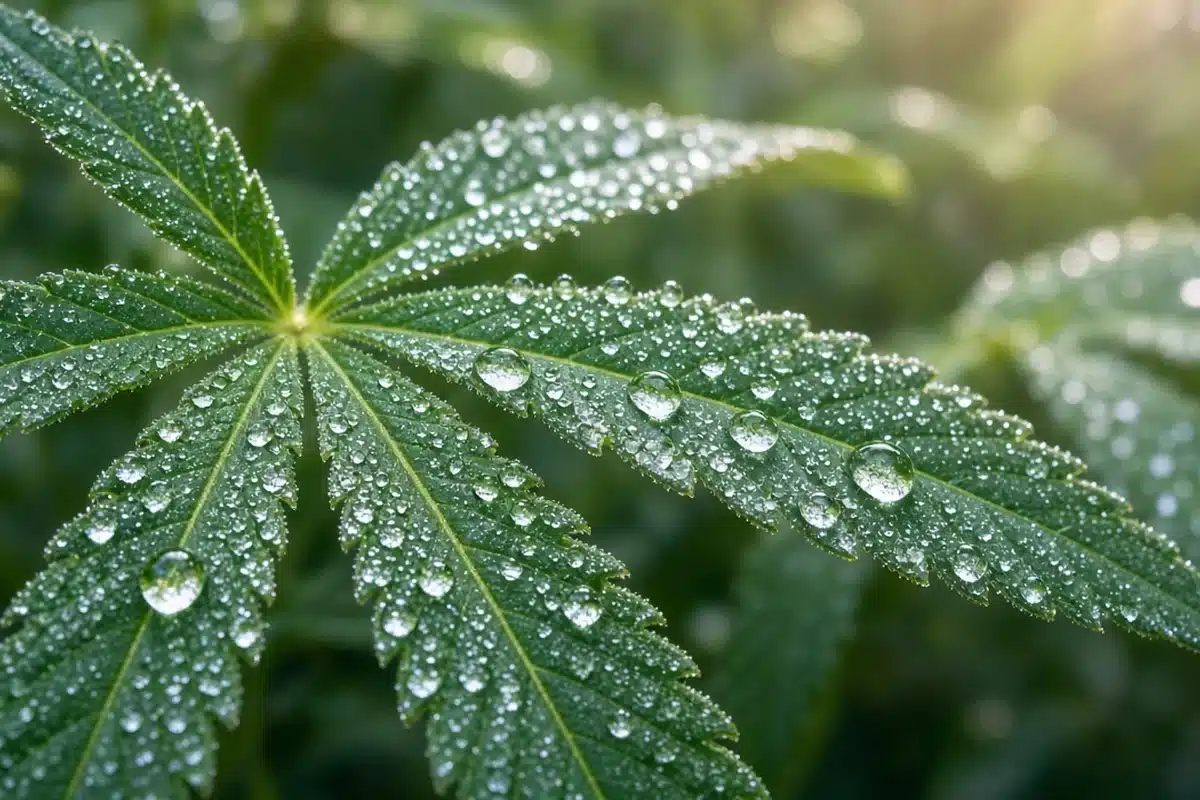
Mississippi State Extension notes that water, especially droplets on leaves and stems, plays a major part in plant diseases. It adds that most plant diseases are caused by fungi, and bacterial diseases also occur. These pathogens spread by spores or cells, which are often not released until they have been wet for a certain period. Once released, they travel on wind, in raindrops or in irrigation water.
Fungal spores are small and delicate. Like seeds, they need moisture to germinate, and once they germinate they die if they dry out. Mississippi State Extension notes that many fungi need a film of free moisture for at least 9 hours to germinate and get into the leaf. Some need a little less time and some need more.
That leads to the key point. Mississippi State Extension calls moisture the critical factor in disease development and says the amount of disease depends on the number and length of wet periods. You can control many plant diseases by controlling how many wet periods there are and how long they last. Timing your watering is one of the few levers a home grower can pull on that.
The case for morning watering
Iowa State Extension gives two reasons to water in the early morning when foliage gets wet:
- Leaves dry quickly once watering is done, and fast drying helps guard against fungal diseases.
- Water soaks deeply into the soil with little lost to evaporation.
As general good practice, morning watering also lets sun and breeze finish drying the plants before the heat of the day.
Mississippi State Extension adds a detail many growers miss. Dew is water too, and it is usually present from about midnight to 8:00 in the morning. You cannot control how heavy or long a dew is, but you can water while the dew is still on the plants. That way the leaves are only wet once, not wet from dew and then wet again later. Mississippi State Extension suggests watching how long dew stays on your plants and timing watering to overlap with it.
The goal is to avoid stretching the wet period. Mississippi State Extension warns against watering just as the dew is starting to dry in the morning, or just before it forms in the evening. Both extend the time leaves stay wet and let more spores germinate.
Midday and evening watering
Iowa State Extension notes that watering at midday is less efficient because of rapid evaporation. With a sprinkler, strong midday winds can also carry water onto driveways, patios and other areas where it does no good.
Evening watering with a sprinkler or hose is the riskier choice. Iowa State Extension says it can lead to more disease because the foliage will likely stay wet through the night. That long, cool wet period is the kind of window Mississippi State Extension describes fungi using to infect leaves.
If evening is the only time you can water overhead, Mississippi State Extension advises stopping early enough that the watered area dries before dark. In the morning, stop early enough that watered areas dry at the same time as, or before, areas you did not water.
When the time of day matters less
The method changes the rules. Iowa State Extension notes that mornings and evenings are both excellent times to water with drip irrigation or a soaker hose, because these methods do not wet the foliage. Watering in the evening is not a problem when the leaves stay dry.
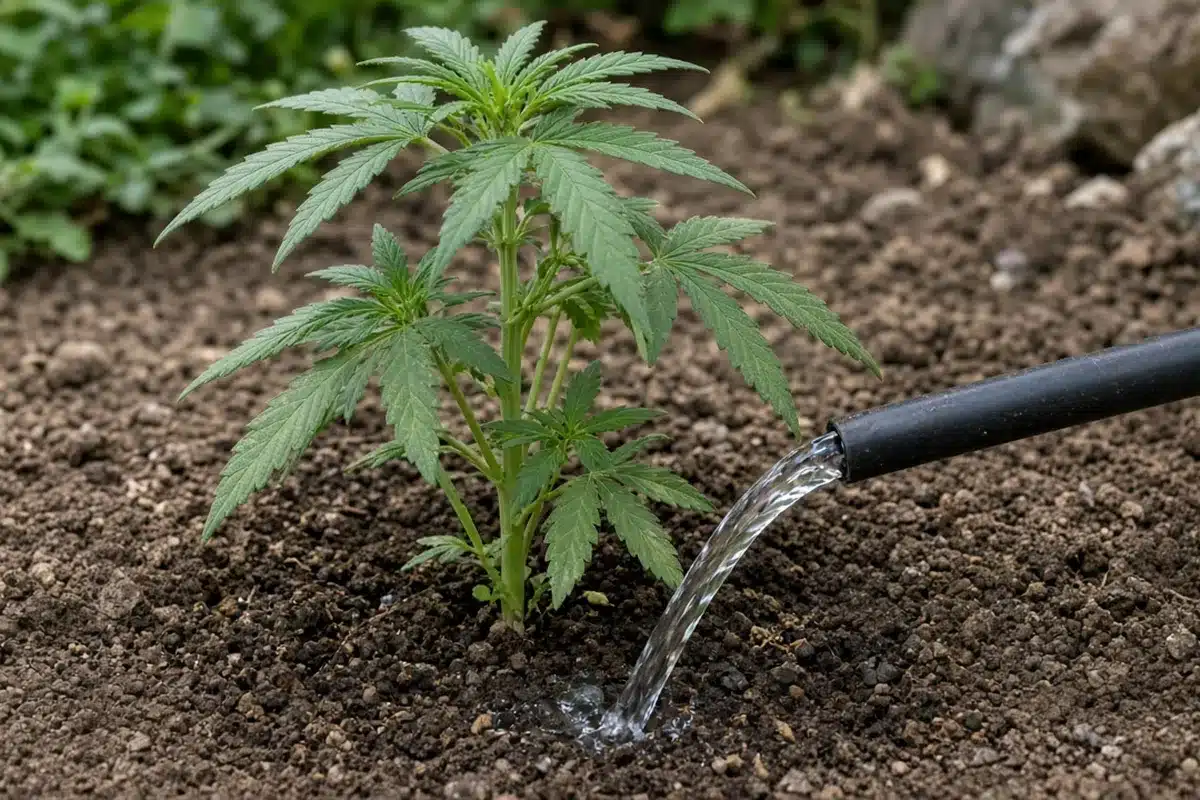
Mississippi State Extension also recommends drip irrigation for established plantings and soaker hoses for temporary ones. If watering by hand, aim at the base of the plant. Watering at soil level reduces the amount of free moisture on the plant canopy. A full setup is explained in drip irrigation for cannabis.
Watering at the soil line, step by step
- Check the soil first. Mississippi State Extension suggests pushing an unpainted wooden dowel into the soil, much like testing a cake with a toothpick. Soil crumbs clinging to it mean the soil is still moist.
- Water only when needed, then water deeply. Mississippi State Extension advises wetting the soil to about 4 inches and then waiting until the plant needs water again.
- Aim the hose or can at the base of the plant, not over the top of the canopy.
- Keep the flow gentle so water does not splash soil onto lower leaves.
- If you must water overhead, do it early in the morning while dew is still on the plants.
- Finish early enough that leaves can dry with the morning sun and wind.
The gentle flow step matters for a reason Mississippi State Extension spells out. Splashing water droplets move pathogens short distances, from the soil to lower leaves, from lower leaves to upper leaves and from one plant to the next.
Deep watering builds deeper roots
Mississippi State Extension explains why depth matters as much as timing. Soil gets moister the deeper you dig, even when the upper layers are dry. Roots grow toward water, so frequent light watering keeps them near the surface, where moisture dries up quickly and leaves plants stressed in hot weather. Watering deeply and then waiting encourages roots to grow down into steadier moisture.
Mississippi State Extension’s broader advice is to reduce the number of wet periods by watering only when needed, and then watering deeply. Fewer, deeper waterings mean fewer chances for leaves to get wet, which serves both goals at once. For how much and how often to water through the season, watering marijuana plants has the details.
Helping the canopy dry
A dense cannabis plant has a lot of leaves on the inside of its canopy. Mississippi State Extension notes that inner leaves are sheltered from sun and drying winds, so water stays on them longer. Plants also shade the soil and raise humidity around themselves. That makes disease more likely to take hold inside the canopy than on the outside.
Mississippi State Extension recommends reducing disease inside canopies with proper pruning and landscaping, and making the best use of morning wind and sun to dry the garden. For cannabis, that means general good practice such as spacing plants so air can move between them and thinning crowded inner growth. For one common wet-weather leaf disease, see the Kind Seed Co article on downy mildew on cannabis.
Rain, dew and the rest of the week
Weather adds its own wet periods. Rain wets leaves no matter what time you water, and heavy dew can keep them wet well into the morning. Mississippi State Extension’s advice to account for dew in your watering schedule applies to rain too. If the forecast calls for rain, there is little reason to add more water on top of it. After a long wet spell, it is worth checking leaves inside the canopy for spots before the next watering. These are general good practices for any outdoor garden.
Troubleshooting watering-time problems
Leaf spots keep showing up on lower leaves. Splash may be moving pathogens up from the soil. Water at the base with a gentle flow and consider a mulch layer.
Plants wilt by afternoon even after morning watering. The water may not be reaching deep enough. Check depth with a dowel and water until the soil is moist to about 4 inches.
Leaves are still wet at midmorning. The watering ran too late or the canopy is too dense. Water earlier, while dew is present, and open up crowded growth.
Evening is the only time you can water. Switch to drip or a soaker hose, or water at the soil line so leaves stay dry overnight.
Water runs onto the patio or driveway. Midday wind may be carrying sprinkler water off target. Water earlier when air is calmer.
Sources
- Iowa State University Extension and Outreach, Yard and Garden. When is the best time to water the garden? https://yardandgarden.extension.iastate.edu/faq/when-best-time-water-garden
- Mississippi State University Extension. The Plant Doctor: Watering and Plant Disease (P3881). https://extension.msstate.edu/publications/the-plant-doctor-watering-and-plant-disease
FAQ
What is the best time of day to water outdoor cannabis?
Early morning. Iowa State Extension names 5:00 to 9:00 am as the best window when watering wets the foliage. Leaves dry quickly in morning sun, which helps guard against fungal disease, and water soaks in with little loss to evaporation. Watering while dew is still on the plants keeps the wet period short.
Is it bad to water cannabis at night?
With a sprinkler or hose that wets the leaves, yes. Iowa State Extension notes the foliage will likely stay wet through the night, which can lead to more disease. Drip irrigation or a soaker hose is fine in the evening because these methods keep the leaves dry. Watering at the base works the same way.
How long do leaves need to stay wet for fungal disease to start?
It varies by fungus. Mississippi State Extension notes that many fungi need a film of free moisture for at least 9 hours to germinate and enter the leaf, and some need slightly less. The fewer and shorter your wet periods, the fewer chances disease has to start. Dew counts as a wet period.
Should I water cannabis leaves or just the soil?
Water the soil. Mississippi State Extension recommends watering at the base of plants or using drip lines so less free moisture sits on the canopy. Watering at soil level also avoids splashing, which can carry pathogens from the soil to lower leaves and from one plant to another plant nearby.


