
Growing Degree Days for Cannabis: A Home Grower’s Guide
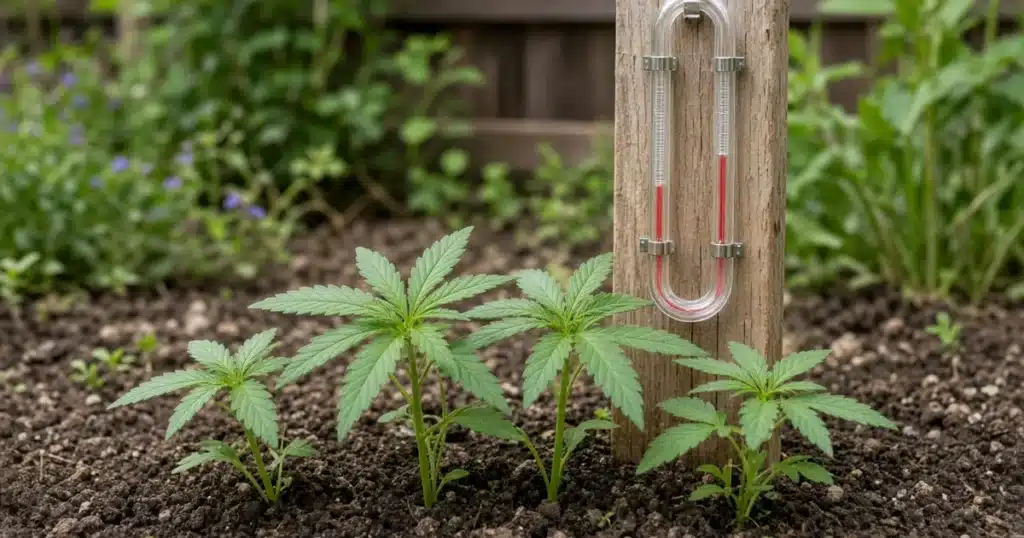
Calendar dates are a rough guide in the garden. A cold spring can push everything back two weeks, and a warm one can pull pests out early. Growing degree days, also called heat units, measure the warmth a season has actually delivered. Iowa State University Extension calls them a practical, science-based way to track plant and pest development, and University of Wisconsin-Madison Extension explains how to work them out with nothing more than a thermometer. For outdoor cannabis growers, degree days are a simple way to time planting and scouting to the weather you really had instead of the date on the wall.
What growing degree days measure
Iowa State Extension explains that growing degree days measure heat building up over time. Most plants, insects and diseases develop in response to temperature, and degree days estimate how much heat was available for growth on a given day.
Every species has a minimum temperature, called a base temperature, below which development slows or stops. UW-Madison Extension calls this the developmental threshold and notes it differs by species. As temperatures rise above the threshold, development speeds up. The warmer the weather, the faster plants and insects develop, and the cooler it is, the slower they go.
The result is a running total. Each warm day adds some heat units, and cold days add none. By tracking that total, a gardener can estimate how far along a plant or insect is in its life cycle.
Base temperatures and why 50 degrees is common
UW-Madison Extension notes that the most common threshold is 50°F. It describes this as the temperature at which plants break dormancy and many insects become active. Degree days on a 50°F base are often written as DD50.
Not every species uses that number. Iowa State Extension lists common base temperatures:
- 40°F for cool-season crops and early spring perennials.
- 50°F for many insects, turfgrass pests and common phenology models.
- 52°F to 55°F for some fruit crops and insects.
- 60°F and higher for heat-loving plants and warm-season pests.
UW-Madison Extension adds that some insects active early in spring have lower thresholds of 38°F or 43°F, and that cool-season vegetables such as cole crops and peas use 40°F.
No published base temperature for cannabis exists in either Extension source. If you track degree days for your own records, a 50°F base is the common default, but treat any cannabis-specific threshold as unverified and compare your totals with what you see in your plants.
How to calculate degree days, step by step
UW-Madison Extension says all you need is a maximum and minimum thermometer. Iowa State Extension uses the same basic formula.
- Record the day’s high and low temperature.
- Add the high and low together and divide by two to get the average.
- Subtract the base temperature from that average. The result is the number of degree days for that day.
- If the result is less than zero, record zero, not a negative number.
- Add each day’s value to a running total for the season.
Iowa State Extension gives an example. With a high of 75°F, a low of 55°F and a base of 50°F, the average is 65°F, so that day adds 15 degree days. UW-Madison Extension’s example uses a high of 60°F and a low of 50°F for an average of 55°F, which adds 5 degree days on a 50°F base.
Iowa State Extension notes that degree days rarely build up before March 1, so that is a reasonable start date for a season total.
The upper threshold for hot days
UW-Madison Extension explains that the simple formula is a very rough estimate. Insects also have an upper threshold, above which their development does not speed up much. To account for this, modified degree days use an upper limit of 86°F along with the lower threshold.
The rules are simple. When the low drops below the base temperature, use the base temperature as the low for that day. When the high climbs above 86°F, use 86°F as the high. In UW-Madison Extension’s worked example, a day with a high of 90°F and a low of 45°F on a 50°F base uses 86°F and 50°F, which average 68°F and add 18 degree days. This matters most in midsummer, when hot afternoons would otherwise inflate the total.
You do not have to do the math yourself
Iowa State Extension notes that you do not need to calculate and add up every day by hand. Several degree day calculators and maps are available, and many include models for common crops and pests. Its own map lets you pick a base temperature, a start date and an end date, then zoom in on your area. Using a nearby weather station or a map is the easiest way to keep a season total.
Using degree days to time planting
Iowa State Extension notes that calendar dates alone can mislead because weather varies from year to year. Degree days reflect the conditions plants actually experienced. It lists the main uses for gardeners:
- Improving the timing of planting and transplanting.
- Predicting bloom and fruit development.
- Monitoring insect and disease development.
- Scheduling scouting and management actions.
Iowa State Extension also notes that seed packets often list days to germination, but degree days can refine that estimate. In a cool spell, germination may take longer than the calendar suggests.
For cannabis, this works best as a record. Track the running total each spring and note the date you transplanted and how the plants took off. Over a few seasons, you build your own picture of when your site is warm enough. Pair that with soil temperature and frost dates, as explained in when to plant cannabis seeds outdoors. Growers with a short, cool season can also compare totals across years when reading the article on cannabis for short seasons.
Using degree days for pest timing
Iowa State Extension calls insect prediction one of the most valuable uses of degree days. Insects are cold-blooded, so their growth closely follows temperature. Many insect pests have well documented degree day totals for egg hatch, larval stages and adult emergence.
That lets you scout at the right time. Iowa State Extension notes that egg hatch of certain caterpillars happens at a specific degree day total, and acting at that stage is often more effective than reacting after damage appears. It also notes that newly hatched larvae are often the most vulnerable stage, so good timing improves control and cuts unnecessary pesticide use.
UW-Madison Extension and other universities publish degree day tables for common insect pests. For a stem-boring caterpillar that can attack outdoor cannabis, start with what Kind Seed Co has on European corn borer in hemp, then use local extension degree day tables for that pest where they exist.
Degree days and indicator plants
UW-Madison Extension explains phenology, the use of indicator plants that bloom or bud at a predictable stage of the season to signal when pests appear. Iowa State Extension gives examples such as lilac bloom lining up with the emergence of certain insect pests.
Both sources treat degree days and indicator plants as partners. UW-Madison Extension notes that indicator plants are not always reliable, because you may not have the right plant nearby or it may not bloom at the exact moment a pest appears. Degree days fill that gap. Iowa State Extension says combining observations with degree day tracking strengthens decisions over time.
Limits to keep in mind
Iowa State Extension lists clear limits. Degree day models rely only on temperature, so they ignore rainfall, soil moisture, day length and extreme weather. Drought or heavy rain can slow growth even when totals look normal. Shady spots or urban heat can make a garden warmer or cooler than the nearest weather station. Varieties and pest populations also vary. Its advice is to use degree days as a guide, not a precise predictor, and to combine them with direct observation and good records.
Day length is a big one for cannabis. Photoperiod plants start flowering in response to longer nights, which a heat total does not capture.
Troubleshooting degree day tracking
Your totals do not match what you see. Your garden may be warmer or cooler than the weather station. Keep a thermometer at the plot and compare.
Midsummer totals jump too fast. Use the 86°F upper limit described by UW-Madison Extension.
You get a negative number on a cold day. Record zero. Negative values are not used.
You started counting late. Add earlier days from a station or online map, starting around March 1.
Pest arrival dates jump around between years. That is expected with calendar dates. Track degree days alongside your notes and compare over several seasons.
Sources
- Iowa State University Extension and Outreach, Yard and Garden. Using Growing Degree Days to Manage the Home Garden. https://yardandgarden.extension.iastate.edu/how-to/using-growing-degree-days-manage-home-garden
- University of Wisconsin-Madison Extension. Calculating Degree Days. https://hort.extension.wisc.edu/articles/degree-day-calculation/
FAQ
How do I calculate growing degree days?
Add the day's high and low temperatures, divide by two, then subtract the base temperature. If the answer is below zero, record zero. Iowa State Extension's example uses a high of 75°F, a low of 55°F and a 50°F base, which gives 15 degree days. Add each day's value to a running season total.
What base temperature should I use for cannabis?
Neither of our sources lists a cannabis base temperature. UW-Madison Extension notes that 50°F is the most common threshold, and many degree day maps default to it. Use 50°F for your own records if you like, but compare totals with what you see in your plants rather than treating them as fixed targets.
Can growing degree days help with pest control?
Yes. Iowa State Extension notes that many insect pests have well documented degree day totals for egg hatch and adult emergence. Tracking heat units tells you when to scout, so you can catch young larvae, which are often the most vulnerable stage. Use local extension tables for the pests you see.
Are growing degree days better than calendar dates?
Usually, for timing. Iowa State Extension notes that calendar dates can mislead because weather changes from year to year, while degree days reflect real conditions. They still ignore rainfall, day length and microclimates, so Iowa State Extension advises using them as a guide alongside direct observation and good garden records.


