Can You Graft Cannabis? What Plant Science Says About Grafting
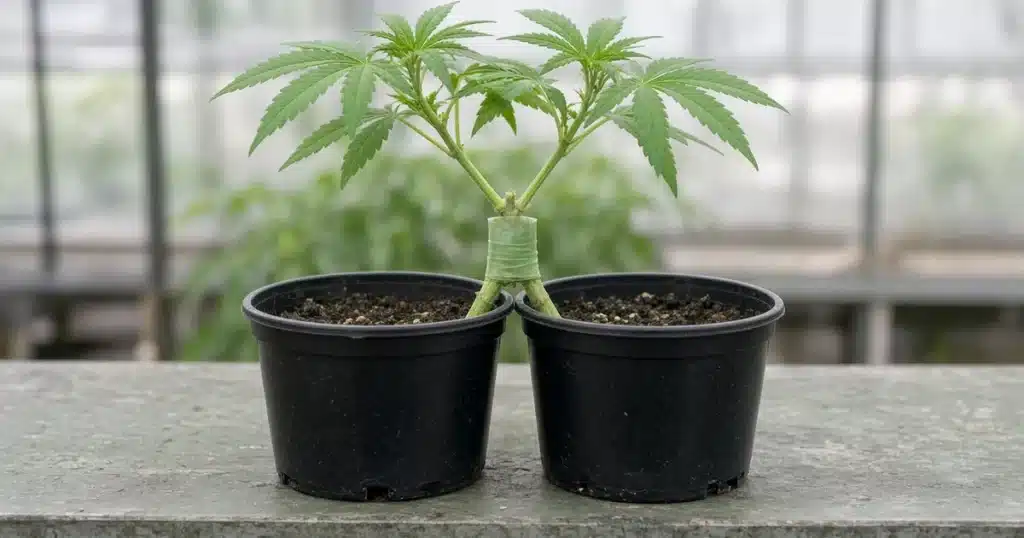
Quick answer: Grafting is a horticulture technique that joins the top of one plant to the root system of another so the two grow as a single plant. Extension guides from Missouri, the Pacific Northwest and North Carolina agree on the core rule. Success depends on how closely the two plants are related. Cannabis joined to cannabis fits that rule best. Cannabis onto tomato does not, because the two plants sit in different botanical families. Grafting will not turn two plants into a new genetic type, and no Extension guide presents it as a method for bigger harvests.
Can You Graft Cannabis?
Most likely yes, if both pieces come from cannabis plants. None of these guides cover cannabis by name, so the answer has to come from general grafting science. MU Extension describes hemp as an annual, dicotyledonous, herbaceous plant in its Industrial Hemp publication. That matters because grafting relies on the cambium, a thin layer of dividing cells under the bark or stem skin. Dicots have a cambium. Monocots such as grasses do not.
A close relative is hops, which University of Nevada, Reno Extension groups with cannabis in the Cannabaceae family in its hops publication.
So a cannabis stem has the basic tissue a graft needs. What about the partner? A second cannabis plant is the same species, and Missouri says plants of the same species can usually be grafted. Think of any cannabis graft as a home experiment and expect some attempts to fail while you learn.
How Does Grafting Work?
Grafting works when the cambium layers of two cut pieces grow together so they live as one plant.
Scion and Rootstock
MU Extension explains the parts in its Grafting guide (G6971). The upper piece, called the scion, grows into the shoots and leaves of the new plant. The lower piece, the rootstock or understock, supplies the roots and sometimes part of the stem. A scion usually carries two or three buds.
The Cambium Does the Joining
The Pacific Northwest Extension bulletin Propagation of Plants by Grafting and Budding (PNW496), a joint bulletin from the land grant universities of Washington, Oregon and Idaho, describes a cambial ring sitting between the xylem, which carries water, and the phloem, which carries sugars. After a cut, the cambium makes a mass of new cells called callus. Callus from both pieces grows over the wound and ties stock and scion together.
That is why contact is everything. If the cambium layers miss each other, no union forms. The bulletin says the scion may sit slightly off center on a wider stock so the layers touch on at least one side.
Six Conditions for a Good Union
NC State Extension lists six conditions in the propagation chapter of its Extension Gardener Handbook. The scion and rootstock must be compatible. Both must be at the right stage of growth. The cambial regions must touch. Buds on the scion must point upward. Every cut surface must be kept from drying out. The graft needs good care afterward.
Which Plants Can Be Grafted Together?
Close relatives graft best, and Missouri Extension puts it plainly. As a rule, only plants with a close botanical relationship tend to form a good union. The guide then walks down the family tree.
- Same species, different variety. These can usually be grafted.
- Same genus, different species. These often take, but the union may be weak, may not last long or may never form.
- Different genera in one family. Success drops, though there are exceptions. Quince works as a dwarfing rootstock for pear.
- Different families. Grafts across families do not succeed. Missouri notes reports of short lived grafts between soft stemmed plants of different families, with no successful home or commercial practice for woody plants.
The Pacific Northwest bulletin draws the same picture as a pyramid. Grafts within a clone sit at the top with the highest success. Grafts between families sit near the bottom, where remotely related plants have little or no chance. NC State Extension agrees, reporting that grafts between clones and seedlings of one species usually take.
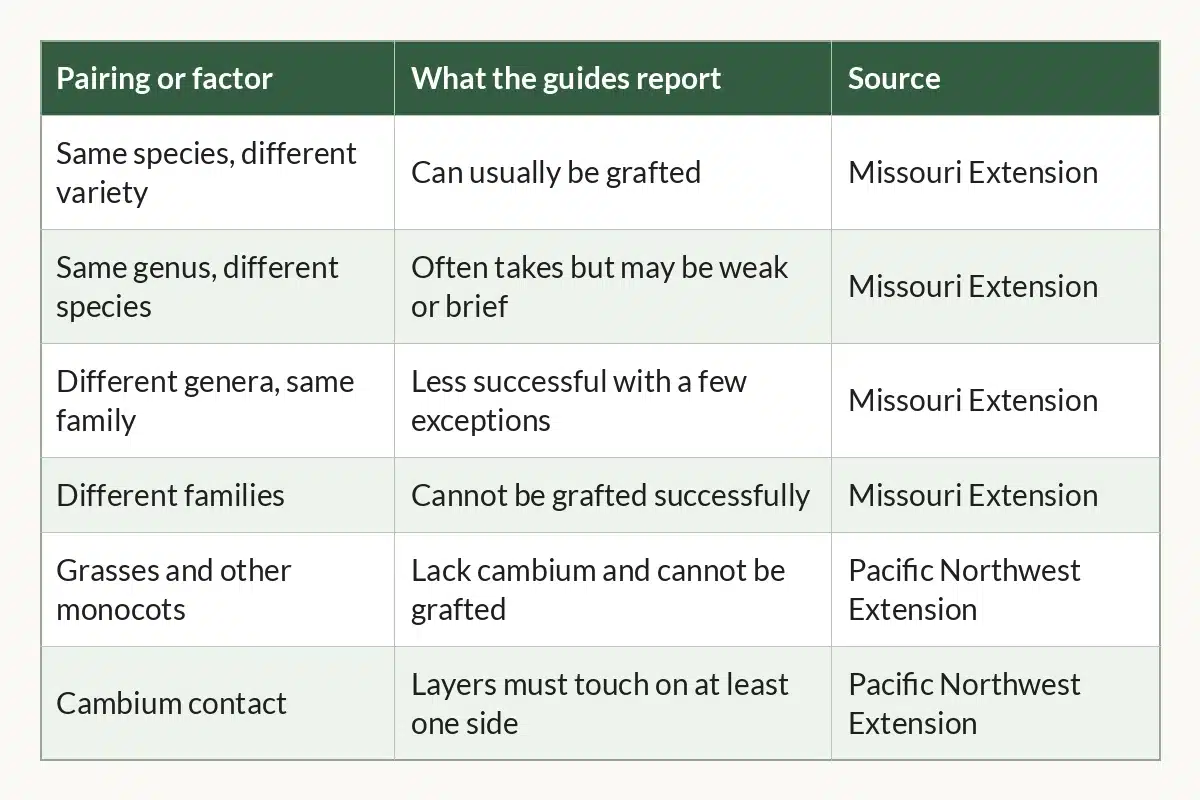
Cannabis Grafting at a Glance
| Pairing or factor | What the guides report | Source |
|---|---|---|
| Same species, different variety | Can usually be grafted | Missouri Extension |
| Same genus, different species | Often takes but may be weak or brief | Missouri Extension |
| Different genera, same family | Less successful with a few exceptions | Missouri Extension |
| Different families | Cannot be grafted successfully | Missouri Extension |
| Grasses and other monocots | Lack cambium and cannot be grafted | Pacific Northwest Extension |
| Cambium contact | Layers must touch on at least one side | Pacific Northwest Extension |
Can You Graft Cannabis to Tomato?
No, the guides give no support for that pairing. Tomato belongs to the nightshade family, Solanaceae, along with potato, pepper and eggplant, as NC State Extension lists in its vegetable gardening chapter. Cannabis is not in that family. Under the Missouri rule, grafts between different families do not succeed. A cannabis top on tomato roots, or the reverse, falls outside the pairings any of the three guides support.
Tomato grafting itself is real. The Pacific Northwest bulletin shows tomato joined to potato by approach grafting, and it lists greenhouse tomatoes and eggplants among plants suited to splice grafting. Both partners in those examples are nightshades. In short, tomato grafts work inside the tomato family.
What About New Hybrids?
Some growers hope a graft will blend two plants. Missouri Extension says there is no basis for the idea that grafting creates a genetically different plant. An odd shoot from a graft union comes from a chimera, a type of mutation, not from mixing the two plants.
Why Would a Grower Graft Cannabis?
The Extension guides list practical reasons for grafting in general. Missouri notes that some cultivars do not come true from seed and others are hard to root from cuttings. Grafting also lets roots suited to the local soil or climate carry a desired top. The Pacific Northwest bulletin adds that grafting can repair damaged plants by restoring the flow of sugars to the roots.
With cannabis, the goals tend to be smaller. A grower might join a second cannabis variety onto one plant to save space, or practice the skill before trying it on garden crops. Cuttings stay the simpler way to copy a plant, as our guide to making cannabis clones explains. Rooting a branch while it stays attached, covered in our post on air layering cannabis, is another option that avoids a graft union entirely.
The Extension guides do not link grafting to bigger harvests. See it as a horticulture project, not a growing shortcut.
How to Try a Simple Splice Graft on Cannabis
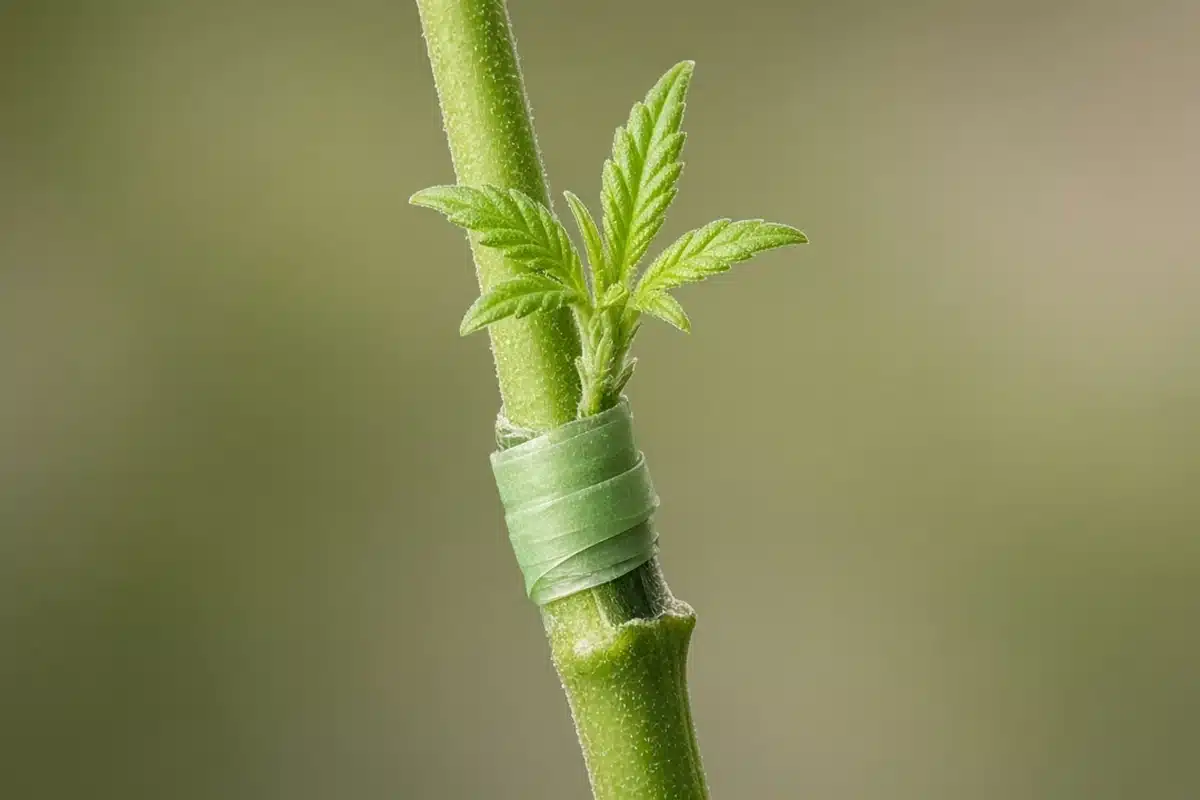
The Pacific Northwest bulletin names splice grafting as the easiest way to unite stock and scion and recommends it for herbaceous plants grown in a sheltered spot. These steps adapt that method and the NC State conditions to two young cannabis plants.
- Pick partners of equal size. The bulletin advises stock and scion under 1 inch thick and of equal thickness. Two vigorous cannabis stems of matching width work best.
- Use a sharp, clean blade. Missouri stresses that a quality knife that keeps a keen edge matters most. Ragged cuts crush the cambium.
- Make long matching cuts. Cut both stems on a long diagonal of the same length so the faces lie flat together.
- Keep the scion right side up. Buds must point upward. Upside down scions seldom form a union.
- Line up the cambium. Press the faces together. If widths differ, match one edge so the layers touch on at least one side.
- Wrap and support. Hold the joint with grafting tape or a budding strip. Missouri warns that tape left too long can girdle the stem, so loosen it once the union firms up.
- Prevent drying. Keep cut surfaces covered and the plant out of hot sun and drafts while callus forms.
- Water steadily. The bulletin notes cambial activity needs an ample moisture supply.
The same tape skills come up in our guide to fixing broken and bent cannabis stems, where a cracked branch still joined to the plant is splinted and wrapped. Bending and pinching stems on purpose, as in super cropping cannabis, relies on that same tissue knitting back together.
Troubleshooting Cannabis Grafts
The scion wilts within days. The cut surfaces likely dried out or the cambium layers did not touch. Recut and try again with a snugger fit.
The union snaps when touched. Missouri lists incompatible partners and poor cambial contact as leading reasons for failure. Use two cannabis plants and match the layers carefully.
A ring forms at the tape. The wrap is girdling the stem. Loosen or remove it once the joint holds on its own.
Shoots grow from below the union. Those come from the rootstock. Pinch them so the scion gets the energy.
Nothing happens for weeks. Missouri notes timing and stress on either piece can block a union. Start with young, vigorous stems.
Sources
- University of Missouri Extension, Grafting (G6971): https://extension.missouri.edu/publications/g6971
- Pacific Northwest Extension (Washington State University, Oregon State University, University of Idaho), Propagation of Plants by Grafting and Budding (PNW496): https://wpcdn.web.wsu.edu/wp-ecommerce/uploads/sites/2/product-4454-sku-PNW496.pdf
- NC State Extension, Extension Gardener Handbook, Chapter 13 Propagation: https://content.ces.ncsu.edu/extension-gardener-handbook/13-propagation
- NC State Extension, Extension Gardener Handbook, Chapter 16 Vegetable Gardening: https://content.ces.ncsu.edu/extension-gardener-handbook/16-vegetable-gardening
- University of Missouri Extension, Industrial Hemp (MX80): https://extension.missouri.edu/publications/mx80
- University of Nevada, Reno Extension, Growing Hops in Southern Nevada: https://extension.unr.edu/publication.aspx?PubID=2744
FAQ
Can you graft cannabis onto tomato?
No. Tomato and cannabis are in different plant families, and Extension guides report such pairings cannot be grafted successfully.
Can cannabis be grafted onto another cannabis plant?
Yes, in principle. Plants of the same species are the most compatible pairing, though results depend on technique.
Does grafting change a plant's genetics?
No. Missouri Extension says there is no basis for the belief that grafting creates a genetically different plant.
What is a rootstock?
The lower part of a graft that supplies the root system, with the scion forming the top.
Will grafting increase cannabis yield?
There is no Extension evidence for that. Grafting is a propagation technique, not a yield method.