Chelated Micronutrients for Cannabis: How Chelates Work
Quick answer: A chelated micronutrient is a metal nutrient, such as iron, manganese, zinc or copper, wrapped in an organic molecule that keeps it dissolved and available to roots. UF/IFAS Extension explains that the word comes from the Greek for a lobster’s claw, after the way the larger molecule grips the metal. UMass Extension notes that chelated iron stays available at higher pH than unchelated iron, and that chelates differ in how high a pH they can handle. For cannabis growers, chelates help most when the root zone pH runs high, but correcting pH is still the first fix.
What Are Chelated Micronutrients?
Chelated micronutrients are metal nutrients wrapped in an organic ring that keeps them usable by roots. Plants need micronutrients in small amounts. UGA Extension lists iron, manganese, boron, zinc and copper among these trace elements in its guide to pH management in greenhouse crops. The problem is that several of them are hard to keep in a form roots can use.
A chelate solves part of that problem. In its publication on chelated fertilizers and soil pH, UF/IFAS Extension describes a chelate as a larger organic molecule, called a ligand or chelator, that encircles a metal nutrient ion in a ring. That ring protects the nutrient from reactions that would otherwise lock it away.
The same publication explains that iron, manganese, zinc and copper exist in soil solution as positively charged metal ions. They readily react with oxygen and with hydroxide ions, forming new compounds plants cannot take up. Both oxygen and hydroxide are abundant in soil and soilless media. The chelate acts as a shield against those reactions.
Plants have their own version of this trick. According to UF/IFAS, roots release exudates containing natural chelates. Grasses growing under low iron conditions, for example, release a compound that grabs iron in the soil solution, carries it to a root hair and lets it go, then returns for more. Synthetic chelates in fertilizers do a similar job on the grower’s behalf.
Living soil works a little differently. Organic matter and soil life produce their own natural chelating compounds, and a soil with plenty of organic matter often holds micronutrients in available forms without much help. Growers in rich, well managed soil may never need a chelated product, while those in inert media rely on them heavily. Figure out which camp you are in before deciding whether chelates belong in your feeding plan at all.
Why Does pH Matter for Micronutrients?
pH controls how available micronutrients are. UGA Extension explains that at high pH, micronutrients become less available, and plants cannot absorb enough. At low pH they become too available and can be taken up in excess. For soilless substrates, the guide points to 5.4 through 6.0 as the band that suits every nutrient.
Iron is the classic example. UF/IFAS notes that plants generally use iron in its ferrous form, which oxidizes into an unavailable ferric form when pH rises above 5.3, and that iron deficiency often occurs above pH 7.4 in soil. Chelation helps slow that conversion.
Hard water makes this worse. UGA’s greenhouse guide explains that water rich in calcium and magnesium carbonates tends to raise substrate pH over time, and the more dissolved minerals a water source carries, the stronger its effect on pH. A grower using hard tap water can watch pH creep up week by week, slowly locking out iron and manganese even when the feed contains plenty of both.
So chelates and pH go hand in hand. A chelate buys time and range, but it does not repeal chemistry. Our guide to pH and how it affects cannabis covers target ranges for soil, coco and hydro.
Which Chelates Hold Up at Which pH?
Iron EDDHA holds up best at high pH, followed by iron DTPA and then iron EDTA. UMass Extension, in its fact sheet on preventing iron deficiency in greenhouse crops, ranks iron forms by how well they correct deficiency as a drench at high pH. From most to least effective:
- Iron EDDHA, effective at media pH above 7.0.
- Iron DTPA, next in effectiveness.
- Iron EDTA, after that.
- Iron sulfate, which is an iron salt and not a chelate at all.
The same fact sheet adds that every one of the three chelates dissolves well when media pH sits between 4.0 and 6.0. So in a well managed root zone, the choice of chelate matters less. The stronger chelates earn their keep when pH climbs.
UF/IFAS describes the same order. Its data show that at pH 6.0 the three common iron chelates are all stable, but at pH 7.5 the strongest one stays fully chelated while the others hold far less iron. The publication also notes that the strongest chelate costs the most.
Foliar sprays are another place chelates show up. UF/IFAS points out that a leaf’s waxy coating pushes away both water and charged ions, and that the organic ring around a chelated nutrient helps it pass through that waxy layer. The publication reports that chelated iron sprayed on lychee trees in Florida corrected iron shortage more effectively than regular iron sources. That is a tree crop result, not a cannabis trial, but it explains why many micronutrient sprays use chelated forms.
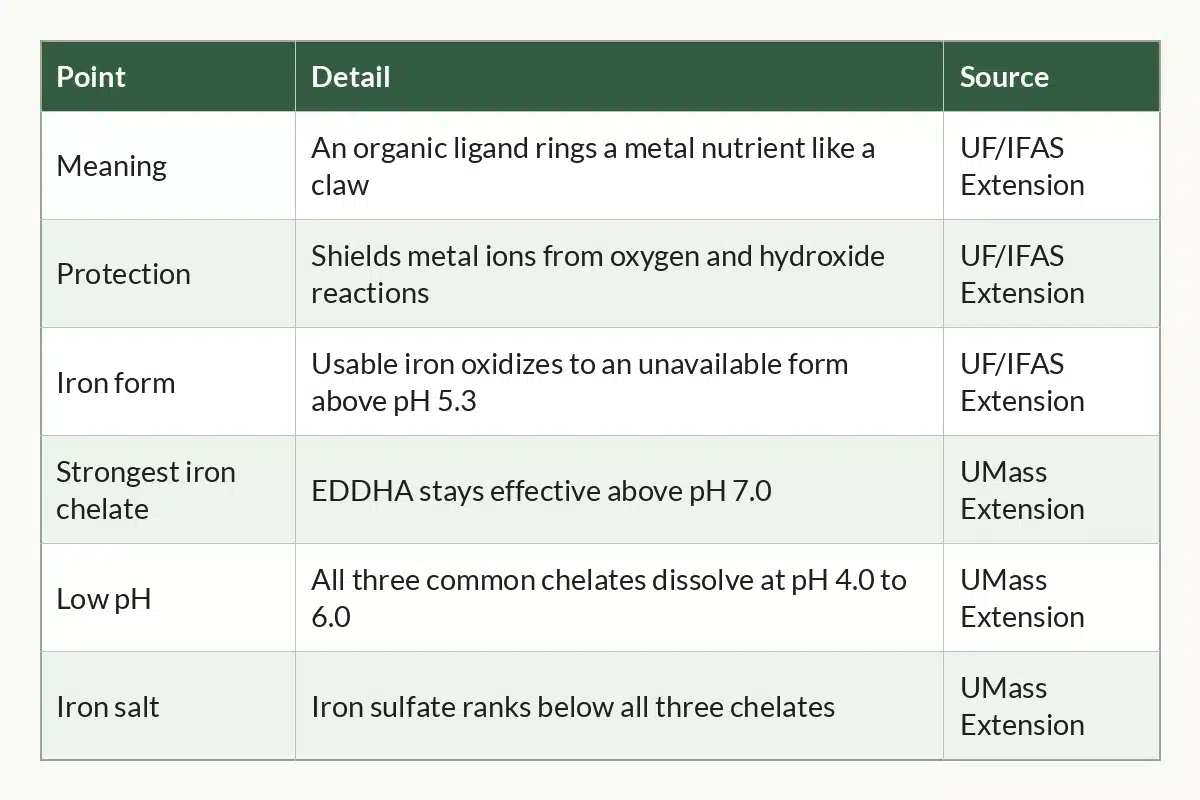
Chelated Micronutrients at a Glance
| Point | Detail | Source |
|---|---|---|
| Meaning | An organic ligand rings a metal nutrient like a claw | UF/IFAS Extension |
| Protection | Shields metal ions from oxygen and hydroxide reactions | UF/IFAS Extension |
| Iron form | Usable iron oxidizes to an unavailable form above pH 5.3 | UF/IFAS Extension |
| Strongest iron chelate | EDDHA stays effective above pH 7.0 | UMass Extension |
| Low pH | All three common chelates dissolve at pH 4.0 to 6.0 | UMass Extension |
| Iron salt | Iron sulfate ranks below all three chelates | UMass Extension |
When Do Cannabis Plants Benefit From Chelates?
Chelates help most when pH works against micronutrient uptake. Common examples in cannabis growing include:
- High pH water. UMass notes that alkaline irrigation water pushes media pH up over time, which reduces iron availability.
- Coco and soilless mixes. These media rely on the feed solution for nearly all micronutrients.
- Hydroponic systems. Nutrients sit in solution where unprotected metals can drop out.
- Pale new growth. Yellowing of the youngest leaves is the classic sign of an iron shortage, often linked to high pH.
UGA Extension warns about a common mistake. Growers who see yellow new growth may assume the plant is underfed and add more fertilizer. That can raise soluble salts without solving the problem. A better move is to test media pH and EC first, and if pH is too high, lower it so micronutrients become available again.
Our guides to iron deficiency in cannabis and manganese deficiency in cannabis show how those shortages look on the leaves.
Chelated nutrients also matter for mixing. Unprotected micronutrients can react with other parts of a concentrated feed and fall out of solution. Chelated forms resist those reactions better. That helps explain why complete liquid nutrients for hydro and coco usually list chelated iron and other metals on the label.
How to Use Chelated Micronutrients Wisely
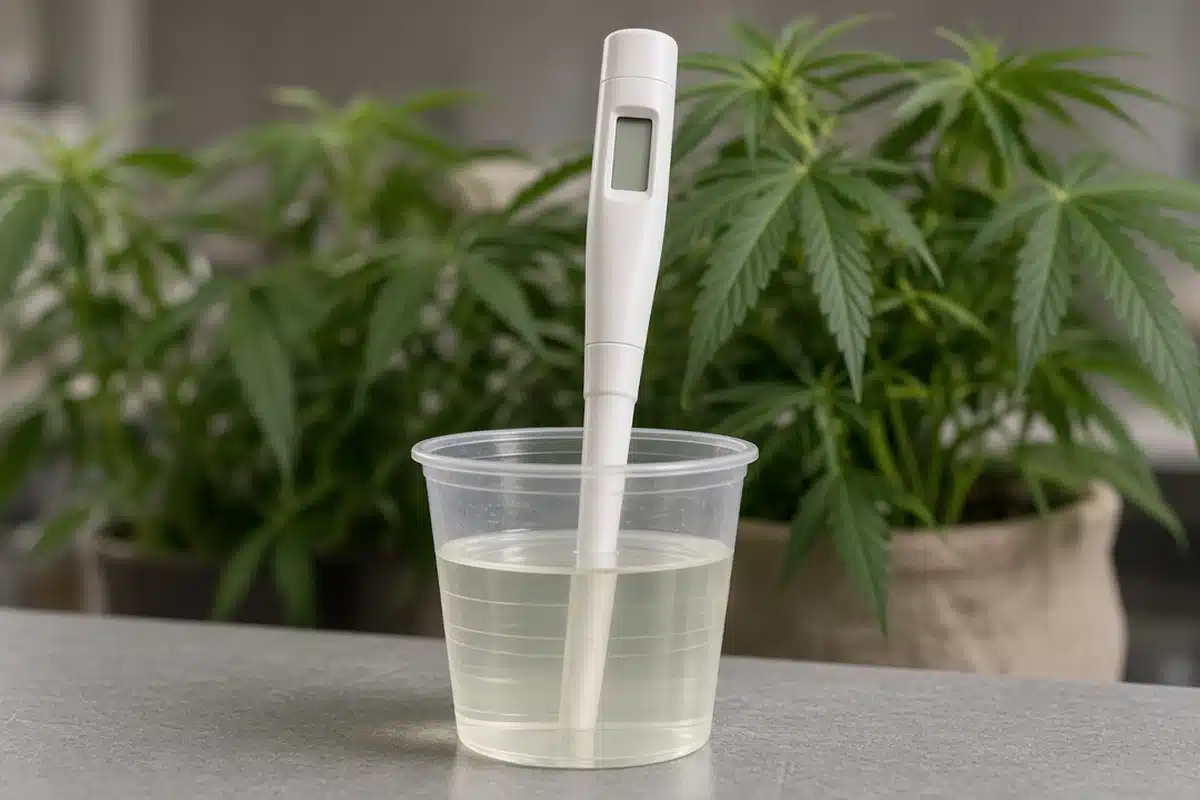
- Test pH first. Measure runoff or reservoir pH before adding anything.
- Fix pH when it is off. Getting pH back into range frees up micronutrients.
- Read the label. Look for which micronutrients are chelated and with what. Our guide to reading a fertilizer label explains the terms.
- Match the chelate to your pH. Stronger chelates matter mainly when pH runs high.
- Avoid heavy phosphorus. UMass notes that excess phosphorus works against iron availability.
- Follow label rates. More is not better, and excess salts stress roots.
- Rinse leaves after foliar use. UMass advises rinsing excess iron off foliage to avoid spotting.
Troubleshooting Micronutrient Problems
New leaves turn pale yellow with green veins. Iron may be unavailable. Check pH before feeding more.
Problem returns after each correction. Water alkalinity may be pushing pH up. Test the source water.
Brown spots after a foliar spray. Concentrated iron left on leaves can spot them. Rinse and dilute next time.
Leaves look pale in coco despite feeding. Check pH and confirm the nutrient includes chelated micronutrients.
Feeding more makes things worse. Salts may be building up. Flush and recheck pH and EC.
Sources
- UF/IFAS Extension, Understanding and Applying Chelated Fertilizers Effectively Based on Soil pH (HS1208): https://ask.ifas.ufl.edu/publication/HS1208
- UMass Extension, How to Prevent Iron Deficiency in Iron Inefficient Greenhouse Crops: https://www.umass.edu/agriculture-food-environment/greenhouse-floriculture/fact-sheets/how-to-prevent-iron-deficiency-in-iron-inefficient-greenhouse
- UGA Extension, Essential pH Management in Greenhouse Crops (B1256): https://fieldreport.caes.uga.edu/publications/B1256/essential-ph-management-in-greenhouse-crops-ph-and-plant-nutrition/
FAQ
What does chelated mean on a nutrient label?
The metal nutrient is bound to an organic molecule that keeps it dissolved and available to roots.
Do cannabis plants need chelated nutrients?
They help most in high pH conditions. In a root zone kept in range, ordinary sources often work.
Which chelate works best at high pH?
UMass and UF/IFAS both rank iron EDDHA as the strongest at high pH.
Can chelates fix a pH problem?
No. They extend availability, but correcting pH is still the main fix.
Why is new growth yellow on my cannabis?
A common cause is iron shortage linked to high pH. Test pH before adding fertilizer.